
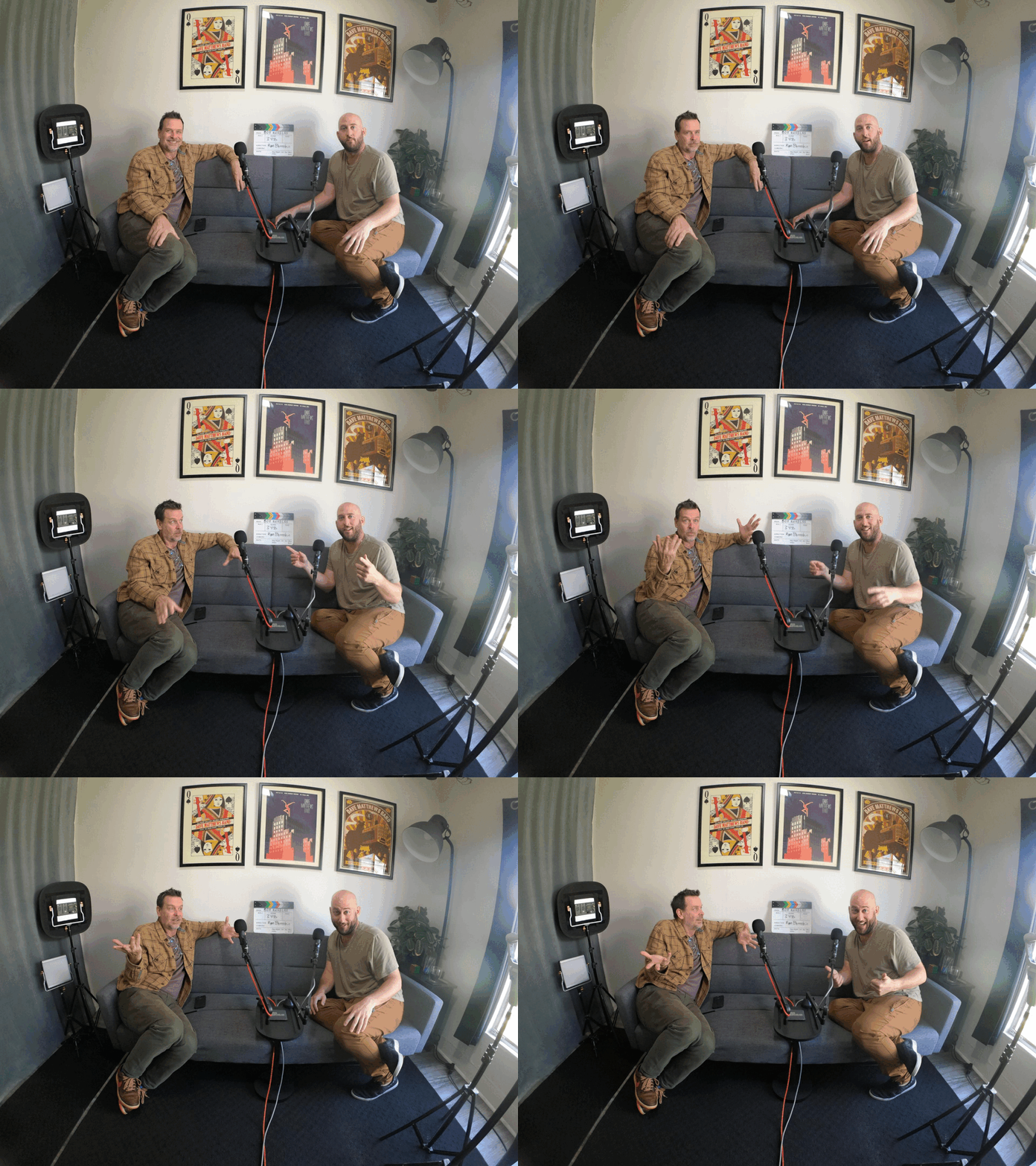
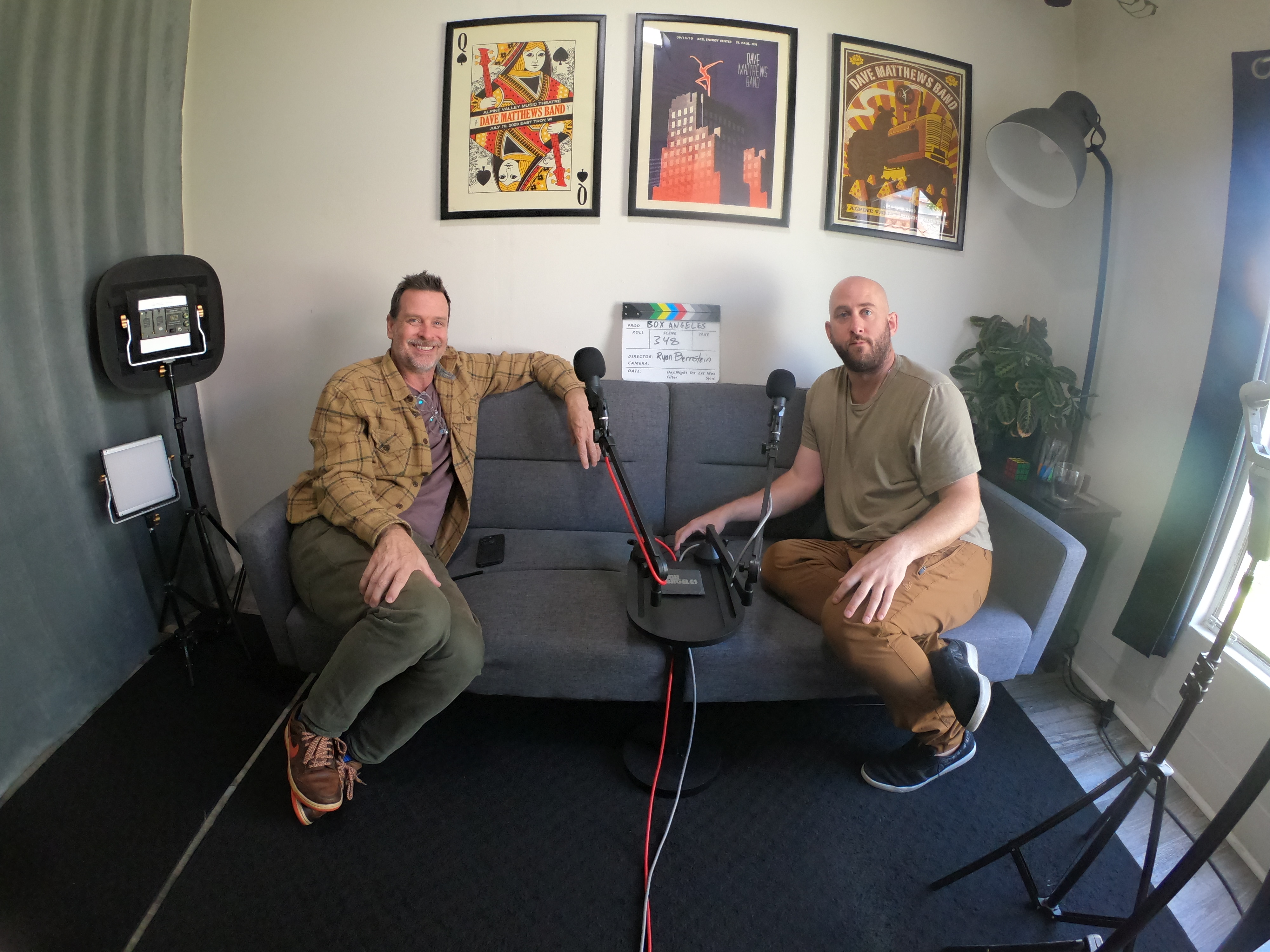
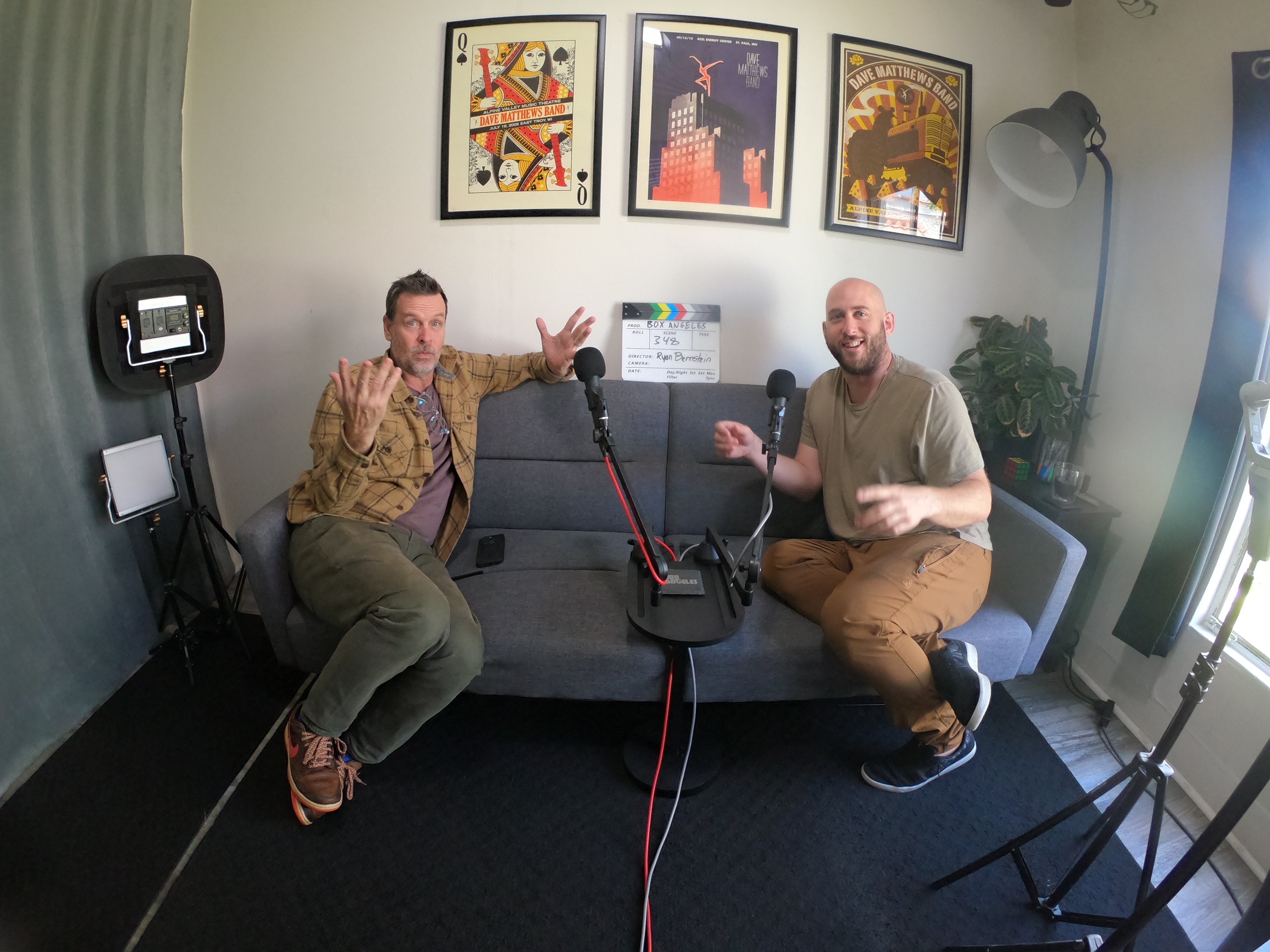
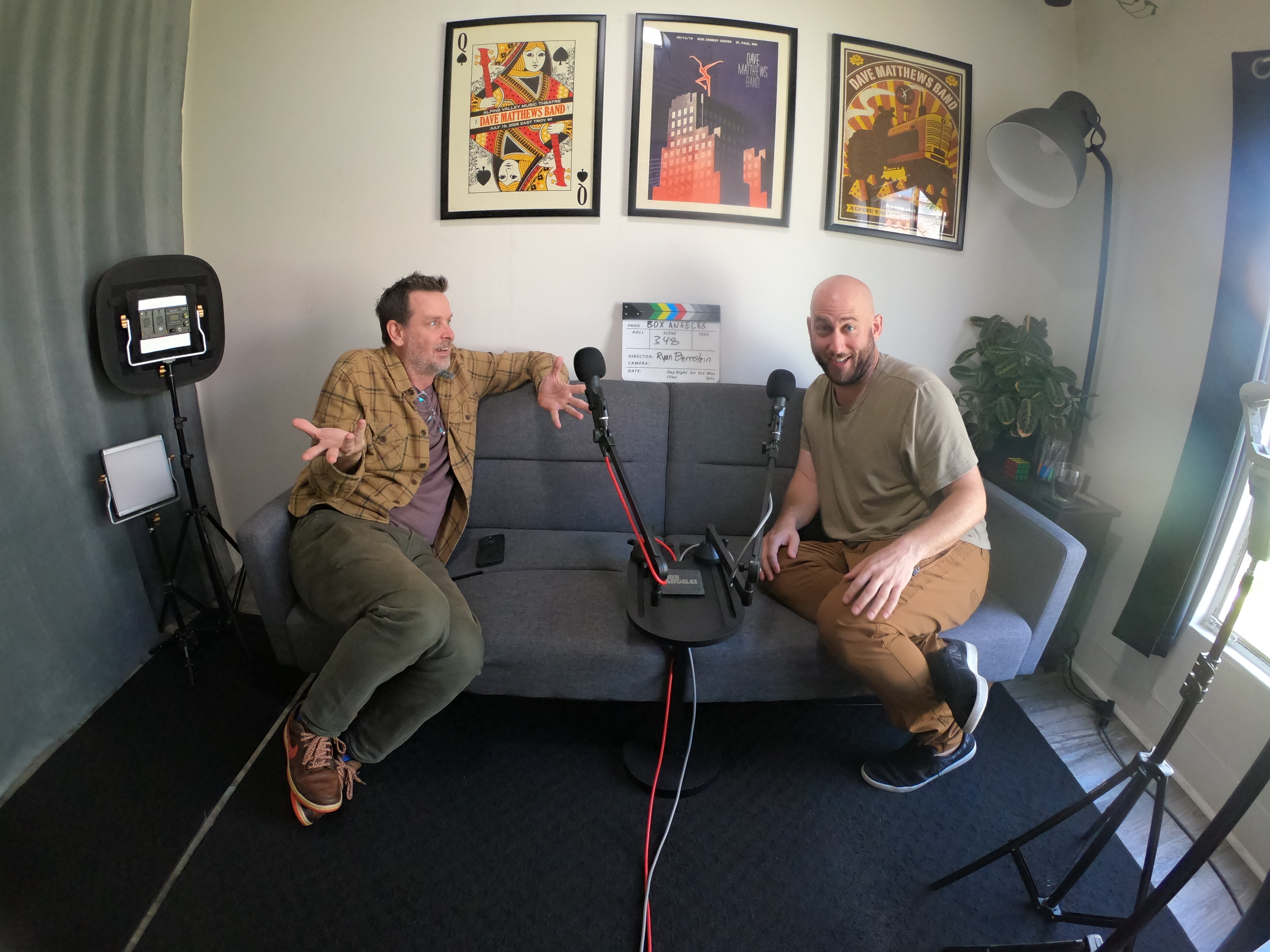
We’ve got another casting podcast today! Casting Director Ryan Bernstein of RMB Casting joins us on the Box Angeles podcast episode 348. Ryan stops by the bungalow and discusses how it’s hard to make a career in this business, callbacks being the goal for the actors, wanting to only do in person auditions at his office, how many submissions he is getting, and more!
“I don’t do anything other than provide an opportunity. It’s the actor that has to come in and execute.”
— Ryan Bernstein
Beats
00:00 – Ryan slates his name.
00:10 – Introduction.
02:10 – Former actor and doing Chicago improv.
06:22 – Goals always changing and shift to casting.
10:18 – Never casting oneself in the work.
13:05 – Is a career possible with the corporate and talent dillution of the industry.
15:05 – AI’s impact on casting.
17:45 – Vulture article, Casting Directors Can Win Oscars Now, But It’s a Lost Art.
19:48 – Commercial side still busy.
24:40 – Mike’s audition numbers at RMB Casting.
26:40 – Callbacks are the goal.
36:09 – Typically, how many actors are submitted and auditioned.
39:18 – Actors cancelling.
42:13 – Self tapes versus in-person auditions.
51:07 – Mike’s recent audition specific numbers.
54:31 – Casting budget and audition line items in production.
56:52 – Celebs in commercials.
1:00:42 – “I don’t wanna see the same thing all day”.
1:04:35 – Who took a chance on Ryan.
More Ryan
 – Check Ryan’s IMDb.
 – Follow Ryan on Instagram @rmbcasting.
 – Check out the RMB Casting website.
Transcript
RYAN BERNSTEIN (00:06)
Hi, my name is Ryan Bernstein.
MIKE ELDER (00:11)
Hello, and welcome to the Box Angeles podcast with me. I’m your host, Mike Elder. Thank you so much for listening to the show. We’ve got a really great episode for you this week. But first, if you’re listening to this on Apple Podcasts, please give me a rating and review. I’ve only had one in the last couple years. It’s very sad.
This is partly on me because I haven’t been pushing it. But please give me a rating. Review. It’s all I ask. If you’re listening this, please, there’s way more listeners than there are reviews.
So go review, please. I can wait. I’ll wait for you to do it now. It takes no time at all, so I can just twiddle my thumbs while I wait for you. Thank you. All right, you did it. Great. Thank you.
Okay, who do we got on the podcast this week? We’ve got commercial casting director Ryan Bernstein. Ryan runs RMB casting down on Wilshire at Envision Studios. By the way, I thanked him after the podcast. I meant to do it during. He used to be at Ocean Park way over in Santa Monica. He moved to Koreatown, Mid City area.
And it’s so much better for us in Los Feliz, Silver Lake, Echo Park, et cetera. So thank you for moving, Ryan, but he’s at Envision Studios. He cast tons of commercials, music videos, et cetera, et cetera. He’s brought me in quite a bit. This conversation was chocked full of good stuff. We talked about callback rates. We talked about AI taking over casting.
We talked about how he got into casting. We talked about everything. We talked about self tapes. It’s all really good stuff. And I really enjoyed this conversation. And this was one of those ones where the time just flew by. And that’s how you know it’s great.
I didn’t even get to all my questions at the end. We were like, hey, I didn’t even ask those. And I was like, wow, you’re right, Ryan. I didn’t ask those. My bad. I apologize. But that’s how good the conversation was.
Just a natural, beautiful, fun, curious conversation. I’m wasting time. This is a good one. So without further ado, ladies and gentlemen, I give you Ryan Bernstein.
MIKE ELDER (02:14)
Hi, Ryan. It’s so good to talk to you.
RYAN BERNSTEIN (02:18)
Thanks. Thanks for having me.
MIKE ELDER (02:19)
Thank you for coming down. I was just telling you, it’s funny. I flipped the switch. You often bring me to your office and then put a camera in front of me. And now I put a Bunch of cameras in front of you.
RYAN BERNSTEIN (02:28)
I know. How am I holding up? Am I. Do I seem anxious? Do I have any twitches happening?
MIKE ELDER (02:33)
But the penetrating questions have not started.
RYAN BERNSTEIN (02:36)
That’s right. That’s right. That’s where.
MIKE ELDER (02:38)
I’m gonna put you in the hot seat, brother.
RYAN BERNSTEIN (02:39)
All right. We need some wings as well, don’t we?
MIKE ELDER (02:44)
Wait, you said you’ve only done one podcast, but you used to be an actor, so cameras aren’t disfamiliar to you, right?
RYAN BERNSTEIN (02:51)
Well, yes, but it’s probably been almost 20 years since I’ve genuinely been in front of the camera or done anything. And not to say that I was actually very good in front of the camera. Hence, I’m not in front of the camera anymore. So that’s not a good barometer of whether or not I’m comfortable in front of, you know, being in front of the camera.
MIKE ELDER (03:17)
Yeah, but you were, like, a proper performer, right? Didn’t you come up through Chicago and do, like, Second City and all that? You just mentioned you took an acting class by my apartment here.
RYAN BERNSTEIN (03:24)
Yes, so I did. I was in Chicago for a couple years. I did the conservatory at Second City. I did Improv Olympic for a couple years. I actually was here in LA in the early 90s. Moved to Chicago. Oh, yeah?
MIKE ELDER (03:44)
You did reverse.
RYAN BERNSTEIN (03:45)
Well, yeah, I had moved there specifically because I wanted to get better at comedy, and I actually wanted to study with Del Close was the goal. So I sort of packed up, moved out there, or, you know, auditioned for the conservatory, got in, moved out there, started doing Improv Olympic as well. And I think at the time, it was like a 5A 5B, and Del was teaching a 5B class, and I was in 5A. And then Del died.
MIKE ELDER (04:20)
No. Yeah.
RYAN BERNSTEIN (04:22)
That sucked.
MIKE ELDER (04:23)
I mean, did you get to know him at all at the bar or anything?
RYAN BERNSTEIN (04:26)
No, not. I mean, you know, like a conversation here or there, whatever. You know, he. He wasn’t, to me anyways, much of a conversationalist, but it was like, all right. And so I. I settled for Noah Gregoropoulos as. As my 5B teacher, and then I ultimately came back here in 2000.
MIKE ELDER (04:49)
Yeah. Let me ask an unfair question. If your goal was to get Del to teach you, and you go there and you put in all this time and effort, and then you don’t get them, is that a fail? Do you consider that a failed experiment, or did you still be grateful for all you learned and.
RYAN BERNSTEIN (05:02)
Well.
MIKE ELDER (05:03)
Or did you learn something from not getting to Del in time?
RYAN BERNSTEIN (05:08)
I don’t think it was A failure. That experience of being there and learning that style, long form and, and being at Second City and, and you know, was, was, was fantastic. And it’s helped me in so many ways. Not none of which really, I mean, I, I, I use it in my everyday life still just the principles, the concepts of, you know, of, of improv. But no, definitely not a fail. And, and listen, I, you know, I was there when was I? 98, 99.
So I was, you know, there at the same time that who was there performing at Idio. It was like Kristen Schall and Sudeikis and Ike Barinholtz and Jack McBrayer and Seth Meyers was there. And when he’s like, Seth and Jill were doing a show. Jill Benjamin were doing a show together. So I was around ultimately some folks that have gone on and had some great success. So there was a lot of value, I think, that I was able to hopefully pick up.
MIKE ELDER (06:22)
Yeah, you know, I don’t disagree. I was just curious because it’s like, I think that’s important for actors to remember too, is like goals don’t have to be firm. They can change.
RYAN BERNSTEIN (06:30)
They can change.
MIKE ELDER (06:31)
The goalpost moves, right? And you need to be able to adapt because they are going to change. You’re not going to hit every goal.
RYAN BERNSTEIN (06:37)
My goal post moved when I got back here. I was fortunate enough. I’m going to take these off. I was fortunate enough to then start to study with, with a teacher named Larry Moss in his, like, main master class.
MIKE ELDER (06:54)
At IO?
RYAN BERNSTEIN (06:55)
No, not at IO. He, he, he now has a, a center out at Edgemar in Santa Monica. But at the time, the class I was taking with him was like, it was on 3rd Street Promenade, like on a second floor, just a small little, you know, studio. But, you know, Larry had, at the time he had coached like, private coach, like Helen Hunt and Jim Carrey. And so he had a good reputation as an acting teacher. But it was because of studying with Larry that my goalpost changed from like, I was like, oh, yeah. I don’t really think acting is in my DNA.
MIKE ELDER (07:39)
Just because. Why, because the class was so hard or he made you do things you were uncomfortable with?
RYAN BERNSTEIN (07:43)
No, I think it was just, it really. I think I just, you know, started to get a better understanding of myself and what maybe my goals were out of life and just why I had decided or chosen to try to pursue a career as an actor. I think it just shed a light on what all those goals were. And I was like, oh, yeah, I don’t think that this is this is not in me to make a go of this or to do this for the next 20, 30, 40, however many years. And so I was like, okay, I need to pivot.
MIKE ELDER (08:26)
That’s a common thing among casting directors. I feel like they have a realization while they’re actors that.
RYAN BERNSTEIN (08:32)
Yeah, you know, I actually kind of got into casting, like my day job. Instead of waiting tables and bartending, which was at the time, you know, everybody do that. I got a job running sessions.
MIKE ELDER (08:50)
Oh, amazing.
RYAN BERNSTEIN (08:51)
Like a commercial session. And I was like, all right, this is, you know, this is cool. This is better than, you know, being at a restaurant. And. And then it just kind of. Over the course of years of doing that, I was like, you know what? I kind of like this, you know, and didn’t really think that being a commercial casting director, because I don’t.
I don’t do theatrical.
MIKE ELDER (09:17)
Right.
RYAN BERNSTEIN (09:20)
I just. It was like, okay, I could do this. Like, it’s like, I. I like the business of it. I liked. There was. There was.
Listen, it’s not the most creative of spaces.
MIKE ELDER (09:31)
I disagree, though. I disagree.
RYAN BERNSTEIN (09:33)
There. There is creativity, for sure.
MIKE ELDER (09:35)
Yeah. You have to envision something and put that.
RYAN BERNSTEIN (09:38)
Yes.
MIKE ELDER (09:38)
To real life. That’s creativity.
RYAN BERNSTEIN (09:40)
Yes.
MIKE ELDER (09:40)
You’re drawing with people.
RYAN BERNSTEIN (09:41)
Yes. But, you know, I mean, I think varying degrees, you know, serial commercial creativity. Yes, exactly. You know, I recognize, you know, that the art that we are doing is not. But I guess it is.
MIKE ELDER (09:57)
But honestly, though, the Zeitgeist, like, nobody’s talking about Picasso. They’re talking about Flow from progressive. You know what I mean?
RYAN BERNSTEIN (10:03)
That’s right. I was just gonna say the Zeitgeist would say otherwise that I actually am in the most creative medium.
MIKE ELDER (10:08)
Yeah. They’re not watching the super bowl for Starry Night.
RYAN BERNSTEIN (10:12)
No, they’re not.
MIKE ELDER (10:13)
They’re what Budweiser will do.
RYAN BERNSTEIN (10:15)
Yeah. Yeah, that’s right.
MIKE ELDER (10:18)
Well, you said something earlier that just made me think of a question. When. When you pivoted now to this. Do you ever have inklings as you’re casting something and you’re like, you know what?
I’d be fucking perfect for this. Do you ever toss yourself in the mix a little bit?
RYAN BERNSTEIN (10:32)
No, I don’t. I. So when I was running camera.
MIKE ELDER (10:39)
Yeah, those guys are definitely doing.
RYAN BERNSTEIN (10:40)
Yeah.
MIKE ELDER (10:40)
Jonathan Runyon is my. One of my favorite session directors.
RYAN BERNSTEIN (10:43)
Yeah, He’s. Yeah. And I was booking stuff, and I, you know, directors would call back, hey, yeah, why don’t you. Let’s put you on for this. And I’d book it. But I think I made a decision for me Right, wrong, or whatever. Not to say anybody else that does something differently.
When I started doing my own and open up my own sort of company, I just made the decision that I wasn’t going to mix the two. I didn’t want to. Misguided, maybe. I thought, you know, what am I gonna ruin the credibility with. With actors if, like, they’re like, see me trying to do the same thing that they’re trying to do? Because the reality is, I. I want everybody that comes in, I want them to get the job.
I really do. It’s like, selfishly. Not selfishly. I don’t bring people in to make myself look bad. You know, I bring people in that I think will. Will crush.
And I just don’t want. Because there’s also a psychological component. I don’t want somebody walking in and going, oh, man, he’s probably gonna put himself on. And I don’t know, you know, it just.
Whether it’s right or wrong. I just made that decision very early on that I. I wasn’t going to or I didn’t want. I’ve been asked, you know, by, like, directors. Yeah, we’re in a session, and we’re like, oh, we haven’t been. You want to go on? And I’m like, nah, you know what?
MIKE ELDER (12:12)
No, I’m gonna be deadly honest with you. I find that very admirable, especially where we’re at in the world right now, where everybody’s trying to use their positions to gain more of position and power. And, you know, Nepo, baby, there’s, like, so many things where people don’t want to separate, and you’ve stuck to your guns, which I. I appreciate. I mean, honestly.
RYAN BERNSTEIN (12:34)
Yeah, I. Listen, I.
And look, look, it’s also. I have no illusions about the difficulty of it. You know, it’s. I don’t think that just anybody can be good at it. You know, it takes acting. What? Acting. Being on camera.
I mean, stage, camera, all of it. I mean, you know, it’s a. It’s a thing that I’m actually, you know, a bit concerned about with regards to the way business has kind of gotten a hold of this industry in the sense of, you know, episodics and commercials.
The money that people can. Can. Can a living that can be sustained in this business. I. I truly believe that now the. The pool is being diluted because younger people that are maybe coming up are like, well, am I going to go to Tisch for what? Or am I gonna.
Am I gonna put all this time and effort not. Doesn’t have to be tisch classes and all the things like can out of this now. And I think the professional actor, the, the person who is, is, is, is out there trying to work and, and, and, and sharpen their craft and, and their camera angles and all the thing that goes in, everything that goes into it, I just think is over the long run, the next five years even, you know, we’re seeing a little bit of a change in what that pool looks like and having accessibility to professional trained. This is what they do. It’s not a hobby. It’s, you know, this is what I want to do.
MIKE ELDER (14:26)
This is something I talk with my friends a lot about because I don’t think it is like you. I don’t think you can make a profession out of this anymore.
RYAN BERNSTEIN (14:32)
It’s hard. It’s really hard.
MIKE ELDER (14:34)
Like, I just interviewed Matt Jones and he did five seasons of a Chuck Lorrey show, Bob Hart’s Abishola. That money’s gone. He’s like, you would be surpr how little I made on five seasons of a network sitcom.
RYAN BERNSTEIN (14:43)
Yeah, yeah. I mean, yeah, well, and Matt, when he was in doing commercials, I mean, he was at the time, you know, he was booking a lot and making, making really good money. And he did end up, I think it was Breaking Bad after that. And. Yeah, I mean, it’s, it’s, it’s not easy anymore.
MIKE ELDER (15:04)
Well, to that point, are you concerned on the casting side at all? Because I’ve asked a lot of my guests lately about AI And I don’t want to sound disrespectful, but it seems like AI could go through 4,000 headshots pretty efficiently. Are you concerned about that?
RYAN BERNSTEIN (15:23)
Well, I think I would be pretty naive or stupid to think that AI is not going to have some sort of impact. I don’t, you know. Yeah, I mean, I, I don’t know. You know, I, you know, I’d like to think that what I do is, I don’t know, like, that you can’t just hit a button and something could do what I do. I’m not saying that what I do or what commercial casting directors do or is, you know, the most complex thing on the planet and there’s no way that we can be replaced because. Yeah, maybe, but I also, but, but there is something to, to what we do individually.
MIKE ELDER (16:20)
Yeah.
RYAN BERNSTEIN (16:21)
I mean, if we’re doing like the spots that I work, that I, the directors I get to work with, I don’t know that AI would necessarily be able to right now anyways. Who’s to Say in five years when it gets super, super smart. It’s already pretty smart.
MIKE ELDER (16:39)
It’s pretty smart.
RYAN BERNSTEIN (16:40)
It’s pretty smart. But it’s gonna get smarter. Just a little bit smarter maybe then. But there’s some nuance. There’s some things that you know that when I’m looking through, I’m not just looking at faces. I mean for me anyway, when I’m looking through, I mean I hear people’s voices, their tone, their, their style. I mean does it work for this director? Not direct.
There is some nuance to who comes in based off of the director that we’re working with. They have different style. There’s things that they like, don’t like. Some are very technical and where are some of the actors that are just much more technical than maybe some of the actors that are free spirited a little bit.
You know what I mean? Unhinged and unrained that you know, that are. Yes. Completely unpredictable. So. Yeah. I don’t know.
MIKE ELDER (17:45)
Did you read that? I think it was on Vulture this week. That article about casting directors. Did you see that?
RYAN BERNSTEIN (17:50)
No.
MIKE ELDER (17:50)
About how we finally have a casting director Oscar. But the business all these casting directors signed up for is not what it used to be and how.
RYAN BERNSTEIN (17:58)
Well I had, I read that that there, that it was. I don’t, I don’t know if it. And maybe, maybe I’m making this up but I feel like I read that or read something about that a while ago that they were going to be having finally.
MIKE ELDER (18:12)
Yeah. March is the first one.
RYAN BERNSTEIN (18:14)
An Oscar category as well as stunt performers. But yeah, I mean it’s a weird one. It’s weird that it had taken so long for it to happen because I sometimes wonder if the directors even in films and TV even really feel like the casting director now does anything.
MIKE ELDER (18:39)
Well, that’s the point of the article. Right. It was like casting is not what it used to be. A lot of these like directors are casting it themselves and they’re asking for influencers and they’re. You’re pushing you guys to self tape so you don’t even get to work with the actors and you don’t even get that nuance or it’s packaged. Talking about earlier. Yeah.
RYAN BERNSTEIN (18:55)
And you’re really okay. I’m just okay. I’m not really putting in the, the main headliners of the, of the film. I’m just, I’m finding the you know, the one or two dayers or you know, whatever it is. So yeah. It’s like the whole business is changing. It really is.
And, and going Coming full circle back to is it, is it really a place that, you know, someone can make a profession out of? And I don’t know. I, I, I, I, I, I hope that were in just a weird, weird point after Covid, because it really feels like, yeah, maybe there were some grumblings where things were changing leading up to Covid in terms of the industry, but it still felt like, you know, it was, there was, it was still healthy.
MIKE ELDER (19:40)
Yeah.
RYAN BERNSTEIN (19:41)
You know, and it just seems like maybe the industry needs, like, a vaccination of some sort.
MIKE ELDER (19:47)
Oh, interesting.
RYAN BERNSTEIN (19:48)
You know, well, how are you doing?
MIKE ELDER (19:49)
Because, like, as much as everyone’s talking about the industry being bad, I feel like commercials aren’t horrible right now. Like, I looked the other day. I’m still SAG eligible, which depresses me. Talk about the goal post moving. But, like, if they’re not going to bang the door down for me to join and they’re not going to push for more SAG commercials, what’s the point? But I’ve had more SAG auditions for commercials six months into the year than I have the previous five years each year. I think I’m at, like, 12 SAG commercial auditions this year, and, like, I’ve never had more than 10 or 11 in a year.
So, like, I feel like commercially I’m going out a lot. So how are you guys doing? How is, do you feel like commercials are still happening quite a bit?
RYAN BERNSTEIN (20:29)
Well, I mean, last year, as an example, was probably one of my busier years.
MIKE ELDER (20:40)
Yeah.
RYAN BERNSTEIN (20:41)
This year is. Started off slow, but if I look back, last year was similar. The beginning of the year was slow. It’s become unpredictable.
MIKE ELDER (20:58)
Unpredictable.
RYAN BERNSTEIN (20:59)
Yeah. It used to be fairly. You could predict based off of a pilot season and all these things that were a thing at one point. You could kind of. Okay, we understand the ebb and flow. I don’t understand the ebb and flow. That’s stressful.
Yeah, it’s stressful. And just like, just like an actor, I, you know, I, I still need work as well. And so when it’s slow, I’m like, you know, you know, I have clients and. Yeah, so it’s, it’s stressful. If it’s, if it’s not, if there isn’t a lot happening out there.
MIKE ELDER (21:33)
Yeah. You know, share as much as you want on this question, but, like, last year was your best year. How many spots is, is your best year?
Is it 30, 50, 100?
RYAN BERNSTEIN (21:45)
No, not 100.
MIKE ELDER (21:46)
I don’t even know.
RYAN BERNSTEIN (21:47)
No, I mean, I mean, it depends. I mean, it’s Less. It’s less than 100 for me. And because it’s just me, I’m not, you know, I don’t have a squad. Correct. You know, I, you know, I’m looking through all the things and all the pictures and I’m doing, you know, but obviously I’m not running the sessions. I have, you know, you know, guys who are running the sessions.
MIKE ELDER (22:12)
So if you ballparked, it would be.
RYAN BERNSTEIN (22:14)
50, more than 50, less than 100, you know, is a. Is a decent. Is a decent year for me.
MIKE ELDER (22:23)
How do you procure? Like, is it the same brands coming to you? Is it the same directors coming to you? Well, and then is it word of mouth, basically, from those people?
RYAN BERNSTEIN (22:32)
It’s word of mouth, I think. I think, you know, when you work with people, you know, producers, directors, production companies, executive producers, ad agencies, it’s just, you know, how every job I view as potentially my last job, you know.
MIKE ELDER (22:50)
It’S an active mindset.
RYAN BERNSTEIN (22:51)
Yeah. And so it’s like, okay, well, I have to, you know, really, you always. Just for me anyway, just try to do absolutely the best I can do on this job. And, you know, did I click with the director?
Did I click with the producer? You know, and so there are. Fortunately, I have clients that I’ve been working with for years, and we have a good relationship. We have a shorthand, you know, and then in terms of, like, you know, getting or. Or meeting new people, it. It tends to be word of mouth. Somebody worked with somebody and they recommend and they come.
Do we get along great. Yeah, we’ll work on this one. Do we work again together? I don’t know. We’ll see. You know, did they like me? You know, there’s a lot of things. Yeah, but.
MIKE ELDER (23:46)
Sorry, are those mostly directors or are those mostly production companies?
RYAN BERNSTEIN (23:49)
It’ll be directors. Usually directors, you know, they’re represented by production companies in the commercial world. And, you know, and then there’s some production companies that, you know, they specialize in comedy or some of them specialize in more visual spots. So, you know, I. I do it all, but, you know, I. My core tends to be comedy in terms of the directors and the spots that I kind of get to work on, I’m fortunate enough to work on and people I’m fortunate enough to work with, you know, and I don’t know. I mean, who knows?
I mean, I guess. I guess I’m a funny guy. I don’t know. Or I understand funny. I don’t know.
MIKE ELDER (24:33)
Well, you were in the conservatory.
RYAN BERNSTEIN (24:35)
I mean, what does that even mean, right?
MIKE ELDER (24:38)
Don’t discount yourself. Wait, do you to know I looked up my numbers for you? Do you.
Are you a numbers guy? Do you like. Because you ballparked how many gigs you did last year?
RYAN BERNSTEIN (24:48)
How many mean how many times you’ve been in for me?
MIKE ELDER (24:50)
Yeah.
RYAN BERNSTEIN (24:53)
Off the top of my head, I don’t know. But I could. I have access to that, Right, Right.
MIKE ELDER (24:57)
I counted.
RYAN BERNSTEIN (24:58)
Okay.
MIKE ELDER (24:58)
Do you. Do you have a guess?
RYAN BERNSTEIN (25:01)
You’re fairly recent.
MIKE ELDER (25:03)
Yeah.
RYAN BERNSTEIN (25:03)
You’re coming in for me.
MIKE ELDER (25:05)
That’s not true, actually. I had a run pre Covid with you, and the only thing I ever. I booked something with you pre Covid.
RYAN BERNSTEIN (25:11)
What was it?
MIKE ELDER (25:12)
Good Rx. I got cut out of the final. You booked me on a good rx.
RYAN BERNSTEIN (25:15)
Okay, yeah, yeah, yeah.
MIKE ELDER (25:17)
I’ve. I’ve wrote it down. I’ve. I’ve got. I’ve done 20 first auditions with you.
RYAN BERNSTEIN (25:21)
Huh?
MIKE ELDER (25:21)
Three callbacks, two avails and one booking. Okay, that feels like pretty good.
RYAN BERNSTEIN (25:25)
Yeah.
MIKE ELDER (25:26)
Do you. Would you say that’s good?
Like, I don’t know. I always.
And listen, I realize everything is nuanced, but like 3 out of 20 feels like a decent 15%. Feels like a decent callback rate. Or are you still seeing people getting callbacks every other audition?
RYAN BERNSTEIN (25:44)
You know, honestly, I’m just sort of staring at those numbers.
MIKE ELDER (25:48)
I’m a nerd. I’m sorry.
RYAN BERNSTEIN (25:49)
No, no, look, I like numbers, but to be honest, it’s. There are sometimes so many people like, I just finished up a Lowe’s and we over. You know, listen, four days, we saw 500 people.
MIKE ELDER (26:09)
Oh my gosh.
RYAN BERNSTEIN (26:10)
So sometimes, weirdly, I have such a short term memory.
MIKE ELDER (26:16)
That’s not good.
RYAN BERNSTEIN (26:18)
Well, it’s good. Yeah, I know, I know. It’s like. You think it’s the worst thing for a cast. Yeah, it’s the worst thing for a casting. They’re like, well, who was the. I’m like, I have no idea.
MIKE ELDER (26:28)
I.
RYAN BERNSTEIN (26:28)
You know, it’s just, it’s.
MIKE ELDER (26:31)
They just leave the room and you completely forget.
RYAN BERNSTEIN (26:33)
Yeah, who is that? I have no. Have I seen this guy? Yeah, they come in all the time. All right. I have no idea. So, yeah, I mean, I Listen, getting a callback, whether it’s, you know, if you can get callbacks consistently.
What is consistently? I mean, well, that’s.
MIKE ELDER (26:50)
Yeah.
RYAN BERNSTEIN (26:50)
You know, I mean, what is it these days? I don’t know what that percentage is. Right. But getting a call back is really. Should. Is really just the goal. Because once you get that callback, every actor should know this the rest of it is out of your hands.
I mean, if you can get the callback and you can at least come in and just do what you need to do in the callback, the booking of it is like, forget it. There’s just nothing you can do about it. There’s so many other things that happen after you walk out of that callback. You know, it runs through, you know, the gauntlet in the room, the cocktail of what the spot needs to look like. Then it has to go through sort of internal approvals at the agency. Like, you know, creative directors need to look at it and do they feel like, okay, does this all blend with what we need, our ultimate product to sort of look like and represent? And then once it gets through there, then it goes to the actual client and they look at it.
So a lot of things can change through no fault of the actor in any which way, shape or form. Yeah.
MIKE ELDER (28:16)
Well, speaking of goalposts moving, that’s really fascinating that you say if you get the call back, you’ve done everything you did. Because I remember specifically when I moved here, everyone’s like, if you get in a veil, you did everything you could and avail. And now you’re saying it’s earlier in the process, almost, which I. Yeah, because.
RYAN BERNSTEIN (28:30)
Even getting an avail is. Is. It’s not easy. And there’s so many things that go. That I. Look, listen, there are. There are callbacks where we have somebody come in, they crush it.
It’s so funny. Whatever. Nail. Whatever that means. Right. Don’t get. They don’t get the avail.
And it’s not because of anything they’ve done.
MIKE ELDER (28:51)
Right.
RYAN BERNSTEIN (28:51)
It’s. It’s. It’s like the thing in its entirety, you know? Totally.
MIKE ELDER (28:58)
So.
RYAN BERNSTEIN (28:59)
So I don’t. I don’t know. I don’t know if getting an avail is a fair. I like this barometer for how you’re doing or if you’re doing your job. I think it’s the callback.
MIKE ELDER (29:10)
Well, what I was going to say, even my bar is even lower. Is like you bringing me back in a month later for a completely different spot.
RYAN BERNSTEIN (29:16)
To me, a repeat customer, that’s the other thing, too.
MIKE ELDER (29:19)
And I know you didn’t. I didn’t alienate myself.
RYAN BERNSTEIN (29:22)
Right.
MIKE ELDER (29:23)
Remembered me after I left the room.
RYAN BERNSTEIN (29:24)
Yeah. Well, that’s the thing, right? You have to think ultimately, with myself or any other office, really, you don’t want to bring in people that you think are going to or that you want to fail. Like, you don’t want to bring in the wrong like, because what that goes back to selfishly, you know, I’m only a good, as good as my last job. And so you want to bring in people that you think for this spot, this look, this vibe that they’re going to be successful. And so like sometimes when I, when I have, you know, director’s agency, like who did you like? I mean, the reality is I like everybody that I bring in.
I have a hope that everybody that I bring in. I know I sound, I know it’s not realistic that they’re gonna, everyone’s gonna get a callback. It’s not gonna be an all back situation. But I really genuinely think, like, I like everybody that I bring in. I like the way it looks, I like everybody’s, you know what I mean? And so yes, you know, I, I, I can’t, I can’t speak for everybody but like for myself when I bring people back or I like for another spot or whatever it is, it’s because, yeah, it’s like, oh yeah, no, I like what they did here. I have confidence in them going, yeah, they, they, they’ll do great here.
Maybe you got a call back or maybe you don’t, I don’t know. But I feel like, oh yeah, no, they’re, they’re going to represent well or they have a good shot or I feel like, you know, I want to try to put people in positions where they can be successful. Right, right.
MIKE ELDER (31:07)
Back to your point about callbacks being everything actors could do. I took a class with Robert d’ Avonzo. I don’t know if you know him in the first class. It was so eye opening. He gave us a scene the day before or whatever had, or maybe the day of class and had us prep it and then put it up. And then he picked a student to go cast it with him. And they go out in the hallway and they come in and they pick two people to cast the part.
And then he’s like, you know what’s funny about this is we didn’t even talk about who was good. We talked about who looks like the part and who would be a good fit with the other person. It had nothing to do with how we read it and it was so eye opening. To be like that is fascinating because it is so much of that sort of ethereal vibe.
RYAN BERNSTEIN (31:48)
It’s a combination. Yeah, listen, there are some spots, there are some directors that I, that I work with that it is, it’s all about the acting. Right. And, and then there are others which again, that’s also on the actors to understand the sort of the business that we’re in. It is, I mean, looks matter. Not good looks, bad looks, but just looks. It’s part of it.
And that’s also having an understanding. And I might think, you know, when I bring somebody in, like they’ve got a good look, but then at the end of the day it is so subjective. Someone else looks and goes. I don’t think there looks right for this. It reminds me of this or it feels like it’s more this, where it should be this. And, and that’s again, that’s just all part of it. That’s all part of like, I think the actor understanding them as a product.
Because you are, you’re a small business, you know, and you are trying to get your product into tv, film, commercial, stage. Like that’s where you’re trying to sell yourself. And you know, I mean, and again, the more sort of fine tuned and ready you are as a product. As much as, I mean, people don’t like to think about that. No one likes to think of themselves as a product.
MIKE ELDER (33:19)
Most don’t. But I do. I think it’s fascinating because we can do this exercise in acting classes, right, where somebody will sit in a chair and everyone says what they think when they see them. And a lot of people can’t handle that. And I’m like, no. But that’s just how human nature works. We have to put somebody in a bucket immediately just to process and file that thing.
It’s not necessarily right or true or fair, but that’s just how our brains are processed to work.
RYAN BERNSTEIN (33:42)
And you’re absolutely right, in my opinion. I just don’t think that every actor can do, be and do anything. Like there are reasons even in film why certain, you know, certain people maybe don’t get cast. And sometimes it’s that anomaly and you go, I would have never thought this person was gonna be in that role.
MIKE ELDER (34:04)
Like, I just don’t do ugly. I’m a very attractive model type.
RYAN BERNSTEIN (34:08)
Yeah, well, that’s, I mean, that’s. I’m shock you’re not with Ford or, you know, Wilhelmina or any of those places because they are really missing out.
MIKE ELDER (34:19)
Thank you for. Yes, Andy.
RYAN BERNSTEIN (34:21)
Yes. There’s a lot of money there. There’s a lot of money to be made right there.
MIKE ELDER (34:25)
Wait, back to callbacks, though. Like you are you. This is dumb, but maybe I just want validation. Do you still do a callback for every commercial audition? Like every project you work on, is there a callback or are you skipping them or just I’m curious.
RYAN BERNSTEIN (34:40)
You’re right, that is a dumb question. No.
MIKE ELDER (34:46)
That’S why my listeners keep coming.
RYAN BERNSTEIN (34:47)
Back for the dumb one. This is the dumbest. I need more of this.
MIKE ELDER (34:52)
Well, I feel like for a while you skipped them, right? No, not you. I mean, the industry like got away from them, but maybe I’m just wrong and I just haven’t had as many callbacks lately.
RYAN BERNSTEIN (35:01)
I mean, I, I would not say that that is a thing. I feel like we’re always having callbacks.
There’s, there’s the occasional. I just, I just did one. I don’t even know if I can say the name of the product, but I, I just did one where we did a first call and they cast off of the. Because they didn’t have time to do a callback.
MIKE ELDER (35:26)
Right.
RYAN BERNSTEIN (35:26)
And so, you know, we, and. But that those usually come after we’ve had a callback. The directors and the agency have sat together, they’ve worked out the yeses and the no’s in terms of what the scene is, maybe made any changes to dialogue, moments, beats, really fine tuned stuff. And we’re missing. We just didn’t hit this one role or whatever it is. And so we have to do another session on it and they don’t have time.
MIKE ELDER (35:59)
Got it.
RYAN BERNSTEIN (36:00)
So they just give us detailed notes of every moment and beat and they’re like, yeah, give us a day.
MIKE ELDER (36:06)
So 98% do callbacks.
RYAN BERNSTEIN (36:07)
Yeah, in my experience.
MIKE ELDER (36:09)
So when you’re. I love numbers and I apologize if this blows your mind, but. So give me an example of something like, I forget I just went in for you like last week, but give me an example of like something I would go in for. How many headshots or how many submissions are you getting? How many are you calling in for an in person? Because you’re doing a lot more in person, I feel like. And then how many would you call back of that?
I think I went in for you for.
RYAN BERNSTEIN (36:34)
What was it?
MIKE ELDER (36:35)
It was the mama frazzled mom and dad.
RYAN BERNSTEIN (36:37)
Oh, oh.
MIKE ELDER (36:38)
Running back and forth.
RYAN BERNSTEIN (36:39)
Yeah, yeah, that was director.
MIKE ELDER (36:40)
That was for Hein, your session director, God bless him. He had to do so much. He was like, he was like doing kids photo shoots because he was like, over here, over here, over here.
RYAN BERNSTEIN (36:49)
Yeah. What’s his name, by the way, for that one? And I think that was Duncan.
MIKE ELDER (36:55)
Okay. Yeah.
RYAN BERNSTEIN (36:57)
Tall, handsome young man.
MIKE ELDER (36:58)
Tall.
RYAN BERNSTEIN (36:58)
Yes. Yeah, handsome. He’s not my level, but no, he’s not. He’s not. He would not make a diamond print. You, you would crush again. I agree I feel like that should be your first call after this podcast.
MIKE ELDER (37:11)
It should be Anna Winter, I’m here.
RYAN BERNSTEIN (37:13)
That’s right. Okay, so I’ll, I’ll take, like, it depends on how many roles we’re looking for.
MIKE ELDER (37:23)
Yeah.
RYAN BERNSTEIN (37:24)
But let’s just say it’s something that we’re, we’re, you know, I’m looking for, you know, 10 rolls of something different I can receive sometimes up to 15,000.
MIKE ELDER (37:36)
It’s up to 15,000 sometimes for a white male in their 30s.
RYAN BERNSTEIN (37:40)
Well, no, no.
MIKE ELDER (37:41)
What’s the best category right now? White male, 20s.
RYAN BERNSTEIN (37:44)
The best category.
MIKE ELDER (37:45)
Biggest.
RYAN BERNSTEIN (37:46)
Oh, the biggest category.
MIKE ELDER (37:47)
Because obviously, you know, you know, Hispanic, 70 year old woman is probably a very small number.
RYAN BERNSTEIN (37:53)
Listen, the. Yes. The fluent, fluent Spanish, you know, 50 to 60 year old category, that’s a small.
MIKE ELDER (38:02)
Right?
RYAN BERNSTEIN (38:03)
That’s a small category.
MIKE ELDER (38:04)
So 15,000 would be what?
RYAN BERNSTEIN (38:05)
Like that would be everything that would mean looking for. If I’m looking for, you know, some rules that I’m looking for people in their twenties, thirties, forties, let’s forget fifties, twenties, thirties, 40s, different types, characters, wide open. Wide open.
MIKE ELDER (38:20)
I honestly would think it’d be higher than that still.
RYAN BERNSTEIN (38:23)
No, I mean, you know, listen, for a union job that has conflicts and dates, you would be shocked on how many people. And that’s what I’m saying. The landscape of, the landscape’s changing. Like a union job, national network stuff. On some of my schedules, I was having a 40, 50% cancellation rate. Yeah.
MIKE ELDER (38:51)
Why?
RYAN BERNSTEIN (38:51)
I don’t know. People are out of town. People. I don’t know. It, it’s crazy. It’s crazy. But that’s what I’m saying is like that landscape is changing because it’s not a priority.
And I know there’s probably people listening, watching, going. What I would kill to.
MIKE ELDER (39:09)
That’s what I was thinking.
RYAN BERNSTEIN (39:11)
Yeah, but, but I don’t know. I don’t, I don’t know. And it’s.
MIKE ELDER (39:17)
What do you do with. Sorry, now we’re on a sidebar. But like when somebody cancels on you, do you give them like one grace period or one grace, one strike? Or like, do you blacklist. Not blacklist them.
Like blue ball, not blue ball. Do you blue ball them for a couple auditions and not bring them in? Like, because canceling, I, I was taught.
RYAN BERNSTEIN (39:39)
Is like, first off, blue balling would be illegal. I don’t, I don’t think that I could blue ball anybody. I was a travel. Yes. And not be canceled. Thank you. I don’t blue ball anybody. Okay. No one gets blue balled.
In my office.
MIKE ELDER (39:57)
I’m not an eloquent speaker. I’m the wild buck in your audition room. I’m not technical. It’s always a bad term.
RYAN BERNSTEIN (40:04)
Yeah. You’re the one that we bring in for the just. I don’t know what I’m gonna get.
MIKE ELDER (40:08)
Crush a beer and see what happens.
RYAN BERNSTEIN (40:09)
Let’s just see what happens.
MIKE ELDER (40:11)
But like that’s a no. That’s a no. No. Right.
RYAN BERNSTEIN (40:14)
So.
MIKE ELDER (40:15)
Or is it not less so now if, if.
RYAN BERNSTEIN (40:17)
No, I. Listen, if I, if. If I’m calling somebody in and then they’re just gonna continue to cancel, I mean, I’ll just stop calling them in.
MIKE ELDER (40:27)
Right.
RYAN BERNSTEIN (40:27)
It’s after a pattern one stuff happens. Right. If, if it, if it’s. And I don’t know, I guess I don’t know how truthful agents will be, but for the most part, again, this goes back to even the AI thing. I try to. Who I’m bringing in for the directors that I get to work with. I really am trying to bring in actors that work, have resumes, credits.
Maybe they’re not, you know, prolifically. Prolifically working.
MIKE ELDER (41:01)
I’m rubbing off on you.
RYAN BERNSTEIN (41:02)
You know what I’m saying? Yeah. Thank you. Please don’t judge. Prolifically, I think is a word somewh in some language. Prolifically, yeah. You know, working all the time.
But you know, I’m trying to find actors that, you know, have credits, training, can, you know, because. Because again, fortunately, the folks that I do work with aren’t only looking for a face.
MIKE ELDER (41:31)
Right.
RYAN BERNSTEIN (41:31)
You know, so yeah, if they’re canceling because they’re working, I can’t fault that. I can’t hold that against somebody. Right. Because that’s not fair. You’re working. Good for you. It sucks for me, it sucks for the client that I think, oh, you’d be great for.
But you know what, Good for the actor. They’re working.
MIKE ELDER (41:56)
Good for you though, to recognize that. Because I got an audition last night at 6 o’ clock that was due at 10am today and it’s like, come on. Stuff like that.
RYAN BERNSTEIN (42:04)
Yeah. And also I will get back to the callback question of how I know.
MIKE ELDER (42:09)
We will. At some point I gotta, we’ll circle back.
RYAN BERNSTEIN (42:12)
It’s not, it’s. It’s in there somewhere.
But, but yeah. So that’s the other thing I thought, I thought initially with the pandemic when we were doing the sort of the zoom auditions, not self tapes, but having people zoom in and I’m not so quick. I’m not such a Fan of self tapes. It’s easy, it’s quick for us, for clients, in the sense of, you know, it’s a little bit. It’s not as much of a lift. But I also. I don’t think it’s incredibly fair for the actor.
And I don’t honestly believe that you’re getting or you’re showing your clients the best of what they can do, because ultimately you’re receiving minimal information. And sometimes you receive this long description of what is needed. And yeah, you could say, listen, hey, they’re professional. They should be able to figure it out. But there’s a lot. A lot of interpretation that has to happen. And maybe you misinterpret something or maybe there’s.
I don’t know. I just don’t feel like it’s the. You’re not getting the best quality.
MIKE ELDER (43:28)
You’re getting a shotgun approach rather than.
RYAN BERNSTEIN (43:30)
Like a targeted shot kind of, you know, And I think targeted is always better. I mean, I know I’ve.
MIKE ELDER (43:36)
I agree. I think everybody agrees for what it’s worth. I mean, we appreciate the convenience at times, but doing it all the time is not sustainable.
RYAN BERNSTEIN (43:44)
I was very surprised when I started to do Mo. I’m really doing 99% of my stuff is in person. A lot of it came out of just competitiveness because we were doing zoom stuff, and another city got more people booked than I got booked. And it felt like, yeah, there was something that was missing. And I think the director was there in person with the other city, and my people were, you know, not in person. And so I was like, you know what? I. I’m just gonna just do the in person.
There’s something that I think I took for granted pre Covid about having people in person that didn’t necessarily go, whatever. That’s just the way it is. But then after, I’m like, oh, you know what? There. There is something. There’s something that you just can’t explain, you know, that’s there. That either is there between two people.
Well, obviously we know what it is. It’s chemistry. It’s energy. It’s whatever.
MIKE ELDER (44:51)
It’s energy for sure.
RYAN BERNSTEIN (44:52)
But, you know, and so I. That’s what all the time. I’ll put ask, oh, are you accepting zooms?
You accepting self tapes? I’m like, no, good for you. It’s in person. I’d like them here. I’d like to be able to work with them, like, be able to redirect. I’d like to be able to guide. Maybe somebody makes a choice because that’s ultimately what we’re hoping.
There’s a choice. Something’s coming in the room. Someone’s making a choice, and you can go, okay, great. Now let’s. And that’s going to be based off of conversations with director treatment.
What we know. It’s not like we’re posting all the stuff and all the information that we get and all the inside baseball that is happening. It’s unnecessary. It’s overwhelming and whatnot. But when we can get somebody in the room and then we can go, okay, we know this, so let’s see if we can help.
MIKE ELDER (45:42)
Yeah, yeah.
RYAN BERNSTEIN (45:42)
Shape and direct and guide. We’re not doing it because we don’t like what you’ve done. Because we don’t. We think you’re bad at that choice. It’s more like, great, you’ve given us this. Now let’s see. Can we shape it a little bit more how we need to?
MIKE ELDER (45:57)
Yeah. I’ve been adamant. The problem with self tapes is no direction.
Like, we’re actors. We need direction. And you can read that. Last night it was a like, hug a person, scene three. Hug a person. If you can really hug somebody, that’d be great. But if not, oh, well.
And I’m like, okay, so I’m supposed.
RYAN BERNSTEIN (46:11)
To fake hug, fake hug and pantomime hugging. And it’s like, what do you.
MIKE ELDER (46:15)
How do I not have direction with that?
RYAN BERNSTEIN (46:17)
It’s just bizarre. And I just. Again, I just.
MIKE ELDER (46:21)
I wrote down, by the way, in my notes, in person. Well, I had it written down anyways. I had written down.
RYAN BERNSTEIN (46:30)
It must not have been important.
MIKE ELDER (46:32)
I was gonna say thank you for doing more in person auditions because you, Allison Horn, Ross elevator at the same location you’re at and everyone at 200 south, those guys are all doing in person somehow. I don’t know if all the other casting offices just went under or what. But, like, pre Covid, I was going to the Valley. I was going.
RYAN BERNSTEIN (46:52)
Well, a lot. A lot of facilities had closed.
MIKE ELDER (46:54)
Wilshire and 200 south are the only in person ones I’m doing. I still do another ones that are self tapes. But you guys are like the squad that’s come back to in person.
RYAN BERNSTEIN (47:02)
It. It. It has a lot.
A lot of. Well, a lot of facilities have closed. And that’s just sort of, you know, financial, you know, ramifications as a result of COVID and just people couldn’t keep it open. But yeah, I don’t know. I don’t know why. Maybe just because they don’t have a facility or.
I Don’t know. I don’t. And I weirdly am shocked whenever somebody comes in and maybe I haven’t brought them in before, or they’re relatively new. And I hear in the lobby conversation, oh, God, this is my first in person in whatever, a year, two years since COVID I’m like, really?
MIKE ELDER (47:49)
It’s frustrating.
RYAN BERNSTEIN (47:50)
I got to imagine it’s frustrating. And again, ultimately, I don’t think it’s fair for the actor, you know, because I don’t really, truly believe you’re getting your, your best foot forward, all the information, the best opportunity. And that’s. Look, that’s all I am is somebody that can hopefully provide opportunity. I don’t do anything other than provide an opportunity. It’s the actor that has to come in and execute, and they’re the ones that are getting the call back. They’re the ones that are booking.
I’m not giving anybody a job. I’m giving an opportunity and saying, hey, together. Let’s see if we can, you know, crush this. Because you have to come in and do the hard work, you know?
MIKE ELDER (48:41)
Yeah, that’s a cool way to look at it.
RYAN BERNSTEIN (48:42)
I mean, I’m not doing the work. I’m not in front of the camera. I don’t have to worry about how you know, like, all the things that you have to learn and know, but then forget when you’re there. So you can actually just be natural or whatever it is. I don’t know.
MIKE ELDER (48:56)
Know, I, I posted a vlog and I tagged you in it, and I think you saw it because you accepted it where I, which, by the, by.
RYAN BERNSTEIN (49:03)
The way, I accepted it, but I’m really not knowing. I said to my wife after, I was like, what have I done? I just, I did this thing and I accepted. Now I’m seeing all these comments. I was like, help me out. I am not a social media.
MIKE ELDER (49:16)
You can remove it from your, you can remove, you can remove it from the grid if you want.
RYAN BERNSTEIN (49:19)
No idea. I, I, I did something. I clicked something and stuff was happening, and I’m like, please put me back in the 1920s because I’m an idiot. All this technology, like, it’s fine, it’s fine, right? But I really had no idea what I was doing.
MIKE ELDER (49:36)
I know. I thought you saw it and liked it.
RYAN BERNSTEIN (49:38)
No, I did like it. I was like, oh, this is cool, okay. And I click something, and all of a sudden it’s like, honey, why are all these comments populating my feed?
MIKE ELDER (49:47)
Well, you like comments, right? You like.
RYAN BERNSTEIN (49:48)
Sure, comments are great, but you Know like I had no idea what the hell I did.
MIKE ELDER (49:53)
The fuck I’m doing is that was a two person, two in person audition in a day.
RYAN BERNSTEIN (49:57)
Yeah.
MIKE ELDER (49:57)
And I hadn’t had one of those in a long time. And that was so fun. And that’s why I did that video is because I was like, this is so. This feels like it was back when you would have to hurry over across town.
RYAN BERNSTEIN (50:08)
And like the funny thing is that’s one of the reasons why I knew where I felt like I didn’t want to be an actor. We will get back to the callback thing, by the way. Still there.
Because I didn’t. It wasn’t in my DNA to let me have clothes in my car and change and run from this one to that one and to wait. Like there’s a lot of things that, you know as an actor. Are we against time? Okay. I just didn’t know if we were there.
MIKE ELDER (50:34)
But we’re good.
RYAN BERNSTEIN (50:35)
We’re running up against. There’s. We’ll be cut off.
MIKE ELDER (50:39)
This is the problem. When I’m the one man show, I produce, I film, I do all this, the moment I look away, every guest is very concerned that they’re doing something wrong.
RYAN BERNSTEIN (50:47)
No, I’m just like, I’m just like, okay, I’m talking too much now. I should probably.
MIKE ELDER (50:52)
This is literally gold.
RYAN BERNSTEIN (50:54)
Do you have music that’s going to play me off?
MIKE ELDER (50:56)
Yeah, we gotta, we gotta wrap it.
RYAN BERNSTEIN (50:58)
Up like a flickering light and it’s going to create like I’m going to have a seizure. And that’s how you get your guests out. You’re like, okay.
MIKE ELDER (51:05)
And we’ll say, we’ll let you know.
RYAN BERNSTEIN (51:07)
I would say if you could get called back.
MIKE ELDER (51:10)
Oh, we’re going to that. Okay, wait, no, let’s do. Actually go back to that real quick. So for that, for that Heinz commercial, how many guys did you bring in from me? Me of how many submissions did you get? 4,000, 5,000?
RYAN BERNSTEIN (51:23)
No, no, no, no. I, I think, I think, I think for that, for that role specifically, you know, maybe only 700, 800 people.
MIKE ELDER (51:33)
Oh, okay. And then you bring in 70, 80.
RYAN BERNSTEIN (51:37)
No, no, I mean I bring in, I brought in for that role. I think I scheduled And I scheduled 36 people.
MIKE ELDER (51:47)
That’s it.
RYAN BERNSTEIN (51:48)
That’s it. I scheduled for three hours a person every five minutes. And I did that knowing that I would lose 40% of the people. So I over scheduled knowing that I was gonna lose and I ended up only seeing about 26 people that actually came in and made it So I lost 10 people.
MIKE ELDER (52:09)
Oh, my God.
RYAN BERNSTEIN (52:12)
For that. And yeah, that was it.
MIKE ELDER (52:16)
Callback.
RYAN BERNSTEIN (52:18)
I think for that role, we only called back four people, but I added another four or five first calls, two callbacks, because they felt like, you know. But here’s the thing.
MIKE ELDER (52:33)
Is it. Sorry, is that normal, that small amount of people for a callback, or is it always sort of a percentage of the original first?
RYAN BERNSTEIN (52:40)
Well, I feel. And so when anybody asks when either new director or whatever, what should we be calling back? I always am of the mindset and always say, listen, if you have seven people, you love everything about performance. Look, that’s enough for me. In my opinion. If you’re not comfortable, maybe stretch it to 10. But that’s what I think.
If you find 10 people per role that you can bring back because of the cocktail that needs to kind of happen, that feels good to me.
MIKE ELDER (53:20)
Yeah.
RYAN BERNSTEIN (53:21)
Now that number. For me, that number usually more aligns up into like the European mindset directors, they don’t even really like callbacks, and they only really, if they could, would call back like two or three people, you know, but it’s. It tends to be all the other sort of input where, you know, when I have people that, like when we have 18, 19 people per role, I usually tend to kind of. We should probably cut because it’s a lot of people.
MIKE ELDER (53:53)
I don’t disagree. I think decision fatigue is real. And it’s the reason we scan through Netflix trying to pick something, because there’s too much. And the reason when I get headshots, I get 150 headshots, I’m like, I don’t know which one of these is good. So I think there is something to that. But I was always under the impression, and maybe I’m just wrong, but I was thinking you guys would bring in like 30 to 40 at a callback, but per role. Yeah.
RYAN BERNSTEIN (54:15)
No, I mean, sometimes when you see. When you walk in and you see a lobby and it’s packed, everybody’s behind or whatever, it’s a lot of different roles that are being called back.
MIKE ELDER (54:25)
But I also guess you only brought in 36 or 26. I was thinking you were bringing in 80 to 100.
RYAN BERNSTEIN (54:30)
Well, no, what some people don’t understand is, like, also when I’m casting something, I’m given a schedule. I’m given how many days they have and I have to put.
MIKE ELDER (54:45)
Because they’re paying you an hourly rate or whatever, and you do the.
RYAN BERNSTEIN (54:48)
How would they pay me? You know, it’s not even that. It’s like they have a budget that they submit. The production company has a budget that they submit to the ad agency that gets accepted. And in that budget are line items from everything from craft detail. Yeah. Craft service to all the stuff. Stuff. That’s the budget that gets approved.
Casting is a line item on that budget. And they have X amount of dollars that was approved.
MIKE ELDER (55:13)
Right.
RYAN BERNSTEIN (55:14)
By the cost consultant, whoever. Based off of the history of commercials, of how many days based off of roles and this and that. We have two roles. We’re looking for two people. Right. Okay. We’ve got two days of casting in there.
That’s a lot for two rolls and a callback. So they say, give you that. So they say to me, okay, we’re looking for these two roles. You got. You have two days to do it. Or for that Heinz commercial, I only had three days for five spots, 20 rolls. So I have to.
Okay, how do I have to see this? Oh, I can only see this roll or this spot for two hours.
MIKE ELDER (56:00)
Right, but you’re doing that math.
RYAN BERNSTEIN (56:01)
I have to do that.
MIKE ELDER (56:02)
Yeah, yeah, okay. That’s right. They say to me, you’re saying they line item that.
RYAN BERNSTEIN (56:04)
No, they say, listen, here’s 10 grand, two days, whatever.
MIKE ELDER (56:08)
And then you reverse.
RYAN BERNSTEIN (56:09)
I have to reverse. I have to deconstruct it and kind of. Okay. How can I see and give them as many options in each of these roles as I can, given what they’ve given me and that I, you know, and so that’s how I break it down. Sometimes I can see the same role all day long. Sometimes I have to only see it for an hour and a half.
MIKE ELDER (56:30)
Right.
RYAN BERNSTEIN (56:31)
You know what I mean? It really is. It’s. It’s not because I’m trying to make anybody else’s life difficult with the schedule. Oh, can you see somebody tomorrow? No, I can’t actually. I’m not seeing this tomorrow.
MIKE ELDER (56:41)
Yeah.
RYAN BERNSTEIN (56:42)
I wish I could bend my schedule to you, to this person, but I also have 400 other people that are coming in or whatever it is that you know.
MIKE ELDER (56:53)
Do you have an opinion on to that? Everything we just said and everything prior. Do you have an opinion on celebrities taking over commercials? Do you like it? Do you not like it? Do you.
Are you indifferent? Does it make your job harder, easier? Any. Any thought about it?
RYAN BERNSTEIN (57:06)
It doesn’t impact me. It doesn’t impact me in the sense of making my. I don’t know, because I. I do feel. Well, I feel like a lot of the spots that celebrities are in are now the spots that are the union spots.
MIKE ELDER (57:25)
Yep.
RYAN BERNSTEIN (57:26)
Which is a good thing. That there are union spots, things out there. Who am I to say that? You know, listen, if that celebrity is being offered, you know, $5 million, who am I to say to them, you have no right to do that? That should be going to a scale actor. I mean, I have no opinion there. Do I feel like they are maybe taking some jobs away from other actors that could be doing. Yes, potentially.
But also, it’s such a numbers driven industry. All of it theatrical, episodic, commercial. What are the metrics that are. What does this generate?
How many clicks, how many views? It’s all tied into it.
And we’ve built that. We being as a society, we’ve built this, we’ve created this.
MIKE ELDER (58:21)
I didn’t. Well, actually I did. I put out so much stuff.
RYAN BERNSTEIN (58:25)
Yeah, I mean, this, I gave you.
MIKE ELDER (58:27)
So, so many comments on your Instagram that you didn’t want.
RYAN BERNSTEIN (58:29)
This is, this is part. This is. Listen, I mean, this is it. I mean, this is, you know, so I fortunately haven’t been. I haven’t worked on things that they’ve specifically asked. How many followers does this actor have? Like, I.
That has not been. Yeah, listen, I’ve had to cast based off of other stuff like shoe size or, you know, eye color or whatever for specific things, but I’ve never been asked to specifically cast based off of followings, which is good.
MIKE ELDER (58:59)
Have you ever cast celebs? Do they come to you and say, hey, we’d like a celeb, or do they usually have the celeb in mind already?
RYAN BERNSTEIN (59:05)
No, I mean, typically they. The celeb is either on board or they’re onboarding them. Because, because when you, when you, when you, when a celeb is being cast, there’s just so many things that need to be taken care of. Service days. How many. All the minutiae of all the things is. It’s not something that, I mean, I can, if they want to give me all the stuff, yeah, I can go out and I can do it, but they have to give me all the stuff, all the information, all what’s involved, the detail, how much money they have.
And a lot of times the agency or the client, they don’t want that out there.
MIKE ELDER (59:42)
Right.
RYAN BERNSTEIN (59:42)
You know, they want to just be able to negotiate directly with the, the agent of whatever celeb is there and be able to lock that up. But what does make my life difficult is if they don’t have a celeb on board yet and that they want to sort of cast a quote unquote scale actor or over scale or whatever it is. But they, you know, really have that slip in mind that they want to do it. And so it’s almost like anybody that I bring in is just not feminist enough. Yeah. Or they’re just. And it’s like, well, well, you know, if you have that in mind, that’s kind of hard to. You know, they’re a celebrity and these other folks.
So they’re not. They’re great. There could be people that are amazing.
MIKE ELDER (1:00:36)
That could become this.
RYAN BERNSTEIN (1:00:38)
Could at some point maybe.
MIKE ELDER (1:00:40)
Yeah.
RYAN BERNSTEIN (1:00:40)
But they’re just not. Yeah, that.
MIKE ELDER (1:00:43)
Okay. I wanted to ask about this thing that. So I got a self tape the other day.
RYAN BERNSTEIN (1:00:47)
Okay.
MIKE ELDER (1:00:47)
And it. This rubbed me the wrong way. And I want your take on.
RYAN BERNSTEIN (1:00:49)
It was a self tape.
MIKE ELDER (1:00:51)
We’re going to rapid fire these couple.
RYAN BERNSTEIN (1:00:53)
Okay.
MIKE ELDER (1:00:53)
And the casting director literally said in the explanation of the self tape, I don’t want to say see the same thing all day.
RYAN BERNSTEIN (1:00:59)
Okay.
MIKE ELDER (1:00:59)
And that really pissed me off and tell me if I’m wrong. But to me I’m like, that’s not fair because we. We are.
RYAN BERNSTEIN (1:01:08)
You don’t know what they’re seeing.
MIKE ELDER (1:01:09)
Well, we don’t know what they’re seeing. A, but B, we have an opportunity to do an audition. We want to do it the correct way. We don’t want to do it the wrong way. You signed up to be a casting director. You knew you were going to see the same thing all day. How is that on us to not let you see the same thing all day?
It’s almost like if a Broadway performer went out on a night was like, I don’t want to do Hamilton tonight. I’m going to do my own monologue. It’s like, no, this audience paid to come see Hamilton because you’re bored doing this every day. Am I right on standing on the soapbox or am I.
RYAN BERNSTEIN (1:01:40)
Well, okay, so if your question is, do I like that question or do I like that statement, do you agree? I don’t agree with that statement.
MIKE ELDER (1:01:47)
Yeah.
RYAN BERNSTEIN (1:01:47)
I don’t rub me the wrong way because I think at the end of the day, hopefully you are just naturally going to do something that is different.
MIKE ELDER (1:01:59)
Right.
RYAN BERNSTEIN (1:01:59)
Than the next guy that is, you know, maybe that you got. You know what I mean? Like in theory, if I just say, okay, can you try to give me something grounded and honest? Nothing that is going to be insane or crazy. Just give me something that feels earnest. You’re going to do something different than that guy.
MIKE ELDER (1:02:21)
Yeah.
RYAN BERNSTEIN (1:02:22)
In theory, because you’re a different person. You might Have a different approach, different energy and whatnot.
MIKE ELDER (1:02:30)
And it’s on the casting director.
RYAN BERNSTEIN (1:02:32)
I don’t know what that statement does other than mind fuck you. It made me mad all day long. I mean.
MIKE ELDER (1:02:40)
And. Well, not bad. I was annoyed.
I was like, what?
RYAN BERNSTEIN (1:02:43)
Yeah. And that’s. That goes back to what we were saying. I just don’t know that. That. What is that? What does that mean?
And it’s too. It’s like, oh, well, we just want to see what they’re going to do. Okay, fine. And don’t say that. And just be like, listen, know that you’re going to do something different. Like, that’s in my brain. That’s how I would go.
Well, I’m not going to do something different. What I would maybe say is, okay, I’m not looking for. I’m asking you for two or three takes. I don’t want the takes to look exactly the same. I’m not looking for perfection on the take. So maybe try to find some nuance from one take to the next. And I don’t know what that is.
MIKE ELDER (1:03:25)
Right.
RYAN BERNSTEIN (1:03:26)
Because sometimes what also people don’t understand is, is the script, the treatment, the whatever it is. This is the first time that sometimes anybody that wrote this commercial script or whatever is seeing it on its feet. It’s been a concept for four months inside storyboard. A room on a storyboard.
MIKE ELDER (1:03:47)
Yeah.
RYAN BERNSTEIN (1:03:48)
So this is the first time they’re seeing it. We’re seeing it. I’m seeing it up on its feet.
I don’t know what. It might not work.
MIKE ELDER (1:03:54)
Right. Yeah.
RYAN BERNSTEIN (1:03:55)
All this stuff, and it may actually not work. And that’s some of the stuff. By the time we get to callbacks, like, maybe he’s been ironed out. Maybe he’s been changed, whatever. So in a first call, sometimes we’re just like, okay, try something a little different. Not looking for them to be exact. And we’re not looking for a perfect take.
MIKE ELDER (1:04:13)
Yeah.
RYAN BERNSTEIN (1:04:14)
So take one. What is that interpretation again? Knowing that I’d like you to simply just please be honest, earnest, and grounded. Now try something a little different.
MIKE ELDER (1:04:25)
Yeah.
RYAN BERNSTEIN (1:04:26)
So that I would say, but I don’t want to see the same thing all day. I don’t even know what that means.
MIKE ELDER (1:04:30)
Yeah. I didn’t like it.
RYAN BERNSTEIN (1:04:31)
Yeah.
MIKE ELDER (1:04:31)
Thank you for validating.
RYAN BERNSTEIN (1:04:32)
Yeah, yeah. You. You are valid. You are worth it.
MIKE ELDER (1:04:36)
My last question I like to ask people is, who took a chance on you?
RYAN BERNSTEIN (1:04:42)
I don’t want to say what I know because I don’t work with this person anymore.
MIKE ELDER (1:04:50)
Oh, I see.
RYAN BERNSTEIN (1:04:51)
But it was a person that did take a chance on me in terms of, like, giving me my first shot.
MIKE ELDER (1:04:56)
Okay.
RYAN BERNSTEIN (1:04:58)
At, you know, casting.
MIKE ELDER (1:05:00)
Yeah, yeah.
RYAN BERNSTEIN (1:05:01)
And I’m grateful for that because they did. They did. They took a chance. And we’re not working together for various reasons. It’s good, bad, whatever, but they did. They took a chance and they gambled, and, you know, I think it worked out. And. And I’m grateful. And I’m.
I’m thankful if you’re. If you’re watching and you know who you are. Thank you. I’m looking at the wrong camera, aren’t I?
MIKE ELDER (1:05:37)
Yeah, well, it doesn’t really matter. It’s in the general direction. I have, like.
RYAN BERNSTEIN (1:05:41)
See, this is why. You see, this is why.
MIKE ELDER (1:05:43)
Well, this is me. Like, I. I just am scared this is gonna not work. So I. This is the backup.
RYAN BERNSTEIN (1:05:47)
Okay. Okay.
MIKE ELDER (1:05:48)
You know what I mean? So I was looking new. Like, this is the first time I’ve seen this on its feet.
RYAN BERNSTEIN (1:05:53)
Okay.
MIKE ELDER (1:05:53)
So.
RYAN BERNSTEIN (1:05:54)
Shit. Wow. Shit. This is.
Is so you just don’t want to see this. Have I given you something different all day or have you seen. You seen the same thing all day?
MIKE ELDER (1:06:01)
This has been gold. This is why I like interviewing casting directors, because we are in this together. We have to remember that. We all guys know that. Actors don’t necessarily know that, and we need to remember that. And you guys just give me gold every interview. I do.
RYAN BERNSTEIN (1:06:15)
Listen, we are in this together. We. We really are. And it’s.
You know, I. I don’t have a job if I don’t have actors that want to or. Because I know that there are some actors that maybe they won’t go into some offices.
Maybe they will. Yeah, they’ve had a bad experience here. Not everybody, but there are some instances like that. And realistically, I honestly want every person that comes in to have. Listen, I’m not a theme park. I don’t want you ever.
MIKE ELDER (1:06:51)
Great.
RYAN BERNSTEIN (1:06:52)
You know, it’s. Oh, my God, I had the best time. I got to come in here all the time. But listen, I want you to be successful.
That’s how I’m successful, is we can. I can show this is. This is who I think. Because that’s ultimately what I’m saying to a director at age. Whatever it is, when I show them a link for a day, I’m like, yeah, this is. I think this would make your spot really kick ass and fun and. And. And this is what I imagine is the realization of what you guys have been working on for so long.
MIKE ELDER (1:07:31)
Yeah.
RYAN BERNSTEIN (1:07:31)
And this is you know, this is my gift to you.
MIKE ELDER (1:07:34)
Oh, Ryan, this was really great. Thank you for doing this.
RYAN BERNSTEIN (1:07:39)
Yeah. Thank you for having me and inviting me. And thank you for your time.
MIKE ELDER (1:07:44)
Well, of course. You know, I mean, I’m not cheap.
RYAN BERNSTEIN (1:07:47)
No, this is costing me a lot. But you know what? It was worth every second I’m watching that computer, the time tick up and realize that I’ve taken up an hour or so of time.
MIKE ELDER (1:08:00)
Yeah, you gotta tail slate here at the end.
RYAN BERNSTEIN (1:08:02)
My name is Ryan Bernstein with RMB casting, and this was the time of my life.