
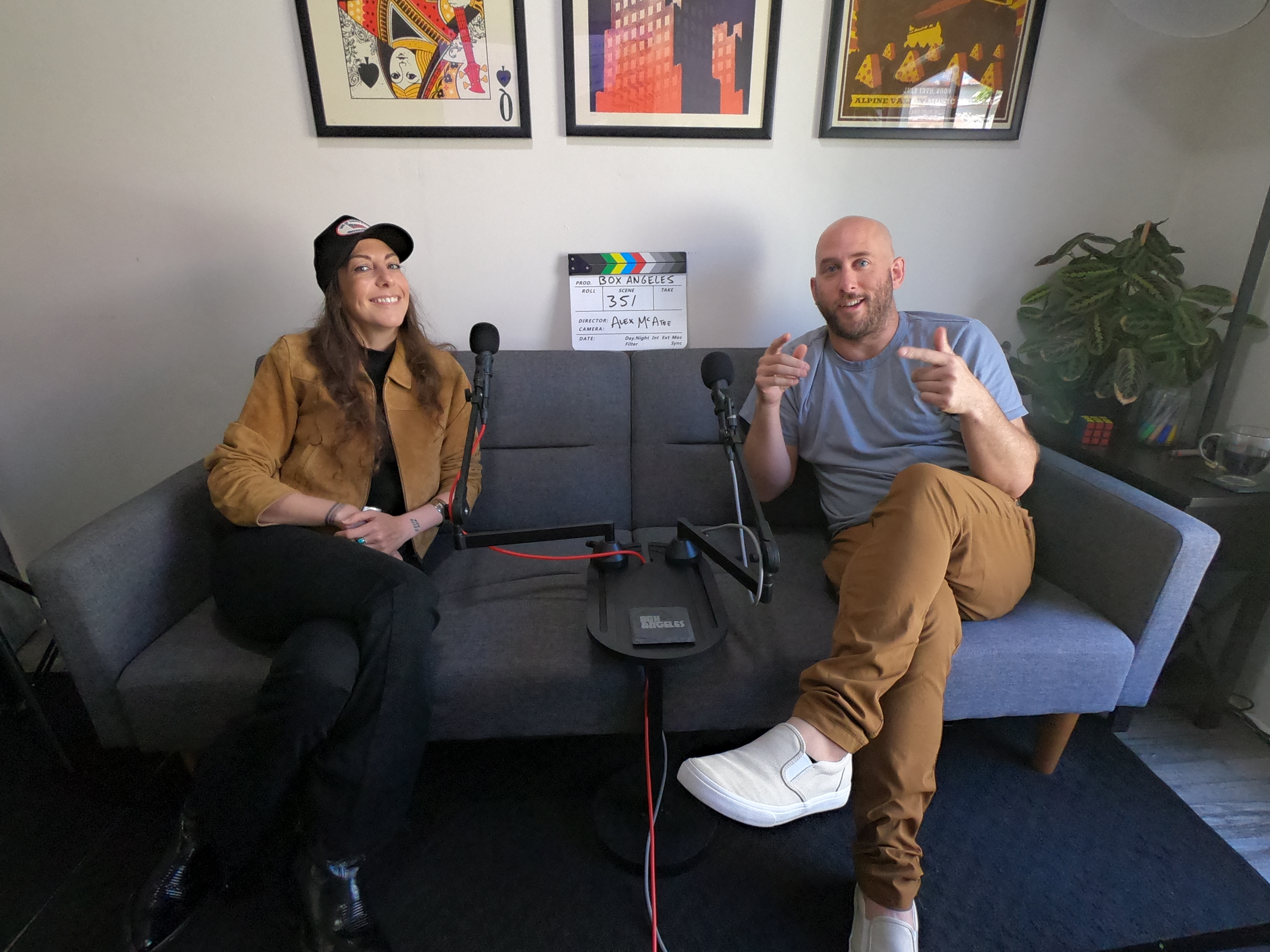
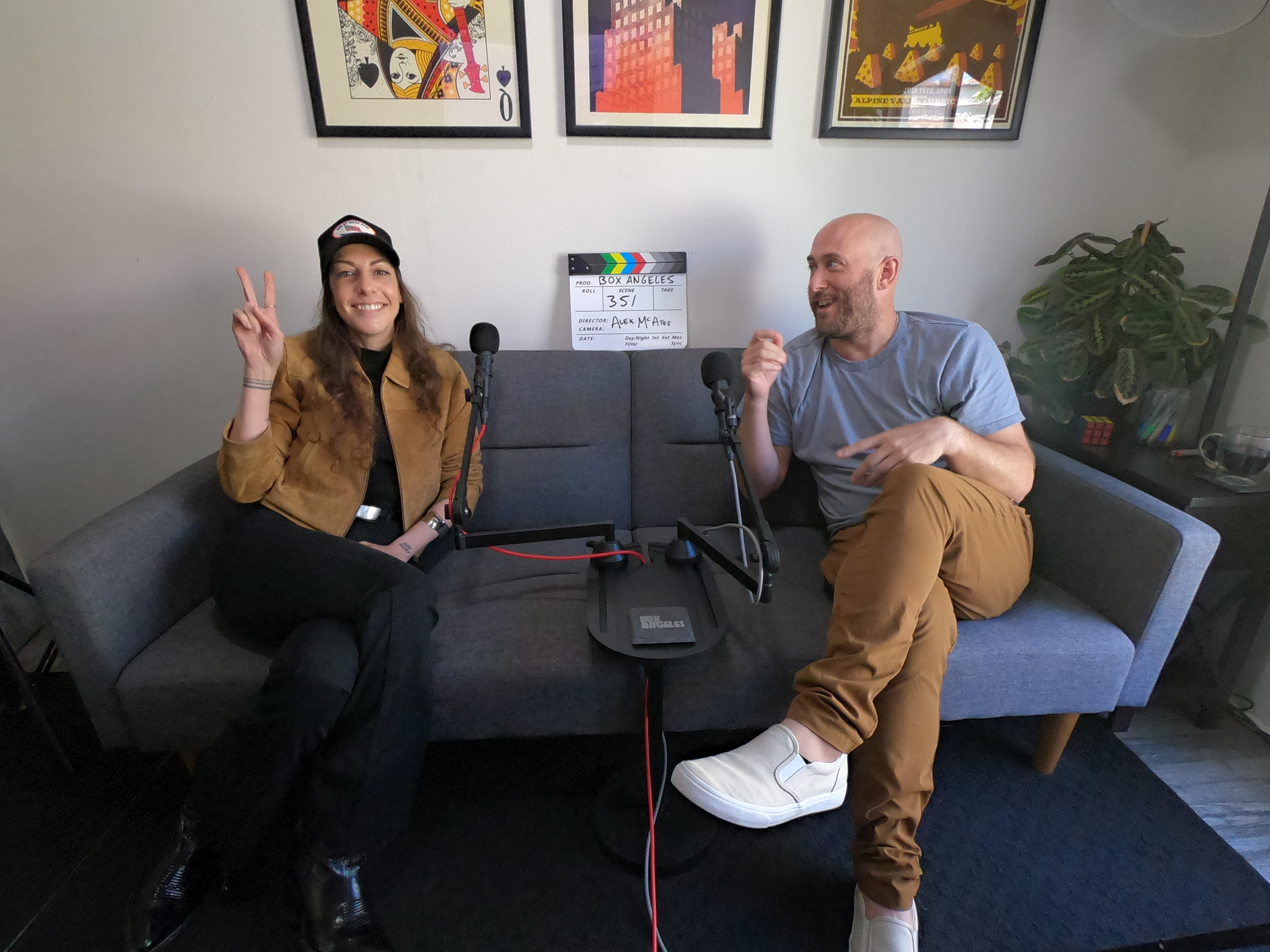
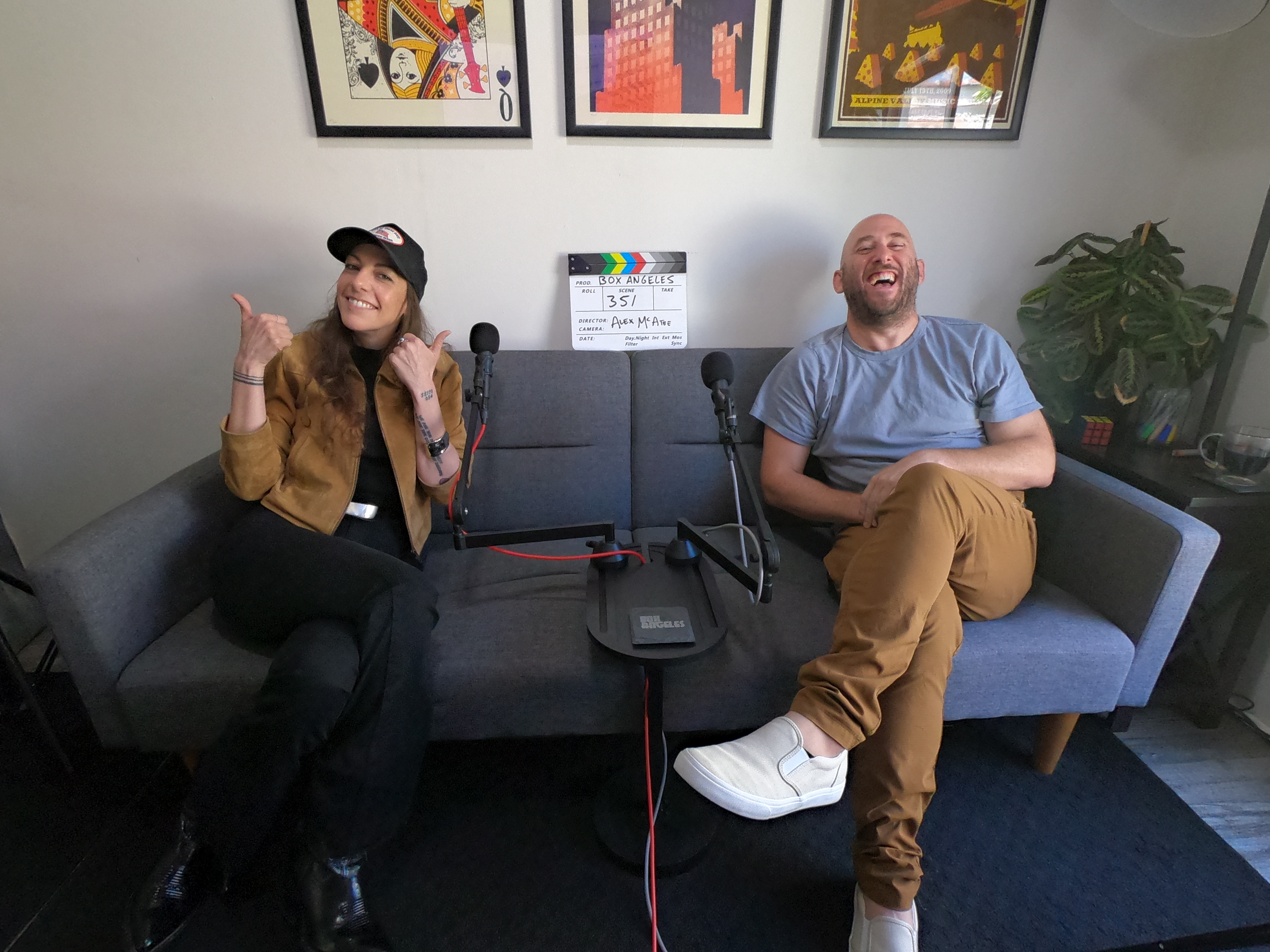
We’ve got another producing podcast today! Producer Alex McAtee joins us on the Box Angeles podcast episode 351. Alex stops by the bungalow and discusses getting her start as a PA to becoming EVP at Point Grey, the struggles in development, navigating pitches, building trust with collaborators while making sure everyone is on the same page creatively, how The Studio hilariously toes the line between satire and celebration, and more!
“One of the greatest things about TV and film is they’re incredibly collaborative.”
— Alex McAtee
Beats
00:00 – Alex slates her name.
00:14 – Introduction.
02:00 – Emailing people you don’t know.
05:27 – Was producing always the goal.
06:25 – Moving to LA to be a production assistant.
11:35 – Starting as an assistant at Point Grey Pictures right after they were founded.
17:07 – Differences between producing TV and film.
19:39 – The Studio both celebrating and lampooning the business.
22:23 – Every pitch is different and every meeting needs a purpose.
30:40 – Point Grey first look deals with Universal for film and Lionsgate for TV.
33:46 – “Executive Producer” definition.
36:11 – Other responsibilites; hearing pitches, being on set, etc.
39:40 – PGA credits.
41:37 – Relying on other people as a producer.
44:13 – The difficulty of making sure everyone is on the same page creatively.
46:27 – Self tapes.
50:37 – Harder to green light indie films lately due to talent deals.
53:12 – Optimism about the industry.
55:07 – Who took a chance on Alex.
More Alex
 – Check Alex’s IMDb.
Transcript
ALEX MCATEE (00:06)
Hi. I’m Alex McAtee. Nice to meet you.
MIKE ELDER (00:14)
Hello and welcome to the Box Angeles podcast with me. I’m your host, Mike Elder. Thank you so much for listening to the show. It’s an honor to have you here. It’s a privilege for you to be here. I don’t take it lightly that you’re spending your time with me. It’s an honor.
Thank you so much. Little housekeeping. Real quick. Go subscribe to the YouTube channel. If you’re listening to this audio, you can watch the videos over on YouTube. A lot of great episodes. A lot of great videos up there.
Check it out. youtube.com/boxangeles if you’re listening in Apple Podcasts, please leave a rating and a review that would mean the world to me. I need to ask for more of those.
Okay, who do we got this week? It’s a really fun episode. I don’t talk to a lot of producers, so this was a real treat.
We have producer Alex McAtee. I reached out to Alex because I love The Studio on Apple TV. The Studio is such a fun show and she’s an executive producer on that. She’s also produced things like The Disaster Artist, Sausage Party, The Interview, Pam & Tommy, Black Monday. She works at Point Grey Productions, which is Seth Rogen, Evan Goldberg and James Weaver’s production company. She’s been there for 14 years. She started very early on there and as a result, she had a lot of stories and a lot of great insights.
In this conversation, we talked about pitches, giving them and receiving pitches, difficulties with production, all sorts of stuff that is really fascinating that I was like, ooh, these are fun little nuggets to learn about. I also asked about self tapes. Obviously, everyone loves a good self tape.
Alex didn’t disappoint. This is a really fun conversation. It was quite a treat. I love producers. All right, ladies and gentlemen, without further ado, I give you Alex McAtee.
🎵 ROCKFORD (01:53) 🎵
You wanna talk to me? You wanna talk.
MIKE ELDER (01:59)
Perfect. Hi, Alex.
ALEX MCATEE (02:00)
Hi.
MIKE ELDER (02:00)
Thanks so much for coming on down.
ALEX MCATEE (02:02)
Of course. Thank you for. I thank you for reaching out. Thank you for finding who I am, I guess.
MIKE ELDER (02:07)
What do you mean?
ALEX MCATEE (02:07)
Well, you just emailed and we don’t know each other. I mean, not every. Not everyone. So, you know when you get an email from someone you don’t know and you’ve never talked to, you go, oh, my God. Thank you.
MIKE ELDER (02:17)
Yeah. Actually, let me ask you something. Sidebar.
ALEX MCATEE (02:20)
What?
MIKE ELDER (02:20)
When you get an email out of the blue for somebody you don’t know, what’s your thought and follow up question?
ALEX MCATEE (02:25)
Yep.
MIKE ELDER (02:26)
Which I’ve been flirting with Lately. Because I’ve been reaching for the stars lately. I emailed Chuck Lorre yesterday. I was like, fuck it, my shot.
ALEX MCATEE (02:32)
Yeah.
MIKE ELDER (02:33)
Do you think. Would you have been more receiving if it came from a quote unquote assistant? If I. Because I’ve been playing with the idea of making a second email and being my own assistant to make it look.
ALEX MCATEE (02:45)
More official, playing pretend.
MIKE ELDER (02:47)
But historically, I’ve pulled at the heartstrings of like, hey, I’m an up and coming actor, of course. Will you send the elevator back down and.
ALEX MCATEE (02:53)
Right, right. Well, one, you know, I’ve worked at Point Grey a long time and I was. I think my title was co producer on the interview. So, like, my email is on the web.
MIKE ELDER (03:06)
You know, the Sony leak.
ALEX MCATEE (03:07)
Yeah. So, like, I get emails, so that to me is like, standard.
MIKE ELDER (03:12)
Oh, you take a lot.
ALEX MCATEE (03:13)
Oh, I get emails from people I don’t know every day.
MIKE ELDER (03:15)
So people do know who you are, I guess.
ALEX MCATEE (03:18)
Yeah. Thank you.
So I get emails from people I’ve never met, never talked to all the time. So that to me is not surprising. And I would bet a lot of. A lot of people do. But that to me is not surprising. And then in terms of now, I wouldn’t. The way I would do it, I think it’s right for you to reach out first.
Be like, hey, here’s who I am and here’s my podcast and all the people I’ve had on. And they’d be like, if you’re at all interested, my assistant can find a time for you to come. So, like, it legitimizes the podcast. You have an assistant, but you’re reaching out first. You know, that’s how I would do it. Yeah.
MIKE ELDER (03:51)
I would. I would press back. In the sense, though, once you get people involved and you have people here. Right.
ALEX MCATEE (03:56)
Yeah, sure.
MIKE ELDER (03:56)
But once I get passed off, it doesn’t often go well for me.
ALEX MCATEE (04:01)
Sure, I understand that. I get.
MIKE ELDER (04:03)
At that point, I’m not a priority anymore. And the string aspect is no longer.
ALEX MCATEE (04:06)
Sure, sure, sure. Yeah, no good.
MIKE ELDER (04:10)
But I like, I like that thought.
ALEX MCATEE (04:12)
Yeah. Well, the reason why I say that is also because, like, then two assistants working together is also different. Right. If you get passed off to people.
MIKE ELDER (04:18)
Yeah.
ALEX MCATEE (04:18)
That’s just a pitch.
MIKE ELDER (04:19)
Yeah.
ALEX MCATEE (04:20)
I take it or leave it.
MIKE ELDER (04:21)
That’s funny.
ALEX MCATEE (04:21)
Yeah.
MIKE ELDER (04:21)
So wait, what did you do? You read every email you get?
ALEX MCATEE (04:26)
Yeah, yeah. Oh, yeah, Yeah. I mean, you know, sometimes it takes a minute. Like, I’ll. If I’m really busy, I’ll be like, checking immediately the ones that I know are about something very active or like, you know, for prepping something or whatever. But then I always go back, you know, I think I have a lot of systems at work. So I have a system where every month day I go back to the emails from last Monday and I go through all the emails.
That’s one system. So that’s. But I.
Yeah, I read every email.
MIKE ELDER (04:55)
That’s the producer mind, though, I feel.
ALEX MCATEE (04:57)
Sure. Yeah, you all. I mean, because I need structure. If I don’t have structure, like, you know, chaos.
MIKE ELDER (05:02)
Yeah. Well, let’s talk about your start. But first I want to say something. I had a friend interview at Point Grey and I told him I was going to interview you. Yeah, I don’t want to speak. I don’t want to misquote him.
ALEX MCATEE (05:13)
Okay.
MIKE ELDER (05:13)
And speak out of pocket. But basically he said you were so kind in that process and so cool.
ALEX MCATEE (05:17)
Oh, I. Well, I’m not sure that is.
But thank you, but. Right, sure. Hey, how nice could I have been?
Not my assistant.
MIKE ELDER (05:25)
So I’m excited to talk to you.
ALEX MCATEE (05:26)
Sure.
MIKE ELDER (05:27)
Okay. So my first question is, did you always want to be a producer?
ALEX MCATEE (05:32)
Okay. Yeah. I thought you were going to keep. Okay, question mark. Yes, from. I mean, certainly not when I was like growing up or something. Right. It wasn’t like I didn’t know what that meant.
And so not when I was, you know, a kid. I think I always loved tv, film and comedy specifically. And then once I started working out here, I think a barrier of entry for me and for other people I have found is like just understanding all of the jobs that exist and producer not only being one of them, but like specifically, you know, development, being a creative producer and sort of working at a production company and what that means. And I had no idea that a job like that even existed, you know, so it took me a while to even learn that. And then once I learned that, I was like, well, that I would love to do that, but it takes all the evening know that a job for me at least to know that a job like that exists.
MIKE ELDER (06:23)
Yeah. Yeah. Are you from out here?
ALEX MCATEE (06:25)
I’m from Dallas, Texas. Yeah.
MIKE ELDER (06:26)
Okay.
ALEX MCATEE (06:27)
Yeah, yeah.
MIKE ELDER (06:27)
But when you moved out here, I was looking at your IMDb, it seems like you just jumped into PA right away.
ALEX MCATEE (06:32)
Well, I heard about a job that I sort of moved to interview for. So I was living in Dallas and my cousin got an email from someone she used to work with whose ex boyfriend. Like this crazy chain of people. And this is in like October of 04 that Entertainment Tonight was starting a new TV show called the Insider with Pat O’Brien in Los Angeles. And no shade to Pat. But sometimes I’ll be like, oh, my first job was the Insider, and people were like, the Michael Mann movie. And I’m like, no. With Pat O’Brien. The Insider with Pat O’Brien.
So I heard about that job, and they were looking for PAs, and I knew that was entry level. I had an aunt and uncle who I’m close with who now live in the desert. But the time we’re living in Studio City. And so I had a place I could stay. So I, like, called interviewed over the phone. They’re like, you sound great. You don’t live here.
I drove out, I was like, maybe, you know, about two weeks worth of clothes sort of thing, and was like, let’s see how it goes. Interviewed in person, got the job. So it was like in a week and a half. I, like, heard about a job and then was working the job in la.
MIKE ELDER (07:35)
What happened if you didn’t get it?
ALEX MCATEE (07:36)
I was. I didn’t know. I mean, that’s why I said I had, like, two weeks worth of clothes. Like, I very easily could have just gone back.
MIKE ELDER (07:42)
So this was during college or after.
ALEX MCATEE (07:44)
Or pre college? No, I.
You know, you could say I quit college. You could also say they asked me to leave because I stopped going to class. You could say either one of those, and those would both be true.
MIKE ELDER (07:55)
So that was in Dallas?
ALEX MCATEE (07:57)
No, I was going to Muhlenberg, which is a very small liberal arts college in Allentown, Pennsylvania.
MIKE ELDER (08:02)
Got it.
ALEX MCATEE (08:03)
So I was there for a year and a half.
MIKE ELDER (08:04)
Seems kind of random.
ALEX MCATEE (08:05)
It was. That was probably why I picked it. But yeah, so I was there for a year and a half. Moved back home over, like, a holiday break going into 2003.
MIKE ELDER (08:16)
So were you studying anything related to the.
ALEX MCATEE (08:18)
I was taking communications, but I still don’t know what that is.
MIKE ELDER (08:23)
Okay, so my question then, like, it doesn’t seem like you had enough.
ALEX MCATEE (08:28)
A huge plan.
MIKE ELDER (08:28)
A huge plan. So I guess, like, once you met, when did you realize that sort of the developmental production was what you wanted?
ALEX MCATEE (08:37)
I would say closer. So I was. I was a PA for or a field assistant, a production coordinator, all of these sort of, like, production jobs on some TV shows. And then I started. I got a job in the office on you Don’t Mess with the Zohan.
That was my first movie. I was a PA in the office on that. And that was where I started. Because for me, a lot of.
I interrupt myself a lot. If you haven’t noticed.
MIKE ELDER (09:01)
I like it.
ALEX MCATEE (09:02)
For me, a lot of working in feature offices allowed for me to ask, like, well, how did we get here? You know, I’d only ever worked in production, like, on a shoot. And so understanding, I was like, well, I have a sense of how this works, but, like, how. Who rented this office? You know, so just trying to understand the process that sold the movie before we got there was big for me.
And, you know, I found asking people like, how did you. How do you do your job? Like, people love. Here I am, love to talk about their jobs here. So it was very easy for people to, like, share with me the various ways the, you know, the movie got set up. And part of those was whoever the producers were. And I was like, well, what, you know, what do they do? Or whatever. And then, like, seeing what they did and understanding more of like, oh, my gosh, like, there’s a job that’s like, kind of based on your taste, and you get to like, you know, help be creative, which was something I wanted that I didn’t have.
Working in the production office, frankly, was like, that creativity and being able to like, impact what was on screen, of course, like, and not that people in production offices or line producers don’t, because they very much do, but maybe not in the way that I was most wanting. So working in those production offices and learning what product producers at production companies did, I was like, oh, my gosh, it’s like based on your taste and you get to like, maybe have a little slate and have like a brand and tell you what to do and the taste and telling people what to do. Like, truly, that’s. I’ve been waiting.
MIKE ELDER (10:29)
So if I, If I understood that correctly, you were a PA on Zohan.
ALEX MCATEE (10:33)
Yes. In the office, in the production office. Yeah.
MIKE ELDER (10:36)
Watching how people worked on that movie really inspired you.
ALEX MCATEE (10:38)
Yeah, absolutely. And I think also like, having conversation, like, watching being like, oh, they’re. They’re helping these creative people make decisions. They’re also a part of that, but they’re also like, helping and stewarding with the, you know, supporting the director or the writer or the actors to make sure, like, their vision is. Is carried throughout. And I found that really exciting. Yeah.
MIKE ELDER (10:59)
When you, when you do something like that, I should know this, but I don’t. I’ve PA-ed. I PA-ed a little bit when I first moved here and it would be like two day gigs. But when you do something like that, is it like a flat fee you get for six weeks or is it.
ALEX MCATEE (11:10)
Yeah, like, you, you get paid hours. I can’t even remember what the fee at the time was. But let me tell you, it wasn’t very much. But yeah.
MIKE ELDER (11:20)
Problably like $20 an hour or something, right?
ALEX MCATEE (11:21)
Maybe, maybe not. I’m trying. It’s been so, you know, it’s been 20 years, so. But yeah, no, you get like an hourly rate and then it’s just. Do you work overtime and you’re filling out a time card every day?
MIKE ELDER (11:34)
Yeah.
ALEX MCATEE (11:34)
Okay.
MIKE ELDER (11:35)
And then. So this was my follow up to that was like, you start working for Point Grey as Seth Rogen and Evan Goldberg’s assistant.
ALEX MCATEE (11:44)
Yes.
MIKE ELDER (11:45)
Were you an office assistant? Were you a personal assistant? What was your title?
ALEX MCATEE (11:48)
Yeah, so I started after the first Point Grey movie was shot. So the company had been founded by Evan, Seth and James Weaver, who’s still their producing partner. And I had met them on the Green Hornet, had wanted to transition out of working in production offices and figured, you know, I’m meeting these writer director producers, not necessarily slash, sometimes comma writer, director producers. When I’m working on these movies, I have what I think could be valuable experience to be an assistant and that maybe one of these people will need an assistant or know someone who does. And that is how I will transition out. And then I’ll figure out the producing part. Like, you know, I don’t know if you can tell, but a lot of my journey has been like, I don’t have like a huge.
Maybe I shouldn’t be saying this, but I don’t have like a 10 year old, 5 year plan of like, here’s how I’m going to. I’m. I’m sort of like figuring it out as I go a little bit, which has to me worked out. So I kind of am okay with that now. That doesn’t mean I like jump blind into stuff, but it does certainly mean that like I am open to taking in data and information and then having that very in a short term impact my decision making. Right. So trying to become someone’s assistant.
I had worked on the Green Hornet for. That was a long job for me. So I had stayed in touch with James as they had had that movie wrapped. And I went on.
MIKE ELDER (13:09)
So you were like a PA on that?
ALEX MCATEE (13:11)
I was, I was the. Well, no, sorry.
On the Green Hornet. I was a PA on that. 50/50 was the first Point Grey movie was shot in Vancouver. So I had working on the Green Hornet. Excuse me. I had started, I think as a production secretary and then I got bumped up to be assistant production office coordinator. So I was the APOC on that.
Then I went and Worked on two other. Two or three other movies, but stayed in touch with James and was always like, if you guys ever need an assistant, I would love to do that. And so I was working in the office as the APOC on the Muppets, the, like, Jason Segel, James Bobin, Amy Adams movie. And when I was working on that one day, Weaver reached out and was like, hey, we’re starting a company and looking for an assistant. Would you want to interview? And so I did. And that was 14 years ago.
And I became technically, I was Evan’s and Seth’s assistant, but the company was just the three of them. Kyle Hunter and Ariel Shaffir, who are writers, were also sort of working out of the office and more a part of Point Grey at that time as well. So I was their assistant, but I was the assistant.
MIKE ELDER (14:07)
Right. So because it was so small, it wasn’t too niche. You had opportunity to do other stuff.
ALEX MCATEE (14:13)
Absolutely. But I was also, you know, scheduling for James and all that sort of stuff. So I was like everyone’s assistant in a way. Some of it was, you know, very work related and some of it was personal stuff and not. And, you know, pick this up or drop that off, some things like that. But it was very much, you know, business work, movie, tv. I mean, at the time it was just movie.
MIKE ELDER (14:34)
Yeah.
ALEX MCATEE (14:34)
Because we weren’t making tv, but movie oriented. So. Yeah.
MIKE ELDER (14:37)
Well, I think. Sidebar. I think not having a plan is probably good.
ALEX MCATEE (14:40)
Yeah.
MIKE ELDER (14:41)
First off, because you could get hit by a bus tomorrow.
ALEX MCATEE (14:45)
Sure, sure, sure.
MIKE ELDER (14:47)
But also, like, it’s interesting because to me, like, the reason I asked if you were technically a personal assistant is because, like, I would worry if I was anybody or you.
ALEX MCATEE (14:56)
Yeah.
MIKE ELDER (14:56)
That you might be seen by those guys, Seth James and Evan, as only the personal assistant. You had a plan to. You wanted to be a creator.
ALEX MCATEE (15:05)
Yeah, of course. Yeah.
MIKE ELDER (15:06)
And I find first impressions are very hard to get past.
ALEX MCATEE (15:10)
Sure.
MIKE ELDER (15:11)
So if they see you as a personal assistant and then they put you in that sort of box as a personal assistant, you could get pigeonholed.
ALEX MCATEE (15:20)
Yeah, yeah, of course. I mean, I could still. Even now, like, I did work as their assistant, they could still see me as that. Right.
MIKE ELDER (15:25)
Yeah.
ALEX MCATEE (15:26)
You know, personal or otherwise. So totally.
I totally get that. I think that’s part of what has made the guys. One of the things that makes them special, frankly, is, you know, they’ve promoted at the company always, only ever within.
MIKE ELDER (15:42)
Oh, that’s cool.
ALEX MCATEE (15:43)
So, you know, myself and then Josh Fagen, who’s another executive there, Loreli Alanis, Gabby Grantham. I could Keep going. But everyone has started as whether it was Evans because evidence has understandably, I think, gotten too busy to share one person. So. So yeah, I mean, everyone’s either started as Evan or Seth’s assistant or James Weaver’s assistant.
MIKE ELDER (16:06)
Yeah. I think if you had a plan though, you might have done what I just did and over analyzed it.
ALEX MCATEE (16:12)
Okay.
MIKE ELDER (16:12)
Like maybe, I don’t know, I don’t want to be a personal assistant, but I guess if it was that small, it makes sense that that’s just like.
ALEX MCATEE (16:18)
Sure.
MIKE ELDER (16:18)
You’re getting in at a very pivotal point for potentially big ups.
ALEX MCATEE (16:23)
Oh, I certainly. Sorry, where did I put my water? Uh.
MIKE ELDER (16:26)
Oh, we’re missing a lot.
ALEX MCATEE (16:28)
I certainly recognize and was aware at the time and I’m very, you know, and I’m aware now that like, I got really lucky that I started when I did with them because it was when the company started, you know, so like they grew, the company grew. I. We’ve grown together. Right. In many ways over the last 14 years. Because like, you know, I think I started. I was 28, I’m 42.
You know what I mean? So that. And we’ve. I’ve been working at the same place that whole time.
MIKE ELDER (16:54)
That’s awesome. Do you got any sweet, sweet equity?
ALEX MCATEE (17:02)
We can talk about that after.
MIKE ELDER (17:05)
Nice. Okay. You do TV and film, right?
ALEX MCATEE (17:09)
Yeah. Yes.
MIKE ELDER (17:10)
That’s. As I was looking at your filmography, that was fascinating me because to me they’re so different.
ALEX MCATEE (17:15)
Sure.
MIKE ELDER (17:16)
Is that normal that producers do both? Have you found it to be difficult.
ALEX MCATEE (17:20)
To jump back and forth at most production companies? I find that people either work in TV or features, so it’s more bifurcated. I really like the freedom, the creative freedom, frankly, and also the freedom of relationships. Because there are people who, you know, I’ve worked with before who’ve made movies and then they’re like, why have a TV show? And I would hate to be like, well, we’ve had this good working relationship. I feel like, you know, I bring out the best in you and vice versa. And now you’re going to go work with someone else.
I’d be such a bummer. So. Because so much of. Yes. I find being a good producer is based in having a good relationship, because that is what it is. Many people who, you know, I’ve worked with on projects have become close friends and I find myself being like, okay, love you, bye. After we talked about work stuff.
And it does sound sort of like 80s stereotypical, like, love you, babe. But I’m like, truly, I love these people. You Know, like, agents who. I are good friends. When I’m like, okay, love you. And, you know, it just seems sort of. You’re like, that’s real, though.
Cause you spend a lot of time together. You go. You have hard conversations, you have celebrations and success, you know, and so you form a relationship and a friendship. I forgot what you asked. And I mean, thank you so much.
MIKE ELDER (18:28)
Do you have to switch your brain, though, when you go back and forth.
ALEX MCATEE (18:30)
I mean, sure. You know, like, it’s certainly a different mode of storytelling, you know, and there’s a lot of differences in between the two. But I also find it exciting, again, creatively, because, you know, you get to be like, well, what’s the best. Sometimes something is brought to you as a TV show, and it’s better as a movie. And to be able to stay engaged in that way, I really like.
But it’s also just. I don’t know.
I watch both, I care about both, I appreciate both. And so it’s more fulfilling for me to be able to work in both mediums. It’s also, like, I have unscripted shows I’m working on or animated shows I’m working. You know what I mean? So I think I find being able to, like, express myself in all of those different mediums exciting and would be, you know, disappointed if there was somewhere else that I went or something else I did where that wasn’t an option.
MIKE ELDER (19:26)
Yeah. As you describe it, it kind of, like, makes it sound almost. You said exciting, which is the word. It’s like, not redundant. You’re probably doing something new every.
ALEX MCATEE (19:34)
Exactly. Absolutely.
MIKE ELDER (19:35)
Interesting and keeps you on your toes for sure.
ALEX MCATEE (19:37)
Absolutely.
MIKE ELDER (19:38)
Well, I reached out to you specifically because I love The Studio.
ALEX MCATEE (19:41)
Yeah. Thank you.
MIKE ELDER (19:43)
I’m absolutely loving The Studio. I watched the whole thing, obviously. But, like, other than. It stresses me out to no end, of course, for some reason, I like it.
ALEX MCATEE (19:49)
Yeah. And I think that’s. Yeah.
MIKE ELDER (19:50)
And I think it’s. It’s obviously inside baseball, but, like, I feel like. And keep me honest to a degree, it’s lampooning the business a little bit.
ALEX MCATEE (20:01)
Sure. Yeah. I think. Absolutely. It’s also celebrating it. You know what I mean?
MIKE ELDER (20:04)
Yeah, it’s definitely doing both.
ALEX MCATEE (20:05)
And I think it’s also trying to show. Yes. Some of the, like, ridiculous aspects, but also, like, the. The fun. Yes. The hardship, the stress. I mean, that’s something we hear a lot, of course, as people.
Especially, you know, the one or episode. Particular episodes. Be like, I had to pause it. You know, like, I was freaking out. And you’re like, I get it. I get it.
MIKE ELDER (20:27)
Take a breather.
ALEX MCATEE (20:28)
Yeah.
MIKE ELDER (20:28)
But because of that lampooning aspect and I mean, this is so fascinating me as I like think about this question. It’s like you are talking about a studio head that clearly is very narcissistic potentially and very fickle and very selfish self. I don’t even know what I’m saying. But essentially they’re very light skinned. Yeah, not light skinned.
ALEX MCATEE (20:53)
Thin skinned.
MIKE ELDER (20:54)
Thin skinned people.
ALEX MCATEE (20:56)
Yeah.
MIKE ELDER (20:56)
Was it hard to pitch that show because of that? Because you’re literally pitching it to the people you’re sort of lampering?
ALEX MCATEE (21:02)
I think in some ways, you know, yes and no. Right. Where you’re like, you don’t want to insult people who you’re pitching to. You’re like, please give us money to make this thing that you could see as about people like you. Right. So I get that. But it’s also like, we’re making a show about people like you.
What a greater compliment.
MIKE ELDER (21:20)
You know, that’s a producer mind right there. I love that. Did it make it hard though?
ALEX MCATEE (21:26)
I mean, I think every, if that could be a particularly difficult thing. But like, every show, every movie has things. Yeah. So, like, I don’t see that as being any more off putting or scary than, than, you know, challenges you’ll face on anything else.
MIKE ELDER (21:42)
Yeah. Well, part of me, and I don’t know if you can talk about this, but part of me was like, is that why it ended up at Apple? Because Apple is a disruptor and they’re like, oh, it’s kind of fun. I mean, fun at our.
ALEX MCATEE (21:52)
Yeah, that totally could be for them, part of that. Right. That would be obviously a question for them, but I think more so, like, you know, Seth has, has another show at Apple. They were great partners and, you know, we had a few things in development with them over the years and I think it just turned out to be the right thing at the right time, you know, so, yeah, but they’ve been great. I mean, super supportive and very understanding of like Evan and Seth’s vision and the creator’s vision. And so. Yeah.
MIKE ELDER (22:23)
Do you have a, like a, I don’t know, a routine you do when you pitch stuff or do you have things you do every pitch or is every pitch unique?
ALEX MCATEE (22:31)
Yeah.
MIKE ELDER (22:32)
Here’s how you approach. Of course, that’s essentially how you audition. I would think that’s your audition.
ALEX MCATEE (22:36)
Absolutely. I mean, every pitch is different, The Studio, the group. Like, I was involved in working on that pitch, but I wasn’t in the room when they went out to pitch that partially, you Know, part of it is when you think about going out to. In person. I’ll say that. So pitches used to be only ever in person, of course. And then Covid hit, and we transitioned to Zoom.
And I would say, in my experience, most pitches are still over Zoom.
MIKE ELDER (23:05)
Oh, wow, that was a bummer.
ALEX MCATEE (23:06)
So oftentimes, with certain projects, I have like, a actually multicam show that I’m taking out to the broadcast networks right now, and we’re doing those in person. So sometimes you’ll be like, listen, we got to come in for this, you know? And so with The Studio, the guys wanted to do that. So it was the two of them, James Weaver, and then I believe it was the other three writers, Frida Perez, Alex Gregory, and Peter Huyck, who are all creators as well. So it was like a big.
And then Lionsgate, our studio partners. And so it was like seven or eight people going in person, and you’re kind of like, not in a rude way to me. I’m like, I don’t gotta go, you guys. You got it. Now, like, this multicam I’m talking about, like, that’s me, and I’m doing. There’s, like, a preamble, you know, that, like, the producer will give about why we’re all here, sort of a thing. Oh, so, like, I’ll do that.
It’s a way just to sort of, like, set up the meeting of, like, what you’re gonna hear and why it makes sense for us and that sort of thing. So I’ll do that. Like, on this particular show, like, I’m giving that.
And that’s me. And then the Madeline Blair, who works in our TV department as well, she comes with me. And then the writer and the showrunner of that. So every pitch is different because even just the makeup of who’s there, you know what I mean, is different. And part of that is just how involved in the show are you? There’s a pilot we’re working on now that I can’t really talk too much about, but it’s very cool. And that’s been something I’ve been working on for six or seven years, and I’m really, like, spearheading.
But it’s different with every project, you know?
MIKE ELDER (24:34)
Yeah. Well, how much prep, I guess, do you do, like, and are there different stages of a pitch? I guess. I don’t know.
ALEX MCATEE (24:40)
Like, yeah, of course.
MIKE ELDER (24:40)
So are you going in with, like, a deck and slide? Are you going in with, like, potential cast people? Are you leaving behind materials that they can flip through? I guess I don’t know how involved.
ALEX MCATEE (24:51)
Of course that is. Yeah, it’s different for every project, which is such an annoying answer kind of. But, but it’s true because every show or every feature of course is both different in like taste and tone and yes, elements. Is it packaged? Is there a director and an actor already attach? So is it a spec, is it a pitch?
Are you having a meeting? Like, you know, it’s always different and something like there was a sort of hour long genre thing. We had been working on a TV show for a while that had a lot of like lore and mythology. And so yes, you have a very robust deck that you’re walking through over zoom with people because it’s in a, you know, it’s a show with a lot of dense information. And so you’re trying to keep people. Sometimes, you know, you’re just like, I’m going to talk at you for 30 minutes about lower end mythology and characters and journey. And so you’re just like, okay.
And having something visually to follow along with is the only way your brain can really like keep up with what you’re hearing. And then even still you’re like, we will send you a version of this deck after knowing that, like it’s hard to totally digest in real time so it’s easier to like, you hear it, you think about it, you ask some questions and you get the deck and you read more about it. Then you could really digest it. Yeah, so but that’s a very, that’s an hour long genre show that’s super dense. Right. And then you have, you know, a half hour idea that’s like a little bit lighter and easier and you’re just like, this is just about these character dynamics. So we’re just going to tell you about these characters.
Here’s a little visual aid with potential actors for each character so you can sort of think about, follow along in that way and that’s it. And then like you don’t leave anything behind. So it’s, it’s certainly, it’s different for each project. And yes, if something has, you know, a director or actors attached, that’s also different. Sometimes you can have them in the room or on the zoom and you know, be a part of that. It depends.
MIKE ELDER (26:38)
I would imagine it’s different per studio too. You probably have relationships with these people at this point and like, you know what they prefer to a degree.
ALEX MCATEE (26:45)
Yeah, absolutely. I think like, you know, they also, the people who, you know well are also kind of going to want to leave it up to you. Being the arbiter of, like, you know, what do you think this pitch needs? But that is, you know, you prep pitches sometimes for months, maybe even a year. It depends.
MIKE ELDER (27:08)
Yeah. When you go into these meetings, are you. Is it a thousand percent clear what the meeting’s about?
ALEX MCATEE (27:17)
That it’s a pitch?
MIKE ELDER (27:18)
Well, is it like. Yeah, but like, to what degree?
Do you know what I mean? Okay. I quit my day job recently and I just had.
ALEX MCATEE (27:24)
Congratulations.
MIKE ELDER (27:25)
Thank you. It’s so funny how everyone says congratulations to me, and I think that’s so great. Anyways. And I met with another company, like, a week ago, potentially consulting with them.
ALEX MCATEE (27:36)
Yeah.
MIKE ELDER (27:37)
But, like, I went into it and I didn’t know if it was like an interview or like a meet and greet or that vibe.
ALEX MCATEE (27:40)
Okay. Right.
MIKE ELDER (27:42)
So I didn’t know what to prepare and how much to prepare.
ALEX MCATEE (27:44)
Right.
MIKE ELDER (27:45)
So I guess my question is, when you go into this, do you know exactly.
ALEX MCATEE (27:48)
Yes.
MIKE ELDER (27:49)
You know exactly what’s happening?
ALEX MCATEE (27:50)
Well, every meeting I go into, I want to know exactly what’s happening.
MIKE ELDER (27:52)
Well, that’s probably why you’re a great producer.
ALEX MCATEE (27:55)
Because I will prep beforehand. Do I need to read something or I need to watch something? Do I need to. Is there going to be a writer or director that I’m bringing onto that meeting that I want to make sure they’re prepped for what’s going to happen?
So, yeah, no. I don’t like going into meetings where I’m sort of like, what are we doing? I also don’t like going into meetings where I don’t know who’s leading the meeting.
MIKE ELDER (28:11)
Yeah.
ALEX MCATEE (28:11)
Because it can get awkward and everyone’s staring at one another going, so what are we here for? Like, someone should show up and lead the meeting.
And it can be me. It doesn’t have to, but I will set up with the other people being like, so who’s meeting is this? Or like, what are we? Like, we’ve got to have a purpose and we need to know who’s in charge. And then that way we can give it some structure and we can get done what we need to.
MIKE ELDER (28:30)
I love how show business is the same as every company. It’s a bunch of useless meetings, probably. But also, nobody knows who’s running them. But to that point. Are you scheduling these? Mostly. Is Point Grey going, hey, Netflix, we’d like to meet with you.
Hey, Apple, we’d like to meet with you? Or are they reaching out for general stuff, too and being like, hey, we’re looking to make some more shows. Come tell us what you got.
ALEX MCATEE (28:51)
Yeah, it goes both ways. But I will say, like, you know, we had, we’ll have ideas we’re working on. Our first look deal in TV is with Lionsgate. They’re our home TV studio, studio. And then we have a first look feature deal at Universal. So what that means is any TV or feature project we have, the first place it has to go is one of those two places. And then they get to decide if they’re going to come on or not.
And you know, once you. Universal has distribution, Lionsgate TV does not. Right. So once we take something to Lionsgate TV, if they sign on, then you have to go out to a distributor, a buyer. So that’s like with the studio. We took that to Lionsgate. They wanted to do it.
You make deals, then you go out to the buyers and Lionsgate would probably initially make the calls to the buyers and then we make a follow up call to your friend who, you know, who’s going to be in the meeting just to talk more about it. But all of this is in service of setting up the most successful, best meeting you can have.
MIKE ELDER (29:50)
Yeah.
ALEX MCATEE (29:51)
So that, you know, everyone feels like they have all the information, both creatively but also business wise. Right. So that they understand if they’re agreeing to something, what that could mean. But usually, you know, calling Universal, if we have like a pitch for them or a spec to send or something that would be the executive to another executive there. And. Yeah. And then, you know, the assistants come in and set the actual time or whatever.
But I also have like executives that work at a financier or a distributor in features or a studio or a network in tv reach out and say, hey, what do you guys, you know, we should just, let’s have a breakfast or we should just chat some time about what we’re looking for and what you guys are up to. So it definitely goes both ways.
MIKE ELDER (30:33)
Yeah. Do you like those?
ALEX MCATEE (30:34)
Sure, I’m happy to do that. You know. Yeah, I, hey, the meetings are my job, like. Yeah.
MIKE ELDER (30:40)
Okay. And I’m going to get into some minutia here because I’m fascinated and curious for the Universal and Lionsgate. I assume they pay Point Grey for that privilege.
ALEX MCATEE (30:50)
Yeah, that’s what. Yes. So we have our first look deal. So that’s what the deal means.
MIKE ELDER (30:54)
Right. So they pay you a certain amount. Amount per pitch or per year for number of pitches.
ALEX MCATEE (31:00)
Sure.
MIKE ELDER (31:01)
How does that work?
ALEX MCATEE (31:02)
It’s, it’s, it’s, it’s usually a couple of years. I mean, I also, you know, not in a way, don’t know how much to reveal in this moment. Here, Right? Yeah.
MIKE ELDER (31:13)
You definitely don’t have to reveal too much, but.
ALEX MCATEE (31:15)
But yes. You make a deal with a studio and they pay you a certain amount per time period? And sometimes, you know, our deals are first look, which means we bring everything to Universal or Lionsgate. They get to evaluate, and if it doesn’t make sense for them, we can move on elsewhere.
MIKE ELDER (31:31)
You have to provide a certain number in that time, or.
ALEX MCATEE (31:34)
No, it’s. People’s deals are all different, you know. Yeah, sometimes.
MIKE ELDER (31:38)
I interviewed some directors lately, and they, like, have deals, first look deals, and then they never make anything.
ALEX MCATEE (31:43)
Sure.
MIKE ELDER (31:43)
They only do one or two pitches and it’s like. That’s fascinating.
ALEX MCATEE (31:46)
Yeah, I know. It’s different for everyone. And then some places the deals are exclusive. Right. Where, like.
MIKE ELDER (31:50)
Right.
ALEX MCATEE (31:50)
You go to Universal if they don’t like it. That’s so, like, you know, but that so much of what kind of deal you get and how lucrative, how many projects they expect from you is dependent on what you have done before and specifically, sometimes what you’ve done with them, you know.
MIKE ELDER (32:06)
Wait, how much of this. I’m fascinated. This is great, by the way. Great stuff. How much of this do you do versus, like, lawyers, though? Are you talking to Universal and saying, hey, let’s get it.
ALEX MCATEE (32:17)
Well, often, like, the way it works is like. Like there’s conversations about deal stuff between executives. But you try for a lot of it. Yes. To go through lawyers, and then the lawyer comes to you and says they want this stuff and you go, what? Never. And then they go back that. You know.
But then often, sometimes you’ll have to cut through the lawyers and call the executive, be like, hey, man, this is. This is why we’re never going to agree to this.
And this is what we want. And then they go, oh, I got it. You know, so there’s most of it’s between lawyers, but a large. Especially the big stuff, the initial conversations would happen between executives. Now, James Weaver being Point Grey’s president, and Evan and Seth’s partner is the one who. With the two of them, those three went out, you know, met various studios and. And acquired our first look with Universal. Yeah, but. But, yeah.
MIKE ELDER (33:08)
Well, keep me honest, isn’t your title executive vice president?
ALEX MCATEE (33:11)
Yeah.
MIKE ELDER (33:12)
So pardon my naivety are you. Essentially, there’s a board, and you’re not on the board, you’re right below it.
ALEX MCATEE (33:20)
Sure. I mean.
MIKE ELDER (33:20)
Essentially, is what you mean by executive?
ALEX MCATEE (33:22)
Yeah. No, you mean at Point Grey.
MIKE ELDER (33:25)
Yeah.
ALEX MCATEE (33:25)
I think. No, it’s just Weaver is the guy’s producing partner, so the three of them started the company together.
MIKE ELDER (33:31)
So you’re just saying they would make any of those huge.
ALEX MCATEE (33:33)
Yes, exactly, exactly. And like, listen, they talk to myself and Josh Fagen, who’s also another EVP there.
MIKE ELDER (33:40)
Yeah.
ALEX MCATEE (33:41)
So certainly we’re a part of those decisions, but we’re not making. We’re not the ultimate arbiters. Got it? Yeah.
MIKE ELDER (33:47)
When you get into these titles, like, we just kind of did, like. Like you’re an executive producer on The Studio. Yeah?
ALEX MCATEE (33:51)
Yes.
MIKE ELDER (33:52)
To me, I’ve always thought, and keep me honest, I’ve always thought of executive producers largely as a. The creator, but also like the money people.
ALEX MCATEE (34:00)
Sure. I know.
This is part of why. Yeah, go ahead. It’s. I know every answer I give is different on every project. It’s so annoying.
MIKE ELDER (34:07)
Oh, really?
ALEX MCATEE (34:07)
Oh, yeah. Like I have an EP credit. I do much less on that than other things that I have an EP credit on, you know, but it’s because there’s so.
I don’t, you know, they. Evan and Seth and James and Pete, like all of these people are EPs, you know, and you’re just like, how many EPs can one show handle?
MIKE ELDER (34:25)
But like there’s, there’s no. I guess there’s no like for. On our side, you know, it’s very specific what a guest star is.
A co star.
ALEX MCATEE (34:32)
Of course. Yeah.
MIKE ELDER (34:33)
On the writing side, it’s very specific what a consulting producer is. Different producer, vice, co consulting. But for you guys, it’s just sort of the wild west. And yeah, it’s up to the studio making it.
ALEX MCATEE (34:42)
Well, it’s up to. I think, I think it’s up to, you know, the, the producers, the very. If there’s, you know, production, various co production companies or whatever that is, to decide whose role is what despite the title. So like the pilot that I am prepping right now, the head writer and the director have EP credits too. So like, you know, it’s not. And they are not not tasked with bringing in money. Now part of my job on this particular pilot was, you know, it was already set up somewhere.
It’s a piece of ip so like we didn’t have to run around and find money. It’s already set up with the, with the people who own it and we’ll finance it. But certainly I think that was one thing that when I was growing up and you know, when you think about working in Hollywood, you’re like, okay, writer, director, actor. I know, like producer. Those are the money people. Right? That was my only.
That was what I thought I just said money people. I don’t know what that means. I don’t even know what money people mean, you know, Like, I don’t even know what I thought that meant. Finding money. You have the money already or that’s then a financier, which is like, often not what producers are. So I think producers are associated with money, but in what way? People don’t understand.
I didn’t understand. And it’s also, again, different on every.
MIKE ELDER (35:56)
Yeah.
ALEX MCATEE (35:58)
On every project because there are people who get EP credits who are at financiers.
MIKE ELDER (36:02)
Right.
ALEX MCATEE (36:02)
So, like, they are the ones who give money, but we have the same credit and I not giving any money, you know, so it’s fine.
MIKE ELDER (36:09)
It’s the Wild West. I used. I used to love to think of producers as just drinking white wine in the afternoon in the Palisades.
ALEX MCATEE (36:15)
I would love that. I would love for that to be what my afternoon is holding.
MIKE ELDER (36:19)
You’re not doing that this afternoon.
ALEX MCATEE (36:20)
That’s not what’s happening for me. This. I’m hearing two pitches this afternoon.
MIKE ELDER (36:24)
Oh, that’s fun.
ALEX MCATEE (36:25)
Sure. Yes.
MIKE ELDER (36:26)
You’re hearing them?
ALEX MCATEE (36:27)
Yes.
MIKE ELDER (36:28)
Oh, that’s a whole different beast I didn’t even think about. So you basically people from outside come to Point Grey and say, hey, will you make my shit?
ALEX MCATEE (36:33)
Yes.
MIKE ELDER (36:34)
And then you hear that. And then you take your favorites, too. That. Wow.
ALEX MCATEE (36:37)
And then I evaluate you.
MIKE ELDER (36:38)
So much different stuff.
ALEX MCATEE (36:39)
Yes, I do. It’s true.
MIKE ELDER (36:41)
No white wine in the palate.
ALEX MCATEE (36:43)
I mean. I mean, I haven’t been to Palisades in a long time, you know, but.
But yeah, no, you do that. Then there’s also the aspect of the job where, like, when you have something shooting and you’re on set all day long for months.
MIKE ELDER (36:55)
So do you have like a. Like sort of a standard time split? You mentioned every week you go back to your emails.
ALEX MCATEE (37:03)
Oh, sure.
MIKE ELDER (37:03)
Do you. Is it like 30% of your time is pitching. 30% is hearing pitches. 40% is on set.
ALEX MCATEE (37:10)
I’ve never thought about that. I mean, the. On the most annoying answer. But maybe this speaks because I’m going to say everything.
MIKE ELDER (37:17)
It changes every week.
ALEX MCATEE (37:17)
Yes. But I would also say, like part of hearing my refrain and I keep saying that phrase all the time. Can just go to show that, like my job and it’s one of the things I love is like, you never.
I never know it’s going to. It’s constantly evolving between. You know, there’s some years where you’re like, oh, my God, I spent most of my time on set, not in LA. And then there’s some years where you’re like, I didn’t go. I wasn’t. I didn’t have anything shoot at all. You know, I think one of the things I love is being on set with the things that I have shooting.
It is really difficult to balance all of the development you have and all of what would be the office work that you normally do while being on set. Because ostensibly, you only have one time to shoot anything, usually, and so you want to be as focused as possible. But all of those people you work with and all of those projects that aren’t shooting still demand your attention. So do you.
MIKE ELDER (38:09)
Because of that, do you see a lot of, like, burnout from producers? Because, like, I think a lot of people resent a 9 to 5, but they also like it because it’s the stability and it’s consistent. Yeah.
ALEX MCATEE (38:20)
Yeah.
MIKE ELDER (38:20)
So do you see, like, a high turnover with producers when you.
ALEX MCATEE (38:24)
I guess I have no clue. I will say, like.
MIKE ELDER (38:29)
Cause it could be a lot.
ALEX MCATEE (38:30)
Sure. I would say that, you know, the older I get, the. The more people. The more solidified the group of people who are like, this is my life. And I. This is all. I’m going. This is what I’m focusing on.
And I don’t just mean, like. I mean, as a career kind of gets smaller, you know, like when you first start out and you’re younger, and this is something James Weaver has said is like. And I’m. I don’t remember where he said he heard it from, but just this idea that, like, when you first start out, there’s so many more people that are a part of that you work with or that you come into contact with that are 25, trying to make it. Then as you get older, for various reasons, some of them personal choices, sometimes outside circumstances, there’s just less people. So it kind of just becomes this pyramid of, like.
Oh, you know, I. I moved out here when I was 21. I’m 42. So, like, the people who I know who are still out here doing the thing have just gotten smaller because, like, people, again, for whatever reason, you know, to opt out in some way.
MIKE ELDER (39:28)
Justa natural funneling. I’ve often joked that I will become the old teacher guy.
ALEX MCATEE (39:32)
Yeah.
MIKE ELDER (39:33)
On a sitcom in my 70s. Because there’ll only be four people in their 70s still acting.
ALEX MCATEE (39:38)
Sure. Yep. Yep. Exactly.
MIKE ELDER (39:41)
So I. I recently shot a short film. My short film I was really excited about.
ALEX MCATEE (39:45)
Cool. Congratulations.
MIKE ELDER (39:46)
Thank you. I’m really excited. I’m editing it. And I couldn’t be more thrilled, by the way. I got to give myself an executive producer credit now that I Absolutely.
ALEX MCATEE (39:53)
Just do it. Yeah. Just do It.
MIKE ELDER (39:55)
But the thing I was gonna say .
ALEX MCATEE (39:56)
But on a short, you would be producer. On features, the highest credit is a capital P producer. And on TV it’s executive producer. So if you made a short, you’d want to be the producer. I know.
MIKE ELDER (40:07)
But wait, who says that? Who’s making these rules?
ALEX MCATEE (40:09)
The PGA.
MIKE ELDER (40:10)
But if I’m not in the PGA, why does it matter?
ALEX MCATEE (40:12)
Because if a short film. Yeah, but wouldn’t you want to be in line with what they do?
MIKE ELDER (40:16)
Yeah.
ALEX MCATEE (40:17)
Yes, but like, on a short, you should give yourself the highest title and it would be producer. Hey, you don’t have to listen to me. I’m just.
MIKE ELDER (40:24)
No. Well, that’s fascinating because it’s like they don’t clarify what those are, but they clarify that they are.
ALEX MCATEE (40:30)
But sure, though, of the hierarchy. Absolutely. I think, like, that’s why when I say, like, everything is different on every project, like TV and features are quite different. I would also say live action tv, the writer credits are different than animated tv. It’s all. It’s all fungible.
MIKE ELDER (40:43)
Right. But what I’m saying is for tv, they say the highest is executive producer. Yeah, but they don’t say what that has to entail.
ALEX MCATEE (40:50)
I mean, online, they absolutely do. There’s.
MIKE ELDER (40:51)
Oh, they do.
ALEX MCATEE (40:52)
Oh, for sure. Oh, yeah, yeah. Yes. You have to apply and then be accepted. Sort of like when you. So when you have credits for anything and you’re like turning them in at the end, you have to all agree that if you’re putting. If the group is agreeing for someone to be an executive producer, that they have performed some version of these tasks.
So there is. And if everybody agrees and you say, yes, this person was instrumental in enough that they deserve to have this EP credit. It’s not like the PGA calls and goes, send me emails that prove it, but they go, this group is now saying that they all agree that this person has earned this title.
MIKE ELDER (41:28)
Got it? Yeah. Okay. Interesting.
ALEX MCATEE (41:30)
Yeah.
MIKE ELDER (41:30)
Okay. Well, I’ll put.
I was going to put a producer anyways, but the most stressful part for me with, in retrospect looking back, was I’m very. As you see, I’m doing all this by myself. I got like eight things. I edit this shit. I put it out. I do all of it myself. Myself. I’m very analytical.
I’m very good at, like, making a spreadsheet, putting out our shot list, put in a calendar. But as a result, the most stressful thing for me on that was relying on other people. Do you find that that is a very stressful aspect of your job or have you gotten to the point where you just know, trust the people you’re around constantly.
ALEX MCATEE (42:06)
Yeah.
MIKE ELDER (42:08)
Can you speak on that?
ALEX MCATEE (42:08)
Sure.
MIKE ELDER (42:09)
Did that make any sense at all?
ALEX MCATEE (42:10)
It totally makes sense. I think I understand that feeling. I absolutely have stress, you know, that relates to when you’re having to like TR that someone else will do the thing.
MIKE ELDER (42:18)
And show up
ALEX MCATEE (42:19)
And in the manner in which you feel like you would.
MIKE ELDER (42:22)
Exactly.
ALEX MCATEE (42:23)
So I understand that, but I think what’s. What is then like a growing challenge is like one of the greatest things about TV and film is they’re incredibly collaborative. And so you have to accept it. And if you don’t, like, you will fail because. And that’s something again, like, that’s a personal growth issue for me too, is being like, okay, there’s this thing that I care about that I’m going to like delegate to you, or you’re saying you’re doing and I’m just gonna like, let it go. And sometimes I’m better at that than other times, you know, But TV and film is, you know, as much as you could, you know, be. Be a one man show on certain projects or in certain ways.
Like you can’t entirely even this, like you’re not a one man show. Right. I’m here, so.
MIKE ELDER (43:06)
Oh, that’s beautiful.
ALEX MCATEE (43:07)
Yeah. So in that way you’re like, everything is collaborative, you know, for sure.
MIKE ELDER (43:11)
That’s very beautiful. I guess for me it’s to your point, like of what you said about will they do it to the degree I think I could.
ALEX MCATEE (43:17)
Sure.
MIKE ELDER (43:18)
And that’s fascinating. That’s where it’s like relinquishing the control, knowing I could do this really well, but trusting them to do it.
ALEX MCATEE (43:24)
Yes. Well, that’s why it’s very important to pick partners who you for sure can trust. Right. But it’s also, I’m sure part of the reason why so many people at Point Grey have worked there so long is because the guys go, I can trust them. I can even trust like they trust our taste that when I tell them like, this is really good, they know that they trust my taste, that when I say that I mean it. And they can believe that not. Part of that just comes from experience and time and all of, you know, these years and projects we’ve had working together.
MIKE ELDER (43:51)
And I want to be clear, I surrounded myself with. We made a very small group and it was people I love and adore and trust and respect. But there’s also the things like we booked a coffee shop. Is the person good? I paid her under the table. Because I didn’t want to pay fees online. Is she going to stiff me?
Is she not going to show up and unlock it? Things like that. So I guess my question to you then, and this is a very generic question. I hate generic questions. But whatever. What do you find to be the most difficult or the biggest challenge with producing? Is it something like that or is it something more grandiose?
ALEX MCATEE (44:25)
You know, and I. There’s this. I mean, this in a few ways. The most difficult part is getting everyone on board for the same vision.
MIKE ELDER (44:33)
Yeah. Okay.
ALEX MCATEE (44:34)
And that is both logistically, but that’s all. And financially, that’s also creatively, you know, like the amount of times that you pitch something or someone pitches something to you. And are you talking about it in the same way? Like, are you actually trying to make the same thing? Is the thing they want and the way they want it to be executed different than how you. What were. What would work best for you?
I can give you a specific example in that, you know, we have this feature deal at Universal. The movies we’ve made with them have been the two Neighbors, Good Boys and Blockers, so big theatrical comedies. And consequently, I would love to bring them more of that, but that means that I have people who bring me things and they pitch them. And maybe the tone is smaller, It’s a little bit like, darker or weirder or India or the scope is smaller or something. And for me, I’m like, oof. I love this concept. And I could see that I could, like, make it bigger and, like, blow it up and make it feel like a big Universal comedy.
Is that what they want? You know, there’s oftentimes people pitch me stuff, and I can see how I could make at what would work best for me, but it’s not what they want. It’s not best for the movie. It’s not their vision. So you just have to be like, I gotta pass. Because, like, I don’t want to make this something you don’t want it to be. And I would.
That would be what would work best for me. And so you gotta let it go, you know?
MIKE ELDER (45:42)
Yeah, that’s a bummer.
ALEX MCATEE (45:43)
Yeah. Of course.
MIKE ELDER (45:44)
You see what this thing could be in your.
ALEX MCATEE (45:46)
Oh, that happens.
MIKE ELDER (45:47)
Stubborn, but also, like, stuck to their idea.
ALEX MCATEE (45:50)
Yeah, but it’s not about being stubborn or stuck. It’s about them knowing what they want and mean and me knowing what I want. And that’s what I mean when I say making two different things. Because, like. Like, if I try to make something bigger, you know, in scope, or whatever. And they do it just to get it made, but they’re like upset and annoyed about it the whole time. I don’t want to do that.
Like, I would rather not because, like, I want to make a movie with someone who’s like, all in and so excited and we’re talking about it in the same way and I’m not having to convince them of stuff, you know what I mean? Like, that’s not a process that ultimately leads to good results, which is always the goal is to make the thing good, you know? Now.
MIKE ELDER (46:27)
Right. Okay. I gotta ask you about casting.
ALEX MCATEE (46:30)
Okay.
MIKE ELDER (46:30)
As an actor.
ALEX MCATEE (46:31)
Yeah.
MIKE ELDER (46:32)
So you mentioned earlier you hate zoom pitches.
ALEX MCATEE (46:35)
Well, I didn’t say I hate zoom.
MIKE ELDER (46:36)
Well, you’re. They’re not preferred.
ALEX MCATEE (46:38)
I guess it depends. But anyway, keep.
MIKE ELDER (46:40)
We’ll roll the tape back.
ALEX MCATEE (46:41)
Okay, great. Yeah, roll it back right now.
MIKE ELDER (46:43)
And nobody’s there. Okay. Self tapes.
ALEX MCATEE (46:47)
Yeah.
MIKE ELDER (46:48)
I’m talk. I feel like I’m talking to somebody that can help in the sense that. That every casting person I talk to, it’s like the production company or the studio just says, just do self tapes. Just do self tapes. Where are you guys at with self tapes? Do you.
Are you guys fans of self tapes? Do you. Are you. Let’s start there. Are you fans of self tapes?
ALEX MCATEE (47:07)
Sure. I mean, I don’t have a particular feeling on them, frankly.
MIKE ELDER (47:11)
If. If every actor in the world said they hated self tapes and we would rather do in person, Would you guys lean that way.
ALEX MCATEE (47:16)
In person with the casting? Yeah, I’d say great. Like, that’s not something I have too big of, like a purview on because.
MIKE ELDER (47:25)
Oh really? I assumed you would.
ALEX MCATEE (47:26)
No, and that’s just because, like, I don’t know, part of it maybe is to me, like, I get. So I get things from. I’ll get, you know, videos from casting, but, like, I don’t have too much of a. An impact at least. And maybe it’s because I don’t have a particular feeling. I guess I could be like, hey, this time. Time could we all have everybody come in?
Or this time could we only do self tapes? I could ask that. But like, generally I just get stuff from casting and check it however they get it or however they set up.
MIKE ELDER (47:59)
But don’t you guys budget for casting when you’re making a whole production sheet?
ALEX MCATEE (48:03)
Of course. Yeah.
MIKE ELDER (48:03)
So isn’t that part of that line item in person auditions?
ALEX MCATEE (48:07)
I don’t know. Yeah, yeah, yeah. That’s just something that I guess I. We have, you know, some of it is like, like to Me that’s more up to casting, you know. Oh yeah, they. They say.
MIKE ELDER (48:21)
They say it’s studios in production.
ALEX MCATEE (48:23)
Sure it might be the studios. For sure it might be the studios.
I really that. But like production and I can only speak to our production company. You know what I mean? I can’t even.
There might be others who.
MIKE ELDER (48:33)
Do you guys do you know if you’re doing self tapes or in person?
ALEX MCATEE (48:36)
I mean I haven’t. I’m trying to think of the last thing I watched that was cast. I guess like most. I think it varies. That’s the thing is like I watch stuff and it can be both. I think the further along you get usually it’s in person. Right.
MIKE ELDER (48:48)
Hopefully.
ALEX MCATEE (48:49)
Yeah.
MIKE ELDER (48:49)
So I talked to a lot of actors. I think we all agree self tapes are.
ALEX MCATEE (48:54)
You hate.
MIKE ELDER (48:55)
Well, they’ve given me a lot. Somebody like me who doesn’t book anything. Right. They’ve given me a lot of opportunity to be seen.
ALEX MCATEE (49:01)
Yeah.
MIKE ELDER (49:01)
But at the same time it’s like are people watching this? Is it being seen?
I’m not getting feedback. I’m not working with the person. It’s just one of those things where it’s like it’s. It had its place and it has done good in that it gets more people in. But now I think it’s just. You can’t really get anything out of it. And it just I think causes more frustration than.
ALEX MCATEE (49:23)
I totally get that. And I get wanting to have that dynamic where you get to work with someone, you know. So I understand that it’s something now for me to keep in mind when I leave here.
MIKE ELDER (49:34)
Yeah, please do. Like I’ve talked to like.
Do you know Matt Jones? Matt Jones was Badger on Breaking Bad.
ALEX MCATEE (49:38)
Okay.
MIKE ELDER (49:39)
He was on a bunch of Chuck Lori shows. I talked to him recently and he’s like, I don’t even know what’s happening. Like I send this off. I don’t know.
ALEX MCATEE (49:45)
Yeah.
MIKE ELDER (49:46)
He flicks off in his slates just because he’s like. I don’t know if people are watching.
ALEX MCATEE (49:50)
Right.
MIKE ELDER (49:51)
If they say something about it, then.
ALEX MCATEE (49:52)
I know they’re watching.
MIKE ELDER (49:53)
Exactly.
ALEX MCATEE (49:54)
Yeah.
MIKE ELDER (49:54)
Like we’re just like. We’re. We’re sending stuff into ether. the wind.
ALEX MCATEE (49:58)
Into the wind. Yeah. That’s tough.
MIKE ELDER (49:58)
We’re just like hope I get that people are watching. It’s really frustrating.
ALEX MCATEE (50:01)
Right. How long have you been acting?
MIKE ELDER (50:04)
I moved out here like 12, 13 years ago.
ALEX MCATEE (50:07)
Okay.
MIKE ELDER (50:07)
We’re similar age so.
ALEX MCATEE (50:09)
Yeah.
MIKE ELDER (50:09)
Yeah. And it’s tough. It’s not easy.
ALEX MCATEE (50:11)
Right. Do you find. Are all of your friends. Are you like in a big acting community?
MIKE ELDER (50:16)
Yeah, yeah, yeah. Most of my people out here are, you know, I did a lot of improv.
ALEX MCATEE (50:20)
Got it.
MIKE ELDER (50:20)
Comedians, improvisers, things like that. That’s sort of my world, for sure.
ALEX MCATEE (50:24)
Cool.
MIKE ELDER (50:24)
Yeah. Let me ask you another question specifically. I was listening, actually, to a casting.
ALEX MCATEE (50:29)
I think I have, like, 10 more minutes. That’s okay.
MIKE ELDER (50:31)
No, you’re perfect.
ALEX MCATEE (50:32)
Okay, great.
MIKE ELDER (50:32)
We’re at 50 minutes.
ALEX MCATEE (50:33)
Okay, perfect.
MIKE ELDER (50:34)
I was. Yeah. Couple more questions.
ALEX MCATEE (50:35)
Yeah.
MIKE ELDER (50:36)
I was listening to a casting podcast and they were talking about how they find. And I’m curious, your take on this Tipsy Casting. I love these. These ladies, they were talking about how they’re working on a lot of indie features and they make offers to people that are, you know, I’m going to speak on their behalf. C list people or whatever.
ALEX MCATEE (50:53)
Yeah.
MIKE ELDER (50:53)
And they would expect them to say yes, but a lot of those people are saying no because it’s in this weird, like, middle ground. And as a result, that’s causing a lot of stuff not getting made.
It’s trickling down. Are you seeing that, too? With more of those indie things not being greenlit because they can’t get talent?
ALEX MCATEE (51:11)
Well, it’s interesting because, like, I, you know, have a movie that’s neon is doing a negative pickup on, which is the first time I’m working in that way. And it’s a smaller budget for us. It’s around seven. So to us, that’s certainly. I’m like, that’s indie financing. And that we didn’t go to a studio that’s, you know, both financing and distributing, and especially our home studio, University Soul. Excuse me.
And, you know, our talent, our two leads, who we already had when we went out, because that was part of how we were getting the money to make the movie. Certainly, to me, A list. But some of the roles that I would call, like, you know, our lead villain, which is like a big role we had gone to. People who I was surprised were saying no for the money. So some of what you’re talking about. Absolutely. And I think I saw that coming from a place of, like, you know, where this indie movie that will be, like, theatrically released and have a home ultimately on a streamer, but is like a small, you know, sort of like, funny, weird little thing.
But they’re getting paid, frankly, more money by these streamers to do movies that, whether they are playing internationally or they’re even VOD or something. And so they’re like, well, I could go make a bunch more money on this other thing that will just, you know, Pay them more, but is also less creatively specific, you know, but those opportunities exist for them, you know what I mean? And so it’s a movie that, like, they’re gonna go take a bunch of money for a movie that will be forgettable, that like, no one will be quoting for years, you know, but that’s. And I get it, you know, the bigger financial opportunity. So that’s the sort of way the wind is blowing now. But that means the, like, these smaller movies that are getting funded based off attachments just aren’t happening.
MIKE ELDER (53:11)
Yeah they’re falling by the way side.
ALEX MCATEE (53:11)
Yeah.
MIKE ELDER (53:12)
Are you generally optimistic right now about the business, like, on our. Our side, actors? It’s very bleak.
ALEX MCATEE (53:18)
Yeah.
MIKE ELDER (53:18)
Like, I get that. I mean, you’re working for a very successful and you have multiple projects.
ALEX MCATEE (53:21)
Yeah. Yeah. I’m sort of like in the most privileged way. Yes, I am.
But I get to be. You know what I mean? And I understand that, like, there’s a lot of people who aren’t as much. And the business has changed quite a lot, lot, obviously, in the last five years since Covid hit. But the strikes, the fires, like, there’s been so much that has affected the TV and film community. Even just the ability, like, there’s not as much stuff that shoots in la, so it just doesn’t. It’s not as much a part of like the local economy for crews and actors that it used to be where you could just make a living only working on things here.
Like, that’s not the case as much. And, you know, you could talk about tax credit and laws and all of the reasons why, but point being is like, like, certainly things are much more difficult to, I think, be like a working act, you know, what people would call a working actor or a working grip or whatever. Like, that’s now, you know, less and less to come by. I think part of why I’m optimistic is hopefully to create those opportunities. So I understand that, like, my particular role and function in the, you know, giant clock that is Hollywood is to be a cog to get money, to make things, to hire those people, you know, so the more I can do that, the more I can help. So that’s why I’m like, I have to be optimistic. If I’m not optimistic, who’s going to be optimistic?
Somebody’s got to be.
MIKE ELDER (54:42)
I appreciate you, but.
ALEX MCATEE (54:43)
Yeah.
MIKE ELDER (54:43)
What you just said is such. It sounds like such a burden. Like, it sounds like such a.
ALEX MCATEE (54:47)
Well, not. I don’t. I don’t think of it like that.
MIKE ELDER (54:49)
Not a burden, but like, it sounds stressful.
ALEX MCATEE (54:51)
Yes. I don’t know. I don’t feel like.
MIKE ELDER (54:52)
Like the entire Hollywood clog is waiting for you.
ALEX MCATEE (54:54)
Well, I don’t. I don’t that stuff. I don’t think it’s like that.
MIKE ELDER (54:58)
That’s what I heard.
ALEX MCATEE (54:59)
Yeah, no, I think in a good way. Way. It’s. It feels like I can be helpful. Is. Is truly.
MIKE ELDER (55:03)
I like that. That’s very cool.
ALEX MCATEE (55:04)
Yeah.
MIKE ELDER (55:04)
A fun way to approach it.
ALEX MCATEE (55:05)
Yeah.
MIKE ELDER (55:06)
Makes your job much more interesting.
ALEX MCATEE (55:07)
Of course.
MIKE ELDER (55:07)
Okay, last question I like to ask is, who took a chance on you?
ALEX MCATEE (55:11)
Well, Evan Goldberg, Seth Rogen, and James Weaver, for sure. I mean, that. They met me working in a production office. I hadn’t worked with them for maybe a year and a half or two years, and then they reached out and asked me to interview to be their assistant. That’s crazy. You know, so, like. And there’s many other people, right?
Like, but I would say, what a huge shot. They took on me, and, like, it’s 14 years later. I would say we. I hope we all would. Would agree it worked out.
MIKE ELDER (55:36)
That’s awesome. Do you know, did they interview other people, or is it just you?
ALEX MCATEE (55:39)
They did.
MIKE ELDER (55:39)
Okay.
ALEX MCATEE (55:40)
Yeah. Yeah.
MIKE ELDER (55:42)
And you made it. Congrats.
ALEX MCATEE (55:43)
And I made it. I know. When they hired me, I said, oh, my God, I feel like I just won American Idol.
MIKE ELDER (55:47)
You did not.
ALEX MCATEE (55:47)
Yeah, I did.
MIKE ELDER (55:48)
Really?
ALEX MCATEE (55:48)
And then they laughed, and then I was like, hang up. Okay, bye. Thank you. Bye. Yeah.
MIKE ELDER (55:52)
Alex, this was a pleasure. Thank you so much for doing it.
ALEX MCATEE (55:54)
Thank you so much.
MIKE ELDER (55:54)
I really appreciate it.
ALEX MCATEE (55:55)
Of course. Thanks.
MIKE ELDER (55:56)
You gotta tail slate at the end.
ALEX MCATEE (55:58)
All right. Just say my name again. Yeah, it’s me, Alex McAtee signing off. Thanks, y’all.
🎵 ROCKFORD (56:00) 🎵
MTV and the channel E!. A thing for a celebrity.