
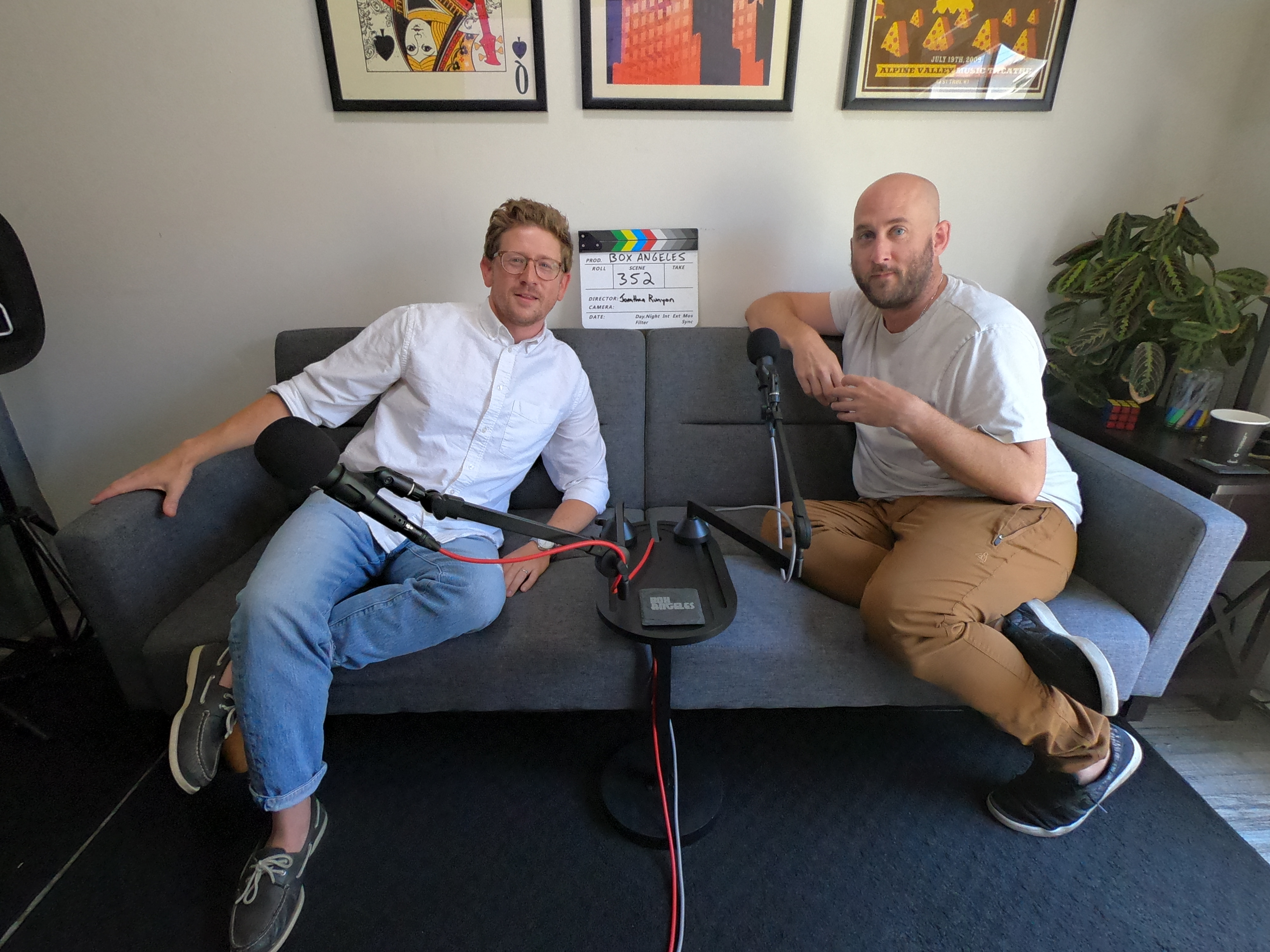
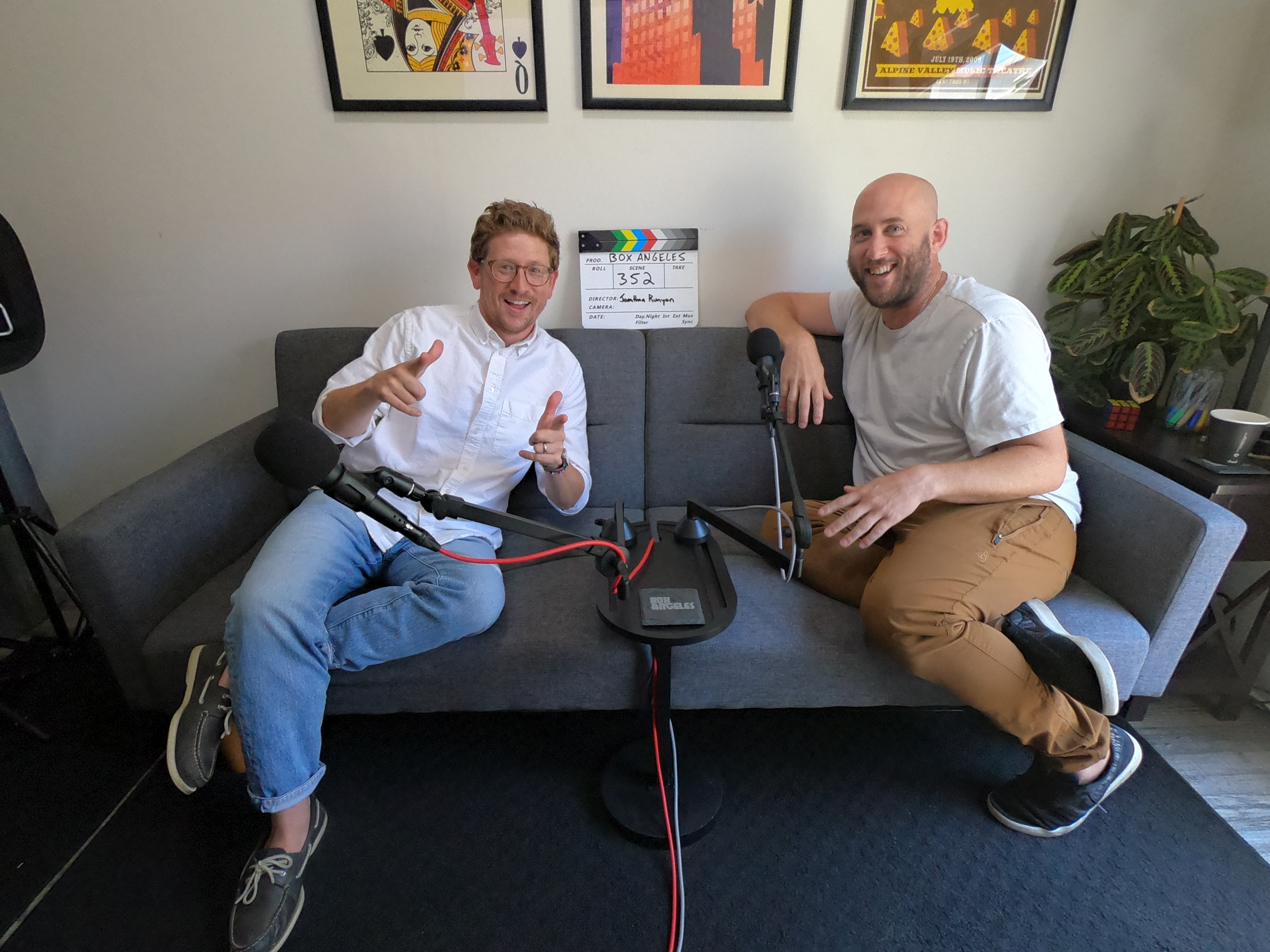
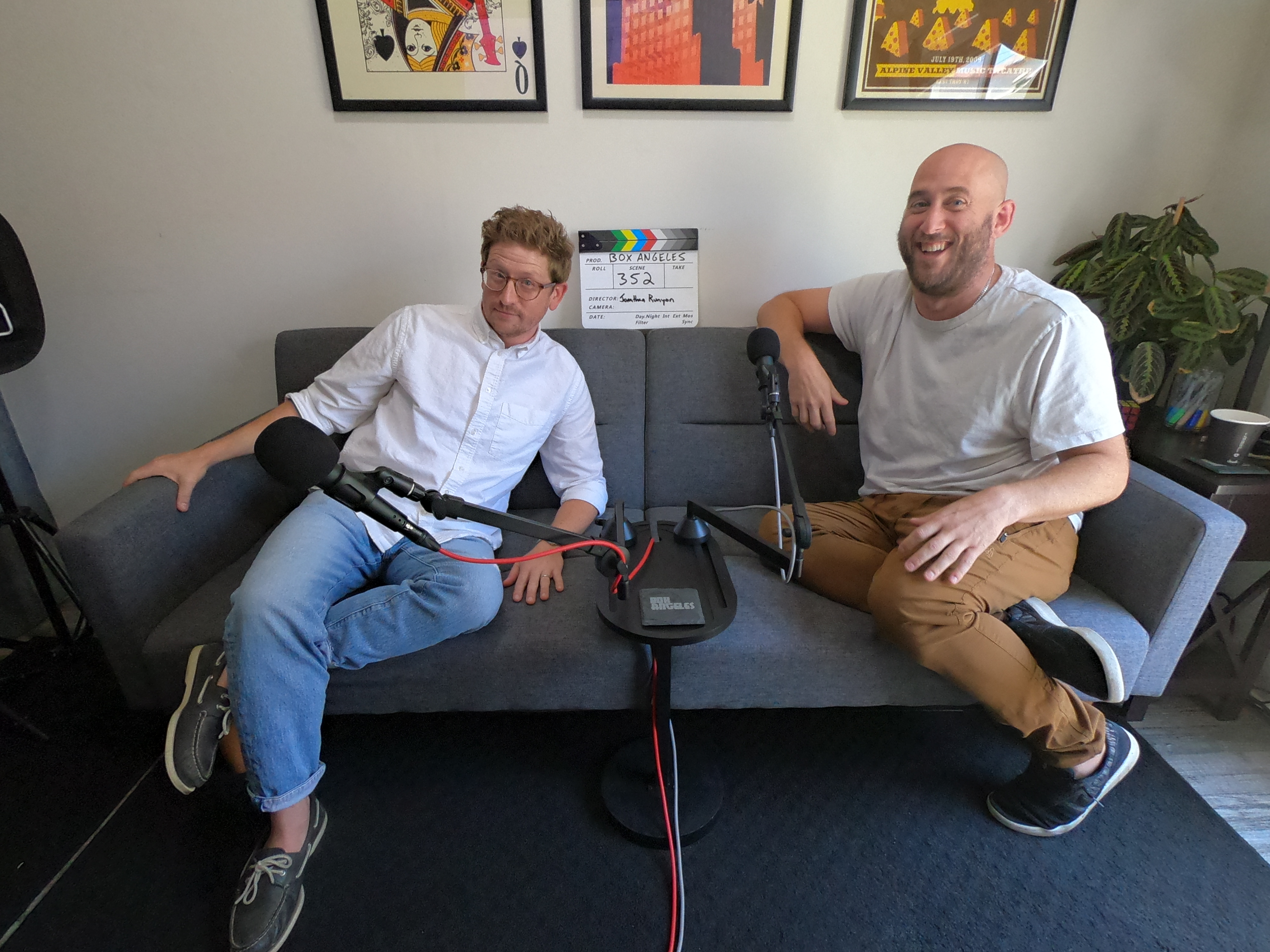
We’ve got another acting podcast today! Actor – and commercial session director – Jonathan Runyon (Modern Family, Mad Men) joins us on the Box Angeles podcast episode 352. Jonathan stops by the bungalow and discusses the economics of being a session director, auditon & callback advice, common things he notices actors doing (and not doing), what the true goal is for commercial actors, and more!
“You really don’t have to be working that hard on your auditions
to be working harder than
almost everybody else.”
— Jonathan Runyon
Beats
00:00 – Jonathan slates his name.
00:11 – Introduction.
02:29 – Acting and working at 200 South La Brea.
03:11 – Slower commercially right now, but not for non union.
05:18 – Session director perspective on self tapes.
09:08 – Being a waiter dating back to studying at the Stella Adler Conservatory in NYC.
12:00 – The economics and schedule of session directing.
17:20 – How do you make acting work with session directing.
20:08 – Working with different offices.
22:35 – Getting a callback or audition for a session you’re suppose to run.
26:36 – Giving personalized feedback / instructions in auditions.
31:47 – Actors that booking bringing themselves to the auditions.
33:59 – Naturally not being “grounded”.
35:28 – Choosing the order auditions are submitted to highlight certain ones.
39:48 – Ideal time to audition in the session.
41:34 – Any patterns in auditions?
43:45 – Real time filtering happening in callbacks.
46:24 – How actors should enter a callback.
50:01 – Knowing who the director is at callbacks and a Philip Seymour Hoffman story.
52:56 – Self sabotaging actors.
57:25 – Are callbacks more stressful.
58:43 – Casting directors livestream of the room.
1:00:53 – Are callbacks the new goal for actors.
1:03:50 – There is a board with the list of auditions at 200 South La Brea (!!)
1:04:59 – Who took a chance on Jonathan.
1:06:37 – Surprised by who books things.
More Jonathan
 – Check Jonathan’s IMDb.
 – Follow Jonathan on Instagram @jonathanrunyon.
Transcript
JONATHAN RUNYON (00:06)
Hi there, I’m Jonathan Runyon.
MIKE ELDER (00:11)
Hello and welcome to Box Angeles with me, I am your host, Mike Elder. Holding for applause. Holding, holding, and thank you. Let’s do some housekeeping really quick. You guys go to the YouTube channel, subscribe there, go to Apple Podcasts, leave a rating and a review. That’s it. That’s the housekeeping.
We’ve got a really fun episode this week. I was so excited about this episode. I could have talked to this guest for hours on end. It’s actor Jonathan Runyon. Jonathan’s been on shows like Modern Family, Mad Men, Once Upon a Time, the West Wing, NCIS. He’s done a ton of commercials too, which is awesome.
But the reason I wanted to talk to Jonathan is his day job. Jonathan works as a session director at 200 South La Brea, the casting space.
A casting facility. I believe it’s called 200 South. A casting facility.
He works for AHC Casting mainly. Who I’ve had all those people on Maya Adrabi, Lindsay Bronson, and Alyson Horn. He is one of the best, I think, at running commercial sessions. He always gives me personalized feedback. He’s always really good with direction. He’s always really patient with actors. And I wanted to get to know his side of it.
I asked him about callbacks. I asked him about actor issues or what actors do wrong or how they self sabotage. He had a lot of insights into the process of callbacks, of what to do when you’re in a room for a callback. Him sending out like the links to the auditions, how he approaches that. It’s. This was such a good conversation and I literally. It’s a long. It’s a longer one. It’s over an hour.
But it was worth it. We might even have to do a part two. We didn’t talk about his acting at all. And again, he’s an accomplished actor. He’s been here for many years and he studied acting. So this was a great conversation. I wanted to talk to John forever and we finally did it, so I’m glad we did.
So, ladies and gentlemen, without further ado, I give you Jonathan Runyon.
🎵 ROCKFORD (02:01) 🎵
You wanna talk to me? You wanna talk.
MIKE ELDER (02:07)
Hi, John.
JONATHAN RUNYON (02:08)
Hey, Mike.
MIKE ELDER (02:09)
Do you want. Does anyone call you John? Is it just me?
JONATHAN RUNYON (02:11)
A lot of people call me John. No, I don’t mind it. I mean, my mom probably doesn’t. I think my mom’s always like, his name’s Jonathan. There are actually people named John. You know.
MIKE ELDER (02:23)
I love that you’re the. You’re the session director at 200 South La Brea. I love that I just had you slate your name.
JONATHAN RUNYON (02:27)
Yeah, no. I’m a fan.
MIKE ELDER (02:28)
That felt great for me. Because you make me slate all the time.
JONATHAN RUNYON (02:31)
I do, I do, yeah. And I mean as an actor myself, I have to slate my name all the time. I’m just like everybody else. I’m, you know, trying to navigate through self tapes and make my in person appointments and stuff. It is a little bit easier because I work at 200 South. Like for instance, yesterday I ran a callback in Studio 9 and I had a callback in Studio 5 for myself. So those days are the best because like you’re still working and then you literally are just, you know, 25, 30ft from your.
MIKE ELDER (03:01)
How often does that happen? Does that happen more than we think? Probably.
JONATHAN RUNYON (03:05)
It happens a decent amount. Yeah. Because just because of the amount of time I’m at 200 South. Yeah, I mean, it’s been slow recently. So anybody watching this that auditions commercially that felt like April and May were slow or maybe even parts of this month, you know, last month, June, it’s definitely been slow. So if that gives anybody any reassurance.
MIKE ELDER (03:26)
That’S funny, I’m having the opposite problem. It’s not slow really. Well, I’m still SAG eligible and again, I hate saying that, but honestly, it’s up to SAG to make me want to join and they haven’t made me want to join. And the majority of my auditions, especially commercially, obviously are non union and I get so many of them every week. Why would I walk away from that?
JONATHAN RUNYON (03:44)
Yeah, I hear that from a lot of the, the students that take my class. You know, AHC and Ross Lacy have a joint venture called the Commercial Class where we teach classes and it’s always taught by, you know, session directors who are also actors. And there’s, you know, like four or five different types of things that we focus on. But I hear that from a lot of my students who are still non union, who have like one SAG credit or two, you know, until you’re a must join, you know, I guess, you know, you would take as many opportunities as you can because as far as.
MIKE ELDER (04:16)
I know, I’ve been a must join for a really long time and they just haven’t.
JONATHAN RUNYON (04:19)
No. Really? Well, it would take that next SAG booking, right?
MIKE ELDER (04:22)
Like I think I’ve booked a couple since then, but uh, oh, they haven’t come at me.
JONATHAN RUNYON (04:27)
Are you not recording this? Are you?
MIKE ELDER (04:30)
But I love seeing you here because you’re always your command of the room, like you’re very professional in the best way and you Just have a good command of your rooms that you direct.
JONATHAN RUNYON (04:41)
Well, thank you.
MIKE ELDER (04:41)
And so it’s fun to see you sitting here in your nice button up shirt. Outside of you. I want, I want you to, you know, lay back and I want to see the real Jonathan.
JONATHAN RUNYON (04:49)
Full disclosure, I asked my wife this morning, I was like, what should I wear on this podcast? Because I was like, it’s on YouTube and I, you know, it’s a big deal. This is actually my very first. I’ve never been a guest on a podcast before.
MIKE ELDER (05:00)
That’s not true. I just looked this up.
JONATHAN RUNYON (05:03)
You did? Oh, I did. Laura Linda Bradley.
Yes, yes, yes.
MIKE ELDER (05:06)
What’s My Frame.
JONATHAN RUNYON (05:07)
Yes. What’s My Frame. That was right during the pandemic. That was like when we were all in lockdown. The reason I’m forgetting that is because it wasn’t on camera, it wasn’t in person. It was, it was very much. It was.
MIKE ELDER (05:16)
Yeah, I hate doing zoom stuff. Wait, to that point. What is your take on self tapes, Mr. Session Director? Not only does it take your job away, but as an actor, I think most actors don’t like them. Would you have an opinion on self tapes as an actor slash session director?
JONATHAN RUNYON (05:33)
Yeah, I just, we just started offering, by the way, a self tape class because there’s just such a demand.
MIKE ELDER (05:40)
Oh, cool.
JONATHAN RUNYON (05:41)
You know, in the market for it. Just things that we see, you know, here’s what a casting office looks for when we’re reviewing your footage and, and just, you know, some of the nuance type stuff. My opinion as a session director is definitely, and I’m sure, I mean, I don’t want to speak for anybody, but I think other session directors feel this way as a percentage of the audition pie. It’s definitely eaten into our job. You know, I don’t think it’s going anywhere. I think a lot of offices, not so much. AHC, Ross, Lacey, some others, you know, they place a high priority on doing certain types of auditions in person, which is really great.
But yeah, definitely as a session director, you’re not working as much as you used to. It always ebbed and flowed, you know, but the ebbs are longer now it seems. So that’s, you know, that’s a bummer. As an actor, you know, I don’t mind self tapes. I go through all the same challenges everybody else does. You know, how am I gonna get this full body? Like how do I frame this?
I don’t have anyone to film me. No one’s here. Where should I cut, you know, all this kind of stuff? But I do think when an office sends out a self tape, they actually are able to send it out to a lot more actors than an in person thing. So in terms of as an actor getting an opportunity to get in front of an office, maybe you haven’t been in front of before or get yourself in. I think that’s kind of cool. I think people sometimes think that self tapes are faster.
Like oh, I don’t have to drive, I don’t have to park, I don’t whatever. But I think if you added up the time you’re setting up your tripod, setting up your lighting, framing yourself up, cutting, obsessing over your performance, overthinking everything, you know, I would argue that it’s that it probably takes as long, if not longer. And then the real thing is that you don’t have someone, you know, like me in the room who has gotten, you know, instruction from the casting director you’re working for, who’s gotten instruction from the ad agency and the director. I usually read the director’s treatments when I’m doing an in person session just because there’s fun little alts in there and there’s tone and there’s, you know, so you know, you don’t have someone like me guiding performance. And when I’ve reviewed self tapes for casting offices where, hey John, can you watch these and you know, either add them to the link that we’re going to submit or don’t, you know, you end up getting some wild stuff because it is kind of like people, you know, if it’s not in the instructions, you know, people, you know, submit some, some crazy stuff. Usually it’s the same type of misstep. Like if it.
Let’s, let’s say it was an interview question that gets. That’s fairly common, you know, someone will give an answer that’s like four minutes long and it’s like, well, nobody’s gonna watch that full four minute thing about why you’re a fan of the Chiefs, you know, or what your favorite holiday tradition is or whatever. So they’re sort of common mistakes. But yeah, I’m really of mixed feelings about the self tapes. I just, you know, as a session director, I’m just trying to do the best with the work that I get and continue to try to do right by all of you actors and set you up as best I can to do the best audition. As an actor myself, I know self tapes aren’t going anywhere so I have to kind of get on board with everybody else.
MIKE ELDER (09:08)
Yeah, yeah, let’s Talk about the career aspect of session director. Did you have many day jobs before you settled on session director?
JONATHAN RUNYON (09:16)
Yeah, I mean, not many types. I was a waiter.
MIKE ELDER (09:18)
Okay.
JONATHAN RUNYON (09:19)
That was. So I started waiting tables when I was in acting school in New York City.
MIKE ELDER (09:24)
Oh, you came through New York City?
JONATHAN RUNYON (09:26)
Yeah, yeah, I went to. I moved up to New York City right out of high school, actually. At 19, I got into the Stella Adler Conservatory.
MIKE ELDER (09:34)
Oh, good for you.
JONATHAN RUNYON (09:35)
Yeah.
MIKE ELDER (09:35)
Nyu. No, that’s its own little thing.
JONATHAN RUNYON (09:37)
So. Yeah. So, I mean, you all. You’re all in the same building, so a lot of. Most of my friends ended up being NYU students. I ended up meeting my wife, who was studying at Tisch at nyu. She was not at Cell Adler.
She was somewhere else. But so I was there. I started waiting tables in New York City. I was in Times Square and the Upper east side. Yeah. Then when I moved la, I first waited tables in Malibu.
Oh, Shout out to Paradise Cove.
MIKE ELDER (10:03)
Sounds like a course.
JONATHAN RUNYON (10:05)
Fun place to go, A tough place to work. Yeah. And then I got a job waiting tables at a restaurant in Beverly Hills.
MIKE ELDER (10:13)
Damn. You’re just hitting the big, expensive areas.
JONATHAN RUNYON (10:15)
Yeah. I don’t know. I don’t. Was not planned that way. But what ended up happening quite literally is the restaurant I was working at started to kind of go out of business. So I was sort of left without, you know, whatever. And I.
The way I transitioned into this was I was always, you know, when I would go to. I was auditioning for commercials at that time, and I would always go to commercial auditions and be like, who are these people that work in the lobby and get to wear their own clothes, like, you know, and not deal with food and. And whatever. And. And I always thought they were so cool and funny and whatever. And I finally asked. I think it was AHC because they were the ones.
They had cast me in, I think two commercials at that point. So they were the ones I knew the best. And I asked Maya, who I know.
MIKE ELDER (10:58)
You’Ve had Maya Adrabi.
JONATHAN RUNYON (10:59)
Yep, Maya Adrabi. And I asked Maya. I was like, how do I do this job? Because I don’t want to wait tables anymore and my restaurant’s going out. And she was like, well, you just have to shadow a session director. And so I ended up shadowing a guy named Mark Jawade, who’s now a commercial director. And he was awesome.
And I literally shadowed him for, I think, the better part of three months.
MIKE ELDER (11:20)
Oh, wow.
JONATHAN RUNYON (11:21)
I mean, it was. I had a long sort of apprenticeship, and then they.
MIKE ELDER (11:25)
Stella Adler to the.
JONATHAN RUNYON (11:26)
That’s Right.
MIKE ELDER (11:27)
Mark. Whatever his name, shout out.
JONATHAN RUNYON (11:30)
He was a great teacher. And they didn’t really. At that time, Alison had a bunch of good session directors.
So there was no room for me. There was no real jobs for me. So I did anything I could. I worked in the lobby, I worked in the office. And then the, you know, the. Some of the session directors that she had hired went to other places. They went out and slowly they were like, okay, why don’t you run this one?
This one’s easy. Why don’t you run this one? This one’s easy.
MIKE ELDER (11:54)
Oh, cool.
JONATHAN RUNYON (11:54)
And from there it just kind of, you know, and I’m. And ever since then, 11 years. 11 years later.
MIKE ELDER (11:58)
Yeah. That’s been your day job?
JONATHAN RUNYON (11:59)
That has been my day job.
MIKE ELDER (12:00)
So do you get paid per session or do you have a retainer or you set. How does that work?
JONATHAN RUNYON (12:06)
You get paid per session. Okay, so.
MIKE ELDER (12:08)
And do you have a standard rate or is it like hourly?
JONATHAN RUNYON (12:10)
You do have a standard rate. You have an established rate. It’s kind like everyone’s kind of different. And again, I don’t want to speak for any other session directors, whatever, but when you start out, it’s obviously not the highest, you know, and then when you’ve been doing it a number of years and you’re someone, you know, if you’re some offices, like number one call, you’re their number one person, then you’re probably making around what sort of the industry cap, you know, top.
And that raises a little bit. Not a ton over time, but it does raise. So when I first started out, you know, I was like, oh, my gosh, this is great, you know, because it was more than I would be making at a day of waiting tables. And.
MIKE ELDER (12:50)
Yeah.
JONATHAN RUNYON (12:50)
You know, and then when it started getting consistent, it was really good. But no, most session directors are, I believe, like, we’re kind of independent contractors. You’re invoicing every.
MIKE ELDER (12:59)
Right.
JONATHAN RUNYON (12:59)
You know, every job, but it’s per.
MIKE ELDER (13:01)
Session, so you get through faster. It behooves you to get through faster, theoretically, because you’re.
JONATHAN RUNYON (13:08)
Oh, you mean get through the session faster?
MIKE ELDER (13:09)
Yeah.
JONATHAN RUNYON (13:10)
Yes. Yeah.
MIKE ELDER (13:12)
The performance. But I’m just saying, like, there’s. There’s not an overtime.
JONATHAN RUNYON (13:15)
Yeah. I mean, look.
And you can only get through it so fast. It’s scheduled where it’s right.
MIKE ELDER (13:18)
But like.
JONATHAN RUNYON (13:19)
Yeah, like, I did something today before I came here. I started seeing people at 9:30 in the morning. The last scheduled time was 11:45. I was done.
Link was ready at 12:15. That’s pretty much, 30 minutes past when the last person is scheduled. That’s sort of on time.
MIKE ELDER (13:37)
Yeah, but like, if you were going really slow, you’re not getting overtime. Right? There’s no. Right.
JONATHAN RUNYON (13:43)
No, no, no, no. Okay. So you get the same thing for running a first call or a callback.
MIKE ELDER (13:49)
Oh, interesting.
JONATHAN RUNYON (13:50)
The only thing that’s additional added onto that is when we run callbacks after the ad agency and the director have made their selects, we have to edit and build the. The selects link so that they can present it to whatever client they’re doing the spot for. So when you do editing, you get to. You invoice more for editing. Yeah.
MIKE ELDER (14:09)
Got it. So in a year, can you. Pretty much. And at this point, I’m sure more so than 11 years ago. But can you pretty much gauge where you’re gonna be at by the end of the year? Like, are you turning down work because you’re working too much or are you taking everything you can get type of thing?
JONATHAN RUNYON (14:25)
So to answer your first question, yes, within the margin of error, I kind of know. Because the years have been fairly consistent.
MIKE ELDER (14:33)
Right. That’s the thing about commercials. Commercials are never going to go anywhere. They’re not commercials till the end of the time.
JONATHAN RUNYON (14:38)
Yeah, advertising is never going to go anywhere.
MIKE ELDER (14:40)
Sorry.
JONATHAN RUNYON (14:40)
What form it takes where. You know, what the.
MIKE ELDER (14:42)
Spoken like somebody that was on Mad Men.
JONATHAN RUNYON (14:44)
Yeah. Oh, yeah. God, yeah. And. But yeah, it’s fairly consistent now. There was a time where it’s not as busy as it used to be for session directors, I think.
MIKE ELDER (14:57)
Right. Because of self tapes, yeah.
JONATHAN RUNYON (14:57)
Because it’s pretty much everybody because of self tapes. So there used to be times where I could have easily worked five sessions a week for four weeks in a row, however many weeks in a row, and then occasionally be like, oh, there isn’t anything on Thursday next week. That’s crazy. That’s kind of cool. And there were times when we were at our busiest where I would look ahead and go, you know, I’m going to probably just black out Friday just to. Because it is a grinding. It can be a grinding job.
You’re on your feet, you’re. It’s a lot of repetition. You’re seeing, you know, hundreds of people, different scripts all the time. You know, it can, you know, you’re directing, you’re trying to be as creative as you can with every person or every group that comes in.
So it can be grinding. But I used to maybe occasionally be like, you know what? I’m going to blackout next Friday for myself just to kind of whatever the last. I’d say two years I don’t think I’ve turned anything down.
That’s the way. No, because the breaks now are like built into the business. Like the lulls, like I was saying that, you know, the ebbs and flows are built in. So I’m like, if I’m slammed, you know, last week I ran four sessions. That was great. You know, this week I’ve done two and a half so far. I don’t know what’s coming for the rest of the week.
MIKE ELDER (16:10)
Well, that’s what I was just going to say. You also don’t know your schedule?
JONATHAN RUNYON (16:13)
No.
MIKE ELDER (16:13)
Like further than maybe two days out or maybe a week at most.
JONATHAN RUNYON (16:17)
Yeah, no, when we get really cooking and busy, you know, I’ll get a text from Lindsay, you know, Lindsay Bronson, and if she knows we’re going to, we’ve got a lot of jobs coming in. She’ll say, she’ll text me booking you every day next week.
Are you good? Any. Do you. You know, sometimes I have kids, so sometimes I.
MIKE ELDER (16:34)
Sometimes you have kids?
JONATHAN RUNYON (16:35)
No, I have, I do have kids, which means sometimes. Yeah, I guess it’s fair to say sometimes. But you know, I have hard outs sometimes I got to pick them up from school or camp or whatever the case may be. But no, if we’re really busy, then you get booked further in advance. But if it’s kind of like trickling in little by little, you know, one job, two jobs, whatever. Yeah. Sometimes you don’t know until a day in advance.
Two days in advance.
MIKE ELDER (17:02)
So this year, seven months in, like, what’s your average days you work in a week?
JONATHAN RUNYON (17:07)
Good question. I’ve also thought about this average. I’d say three.
MIKE ELDER (17:14)
Okay. That’s enough to be quote, unquote livable.
JONATHAN RUNYON (17:17)
Yes.
MIKE ELDER (17:18)
Yeah. That’s great.
JONATHAN RUNYON (17:18)
I mean when you mix it in. But that by itself, I don’t think you, you would be. I mean, my wife works for, you know, dual income house.
MIKE ELDER (17:29)
But that’s why I said quote unquote.
JONATHAN RUNYON (17:30)
Yeah, yeah, I think that by itself. But when you put that in the pie with, you know, you have a commercial running you, you did a little spot on a TV show, you, you know.
MIKE ELDER (17:40)
Yeah. So how. So my question then follow up to what you just said actually is how do you make this work with acting? Because I do feel like I just, I had the same day job for 10 years. It was like literally work from my desk here. I would just duck out, go to self tapes and stuff. When you’re running a session, you can’t necessarily go to an audition necessarily. So like.
JONATHAN RUNYON (18:01)
Right.
MIKE ELDER (18:01)
Has it been hard. Has just AHC just been so flexible or have you missed work because of your day job?
JONATHAN RUNYON (18:09)
I have on occasion missed auditions, but I’d say over 11 years, I can count on one hand the number of times that that’s happened. I will tell you pre Covid, it used to be a lot more stressful and a lot harder because there were no self tapes. Everything was in person.
MIKE ELDER (18:31)
Yeah.
JONATHAN RUNYON (18:32)
And so, yeah, you’re exactly right. I would be hired by AHC or whoever. You know, I occasionally work for other casting directors, but. And then it’s all about, you know, you would have to get covers. So, you know, not unlike waiting tables, bartending. Someone would need to come in and cover your shift for an hour or two hours. And number one, the office you’re working with has to be okay with that.
Number two, you have to pay that person. Maybe you try to get a time frame from the office you have your appointment from. You know, and this was when, you know, a lot of the people who’ve been doing this a while will remember this. This is when there were so many offices in Santa Monica. So Allison’s office used to be right on La Brea and like Santa Monica, it’s Sycamore right there before we moved down to 270. But I mean, the amount of times you’d have to race out to Ocean park or go to Dan Bell, you know, on the. In Glendale.
So it used to be a lot more stressful. I think with the ad, with the advent of self tapes, it’s gotten a little bit easier. And also, I will say the, the professionalism. What do I want to call it? The sort of the camaraderie of people who run session who are also actors. We try to be really good with each other. Like, you know, instead of calling your agent and telling them you’re going to be.
You need a time frame. Whatever, you know, why don’t I know that I find out that, you know, my buddy Dave Wilder is running that session. Why don’t I just text Dave and say, dave, I’m coming in for the dad, can I come in at 2:15? You know, hey, can I. Can I make it by 5pm you know, and we work it out. That’s cool. And that’s, that’s a very cool bonus of the job.
MIKE ELDER (20:09)
That’s very cool.
JONATHAN RUNYON (20:10)
For sure.
MIKE ELDER (20:10)
Because there’s a lot of. You are really great and I’m sure you guys have a tight group. Do you technically have like, is there a guild or anything for session directors?
JONATHAN RUNYON (20:17)
There’s not. Is There a club? There’s not a club. There’s a Facebook group. Yeah, there’s a Facebook group.
MIKE ELDER (20:26)
There’s not a WhatsApp conversation.
JONATHAN RUNYON (20:28)
If there is.
MIKE ELDER (20:28)
You’re not in it.
JONATHAN RUNYON (20:29)
I’m not in it.
MIKE ELDER (20:31)
You mentioned you mostly work for AHC.
JONATHAN RUNYON (20:33)
Yes.
MIKE ELDER (20:34)
So is that by choice or are they paying you more to only work with them or make them your number one or.
JONATHAN RUNYON (20:41)
They kind of. I don’t know. I think every office might do it differently, but no, it is by choice. Okay. You are. And people who work for a lot more offices than I do. I’m a very undiversified session director in the sense that, like, there’s a lot of us that do this job that work for four or five different offices.
I work for primarily one, and then there are like maybe two or three that when we’re slow, I occasionally get to work for. And I love that. I like the change of scenery. I like, you know, different offices. You know, it’s great. But no, I mean, I think when an officer has confidence in you and you’re their first call if a session comes up. I think it used to be called, like, what was it?
Oh, I’m blanking on what they used to call it. But it was basically like, you. You as a session director, kind of promised to check in with that main office before you accepted any other work. I can’t believe I’m blanking on what it was called. But anyway.
MIKE ELDER (21:38)
Exclusive or something. Exclusivity?
JONATHAN RUNYON (21:40)
Yeah, exactly. Like you. You have to check in.
MIKE ELDER (21:44)
So conflicts.
JONATHAN RUNYON (21:45)
So it’s, It’s. It’s a great thing to be in offices.
Number one, call it. There’s a lot of confidence there because, you know, you’re on the front lines of what they’re turning into. Their. The people who hire them.
MIKE ELDER (21:56)
Yeah. But the reason I ask is, like, if you’re only working three days a week, you don’t want to work those that fourth and fifth day more consistently.
JONATHAN RUNYON (22:03)
No, I would. No, I definitely would. But again, life kids.
MIKE ELDER (22:08)
Podcasts.
JONATHAN RUNYON (22:10)
Different, podcasts. So many podcasts. I do.
But no, I mean, you know, there are just times where, you know, you can’t do it or, you know, if you do have an audition that comes up, let’s say, and you get a couple days notice and it’s immovable and it’s something you really want to go in on. And they. That I get a text that says, hey, John, can you need you to run a session on Friday? You know, you’d have to turn that down.
MIKE ELDER (22:30)
Yeah.
JONATHAN RUNYON (22:31)
Or this happens sometimes. I will get called back for something that I was for a callback I was supposed to run. Now, on occasion, I’ve both run the callback and then done that weird thing of being like, my turn. You know what I mean? And we stopped doing that. I think we all kind of agreed.
Me, Maya, Ali, Lindsey. It’s not fun for the directors in the ad agency. It’s not fun for you. It’s awkward, kind of for everybody. Occasionally it’s no big deal because everyone’s so friendly or whatever, but I try to avoid that. So there are often times where I was scheduled to run a callback. Oh, but you got called back.
And I will, you know, sacrifice the session fee for a chance to just be an actor that day, come in, do my thing, and. And try to book that commercial.
MIKE ELDER (23:19)
Yeah.
JONATHAN RUNYON (23:19)
You know, and I also want to say. And I don’t know, maybe this was gonna be one of your questions. Cause sometimes I’ll run a session for something, right? And I’ll see you. You’ll come in, and, you know, whatever. And then I will also, Ali or Maya or whoever will also ask me to audition for it. Ross, Lacey, somebody like that.
So I’ll turn in a first call, you know, of myself, and then I get called back, and I have to go to the callback. So I think maybe sometimes there’s maybe a perception that, like, I come in and, like, you know, put myself in there and snake in there and kind of try to get the job. It’s not true. I mean, I still. I have to do a first call every time. I have to do a callback every time. And even if, for instance, it was directors you had worked with before or people you had run callbacks before, a long time.
Even if you were the director’s first choice and the agency’s first choice, you know, when they present to the client, client makes the ultimate decision. So you being tight with them has no bearing on you necessarily booking it, yeah.
MIKE ELDER (24:16)
Right. For sure. You just reminded me of something Ross said on this podcast many years ago. And I don’t know if he still feels this way, but I asked him about, like, audition crashers, and he said, no, no, no, no, Never. I hate that people pisses me off. But he did say, if you happen to be at 200 South for an audition and you see an audition that looks like your type, ask, and we can pop you in. Do you do that ever? Like, if you’re sitting there running a session and then you see all your type walking into a dining room.
Yeah, because that would be A benefit, I would think, to being at 200 South.
JONATHAN RUNYON (24:47)
Sure. I do it occasionally. That happens. I mean, listen, being at 200 South, working at a place like that or any other casting facility that has multiple offices, you know.
Yeah, you just. There have been times I’ve seen people waiting and I’ve been like, I’m kind of in that category, you know? And I’ll usually just ask whoever’s running that session, hey, would you mind asking Ross if I could go in on this? I do that occasionally. Yeah. As a session director. I agree with Ross, though, in terms of crashing, I think always ask me, like, come up and, hey, man, I feel like I’m kind of right for this.
Could I go in for whatever, Pizza Hut or whatever? And then I’m. And I’ll be like, you know what?
Let me check. And I’ll just message the ladies in the office and say, hey, so. And so asked if they could go in, and the answer is yes or no or whatever. But at least you asked.
You took your shot.
MIKE ELDER (25:41)
Yeah. I’m not saying I would do it.
JONATHAN RUNYON (25:42)
No, no, no.
MIKE ELDER (25:43)
This came up because he said he hates when people do it.
JONATHAN RUNYON (25:46)
But what I don’t like is don’t sign in.
MIKE ELDER (25:49)
Oh, yeah.
JONATHAN RUNYON (25:50)
And then kind of. Kind of like, be vague about like, what time were you scheduled, Mike?
I don’t, I don’t. I don’t see you on here, buddy. I’m looking. And that happens a lot. I get a paper schedule in the morning, but that doesn’t affect real time changes for, you know, six, seven hour period. I’m like, oh, I don’t. Dude, I.
And I’ll go into the system and refresh and I don’t see you in here. And then, you know, occasionally people are like, yeah, but can I, like, still. And I’m like, dude, I. I took a couple of good minutes.
MIKE ELDER (26:19)
Yeah.
JONATHAN RUNYON (26:20)
To like, search for you in the system. Like, if you were just like, hey, man, any way I could get in on this answer is going to be yes or no. But I’m not going to be like, oh, that’s weird that you asked.
MIKE ELDER (26:28)
Yeah.
JONATHAN RUNYON (26:29)
You know, I. I get it. I like the hustle.
I respect it. But the honesty needs to be.
Yeah, yeah, that’s. That’s.
MIKE ELDER (26:35)
Yeah, I can appreciate that. Okay, let’s talk about your session specifically. You kind of touched on this earlier. I think you do a really good job with this, and I think you’re one of the best at this, if not the best. You’re welcome.
JONATHAN RUNYON (26:44)
Thank you.
MIKE ELDER (26:45)
You can pay me later.
JONATHAN RUNYON (26:46)
Yeah. I don’t know what you’re gonna say at the end.
Best at what? I don’t.
MIKE ELDER (26:51)
Yeah, I’m like being a snake in the.
JONATHAN RUNYON (26:54)
Yeah, yeah, yeah. Making faces behind the camera while we’re doing our best.
MIKE ELDER (26:57)
No, I think you, you see the same thing every day. It’s very repetitive, as you said. But you, I feel like. And maybe it’s just me you’re doing this for, but I think you give personal feedback in the sense that you’re like, Mike, I think it would be funny if you did this. And I get the sense you don’t tell me the same thing. The guy that went in before me.
JONATHAN RUNYON (27:16)
No, right.
MIKE ELDER (27:17)
Do you do that for everybody? And how did you pick up on that? Like, I think it’s just such a smart way to approach it.
JONATHAN RUNYON (27:23)
Well, thank you. I really appreciate that. I just say that. I mean, I think it helps.
And I’m an actor myself.
MIKE ELDER (27:30)
Yeah.
JONATHAN RUNYON (27:30)
And, you know, I, I tell my students this all the time. I didn’t realize until I started doing both acting and session directing that the job in the commercial world, and I guess you could argue the theatrical world too, but the job is to be good at auditioning. That’s the job. I mean, nobody has to take a class on how to shoot a commercial. By the time you book that thing, you’ve got a million people to tell you what to wear, where to stand. Oh, the script changed. Oh, here’s your blocking.
You know, just get a good night’s sleep and go with the flow. Do it. Do what you did at your callback, you know, do it. Helped you book the job. And I really like the community of actors in LA that I get to interact with on usually a daily basis.
I really do. And to your point about individual feedback and direction, I try to. It’s true. Now we’re always under the gun time wise. You know, I’ve got three minutes with you, four minutes with you. I’m gonna start really getting behind. But I think maybe sometimes people think that I am just a button, improv alt, you know, factory, that I’m like, hey, try this, try this.
And it isn’t true. What it is, is I’ll watch you do a take. And I know you as an actor and I know a lot of the people that come in, but even if I don’t, I’ll watch you do a take and get a sense of kind of your cadence, your personality, your, you know, the way that you’re doing the role, the perspective that you have, and that will give me the that’s where the idea comes from. Oh, it’d be kind of funny if maybe you just said something like this. Or it’d be funny if you look back over there because you weren’t sure that you had really just seen what you said. Something. Yeah, a verbal button, a non verbal button, whatever.
So it is personalized in the sense. Because no actor is the same. That’s why, you know, when actors get concerned about. You’re not giving that to anybody else, are you? You know, has anybody else said it? It’s like. Well, no, because, you know, it’s not like the same improv or the same line delivery or the same take on something.
Absolutely changes from person to person. It’s not a one size fits all. The button that works for you isn’t the same button. That’s going to work for me for the best take. So the individualization of my direction comes from you guys, from the actors. You know, I’ll be like, oh, it’d be cool.
Be kind of fun if he did this. You know, it’s all based on you guys.
MIKE ELDER (29:54)
Yeah, I love that. That’s really cool. Yeah, I feel like I’ve seen that more like Henry over at 4201 Wilshire is. Is really good at that too. But I think you’re phenomenal at that. Can you point though, like, if I’m getting a demonstration from one of you guys and they. And you say like a throwaway line, like, I’ll pick up the tab.
JONATHAN RUNYON (30:11)
Yeah.
MIKE ELDER (30:12)
I always in my mind say, okay, I’m not going to say it exactly like that. I’m going to change it slightly. Should I be doing that or should I be doing it? Because I feel like, yeah, I don’t think they want to see the. The exact same line.
JONATHAN RUNYON (30:25)
No.
MIKE ELDER (30:26)
Even if it does deliver differently.
JONATHAN RUNYON (30:28)
Yeah. So I think usually. And again, I cannot speak for any other session director, but if I’m using a line in an explanation or a demonstration, like you said, it’s probably gonna be. I’m probably consciously gonna be doing something that I haven’t heard everybody do a million times.
MIKE ELDER (30:49)
Okay.
JONATHAN RUNYON (30:50)
However, to your point, it’s smart to maybe before you do your first take, go, hey, John, is everyone saying something like that at the end? And then, you know, I’ll let you know. Yeah, I’ve heard that one a couple times, you know, maybe try something else here.
MIKE ELDER (31:03)
Yeah.
JONATHAN RUNYON (31:04)
So it’s not wrong to think if we’re using it in our explanations, which usually don’t change over the day, they might. If they, you know, if Our bosses come in and say, hey, you know, this is getting a little skewed this way or this way. We need to kind of bring it back in. Or. We just got an email from the agency. They’re really wanting a big reaction here. And so maybe the explanation changes slightly, but, no, I don’t.
It doesn’t help us at all to make the link better, which is what our job is to turn in a really quality link. At the end of the day, if everyone’s doing the same improvs, everyone’s putting the same buttons on things or having the same perspective on things. Yeah, Variety, you know, and diversity is what we want.
MIKE ELDER (31:48)
What do you think, like, people that book have in common? Like, what are they doing? Courtney. Richards?
JONATHAN RUNYON (31:57)
Richards. Yep.
MIKE ELDER (31:59)
He books all the time. What’s he doing?
JONATHAN RUNYON (32:00)
Books all the time.
MIKE ELDER (32:00)
You know what I mean? What are these people that regularly.
JONATHAN RUNYON (32:02)
They’re killers.
MIKE ELDER (32:03)
One guy in that Progressive ad with the mustache that keeps booking stuff like, what are these guys doing?
JONATHAN RUNYON (32:05)
Mike Nelson.
MIKE ELDER (32:06)
Probably. Yeah, what are these guys doing?
JONATHAN RUNYON (32:11)
They know what they do. That’s what they’re doing. They know who they are. They know, you know, not to get to acting school terminology, ish. But they know their instrument. You know, I tell this to students all the time. I’m like, you know, when you’re auditioning for a commercial, a good way to make sure you’re always grounded, which is one of the, you know, most common notes we give.
Keep it grounded. Keep it grounded is, you know, no matter what the commercial is, what the spot is, where you are, whatever, you’re a version of you, you’re a version of you. We all have different versions of ourselves. You know, the version of ourselves when we’re with our friends hanging out, you know, version of ourself at work, a little more buttoned up, a little more eager. Some of us are drier, more sarcastic, some of us are peppy or whatever. You know, you are kind of the secret sauce. And the people that book all the time, like, you’re talking about, they know they get a piece of material, they kind of digest, get a certain amount of ownership over it, and then they do their thing.
You know, you want your auditions to stand out and all that kind of stuff. Just, you want. You want to be more you than everybody else, you know, because there’s a lot of people, you know, putting on an act or doing a performance or a lot of people have what I jokingly kind of say is like a commercial auditioning avatar. And sometimes I’m like, you know, the People talking to each other in the lobby. Those are the people I want to come in and audition for the commercial. You know, I don’t want a big change. When you pass through that doorway and, you know, either dial it up or, or do anything, you know, too extraneous, whatever, those people, they really understand what their take is, what their sense of humor is, how their, you know, how their brain works.
MIKE ELDER (33:55)
Yeah.
JONATHAN RUNYON (33:56)
That’s what they’re doing.
MIKE ELDER (33:57)
So stand out by being you. What happens if you say, you give the note? Grounded. Be grounded a lot. What if you’re just not. Not naturally grounded like me?
JONATHAN RUNYON (34:06)
Yeah.
MIKE ELDER (34:07)
I’m very animated. I got these big movements. I was a mascot in my past life. You know what I mean?
JONATHAN RUNYON (34:13)
I do hear that often when people are like, yeah, but I am this animated.
MIKE ELDER (34:18)
This is who I am. I talk loud.
I don’t modulate. I’m always at the same level.
JONATHAN RUNYON (34:24)
Well, it helps here.
MIKE ELDER (34:26)
I know, it helps in a lot of cases.
JONATHAN RUNYON (34:28)
Podcast Mike. Yeah. Then if, if, if that’s truly really who you are and you’re. You’re a little bit more gregarious and all this kind of stuff, then when we watch the take, it will be grounded. I’ll believe it because I just. You’re being you. You’re being, you know, a version of you.
And so it might seem big or whatever, or I might even give like a, A real result oriented direction. Like, that was great.
Just, just less volume. Just a little bit lower on the, on the voice and that, that could be the trick right there. But I certainly, I’m never trying to kind of cut someone off at the knees, you know, or, or neuter anyone’s personality or whatever. Certain aspects of our personality work for certain auditions. It depends on what the script is, what the, you know, what the job is. But, but yeah, you’re, you’re. The way you perceive it, you being large and, you know, big personality.
It will work. Yeah, it will work for auditions. Yeah.
MIKE ELDER (35:28)
Yeah. How much. At one time or another, somebody told me, and I don’t remember who, somebody told me the way that you guys, you keep referencing a link, and the link at the end, I assume, is all of the auditions. You send them a link to that folder with all the audience.
JONATHAN RUNYON (35:41)
That’s exactly right. Yeah.
MIKE ELDER (35:42)
At one point, maybe it’s Colin Sweeney, who you might know, used to run sessions. Yeah, maybe it’s him. Somebody told me that you session directors choose what order those auditions go to the person in. So, like, you can move me up to the first spot or you can move me up the last. Do you still do that? And is that a technique to put people you think had a really good read higher, more in the forefront?
JONATHAN RUNYON (36:04)
So the first answer is, yes, that’s true. We have that ability. It really depends on what casting director you’re working for. Some casting directors want to rearrange and reorder and be very specific in that way. Others are kind of more hands off. You know, they’re just, you know, here’s what it is. So it does depend on who you’re working for.
But no, we certainly have the ability to, you know, if you came in 25th of the day and you were. You did what I thought was one of the best auditions of the day. If I’m working for AHC.
Yeah, you’re going up.
MIKE ELDER (36:42)
Yeah.
JONATHAN RUNYON (36:42)
I mean, you’re gonna go to number two, three, you know, four.
MIKE ELDER (36:46)
Not one. I noticed.
JONATHAN RUNYON (36:48)
And there’s different. Yeah, no, Right. Well, no, because there’s a strategy there. You might not want to be first because it’s like, you know, they’re.
Think about it. The director, the Addie, wherever. They’re watching it at home on a laptop. They’re just sitting down to start watching it. They might not even know how we’re running it. You know.
MIKE ELDER (37:03)
Wait, that link goes directly to the director? It doesn’t go. I. Sorry, I thought I went to the casting director. They filtered and then the callbacks will go to the director. But you’re saying the first call goes to the director.
JONATHAN RUNYON (37:13)
Oh, I’m so glad we’re touching on this. This is great.
MIKE ELDER (37:15)
Yes, please.
JONATHAN RUNYON (37:16)
Okay, so once you’ve gotten a first call audition from a casting office. From a commercial casting office. Yeah, that office has basically done all they can do for you.
MIKE ELDER (37:27)
Oh, wow.
JONATHAN RUNYON (37:28)
That. So there you go.
Okay, you might want to move this up in the podcast. The. Really? I mean, with. With. With. I think with very rare exception.
With very rare exception. I think the. The entities that are calling you back are the director and the ad agency.
So you’re right that the casting office filters. Okay. If we felt like, you know, and again, we want quality throughout the link. So let’s. Let’s just say for the example, it was the same scene all day.
I didn’t change scenes. So it’s the same scene all day.
You know, you don’t want to front load your link with, you know, you don’t want the first 10 people to be awesome and then have, you know, 20 more that, you know, what varying degrees of okay. Or. Or whatever.
MIKE ELDER (38:11)
But why wouldn’t you want that? Because, let’s be honest, are they going to watch all of them?
JONATHAN RUNYON (38:16)
I mean, I don’t know. I’ve never been with a director, ad agency. I’ve never physically been in their presence when they’ve watched.
MIKE ELDER (38:21)
Right. So to me, I.
I don’t know. Yeah, I see both sides. Okay, sorry.
JONATHAN RUNYON (38:25)
But. But yeah, I mean, and again, it’s all about what your boss says. You know, your boss wants you to front load that link with all the best people, then great. If they want you to spread it out, then great. You kind of do what you know. You also have the ability, you know, if someone come in, came in, and really just didn’t get it, for whatever reason, you. You hide them.
You don’t have them on the link, so. Because. And again, that sounds mean. Again, as an actor, you’ll never know if that happens.
MIKE ELDER (38:50)
Right.
JONATHAN RUNYON (38:50)
So that’s kind of nice.
MIKE ELDER (38:52)
Well, I know I can think of one time when it happened to me.
JONATHAN RUNYON (38:55)
But for the most part, you’ll never know when it happens. And also, it’s just like if you think about it from the casting director’s point of view, it’s like if. If presenting you as a viable choice makes your taste not look great to the people who hired you to do it.
MIKE ELDER (39:09)
Right. Right. Yeah.
JONATHAN RUNYON (39:09)
Why would you, you know, why would you do that? You don’t want to waste, you know, two minutes of their time watching something. So we do move you around. We can do that. But no, but the filtering happens that day, and usually the link gets sent in an email to the ad agency and to the. To the director of the commercial, and they’re the ones that decide who gets to be called back.
MIKE ELDER (39:33)
That’s wild.
JONATHAN RUNYON (39:33)
Yeah.
MIKE ELDER (39:34)
So you guys do sort of adjust that order definitely, to some degree, based on what your boss would like usually.
JONATHAN RUNYON (39:40)
Yep, not always. And it’s different for everybody. And it might even depend on what that specific director or ad agency likes. So it’s kind of always different.
MIKE ELDER (39:48)
Do you find that people. And this might be a you thing or the actors, but like, if. If I’m the first in a group, is that better? Or do you think it’s better to go at the end? Or do you have an opinion or is it just sort of a crapshoot?
JONATHAN RUNYON (40:01)
It. Yeah, it’s a crapshoot. I think there. I know that there’s a lot of actors that don’t like going first. They don’t like going first in callbacks because they think, you know, everyone’s barely on the couch, you know, every Someone’s on a laptop, someone’s on a phone. You know, it’s every color, or maybe it’s just a voice coming over zoom. You know, that happens a lot now.
You know, your directors in some other location or the ad agency’s watching remotely or whatever. But no, I’ve been doing this a lot. That statistically going first, there’s no advantage or disadvantage. I’ve seen the first person book it. I’ve seen them not get it. And if it’s a first call, normally if you’re going first, you’re going to get a lot more takes. Because me and whoever I’m working for, whoever the casting director is, Ross, Lacey, Allison, whoever, we are kind of figuring out how we’re gonna run it for that day.
MIKE ELDER (40:49)
Yeah.
JONATHAN RUNYON (40:50)
So it feels a lot more maybe like, you know, and sometimes we have a very clear idea of how we’re gonna work it because the director and ad agency were very clear with us what they want. Sometimes we’re figuring it out. So most time it’s kind of seeing what works and what doesn’t. So you get a lot more takes. First group. Yeah, I would just say if. If you get a 10am first call audition, which is usually the first time of the day, sometimes it’s 9:30, but most of the time it’s 10.
If there’s a script and there’s dialogue and you’re first, just be slightly more prepared than maybe you were or used to being. Just because we need you to know what you’re doing so that we can block it and all that kind of stuff.
MIKE ELDER (41:34)
Yeah, I like the idea of, like, trying to solve this equation. And I realize it’s really stupid and futile ultimately, but, like, when you’re running a callback, these are dumb questions. I apologize, but I’m curious. I sit outside the room and I’m like, this one’s going really long. I bet they’re going good. And then I go in there and I go really short. And I’m like, oh, that’s bad.
I went really short. Is there any rhyme or reason to like. I would think the director, if they, like you, would want to work with you a little bit and massage and confirm that they can work with you. But obviously I’ve booked stuff where I went in, I thought, I didn’t book it, I sucked, and I booked it. So is there any sort of rhyme and reason to, like, is there any patterns I could, as an actor, pick.
JONATHAN RUNYON (42:13)
Up from a callback or, you know, here’s the thing. I would. I would Love to say yes. I know. I tell my students sometimes, too. I’m like, I’d love to teach you in rules like Jonathan’s five rules for auditioning for commercials. The problem is, is that I work in casting all day.
And so it’s just every job is different. Every director is different. The demands are different.
Similarly, with callbacks, there is. There really isn’t. Those patterns. They could be in there a long time because they’re getting a lot of takes. They could be there in a long time because my casting software crashed and I’m rebooting the system. They could be in there in a long time because the agency and the director are trying to figure out how to make this joke land, because they really haven’t yet. So there’s a lot of possibilities.
It’s not always that people are getting take after take.
MIKE ELDER (43:02)
Yeah.
JONATHAN RUNYON (43:03)
And sometimes a director will give it, you know, a piece of direction where I know that that’s not really how he or she wants it played. They just want to see how malleable you are on the day. Can you.
Can you do a 180? Can you, you know, can you give us a bunch of alts, Whatever. And sometimes they’re, you know, they’re really rooting for you, and it’s just clear that, like, maybe you’re not taking the direction well. So that’s why you’re getting a lot of takes. Hey, you come in and do two takes, and it sometimes. There he is.
MIKE ELDER (43:30)
Yeah.
JONATHAN RUNYON (43:30)
You know, so truly, I wish I could say there’s patterns, but there really is not.
MIKE ELDER (43:35)
Do you. On your side of it. When I was at a callback for you, like, a month ago.
JONATHAN RUNYON (43:42)
Yes.
MIKE ELDER (43:42)
I don’t know if you remember that.
JONATHAN RUNYON (43:43)
The NFL thing.
MIKE ELDER (43:44)
Yeah.
JONATHAN RUNYON (43:45)
Yeah.
MIKE ELDER (43:45)
So, like, when I leave, do you. Do they immediately say no? Or. Or do they have, like. Do they. Are they filtering in real time for you, or are they just. Do you know what I’m saying?
Like, yeah, is there a yes and a no pile in a maybe pile? And they’re moving them right after I leave.
It’s like, oh. No. Yes, Maybe.
JONATHAN RUNYON (44:03)
Again, I feel like a broken record. Every. Every director is different. Every ad agency is different. But there’s some version of that happening. Lots of directors are making two different piles at their feet.
MIKE ELDER (44:14)
Yeah.
JONATHAN RUNYON (44:14)
You know, and the ad agency, they’re watching, too. They’re making their picks who they like. Sometimes we’ll pause in between roles, like when we’re about to move on to a role. Hey, guys, who are we liking? For the best friend, there might be a little discussion between agency and director about who they’re feeling. You’re hoping that there’s a lot of crossover because that means that selection process at the end of the day is not going to be bad sometimes.
This is why you should never, even if you know you’re next in a callback, always wait for someone to come out and say, yeah, come on in. Like, someone like me. Or if there’s a lobby, someone working in the lobby. You never just want to just walk right into a callback. If you do it in a first call, I’m kind of okay with it because I’m just on the computer doing something or whatever. But you don’t ever just want to walk right into a callback because oftentimes, you know, Mike, you just left the room. Or let’s say we’re casting, that’s a better example.
And our actor just left the room. You know, there’s a lot of little micro conversations that happen.
MIKE ELDER (45:08)
Yeah.
JONATHAN RUNYON (45:09)
Pretty good, right? Yeah, it was good. I mean, he kind of nailed it at end. The end there. Yeah. Yeah, that was. That was nice. How. How tall is he? How. You know, little, little things like that are happening Again, not always.
Some don’t like to discuss until the very end.
MIKE ELDER (45:20)
Interesting.
JONATHAN RUNYON (45:21)
But you don’t. You don’t, as an actor, you don’t want to walk in on.
MIKE ELDER (45:23)
Yeah. How much are they talking to you? How much are you influencing it? Are, Are they conversing with you ever saying, Jonathan, what did you think about that?
JONATHAN RUNYON (45:30)
Some. Okay. In the beginning, never. You know, never ever. Like I would, you know, I was there to make sure the footage looked good, that I was recording sound, that I was keeping track of everything. Callbacks is. There was no directing.
It was just you’re pushing buttons and you’re keeping everything organized and trying to keep them maybe on time, keeping them aware. Hey, guys, we’re 20 minutes behind.
That might be it. Then. When you’ve worked for a director both behind the camera and in front of the camera or the same ad agency a bunch of times, and you’ve been doing it a certain number now, there are times where the directors that I’m the most familiar, familiar with are like, what can you tell me about this guy?
Yeah, is he. Is he pretty good? Do you see him often? Or, you know, what do you think? Or what’s the comment here? Or whatever. And again, that also happens because I’m usually asked to act opposite you guys behind camera.
So I’m kind of involved in the scenes a lot. Sure, yeah.
MIKE ELDER (46:27)
When I first came out here, I think I messed up in the sense that I treated auditions like a job interview. And I think I was too professional when I first got here. This is just my opinion. Nobody ever told me this. But now I’ve got to the point where I’m much more friendly and I try to be me. Like you said earlier, be you. At a callback, it’s a very awkward situation.
When you go in there, there’s six people on the couch. I’m always like, hey, guys, how are we doing? And then I immediately go to you, but, like, what should we be doing? How should we be pretending they’re there? Should we be pretending they’re not there? Like, what do you have a sense of what the actor should be? Should we acknowledge them?
Should we not?
JONATHAN RUNYON (47:02)
I mean, God, you know, I think you want to have your antennas up, so to speak.
MIKE ELDER (47:09)
Sure.
JONATHAN RUNYON (47:10)
I say that same thing about when, when. When you go to an in person audition and you get an in person group explanation, hey, everyone for Honda, come in for this group explanation. I tell actors all the time, you really want to go? And it took me a long time to learn this myself. You really want to be in download mode. And I know actors aren’t meaning to not listen to pieces of instruction I’m giving you. I know what happens.
What happens is I say, hey, if you’re playing the boyfriend, you’re gonna enter after she says this and just improvise something. When you come in and your brain goes improvise something. What am I gonna say when I come in there and I’m still explaining stuff and my voice becomes like .
MIKE ELDER (47:50)
Don’t they say like a third of people at a class are paying attention at any given time to the teacher.
JONATHAN RUNYON (47:54)
I’ve never heard that, but.
MIKE ELDER (47:55)
It’s something like that. Yeah.
JONATHAN RUNYON (47:55)
I would probably agree with that. And the problem is, you know, you want to. And I get it. People are going to make mistakes. You’re not going to hear it. Sometimes the instructions are very complicated. I try to be as specific as I can, but you want to spend the time you have with someone like me getting direction, not correction.
MIKE ELDER (48:10)
Agreed.
JONATHAN RUNYON (48:10)
Yeah. I mean, that’s because that’s, you know, you want to. Hey, Mike, you weren’t supposed to enter there. Let’s. Let’s do that again. Not that you want, like, hey, Mike, this time just like, look over at her one more time. Yeah, that would be really funny.
You know, that’s what you want. But in terms of what to do when you walk into a callback room. Assuming there are people on that couch. You just want to kind of feel out the room, you know, I don’t think. I’ll tell you what I don’t think works. Changing. You’re not there to change the vibe in the room.
You’re not there to be. How we feeling? You know?
Come on, y’, all, it’s Friday. Why so long?
Why the long faces? Let’s go. We’re casting. I mean, there are. People have done stuff like that, and it’s just. And you gotta. You gotta just respect everyone’s sort of spoke in this wheel.
That person who’s on the laptop is not trying to be rude and ignore your audition.
MIKE ELDER (49:01)
Right.
JONATHAN RUNYON (49:02)
They just lost a location. The director wants another on camera principal and they don’t have the budget for it. They’re freaking out because something happened on the tech scout. The copywriter’s wondering what’s going on because the copy that she wrote is now getting all messed up and they’re trying to, you know, figure this out. The director is worried about dealing with the art department, whatever. It’s like those distractions are. Everyone’s kind of doing their job.
So it’s not our job to come in there, kind of change the room. You go in there, as I like to think the most professional way you can go into a callback is for the amount of time I’m in this room. I’m here to work with the director. I’m here to take notes. We’re working together.
MIKE ELDER (49:40)
Yeah.
JONATHAN RUNYON (49:40)
Like, it’s a collaboration. So being friendly and. Hey, guys. Acknowledging them. Absolutely, of course.
MIKE ELDER (49:46)
Yeah.
JONATHAN RUNYON (49:48)
Trying to kind of do anything that seems too motive driven or premeditated. I don’t really think that helps you out much.
MIKE ELDER (49:56)
Yeah.
JONATHAN RUNYON (49:57)
And again, you just want to be as open as possible to whatever direction you’re about to get.
MIKE ELDER (50:01)
Are we supposed to know who the director is, though? No, Like, I had a callback this morning.
There’s six people. People in there. And I was like, no, I didn’t know until they spoke up.
JONATHAN RUNYON (50:08)
Here’s a story. One time.
MIKE ELDER (50:10)
We don’t have time.
JONATHAN RUNYON (50:11)
Okay, well, here’s the quick version.
MIKE ELDER (50:15)
No, I’m joking.
JONATHAN RUNYON (50:16)
One time. No, you’re not supposed to know who the director is. That doesn’t. I mean, actors who are very experienced, who’ve worked a lot will sometimes ask me who’s directing this is so and so directing this. And if I know the answer to it, I’ll tell them. Yeah, but new directors are coming along all the time.
MIKE ELDER (50:29)
Tell your story. I feel Bad.
JONATHAN RUNYON (50:31)
No, don’t feel bad. I was once. This is pre session director days. I had a. I had a first call and then my callback was at 200 South, of all places. And it was in like Studio 8, one of the big ones. And I didn’t know who the director was.
Again, I didn’t have nearly the experience. I just. Thank God I didn’t know because I just went in.
Just blissful, you know, ignorance. And I walk in and sitting on the couch, it was for like a, like Fifth Third bank or something. You know, I was playing like a young intern. And then the boss gives me like a briefcase that I put all the coffees on. So it’s a cute moment in an elevator. Yeah, no big deal. I walk in and sitting on the couch is Philip Seymour Hoffman. RIP. Awesome.
And he hops up off the couch, which if, you know, if you audition for commercials that doesn’t happen, comes over, is like, hey, man, I’m Phil. And I was just like, oh, what the heck? So he just sits down and he’s like looking at me. And finally after a minute, I’m like, do you want me to do kind of like what I did in my first audition? I just speak up. And he’s like, no, no, no. I saw your audition, man.
I know you can do all that stuff. I just.
What’s your deal? Like, what’s. What’s up? And I couldn’t. I was like, oh my God. Like, I. I think I accidentally did a couple things, right.
I didn’t fan out immediately. I wasn’t like. I mean, I think he had, he had just won an Oscar.
He was about to. I just, I knew that we had had a couple of teachers in common in New York, and so I said, yeah, well, I moved out here in such and such year and actually I studied at Stella Adler with so and so. And I think you. Oh, yeah. How are they doing? Yeah, great. You know, it was great.
And we just literally powwowed about New York acting schools for a minute and, and I. And. And it was just a back and forth conversation. And he was like, all right, man, thanks so much. And he. I left and I was just like. My ears were ringing.
I was just like, I cannot believe what just happened. I’d never even did a take of the audition.
MIKE ELDER (52:29)
He was directing it.
JONATHAN RUNYON (52:29)
Yes, he was directing the commercial. I never even did a take. And I got my car and I was driving up La Brea and I got to like, La Brea and like Melrose or something. And my agent called and they were like, you got it.
MIKE ELDER (52:39)
That’s amazing.
JONATHAN RUNYON (52:40)
So I think he just made that decision really quick. What.
MIKE ELDER (52:42)
What was it?
JONATHAN RUNYON (52:43)
I’m gonna. I don’t know if I’m getting this right. Fifth Third Bank.
MIKE ELDER (52:45)
Oh, it was a bank.
JONATHAN RUNYON (52:46)
Yeah, yeah, it was a bank. Commercial. So very cool. We just had this kind of back and forth. So no knowing who the director is unless you’ve worked with them before. And you know that that might inform, like, the tone. Yeah, it doesn’t really matter.
MIKE ELDER (52:58)
Back to your point about, like, directions. I find it fascinating that actors. I think actors largely are self sabotaging. I really do believe that. And I know it’s not a great thought to have, but I just see so many examples of it. I think the fact that people sit. Actors sit in waiting rooms and just stare at their phone when you could be thinking of buttons.
You could be doing so much stuff. You could be talking to who you’re going in with. Like, it’s madness to me that you can sit on your phone for 23 and a half hours throughout the day, but for this, 30 minutes, if you really want to be an actor, work on your thing. To your point about, like, auditioning is the job. Like, it’s wild to me.
JONATHAN RUNYON (53:31)
It is. And I. Again, I say to actors all the time, you really don’t have to be working that hard on your auditions to be working harder than almost everybody else. It’s the truth. And I think, you know, early on I thought. Same thing everybody thought. I thought, you know, I came out here and I was like, well, commercials, you know, for Applebee’s. There’s. There’ll be a board in the room.
No big deal. Oh, but if I had a co star audition for like, you know, like Scandal or something, I’d like, write a character journal and I’d be like, where did this valet go to school? Do you know, like, what is he doing here? Why does.
What does he want? And, you know, and there’s several reasons to take your commercial auditions just a tiny bit more seriously.
A fact of life. One is just money. I mean, anybody who’s doing theatrical jobs right now for any of the streaming services or anything like that, you know, that, you know, the money’s tough. It’s not that great.
MIKE ELDER (54:29)
Yeah.
JONATHAN RUNYON (54:31)
And commercial still, even with all the contracts and different things like that and usages and stuff, it’s still pretty good. And, and, and can help stay afloat in a tough, tough city. But. But no, I just think a little bit more ownership over copy. Meaning, like, have it have it a little bit more embedded. You know, don’t, don’t always rely on the board. You know, sometimes you have to.
We’re not crazy in casting. If it’s pharmaceutical copy or financial copy, I’m not gonna be like, why can’t you do this all to camera on your very first audition?
However, I’m surprised by this. All the time when people get called back and they know the eye line is like the camera and that they have dialogue, they’re still ping ponging their eyes back to the board and kind of reading off the board. I’m like, oh, I mean, you knew you were gonna get called back. You knew. You’re really getting closer to getting this job. And I just say to people, yes, you can use the board. You can do those little tricks.
I know a lot of. We do it with self tapes and stuff. And again, sometimes we have to. I’m not hating on, not saying we should be memorized all the time, but just know that there are gonna be a good number of actors that are gonna come into that room, look dead into the camera.
MIKE ELDER (55:45)
Yeah.
JONATHAN RUNYON (55:46)
And you’re gonna believe every word out of their mouth.
MIKE ELDER (55:48)
Yeah.
JONATHAN RUNYON (55:48)
And that’s your competition. So it’s totally up to you.
MIKE ELDER (55:51)
You know, you just touched on. My biggest pet peeve with auditions is when they give us the copy and then they say read to the board. I hate that because I make it a point to get off. And then when I find I also have really bad eyes.
I’ve always, all my life had really bad eyes. So, like, I oftentimes can’t like, clearly read it.
JONATHAN RUNYON (56:11)
They look nice.
MIKE ELDER (56:12)
Thank you. They do look nice, but they can’t see for shit.
JONATHAN RUNYON (56:14)
They don’t work. Yeah.
MIKE ELDER (56:15)
But like, so if I’m half reading it but I’m off, like, it always trips me up. And I’m so maddening because I’m like.
JONATHAN RUNYON (56:22)
You can ask us to. I never mind. If an actor’s like, would you mind just turning the board around?
MIKE ELDER (56:26)
Oh, really?
JONATHAN RUNYON (56:27)
Yeah, I don’t mind.
MIKE ELDER (56:29)
That’s good to know. Yeah, I’ve never done that. Like today they gave me a line right before. One line, easy. And then they’re like, read to the board. I’m like, okay, cash back, Visa Unlimited. And then I find I trip up more because I’m half reading but half memorized.
JONATHAN RUNYON (56:42)
Yeah, I mean, I think we, we make the eyeline the board as much as we can as kind of a safety net for you so you don’t lose your place if it’s a group thing. You know, there’s a lot of reasons to do it, but let’s assume maybe you didn’t ask to turn around the board. Then I would just pick a board. Ish. Fixed point.
MIKE ELDER (57:04)
Right.
JONATHAN RUNYON (57:04)
And make, you know, make the C stand your. Or whatever the board is on. Make that your eyeline. You don’t necessarily have to tell us you’re not reading it off the board.
MIKE ELDER (57:09)
The other person’s line.
JONATHAN RUNYON (57:11)
Yeah, but yeah, it’s, it can be shocking sometimes the sort of the, the people come in not just not ready to. Not ready to go.
MIKE ELDER (57:22)
Yeah. We’re coming up to an hour and I want to ask you some questions.
JONATHAN RUNYON (57:25)
Yes.
MIKE ELDER (57:25)
Let’s just do this rapid fire away. I’m curious about them. So back to callbacks really quick. Are those as stressful for you as they are for like. They’re not stressful for us, but there’s obviously a ratchet up pressure when there’s people in the room. Is that more, more discomfortable for you?
JONATHAN RUNYON (57:40)
When I’m running them, yeah. Yeah. It’s more, well, different pressure than a first call.
First call is your, your quality control.
MIKE ELDER (57:48)
Yeah.
JONATHAN RUNYON (57:48)
Right. My direction.
MIKE ELDER (57:49)
Feels like you can play in that and be relaxed.
JONATHAN RUNYON (57:51)
When it’s at its best. Yes. And that’s when and oftentimes it is. And that’s why I love it and why I’ve done it for as long as I have. And I hope that how much I like doing it comes across because truly, I mean, you know, I’ve just statistically interacted with way too many people at this point for, for everybody, me or, or think that I’m helping them or whatever. I’m lucky in that I don’t think about that much until I hear other actors or other actors complain about other session directors.
And I’m like, oh, that’s definitely happening to me. Shoot. But. But I, but I genuinely love doing it and. But no, the callback’s a different kind of pressure. It’s like make sure you’re getting the footage, make sure it’s clean, make sure it’s. And you.
There’s always the time crunch, different software issues, the time crunch, whatever. So it’s a different kind of pressure. But certainly in the beginning I was terrified with callbacks.
MIKE ELDER (58:44)
Okay. I have been told by multiple casting directors that they are watching a stream of the room in their office. Are they really watching it? And how often do they chime in and they’re like, Jonathan, you’re fucking up. Or Jonathan, do this.
JONATHAN RUNYON (58:56)
Or yeah, most offices, yes, I’ve seen have monitors going.
MIKE ELDER (59:02)
Yeah.
JONATHAN RUNYON (59:03)
Very rarely have I seen monitors going with Audio on. Okay, so there’s no audio. I think Lindsay touched on this too when I watched her sit down with you. Yeah. And I think they’re looking up, kind of getting a quick little five, six second tonal whatever feeling from it.
MIKE ELDER (59:23)
Yeah.
JONATHAN RUNYON (59:23)
And going like, okay, you know, whatever. And then they always have the ability, you know, when I’m. When I hit upload or find out whatever software I’m using and it goes to the casting link, they’re able to go and watch the group that I just did. So if I’m off and they want to watch and it’s important that they hear audio and stuff. If I’m off, they will definitely call me on the studio phone or come into the studio in person or just text. Sometimes it’s a text and redirect me here or there, say, hey, make sure people are hitting this particular beat. How often does that happen?
I don’t know. I mean, pretty often the severity of how much it needs to change, usually it’s pretty nuanced. I think it’s pretty rare that it would. That I would be severely off.
MIKE ELDER (1:00:10)
Got it.
JONATHAN RUNYON (1:00:10)
Although I. I’m insecure about that too sometimes. I really am. I’m. Sometimes I’m like, I don’t. You know, it’s creepy to have somebody sit so much. You see the same scene over and over again.
Even if it’s funny. At 2:00 o’clock, at 5:00 o’clock, I’m like, I don’t.
Is this good anymore? I’m not. I’m just like, what am I? Am I do? Is it me? Is. I don’t know.
MIKE ELDER (1:00:30)
I imagine you deal with that a lot. I’m editing a short film I finally just shot recently and I’m watching seven different takes and I’m like, wait, is this funny?
You know what I mean? Like, is this even a funny line?
JONATHAN RUNYON (1:00:39)
See, that’s where self tapes. Boo. Because. Oh yeah, now I’m editing for you. I’m editing your takes when you’re coming in in person.
MIKE ELDER (1:00:47)
I mean, you guys spoil us.
JONATHAN RUNYON (1:00:48)
I’m picking the best takes.
MIKE ELDER (1:00:50)
I hate self tapes because I don’t have direction. I don’t have somebody giving me a subtle little thing. Okay, Ryan Bernstein, I just had him on recently. The casting director.
JONATHAN RUNYON (1:00:58)
Yeah.
MIKE ELDER (1:00:58)
And when I was. When I was coming out to LA 13 years ago, whatever, everyone said the goal is an avail. You did everything you can to get to an avail. He said. Now, in his opinion, the callback is the goal. And at that point you did everything. Would you agree with him on that or do you have a thought on that?
JONATHAN RUNYON (1:01:15)
Yeah.
MIKE ELDER (1:01:15)
I tell you, sorry, to your point earlier about, like, the director and the ad agency is picking from the first call, which I didn’t even realize.
JONATHAN RUNYON (1:01:22)
Yeah.
MIKE ELDER (1:01:23)
Does that resonate with you that the callback should be the goal?
JONATHAN RUNYON (1:01:27)
Yeah, it’s definitely the first goal.
MIKE ELDER (1:01:29)
Okay.
JONATHAN RUNYON (1:01:29)
You know what I mean? I mean, it’s. It’s. I mean, you know, and I get. And I, again, I agree absolutely with Ryan. I tell students that all the time, if you get on a veil for something of the things you had control over, which, let’s face it, are a lot smaller than the category of things we don’t have control over in this business, you kind of executed everything right. If you’re on avail for something, either the ad agency or the director or both have kind of said, whether you’re the first choice or the backup or whatever, they’ve said, we’ll shoot this commercial with this person.
And that means you’ve done a lot. And think about how many people not only were submitted for that job, but ended up getting a first call audition for that job. Ended up getting a callback for that job. So a callback’s a great goal.
I agree with Ryan. The avail or you’ve done everything that you can do. The thing about getting called back is the other thing to think about when you’re auditioning commercially is, yes, you’re auditioning for Pizza Hut that day, but really you’re auditioning for the office.
MIKE ELDER (1:02:31)
That’s how I feel.
JONATHAN RUNYON (1:02:32)
And that’s why callbacks are the goal. Because someone will say. I’ll hear them say in the office all the time when they’re prepping a new job, which means giving people, you know, building a schedule for a new job. You know, who was that guy who got called back from McDonald’s? We thought he was so funny and that. We thought they were crazy for not picking him. Who was that? Mike. He would be great for Adidas.
Let’s bring him in for Adidas. And that is kind of how you can make an office. A fan of yours.
MIKE ELDER (1:02:56)
Yeah, that’s been. That’s been my barometers as a repeat customer. Like, I feel for a long time I wasn’t getting callbacks. I think I only had a handful last year. In the last, like two or three weeks, I’ve had a ton. So I don’t know what’s up with that. But like, yeah, if.
If Alyson Horn brings me in and then brings me in a week later, I’m like, that’s good. A repeat customer in my Opinion is better or is. Is a good goal.
JONATHAN RUNYON (1:03:17)
Yeah. It means they like. They like your stuff.
MIKE ELDER (1:03:19)
Yeah.
JONATHAN RUNYON (1:03:20)
That’s the other thing. If you get an audition for a commercial, whether it’s in person or self tape, I really would encourage people to waste zero time thinking of, I’m not really right for this. Because they looked at your picture. They might know you from past auditions or maybe they’ve booked you on something. The cast, they’ve. They’ve talked with the director of the ad agency about what the specifics are for that role in terms of whatever they need. And they gave you a much coveted time slot.
MIKE ELDER (1:03:48)
Yeah.
JONATHAN RUNYON (1:03:48)
They think you’re right for it. Don’t worry about thinking you’re not right for it.
MIKE ELDER (1:03:51)
Yeah.
MIKE ELDER (1:03:53)
How are we going to get people at 200 South to realize there’s a board in the middle with all the rooms? Can you guys put like a giant arrow, please?
JONATHAN RUNYON (1:04:00)
I don’t know, man. I don’t know what I gotta do.
MIKE ELDER (1:04:02)
I was just at a division this morning and it was happening at a vision. And I was next to a bunch of the people working the session directors.
And they’re like, it’s right there. How did people not see them?
JONATHAN RUNYON (1:04:10)
I mean, the amount of people.
MIKE ELDER (1:04:11)
That’s my pet peeve.
JONATHAN RUNYON (1:04:12)
Yeah. The amount of people that will come up and start signing in for, like, a job I’m running. And they’re clearly not the spec for what I’m seeing that day. And I’m like, hey, I’m sorry. I don’t think you’re auditioning for this. They’re like. And the certainty that they have no. I am.
No, I’m definitely. I’m like, you might want to check your phone again.
MIKE ELDER (1:04:31)
You got to put like a neon sign that points to that wall or something.
JONATHAN RUNYON (1:04:35)
And none of us do that. That’s all the credit for the chalkboard art and direction goes to the good people that work at 200 South and.
MIKE ELDER (1:04:41)
Oh, people actually work at 200 South?
JONATHAN RUNYON (1:04:43)
Yeah, there’s, like, behind, you know, where all the casting director offices are. There’s a couple of desks and there’s people that, you know. Like, there’s a studio manager and there are people that, you know, make sure the equipment’s good and, well, we need.
MIKE ELDER (1:04:54)
To tell them to go to Neon signs.
JONATHAN RUNYON (1:04:56)
Yeah, maybe we do.
MIKE ELDER (1:04:58)
Like a beer here sign so people go there.
JONATHAN RUNYON (1:04:59)
I’ll ask Ross. That’s a great idea.
MIKE ELDER (1:05:01)
All right, last question I like to ask is, who took a chance on you? This could be session or actor. We didn’t talk at all about your acting. Jonathan’s a very talented actor. You’ve seen him in a ton of commercials.
JONATHAN RUNYON (1:05:12)
But.
MIKE ELDER (1:05:13)
Sorry, I needed to geek out on the session director.
JONATHAN RUNYON (1:05:15)
No, that you needed to mine for information. That’s what I’m. Yeah, we don’t need to talk credits. That’s silly. Who took a chance on me? That’s a great question.
Man, what a curve. I mean, well, in one sense, you know, AHC. Alyson. That being number one, you know. And then by extension, Maya and Lindsay definitely took a chance on me doing the job I’m in now, which is, you know, great. So that was definitely taking a chance on me. And then the.
I had done one theatrical job, and the casting director. I won’t say, but the. The casting director. My very second job in Los Angeles was. I was on, like, one of the. I think I was on the second to the last episode of West Wing. That’s aging me so badly. But. But, yeah, they had to have taken a chance on me because I.
You know, I think they even had to, like, you know, Taft Hartley me into the union. And I had done. I had one credit.
MIKE ELDER (1:06:18)
Wait, you’re not gonna say who the casting director is or you don’t remember, or both.
JONATHAN RUNYON (1:06:25)
You know what it is, Mike? I’m like. I’m like 60% sure I remember, but I don’t want to get it wrong. Okay, but we can all look it up.
They had to have taken a chance. For sure.
MIKE ELDER (1:06:35)
Wait, real quick. Last question.
JONATHAN RUNYON (1:06:37)
My wife.
MIKE ELDER (1:06:37)
Sorry. Definitely your wife. Took a chance, clearly. How often are you surprised by who booked something?
JONATHAN RUNYON (1:06:44)
A lot.
MIKE ELDER (1:06:45)
A lot, A lot. You have, like, favorites. And then you’re like, whoa. They went that way.
JONATHAN RUNYON (1:06:48)
Oh, yeah, I’ve got internal favorites.
MIKE ELDER (1:06:49)
And, you know, that’s funny to me.
JONATHAN RUNYON (1:06:51)
We’ll talk about. Why did they pick this person?
I don’t know. And again, this. It’s just. It’s a creative business. It’s totally subjective. It’s, you know, who, whatever. And again, I’ve thought it was.
I’ve thought certain casting choices were weird. And then I’ve seen the actual spot on TV and been like, oh, that was pretty great.
MIKE ELDER (1:07:09)
Well, that’s what I just think about when I see a commercial I auditioned for. I’m like, oh, interesting. And it’s gotta be a similar vibe for you where you’ve worked on these. And they’re like, oh, interesting.
JONATHAN RUNYON (1:07:18)
And it’s always fun, you know? Cause we always joke about it. So what we. The hoops we make you guys jump through in auditions is always and necessarily much larger than what you actually see on the spot. You know, we’ll obsess over a beat, and then, you know, we. We watch the edit and it’s just you going.
MIKE ELDER (1:07:36)
Yeah.
JONATHAN RUNYON (1:07:36)
That’s it. That was it. You know, and we. I had you improv. I had, you know, a whole family with you or whatever.
But no, that. That happens sometimes where I, you know, I. I’m like, what is that choice? But that’s, you know, that’s why you do it.
Everyone’s got their. Everyone’s got their opinions, but ultimately the client is the one paying everybody, so they’re the ones that get to make the final decisions on all that.
MIKE ELDER (1:07:57)
Yeah. Jonathan, this was great. I could honestly talk to you for another 45 hours because I feel like,
JONATHAN RUNYON (1:07:59)
dude, I could.
MIKE ELDER (1:07:59)
You’re a treasure trove of resource.
JONATHAN RUNYON (1:08:04)
Well, thank you so much. I. I really appreciate you asking me to be here.
And I’m a fan. I, you know, I did my. I did my homework. I went. I watched a lot of your episodes, and I. I know a lot of the people that you. And admire them so much.
You’ve had some phenomenal guests.
MIKE ELDER (1:08:21)
I’ve been getting approached at audition. This morning, I got approached, and nice little Eddie came up to me. He’s like, hey, Box Angeles, I’m a fan. I’m like, oh, my gosh.
JONATHAN RUNYON (1:08:27)
Having me on is a good way to stay under the radar.
MIKE ELDER (1:08:32)
I don’t know. Literally, my trivia team name is boxangeles.com and last night we were talking about how people come on and then they get a bump. Like I was saying how I interviewed the director of the Fantastic Four, and they’re like, when? And I was like, years ago. Yeah, but like, I have people on, and then, like, four years later, they do big stuff. So. Dude, well, can’t wait for your.
JONATHAN RUNYON (1:08:56)
Yeah, next time you ask, I won’t be available.
MIKE ELDER (1:08:59)
That’s funny. You got a tail slate John.
JONATHAN RUNYON (1:09:02)
Hi, guys. I’m Jonathan Runyon.
🎵 ROCKFORD (1:09:04) 🎵
MTV and the channel E!. A thing for a celebrity.