
We’ve got another writing podcast today! Writer and showrunner Alan Freedland (King of the Hill, Due Date, The Freak Brothers) joins us on the Box Angeles podcast episode 364. Alan stops by the bungalow and discusses breaking into television, working with a writing partner, how writers get work, the changing economics of Hollywood, and what actors should know about auditions and casting, and more!
“There are a billion reasons why
you may have been great, and
why you didn’t get it.”
— Alan Freedland
Beats
00:00 – Alan slates.
00:14 – Introduction.
2:14 – Doing Second City improv in Chicago.
4:03 – “Alan” being the correct spelling and Hawaii story.
6:59 – Birthday week and introversion.
8:34 – Work procurement as a writer.
13:36 – Meeting writing Partner Alan Cohen.
17:35 – Splitting the checks and working together as a duo.
24:26 – Approach to casting.
32:36 – Self tapes.
35:04 – Advising kids not to pursue show business.
36:02 – Writing rooms.
39:20 – AI and optimism in the business.
43:57 – King of the Hill reboot using new writers.
45:54 – Where is the Emmy and Palisades fire and Vuori.
48:22 – Is writing just work now.
50:15 – Hobbies.
54:27 – Who took a chance on Alan.
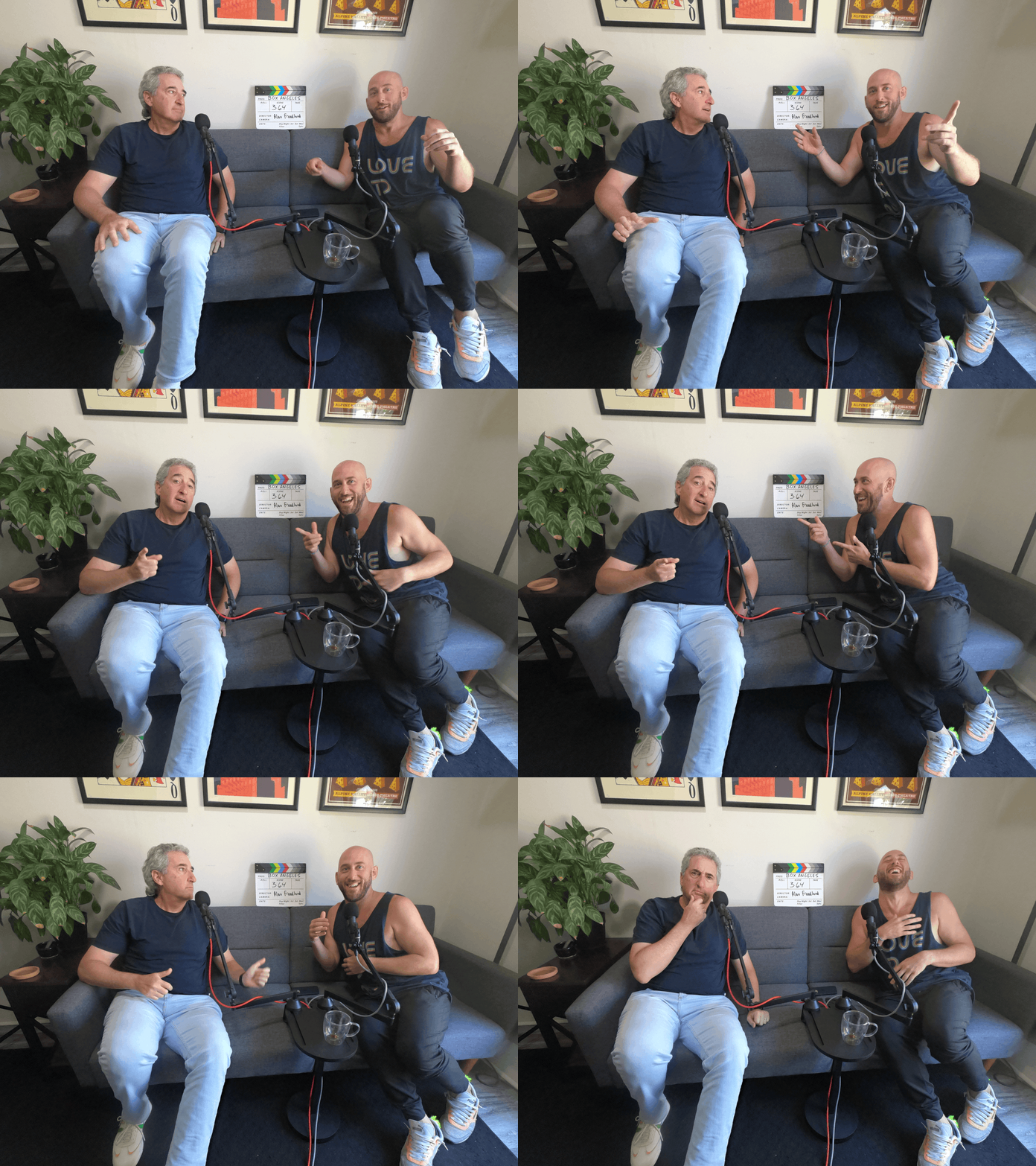
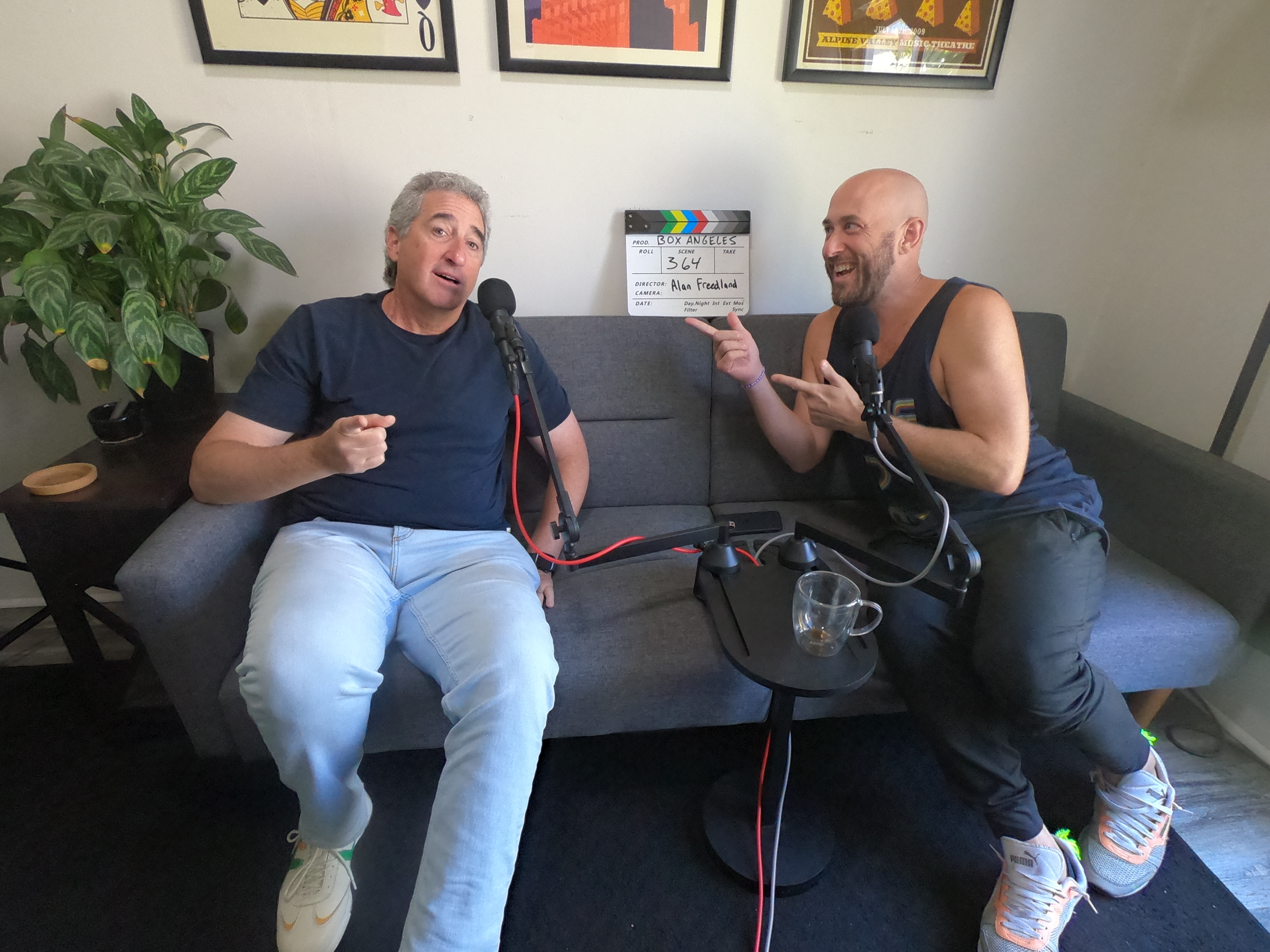
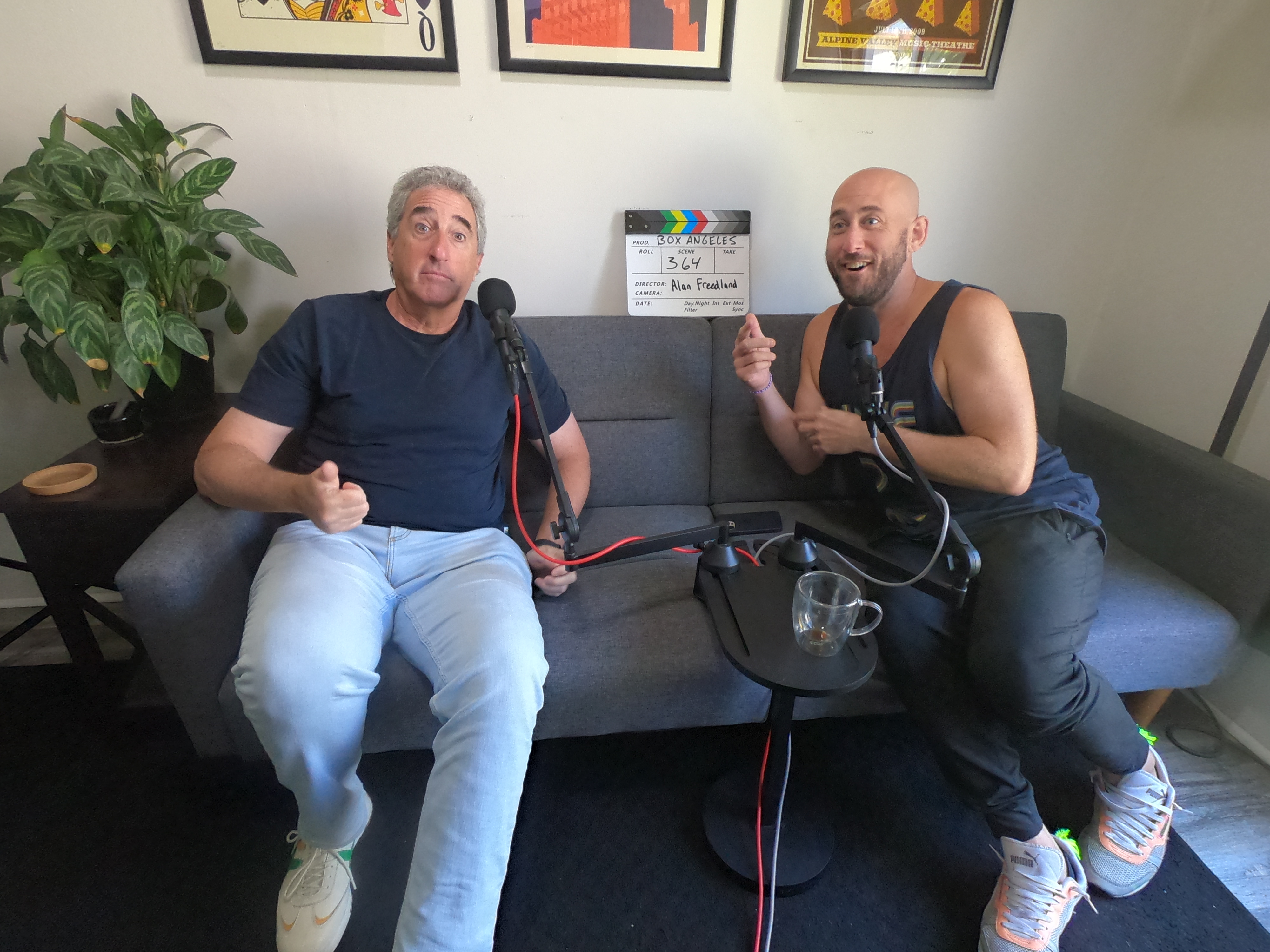
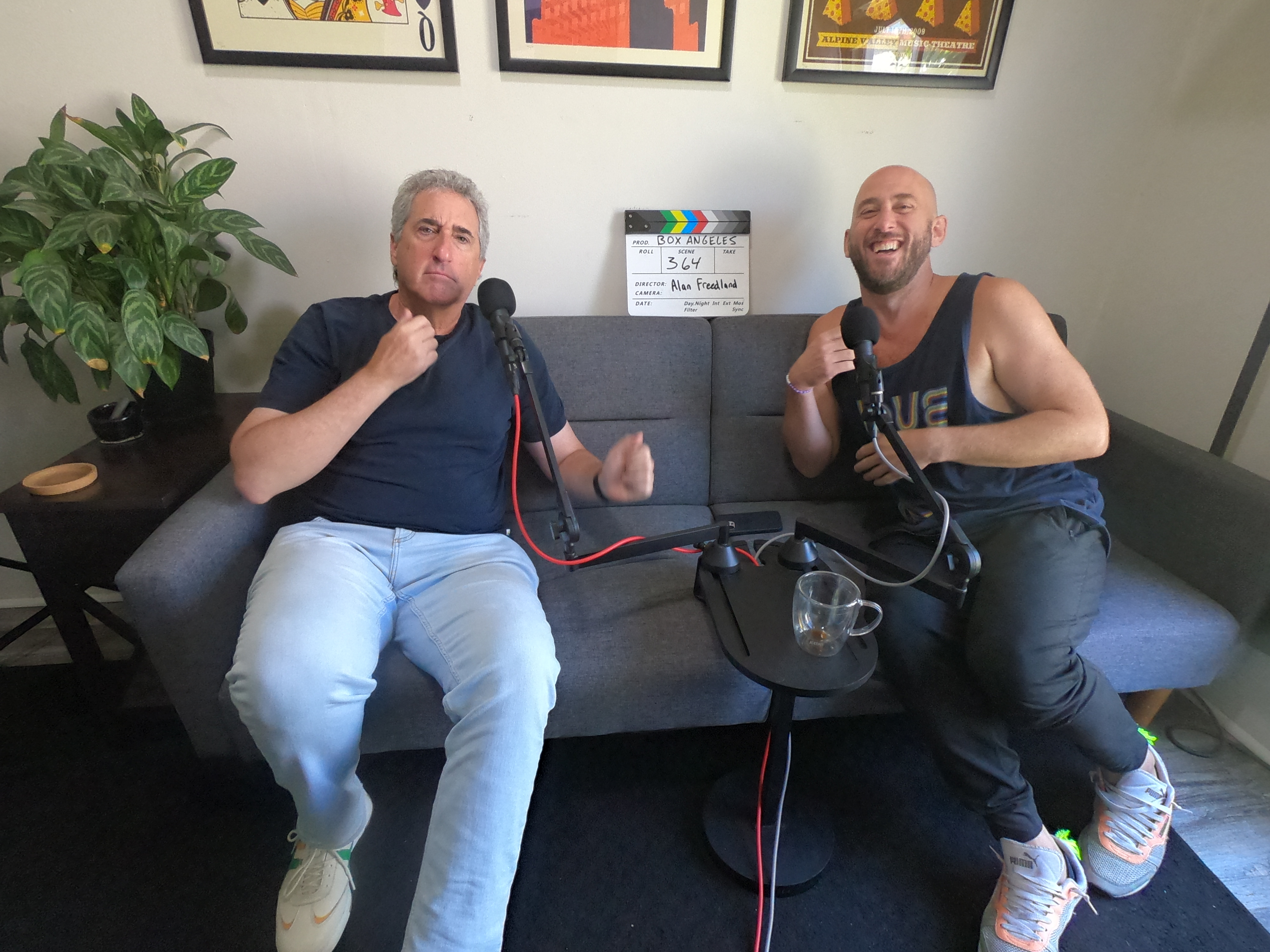
More Alan
 – Check Alan’s IMDb.
Transcript
ALAN FREEDLAND (00:00)
Alan Freedland 6 feet tall and too heavy. That won’t be rectified ever.
MIKE ELDER (00:16)
Hello and welcome to the Box Angeles podcast with me. I’m your host, Mike Elder. I’m back, baby. Sorry for the delay of new episodes. I’ve been a little bit busy. Life’s been different. Life has… been a whirlwind lately. But I’m back. I want to do more episodes. If you guys want it, I don’t know, we’ll see how this one does, I guess. But I’m back. I’m kidding.
This episode is going to do great, because this week I talked to writer and my friend Alan Freedland. Alan’s written on shows like The Nanny and King of the Hill and Betas and The Freak Brothers. He also wrote the movie Due Date, which I think is absolutely hilarious. He’s written Strangers movies, Strangers Chapter One, Chapter Two, Chapter Three, the horror movies. He’s been in the business for years and years and years, and we had a really good, really fun conversation.
We talked about writing partners and work procurement and if writing rooms are still a thing, and how he staffs writing rooms, and what he’s looking for from actors when he’s running a show with their auditions and casting and all this. It was a classic episode. Really good stuff. Really good intel in here. I think you’re going to enjoy it, whether you’re a writer, whether you’re an actor, or whether you’re just my mom listening to the episode like you always do. Thanks, Mom. Good conversation. I’ve known Alan for a while. We played trivia, so we had a good rapport, if you will.
And like I said, I want to do more episodes. So if you have any ideas, thoughts, feedback, let me know. Hit me up. Follow me on social media: Instagram, TikTok, YouTube, @boxangeles. I’m at all of those. Give me your feedback. Let me know what you want, what you want to hear, who you want to see on here. And I will see if I can make it happen. I’m going to try to be more consistent for you guys, because I know you guys wanted more episodes.
Alright. I don’t want to waste any more time. Without further ado, I give you Alan Freedland.
🎵 ROCKFORD (01:52) 🎵
You wanna talk to me? You wanna talk.
MIKE ELDER (01:59)
Alan! Thank you for coming down.
ALAN FREEDLAND (02:01)
Happy to be here. Happy to be here.
MIKE ELDER (02:03)
How often have you slated before? Is that your first slate?
ALAN FREEDLAND (02:06)
No, I’ve slated. You know, you have to do interviews for movies and TV when they do the, you know, behind the scenes. The kit.
MIKE ELDER (02:12)
Oh, sure, yeah.
ALAN FREEDLAND (02:13)
The press kit.
MIKE ELDER (02:14)
And you used to perform a little bit. You did improv, right?
ALAN FREEDLAND (02:16)
I did Second City in Chicago.
MIKE ELDER (02:18)
Yeah. Did you ever have an acting phase?
ALAN FREEDLAND (02:21)
It was kind of together. I did Second City and in the and when I did Second City and Player’s Workshop and the, I did take an acting class there, and I remember one of the great quotes was “Your job as an actor is to audition. Acting is something you do in between.”
MIKE ELDER (02:43)
That’s funny. Because that’s what I’ve been saying this on the podcast lately. I’m an auditioner, not an actor. I feel like all I do is audition.
ALAN FREEDLAND (02:49)
Well, that’s-.
MIKE ELDER (02:49)
And I can’t book anything.
ALAN FREEDLAND (02:50)
More of-. Who was that? Who’s fault is that? No, but there’s no-.
MIKE ELDER (02:55)
I’m the problem. It’s me.
ALAN FREEDLAND (02:56)
There’s no yeah, I mean, most of your life, for most actors, unless you’re, you know, Brad Pitt or whatever, you’re going to be auditioning. And you’ll get jobs, but they’ll never equal the amount of time you audition.
MIKE ELDER (03:08)
It’s a grind. It’s crazy. Did you go into improv for writing specifically? Like, you started because you wanted to write, or did you initially want to perform?
ALAN FREEDLAND (03:16)
I–a little bit of both. I mean, the- for anything that’s context-wise, I did my high school radio station. I was a DJ and a sports director. So I kind of like that.
MIKE ELDER (03:26)
Performance aspect.
ALAN FREEDLAND (03:27)
Yeah, that part of it. But I also you know, I wanted to do improv because comedy and the truth of how I ended up out here was I had done that and I was, at the time, we can get into it if you want to. I was working in advertising, but I was on the account side.
And I said, well, I want to get on the creative side and be a copywriter. And maybe I would have been happy doing that. But then I was like, well, from the Second City experience, I was like, well, what do I like? If I didn’t have to work at all.
Like, if somebody said, here’s a, you know, here’s the lottery. You got it. And I was like, I liked sitting around doing comedy with people. And so that’s what brought me out here.
MIKE ELDER (04:03)
That’s great. I love it. I didn’t mean to get right into it, by the way. I apologize. Because I had a story that you were curious about in my bullet point.
ALAN FREEDLAND (04:09)
Oh, I don’t know what that story is.
MIKE ELDER (04:10)
I want to share the story with you, and I want to talk about myself, obviously, because that’s what this podcast is about.
ALAN FREEDLAND (04:14)
The only reason I’m here is to feature you and try to get more acting gigs.
MIKE ELDER (04:18)
Well, we’ve known each other for a while. We do trivia together. You’re on the team boxangeles.com sometimes. So now you’re on the podcast.
ALAN FREEDLAND (04:25)
And we have won.
MIKE ELDER (04:25)
But we have won. It’s rare. But what I want to tell you, I don’t think you know this, is my middle name is Alan. Did I tell you that ever?
ALAN FREEDLAND (04:31)
Did not. Do you spell it the right way?
MIKE ELDER (04:33)
Now here’s my story. I spell it A-L-A-N as well.
ALAN FREEDLAND (04:37)
Great.
MIKE ELDER (04:37)
And it’s very rare.
ALAN FREEDLAND (04:38)
This is why we’re friends.
MIKE ELDER (04:39)
Exactly. And it’s very rare to meet another Alan with A-L-A-N. But you’re–Alan Cohen, your writing partner, who also spells it A-L-A-N?
ALAN FREEDLAND (04:48)
Yes. We met years ago, and I had come out here to do writing and met him, and he was doing writing, and we–two Alans.
MIKE ELDER (04:57)
That’s crazy.
ALAN FREEDLAND (04:57)
Yeah, same.
MIKE ELDER (04:58)
Because it’s always A-L-L-E-N, and those guys are idiots.
ALAN FREEDLAND (05:01)
Or A-L-L-A-N.
MIKE ELDER (05:03)
Sure.
ALAN FREEDLAND (05:04)
But yeah, no, it’s–Alan is, as I say, the proper way to spell it.
MIKE ELDER (05:09)
I agree. And that’s what’s on my driver’s license. And here’s my fucking story I want to share with you and talk about me. I was in Hawaii in like April. That’s not relevant to the story. It’s just a humble brag by me.
ALAN FREEDLAND (05:18)
Somebody’s doing well.
MIKE ELDER (05:21)
And I’m getting dinner, and the server walks up, and I swear–And let me preface this by saying my vision sucks. I’ve always had really bad eyesight, especially when it’s dark and stuff. So our server comes up. His name is Alan, I read on the thing, and he spells it A-L-A-N. And I strike up a conversation like I just did with you. You never see that.
ALAN FREEDLAND (05:38)
Right.
MIKE ELDER (05:39)
He yes ands me and is like, yeah, dude, the other day, like a couple weeks ago, there were two Alans and we were doing like the Spider-Man meme. And then we all spelled it A-L-A-N. I was like, oh, that’s hilarious. So funny. All right, well, we’ll have this. And he leaves. The girl I’m with goes, I didn’t get that. I was like, what? She’s like, his name tag said A-L-L-E-N.
ALAN FREEDLAND (05:59)
Oh, wow. You would have had a whole conversation about A-L-A-N, and he was just going along with it.
MIKE ELDER (06:04)
Yeah. Not only was he going along with it, not only was he just letting me talk, he lied to my face. Like, and made me look like an asshole. And I was so livid.
Like, I’ve never been that mad at a server in my entire life, but I could not get over that. Not only did he yes-and me, he lied about a story and experience just to get a better tip from me. And I was like, this fucking asshole.
ALAN FREEDLAND (06:26)
Oh, so you didn’t get the free dessert because he thought you were both Alan?
MIKE ELDER (06:29)
No. I got nothing.
ALAN FREEDLAND (06:30)
You got nothing. So was he.
MIKE ELDER (06:31)
Because he was a punk-ass Allen, and I was so mad, dude.
ALAN FREEDLAND (06:34)
Did it ruin the trip?
MIKE ELDER (06:36)
It ruined my dinner.
ALAN FREEDLAND (06:37)
Yeah.
MIKE ELDER (06:37)
I was upset.
ALAN FREEDLAND (06:38)
Yeah.
MIKE ELDER (06:38)
I truly was upset. Because it’s one thing if you’re-.
ALAN FREEDLAND (06:40)
But you can’t see? That’s what you’re upset with.
MIKE ELDER (06:42)
Well, that for sure. That’s always been a problem. But it’s one thing if you just like nod your head and go with it, but he like lied to me.
ALAN FREEDLAND (06:49)
Yeah, part of it you might say, hey, no, I spell it differently.
MIKE ELDER (06:52)
I know. It’s unbelievable. Or just like, yeah, just, oh, it drove me crazy. But we’re good Alans.
ALAN FREEDLAND (06:58)
Okay. Yes, we are.
MIKE ELDER (06:59)
And it’s your birthday this week, I heard.
ALAN FREEDLAND (07:01)
It is my birthday this week. I
MIKE ELDER (07:02)
I read that on IMDb.
ALAN FREEDLAND (07:04)
I am–I am so, you know, like people say it’s your birthday, I go, oh, like I forgot. Like it’s just another day of the year. And I think we have–I am not anti-birthday, but I think there was–as a kid, like when I was like five, I think when they were bringing out the cake, there was video of me crawling under the table. I did not want–didn’t want the attention.
MIKE ELDER (07:26)
Are you an introvert?
ALAN FREEDLAND (07:28)
I don’t know, because I did Second City. So but maybe.
MIKE ELDER (07:31)
Yeah, but introvert–people always confuse this. And I don’t mean to speak down to you.
ALAN FREEDLAND (07:35)
No, no, you’re smarter. Go ahead. Again.
MIKE ELDER (07:38)
It just means you get energized by not being around people. You get energized in your alone time.
ALAN FREEDLAND (07:43)
No, no, I mean, I enjoy being around people if I like them.
MIKE ELDER (07:47)
Yeah, that’s true. Ain’t that the truth?
ALAN FREEDLAND (07:49)
Yeah.
MIKE ELDER (07:49)
I went out to the bar this weekend. I didn’t say a goddamn word because I didn’t know anybody, and that felt weird for me.
ALAN FREEDLAND (07:53)
Sometimes that’s-that’s a good time. Because you’re like, you don’t know anybody. You know, you can chat with anybody.
MIKE ELDER (07:59)
There’s no pressure.
ALAN FREEDLAND (08:00)
No pressure, nothing to risk.
MIKE ELDER (08:01)
Yeah. But you strike me as a little bit of an introvert. And then with that birthday cake story.
ALAN FREEDLAND (08:07)
It is true. I mean, yeah, so I don’t–sometimes I don’t like a lot of attention. Yeah. I have no social media presence.
MIKE ELDER (08:13)
Oh.
ALAN FREEDLAND (08:14)
I’m like, why?
MIKE ELDER (08:15)
What’s the point?
ALAN FREEDLAND (08:16)
Well, I mean, I understand the point, but I’m like, I’m not interested.
MIKE ELDER (08:20)
Have you ever done a podcast? Is this your first podcast?
ALAN FREEDLAND (08:23)
Have I done a podcast?
MIKE ELDER (08:24)
I didn’t look that up. I usually look that up.
ALAN FREEDLAND (08:26)
I feel like I–I mean, I don’t–maybe? Maybe?
MIKE ELDER (08:30)
Doesn’t he even know?
ALAN FREEDLAND (08:31)
I mean, I’ve done similar things, but–maybe.
MIKE ELDER (08:34)
All right. Let’s get into it now. Let’s talk about work, sadly. Boo.
ALAN FREEDLAND (08:39)
Boo.
MIKE ELDER (08:39)
At least this is–I like to think this is a safe space, a container to talk about work where it doesn’t feel dirty. But you mentioned coming out here, you thought you wanted to do copywriting and stuff.
The thing that interests me about writers, and I ask every writer this, is like, how do you procure work? Like, if I went and wrote a screenplay right now, what would I even do with that? Like, how do you–how historically have you procured work, and what are you doing now to procure work?
ALAN FREEDLAND (09:04)
Procuring work is always having–well, having the material or back when there was more of this pitching, you know? And so I came out here to do TV. Because I was like, well, that’s sitting around with people and it’s more social. You talk about being an introvert, but more social.
And as I like the analogy is, instead of me carrying the sofa up the stairs to the apartment, I got to, you know, five or six of us are doing the same thing. So I’ll go in the same direction. But and then movies were kind of done as a hobby, you know, done on the side. And so, as you said, I did writing partner, started early on with one.
And procuring work was having writing samples. And that would get you onto staff if they liked your sample and met with you and liked you. For movies, a lot of times this-it’s not arrogant, but I was like, I don’t want to have to write the whole spec script and try to sell it.
I’d rather say, here’s–I’ll pitch it, and here’s the movie, and I’ve put, you know, basically I’ve probably done an outline to pitch it. And then if you want to buy it, pay me to write it. And that worked–has worked well.
MIKE ELDER (10:12)
But like, how have-like, okay, so how do you get into those pitch meetings? So like, was the first thing you wrote on The Nanny?
ALAN FREEDLAND (10:18)
The first job was The Nanny.
MIKE ELDER (10:20)
So like, did you have an agent at that point?
ALAN FREEDLAND (10:23)
Yeah, so.
MIKE ELDER (10:23)
And he got you–his sent his sample out, your sample out, or?
ALAN FREEDLAND (10:26)
Yeah, so I came out here–the I was already married at the time. I grew up in Detroit, but I was living in Chicago. And my wife said, if you get an agent, we’ll move out here. And so I was able to get an agent.
MIKE ELDER (10:40)
Look at her.
ALAN FREEDLAND (10:40)
I didn’t know anybody out here. I knew nobody. But I wrote spec scripts and got an agent. And then when I was out here, met. In a short.
MIKE ELDER (10:49)
And sorry, not to glaze over that. You were just sending your writing to every agent you could possibly find their information for?
ALAN FREEDLAND (10:55)
Yeah, you know, be resourceful and sent my stuff out. And I said, I’m going to be out here this week, you know, and got a few meetings and got an agent.
And it was a small-it was a smaller agency. But they had somebody, you know, they had clients who were on Mad About You, so it wasn’t-it was real.
And then after a while, then I met my writing partner at a writing class, which is a separate thing, but.
MIKE ELDER (11:21)
Oh, that’s cool. I assumed you met on a show.
ALAN FREEDLAND (11:24)
No, no. And I can tell you that story in a minute.
But the-and then I was like, well, let’s, you know, one plus one equals three. Let’s try to, you know, write together. And we did, and then got some samples.
And I said, well, I think we can get a better agent than the one I had. We got somebody, and then he disseminated our stuff, and we ended up on The Nanny as the long story short.
MIKE ELDER (11:43)
Got it. So for the most part, it’s the agent sending your–you’re sending your stuff to the agent, the agent’s trying to get it in front of you.
ALAN FREEDLAND (11:49)
Right. It’s a weird business in that, and for those people who don’t know.
MIKE ELDER (11:54)
It is.
ALAN FREEDLAND (11:54)
Like, if you were-if you were, and this is the, you know, unfortunate part, if you were trying to get a job at a bank, you know, and as a loan officer or something, you’d be like, all right, well, I’m going to put my resume together, I’m going to send stuff out, I will go call people, I will, you know, do all that on my own.
In this business, as you know, it’s suspect if you’re pitching yourself.
MIKE ELDER (12:14)
Yeah.
ALAN FREEDLAND (12:15)
It’s like, well, who has–you haven’t been validated yet.
MIKE ELDER (12:18)
Yeah, you don’t have a gatekeeper.
ALAN FREEDLAND (12:19)
Right. So the agents–well, I get the agents. Well, you can’t just have everybody in the world just submitting stuff, but it validates you to have the agent. And so I would prefer to, if it were allowed to just go get my work, I can be resourceful and go get her and do that. But in this business, as you know, you need the agent to submit you and.
MIKE ELDER (12:41)
So you’ve never gotten your own–sorry.
ALAN FREEDLAND (12:43)
No, I got my own work. I’m saying to start, once you’re starting, you just don’t cold call somebody. If you know somebody or you’ve met with, you know, people, then you can do that.
MIKE ELDER (12:52)
Yeah. How often does that happen? And what triggers that? Is it something like you talk to somebody about something in passing, and then you just like revisit it?
ALAN FREEDLAND (13:01)
You know, I think the business has changed over time. But I think.
MIKE ELDER (13:03)
Of course, that’s why I’m curious.
ALAN FREEDLAND (13:04)
Right. But I would say that the pro and the con is you get in the door, the agent gets you out there, you get on in TV, it was getting on various staffs, and you develop a reputation.
At a certain point, you rise to a certain level where you know a lot of people, and unfortunately or fortunately, you get your own work because you’re like, oh, yeah, I want to do this project with you, or I like that idea.
And then you call the agent and go, hey, go ahead. Go ahead and negotiate the deal. And so.
MIKE ELDER (13:36)
Tell me the story about your writing partner. It sounds like a good one.
ALAN FREEDLAND (13:39)
Yeah, so we–I had read, and Woody Allen in his biography had said that he had like three great mentors of people. And I was like, well, Woody Allen, this is pre all the Woody Allen stuff. But it was, you know, Danny Simon was, who is, I’ll tell you who he is in a second, was one of his three great mentors.
And he was a writer who’s since deceased. But he is Neil Simon’s older, less successful, bitter, senile brother.
And so he was teaching a writing class in Sherman Oaks, to which he did not have an exclusive. So he would teach a writing class on half the room, and then there’d be a bunch of women playing mahjong on the other half.
MIKE ELDER (14:26)
That’s hilarious.
ALAN FREEDLAND (14:27)
And so go up there, signed up for it, you know, eight-week class at night. And there’s 10 of us in a semicircle around him.
And a couple of things about Danny is, when he was teaching a class, and again, you have to deal with this as a comedic guy, he didn’t know comedy came from character and everything else, but he said, this is a comprehensive class.
Because I guess he’d worked with Woody Allen on Your Show of Shows or something like that, some old show. And he said, you will-it’s comprehensive. We are going to cover everything. We are going to start with Your Show of Shows, and we are going all the way through Shields and Yarnell. Shields and Yarnell is a mime group from 1971.
MIKE ELDER (15:08)
Jesus.
ALAN FREEDLAND (15:08)
So it’s like, that’s as far as he was going to get.
MIKE ELDER (15:11)
Wow.
ALAN FREEDLAND (15:12)
But the very first day of the class, driving rainstorm, one of those January rainstorms here, we’re in the circle, the collection of people. One of the people in the class was a pastor who had been sent by his congregation to make his sermons funnier, to learn comedy.
MIKE ELDER (15:32)
Oh my God.
ALAN FREEDLAND (15:33)
About.
MIKE ELDER (15:34)
Not be ironic if that’s your writing partner, by the way.
ALAN FREEDLAND (15:36)
No, no, it was not him. So at about, I don’t know, 10 minutes into the class, he–Danny’s talking and whatever he’s saying about comedy and writing, and he just stops and goes, you. Pointing to the pastor, he goes, you.
I didn’t get your check. I didn’t get your check to sign up for the class. And the pastor’s like, the congregation was supposed to send it. I didn’t get it. I didn’t get it. Do you have it?
He goes, well, I don’t know. You got $300 cash on you? He goes, I’m a man of meager means. Get out.
MIKE ELDER (16:09)
What?
ALAN FREEDLAND (16:10)
Get out. Guy’s got the collar on and everything.
MIKE ELDER (16:14)
No wonder he’s less well-known than his brother.
ALAN FREEDLAND (16:16)
Yeah, he says, get out. So, you know, okay, guy gathers up his notebook, and he gets out. And again, it’s about 8, 10 minutes into the class, and he’s walking by, and this is almost like, if you wrote this into your script, you go, this isn’t real. He grabs the guy by the collar, and he says, your notes. When I get your check, you get your notes.
MIKE ELDER (16:37)
Oh my gosh.
ALAN FREEDLAND (16:37)
Well, what notes? We were eight minutes into a class. I mean, the first four minutes were probably like, you know, besides the Shields and Yarnell bit, it was going to be, you know, we’re going to have muffins at the class break. And he kicks him out into this driving rainstorm.
So now the–in a horseshoe, I’m at one end, Alan Cohen is at the other end. Most of the other people in the class, the other seven, eight people in the class are like, man, it’s terrible. You should have sent the check in, you know? And they’re all like, you know, Danny’s right. I’m laughing so hard at this ridiculous thing.
And I look across, and Alan Cohen is also laughing. Now we’re trying to stifle the laughter. You know, you’re in a class, you’re like, but you’re like, you know those situations. You’re laughing. So, but it’s one of those things where I’m laughing, he’s laughing, we’re trying to get classes going. Every time I make eye contact with him, with Alan Cohen, I start laughing again.
MIKE ELDER (17:30)
Of course.
ALAN FREEDLAND (17:31)
And then, so that’s how we met, and then.
MIKE ELDER (17:33)
The rest is history.
ALAN FREEDLAND (17:34)
Yeah, so there you go.
MIKE ELDER (17:35)
Okay, so I assume you guys met on a show, but now that makes a lot more sense. So are they–what is your thought? I’ve had many a writing partner on the podcast. You split all your money half and half still.
ALAN FREEDLAND (17:47)
Yeah, the.
MIKE ELDER (17:47)
You’re a package duo.
ALAN FREEDLAND (17:49)
Well.
MIKE ELDER (17:49)
From here hence forward.
ALAN FREEDLAND (17:50)
For many, many years. And the pro and the con is you have a writing partner, and you know, and certainly for movies, 100% get it. You’re like, we’re writing a movie, we’ve sold it.
MIKE ELDER (18:00)
Yeah.
ALAN FREEDLAND (18:00)
You get $100, I get 50, you get 50, that’s fine. We’re writing this thing together.
MIKE ELDER (18:04)
You’re selling movies for 100 bucks?
ALAN FREEDLAND (18:06)
100
MIKE ELDER (18:06)
Your agent’s not great.
ALAN FREEDLAND (18:08)
$100.
Less 10%. So it’s 45 each. But on a TV show, as you’re probably aware, you’re most of the time, you’re in the writing room, and you are your own voice speaking up. So it’s kind of like, oh shit, we’re splitting this money. We are going to write the script together when we get off on assignment.
But basically, you’re acting as a, you know, individual writer, and the person next to you is making the full freight, and you’re not. That was the gig. After a number of years, and we rose up in the business, we said, we’re both in the show, we’re going to get paid separately. But it took, you know, a lot of years.
MIKE ELDER (18:46)
Yeah. Does WGA still do that? That’s still a thing?
ALAN FREEDLAND (18:49)
Well, that was, no, we just, we said, you’re going to pay.
MIKE ELDER (18:51)
No, I know, but do they still do writing partners as one writer?
ALAN FREEDLAND (18:54)
Well, it’s not the WGA. But the show, yeah, the show.
MIKE ELDER (18:58)
Oh, it’s not a WGA thing?
ALAN FREEDLAND (18:59)
It’s a, you can, well, I guess you can pay the team one salary. You’re hiring the team. And for, I guess it made sense for, in the sense of, hey, I’m going to get two voices for one. That’s the allure. But I think then it got to the place where like, well, the room’s getting full, we don’t want extra bodies. We don’t need two people, we just need one. So I can see the pros and cons.
Certainly, you know, I, as I said, I came out here to write on TV because it was for TV comedy, because it was social, and there’s other people, and you’re all pulling, you know, pulling the couch up the stairs. I would not want to, on my own, just sit around writing movies. It’s a lone by myself, because it’s a lonely experience. Certainly could do it. But having a writing partner certainly is more enjoyable.
And we would use to, when we write movies or scripts, literally one guy’s at the keyboard, one guy’s pacing, switch off, and you’re pitching stuff. And then you get to a place where you’ve, you know, you’re more experienced, and you go, okay, we’ve done the outline. Now you take these scenes, I’ll take these scenes, we’ll put them together.
MIKE ELDER (20:04)
Yeah.
ALAN FREEDLAND (20:04)
And get.
MIKE ELDER (20:05)
That’s what I like, the romantic idea you just mentioned, where one’s sitting on the couch, one’s typing.
ALAN FREEDLAND (20:11)
Smoking a cigar.
MIKE ELDER (20:12)
Yeah, sipping whiskey neat or whatever.
ALAN FREEDLAND (20:14)
Yeah.
MIKE ELDER (20:14)
And just burning the midnight oil, just staying up late. Like that sounds so fun and silly to me.
ALAN FREEDLAND (20:20)
It’s more, yes, it can, it’s certainly, you know, you have your own mini writing room. It’s two people. And yeah, certainly I prefer it. It’s much more enjoyable. I’m sure he prefers it. And other writing teams, it’s you’re just, and supposed to, here’s the blank screen, go.
It’s, here’s the blank screen, both of you. All right, what about this? Oh, how about this? And you know, and, but then after a while, you know, I think you just get better at your craft, and you’re like, well, we can do this a little quicker if we don’t sit around literally on each line.
And of course, you know, you have to, like a marriage, you’ve got to like each other and work through it. Because a lot of times you go, oh, I think it should be this word in this line. And you know, then you go, well, I think it’s this way. And you just kind of, but hopefully in the end, it’s a better product.
MIKE ELDER (21:03)
What do you guys do now? Do you have like a regular meeting time every week, or do you guys have a regular, do you guys have an office you go into or anything?
ALAN FREEDLAND (21:09)
You know, for years, even if we had a, because we were also doing movies on the side or writing pilots sometimes, or sometimes you’re not on the show, you’re just writing pilots and things like that. We would rent an office, and we’d find a place, and we had various places.
There was, one was like in a Santa Monica high rise, like the third floor, there was a crazy, like cut-out corner area that like, it was hard to rent as one office, because it was like a triangular.
Another one, the one we had probably the longest was, it’s actually on Wilshire Boulevard by 26th Street, like 24th, across from the California Chicken Cafe is a place called Michael’s Liquor.
MIKE ELDER (21:49)
I love California Chicken Cafe.
ALAN FREEDLAND (21:51)
Yes, we do. And above it were like four converted, I guess, probably someone must have lived up there, four rooms that were converted into offices. And so for years, we would have that as our office.
MIKE ELDER (22:04)
Yeah. But now do you have any like set meeting time, or you guys are just in your groove where you just start emailing and texting?
ALAN FREEDLAND (22:10)
Yeah, I mean, it’s much more get on the phone. And, you know, obviously COVID made Zooming much easier, but even then we’re like, I don’t need to stare at, you know, we can be on the phone and have a conversation. We’re not like writing on the screen together, you know?
MIKE ELDER (22:28)
Yeah.
ALAN FREEDLAND (22:30)
That’s how we do it.
MIKE ELDER (22:30)
I assume you guys have the same agent. Do you guys meet regularly with your agent as writers? To like get a sense of what you’re writing and what they need, or what the.
ALAN FREEDLAND (22:38)
No, I mean, I think it’s more of, I don’t know, I feel like, you know, we know what needs to be done.
And in the past, have other times where we said, hey, you know, like, what about a show like this that turned out to, you know, like Modern Family came out.
And a few years before that, we said, what about a show we do as a single camera show about a family with a documentarian living in it?
And we wrote the spec, you know, but like wrote the spec script, but like the agent’s like, ah, nobody wants that.
MIKE ELDER (23:04)
That’s hilarious.
ALAN FREEDLAND (23:05)
You know, and then of course, several years later, I feel like we’re ahead of the curve on a lot of things. A lot of things like we were pitching or writing, and then a few years later, something else comes out. And the message I would give to all you writers out there is, have the courage of your convictions and say, I think this is the right thing to do, and try to force it through.
MIKE ELDER (23:24)
Yeah. Do you fire your agent after that, or do you give him a stern talking to when Modern Family comes out?
ALAN FREEDLAND (23:30)
I think at a certain point, and this is more jaded, I think, you know, you, you know, you realize you’re doing more of the work than the agent, than they’re, you know, you, a lot of them saying, hey, I know that so-and-so is hiring on a, or looking for writers on a particular show, you know, submit me, you know, to that show.
As opposed to, hey, they call you and go, hey, we submitted you to such and such a show.
MIKE ELDER (23:51)
Yeah.
ALAN FREEDLAND (23:52)
That’s my jaded view. And, you know, that’s probably over time what happened, you know?
Or you find out you’ve, you know, without naming, and this is not a story just about our situation, but you go, hey, somebody, like we work with somebody who said they met somebody on a show, they ended up getting the job on the show, but they are like, told their agent, hey, don’t forget to submit me, you know, because I’ve met this person, they said they’re expecting it.
And then they find out a few weeks later, the agent submitted a package of writers, but not that person.
MIKE ELDER (24:21)
Oh.
ALAN FREEDLAND (24:22)
Like, come on.
MIKE ELDER (24:23)
That’s annoying.
ALAN FREEDLAND (24:24)
Right.
MIKE ELDER (24:25)
That’s infuriating.
ALAN FREEDLAND (24:26)
Yeah.
MIKE ELDER (24:26)
How often have you like been in the casting room as a writer? Do you get in there much?
ALAN FREEDLAND (24:30)
Well, as a showrunner, you know, I’m running shows. I mean, even before it’s my main job.
MIKE ELDER (24:34)
Wait, what show did you run? Sorry.
ALAN FREEDLAND (24:36)
Well, a number of shows. You know, the current show is certainly the Freak Brothers that’s on, but in the past there were other shows that some were short-term and on the IMDB page, but you’re in there casting, or you know, Beta’s, for example, was the first.
MIKE ELDER (24:56)
Oh yeah. I just saw Karan [Soni] the other day.
ALAN FREEDLAND (24:58)
Oh, did you? Yeah, yeah. He’s done very well.
MIKE ELDER (25:00)
He’s killing it.
ALAN FREEDLAND (25:01)
Yeah, he’s doing great.
MIKE ELDER (25:02)
He did my podcast and then he took off.
ALAN FREEDLAND (25:04)
Yeah, so, you know, for example, that show, which by the way, was literally Amazon’s first show.
MIKE ELDER (25:11)
Oh, crazy.
ALAN FREEDLAND (25:11)
And they had, it was that and another show called, it was crazy, I think it was called Alphas, or something like, well, you can have Alphas and Betas. But it was literally the couple things about that, unfortunately. Now Amazon, like people are like, oh, shows you’re watching on Amazon all the time.
MIKE ELDER (25:26)
Yeah.
ALAN FREEDLAND (25:27)
So at the time though, you know, nobody knew what it was. Like, you mean, you’re doing a show for the bookseller?
MIKE ELDER (25:33)
The toiler paper company.
ALAN FREEDLAND (25:34)
Right, right, right. And so, and you do it, and like, trying to find writers, trying to get people to cast, and be like, well, let me see what I can do on other shows, and if I can’t, then I’ll come interview for your show.
But, and then once a show got on the air, you’d put it in Beta’s and you’d try to find it, and you’d be like, no, I’m running the show, it’s my show, and I can’t even find it, because it tends to be like Betamax recorders, video recorders.
And so, but yes, I’ve been in plenty of rooms where you’re hiring.
MIKE ELDER (26:04)
Wait, did you co-show run that?
ALAN FREEDLAND (26:06)
Yeah, yeah, yeah, yeah, yeah.
MIKE ELDER (26:08)
So wait, yeah, back to casting, like what are you looking for when you’re, like give us actors some tidbits. Like, do you just know every time, is there nothing I can control and my life is pointless? Or like what is your.
ALAN FREEDLAND (26:19)
Here’s several tips. I feel terrible for the guy, you know, or the girl on that side of the camera. It’s, you know, ways we’re filming it. I’m like, this is an awkward situation, you know, the whole thing.
Sometimes like, I don’t know, we’re like shooting out in Santa Clarita, the person’s, you know, probably driven, you know, with traffic an hour and a half for what’s going to be potentially, you know, a one-minute audition. And, but, here’s a.
MIKE ELDER (26:46)
Thank you for having empathy. I feel like not everyone does.
ALAN FREEDLAND (26:48)
I, yeah, I do. And I will say this. There are times where you come in and you audition, and I’ll give you an adjustment, and then I’m laughing and doing all that. And there are other times you may come in, and I go, thank you very much, that was great. I have nothing, you go any adjustments? Nope. And you leave. And there are, there is no rhyme or reason.
It may, the guy we cast, Joe Dinnacall, is the lead on Beta’s. He came in, he did it, he was like the first person we saw. Like, thank you very much, goodbye. He probably thought, okay, I blew that. But no, because like, that was what we wanted. You’re the first guy we saw, we’re going to see more people, but, and.
MIKE ELDER (27:33)
But do you, how often do you just know? Like, nope, they’re not it, yes, be good, be good, be good.
ALAN FREEDLAND (27:39)
I mean, there are times when unfortunately, you’ve seen it all. The look is not right given what other casting’s already gone on, or maybe, or there’s, as an actor, I would say, you go in, you leave it on the table, and that’s all you can do.
And they may call, they may not call. There are a billion reasons why you may have been great, and why you didn’t get it. That you’ll have no understanding of it.
They’re like, oh, in your case, they may go, oh, Elder was fantastic. We had another bald guy in there, we didn’t want to have two bald guys. You never know.
MIKE ELDER (28:14)
Yeah.
ALAN FREEDLAND (28:15)
And you won’t know.
MIKE ELDER (28:17)
Which is madness.
ALAN FREEDLAND (28:18)
Yes. I guess, yeah, I mean, I suppose, well, I suppose saying, well, you weren’t really good.
MIKE ELDER (28:24)
Yeah. That at least gives me something.
ALAN FREEDLAND (28:26)
Yeah, to work on.
MIKE ELDER (28:27)
I would rather know it was out of my control, you know? Or anything. Like I get, I had a callback last week, there was three guys in for my role, including me.
ALAN FREEDLAND (28:36)
Did they all look like you?
MIKE ELDER (28:37)
No, all different.
ALAN FREEDLAND (28:37)
Okay.
MIKE ELDER (28:38)
Well, it was two other guys and me, we all looked different. One was bigger and chubbier, one had hair.
ALAN FREEDLAND (28:43)
Right.
MIKE ELDER (28:45)
But I didn’t get it. And I’m like, oh my God, I would just like to know something.
ALAN FREEDLAND (28:51)
There’s, I mean, right, you just don’t know. So that’s why you just have to have, I hate to say the confidence to go, I think I’m good, here’s what I did. You know, and by the way, sometimes where you may go in and go, do they want me to play it, play under it a bit? Do they want me to play it bigger? You know, you don’t know. Because everybody’s different.
MIKE ELDER (29:14)
Yeah.
ALAN FREEDLAND (29:14)
And so you may go, should I be over the top? Should I be, you know, more subtle? The whole, I would hope when I’m on this side and I’m casting, and if you came in and did it, you know, more over the top, and I’m like, I’d rather you do it subtle, I’ll give you the adjustment, because hopefully I see, you know, oh, there’s talent there.
Or I might try to have you do it more subtly, and you go, you can’t do it. And they’re like, all right, well.
MIKE ELDER (29:38)
Yeah.
ALAN FREEDLAND (29:38)
You know?
MIKE ELDER (29:39)
I don’t know why I keep asking this question, because like, I’m never going to get an answer.
ALAN FREEDLAND (29:42)
You’re hired. You got the job.
MIKE ELDER (29:45)
That satisfies me, but I’m.
ALAN FREEDLAND (29:47)
For the role of Mike Elder, you didn’t get it.
MIKE ELDER (29:50)
Damn it.
ALAN FREEDLAND (29:50)
You were close.
MIKE ELDER (29:51)
I’ve had people audition for roles that are based on them and not get it.
ALAN FREEDLAND (29:54)
Really?
MIKE ELDER (29:54)
This commercial guy, Dan Gill, came on the podcast years ago, and he was like, I auditioned for a Dan Gill type and didn’t get it.
ALAN FREEDLAND (30:01)
Well, Dan Gill type.
MIKE ELDER (30:03)
Yeah, but like, my brain is just so, I’m an engineer by trade, so I’m just formulaic, and I just want to solve the formula, and I don’t know why I keep wanting to do it, because it’s never going to be a formula, and it’s just wracking my brain is a waste of time, but.
ALAN FREEDLAND (30:16)
Well, I get it. I mean, I get that.
MIKE ELDER (30:20)
We want to take the entropy and kind of like contain it a little bit, but it’s a waste of energy.
ALAN FREEDLAND (30:26)
I don’t know that you can’t, because it’s a qualitative business, and it’s not like, I mean, unless it’s like a one-man show they’re casting for, you know, there’s other people, and so then they got to factor in, how does this with this? I mean, I think I was reading a story, was it, Back to the Future, that whoever was originally cast, and I think they started filming.
MIKE ELDER (30:49)
They did film him for a bit.
ALAN FREEDLAND (30:50)
And it was, but was it the guy or the girl they replaced?
MIKE ELDER (30:54)
The guy.
ALAN FREEDLAND (30:55)
Oh, okay. So it wasn’t Michael J. Fox, it was whoever it was. And then because the Leah Thompson, she was too not tall enough, or he was too tall or something, and it didn’t look good.
MIKE ELDER (31:07)
Yeah.
ALAN FREEDLAND (31:08)
And I mean, brutal.
MIKE ELDER (31:09)
Yeah, it’s insane.
ALAN FREEDLAND (31:10)
Brutal. You hope that I tell people, you want like the, no, why am I blanking on her name, the who played Lisa Kudrow story.
MIKE ELDER (31:19)
Yeah, yeah.
ALAN FREEDLAND (31:19)
Like, well, I think she went in for Frasier.
MIKE ELDER (31:22)
Frasier, right. For Roz.
ALAN FREEDLAND (31:23)
And didn’t get it. You’re like, oh my God, Frasier. One door closed, another one opened, even better.
MIKE ELDER (31:29)
Yeah.
ALAN FREEDLAND (31:30)
It worked out. You know, that.
MIKE ELDER (31:31)
But the thing about that though, is we’re talking about the people that made it.
ALAN FREEDLAND (31:35)
Right, you know those stories.
MIKE ELDER (31:35)
There’s millions of people that are like me that haven’t booked in years, and we’re like.
ALAN FREEDLAND (31:40)
Well, that’s why there’s a lot of actors. It’s because you go, like, I remember the Harrison Ford, well, I just, you know, I’m not going to do a Harrison Ford voice, unless I have the hat.
MIKE ELDER (31:54)
That’s Indiana Jones.
ALAN FREEDLAND (31:56)
Right, no, I’m saying, if you give me the Raiders hat, then I’ll do my Harrison Ford. Not that I have one. But he said, I just, he was a carpenter, right? He just said, I just thought I’d keep auditioning until I outlast everybody else who quit.
MIKE ELDER (32:08)
That’s what I tried to do.
ALAN FREEDLAND (32:10)
But I think that the reason so many actors, let’s just even say, is because people are like, they see the story of that, and they’re like, oh, well, it’s doable. Well, but you’re hearing, it’s a, you get it as a mathematics engineer. It’s not a, you’re pulling from, you’re just telling me the success stories.
MIKE ELDER (32:31)
Yeah.
ALAN FREEDLAND (32:32)
So it’s not.
MIKE ELDER (32:33)
And there’s a lot more failure stories than success stories.
ALAN FREEDLAND (32:35)
Yeah, probably.
MIKE ELDER (32:36)
And now with self-tapes, like you don’t even have to live here, like the playing field is so much more wider. Speaking of like, do you approach self-tapes differently? Do you watch all of self-tapes when you get them?
ALAN FREEDLAND (32:45)
Well, I mean, ideally you hire a casting director to.
MIKE ELDER (32:49)
That filters enough?
ALAN FREEDLAND (32:50)
Well, that would be the idea.
MIKE ELDER (32:51)
But then the ones that they filter to you, are you watching the whole thing?
ALAN FREEDLAND (32:54)
Yeah.
MIKE ELDER (32:54)
Okay.
ALAN FREEDLAND (32:54)
Yeah, yeah. I mean, if there’s self-tapes, here’s whatever they give you. Now, do you watch, you know, I don’t want to say that it’s a three-minute audition, and you know a minute into it, this is not the person. Well, I mean, you know. I mean, right?
MIKE ELDER (33:07)
Sure.
ALAN FREEDLAND (33:07)
For whatever reason. I’m not watching yours.
MIKE ELDER (33:10)
Of course not, nobody is.
ALAN FREEDLAND (33:11)
I’m like.
MIKE ELDER (33:12)
I think that’s actors, I’ve interviewed a lot of actors, and we’re all like, are people watching this? We send it off, and then we’re like, not only are we not getting feedback, we don’t even know if people are watching it.
ALAN FREEDLAND (33:20)
Right, and right. So the pro and the con of the self-tape is that you can do it more easily, or whatever the con is, it’s probably easier to do, and as opposed to before, you had to, oh, I made it to the cut to get to the casting director’s office, right?
MIKE ELDER (33:35)
Yeah.
ALAN FREEDLAND (33:35)
Which I agree. I mean, I think certainly it’s better to be in person, but it’s easier for people not to.
MIKE ELDER (33:42)
Do you try to get the shows you work on, do you try to get people in person?
ALAN FREEDLAND (33:46)
It depends how big the role is, I guess, but I would prefer always in person.
MIKE ELDER (33:50)
That’s good.
ALAN FREEDLAND (33:50)
But I think.
MIKE ELDER (33:51)
You can be the change.
ALAN FREEDLAND (33:53)
Sure. Well, it’s a little bit like.
MIKE ELDER (33:55)
It all starts with you, Alan.
ALAN FREEDLAND (33:56)
It’s a little bit like, for years you would, as a writer, you’d go, well, write a sample script. Well, write a sample script of a show that’s on the air.
MIKE ELDER (34:03)
Yeah.
ALAN FREEDLAND (34:04)
So that you’re showing that skill set. Then somehow it became in the business, and I don’t know how, no, no, write a pilot, which is really hard to do, write an original pilot, and that’s your sample. And I’m like, yeah, but if I’m hiring you to be on this show, I’m asking you to write.
MIKE ELDER (34:20)
For this show.
ALAN FREEDLAND (34:21)
This show, these characters. So I want to see, A, you can write a show with other, you didn’t create the characters. And B, the advantage to me of a show that exists is, it’s a lot easier for, and it should be better for the writer to picture, you know, you’re writing, even if it’s today, a Scrubs sample, I go, well, I know those characters, you know, I can read your script and get how you’re doing, as opposed to, here’s an original pilot, which maybe I’d ask for as another sample, but, so yes.
But I still think the prevailing wisdom is, no, no, write an original pilot, which is, again, certainly much harder for, certainly a younger writer, even an experienced writer, it’s hard than to write for a show that exists.
MIKE ELDER (35:04)
Yeah. Given everything we just talked about, I’ve never asked you this, but your daughter, Sara, who is how I met you, she’s an actor. Did you discourage her from being an actor?
ALAN FREEDLAND (35:12)
I, yes.
MIKE ELDER (35:14)
Did you really?
ALAN FREEDLAND (35:15)
For years, I said, this business stinks, it’s shitty.
MIKE ELDER (35:18)
Did you really?
ALAN FREEDLAND (35:19)
Yeah, yeah, basically, don’t do it. But I did it, and I luckily, you know, I was successful at it, so, you know, but my thought was, well, you heard all that, and you still want to do it.
MIKE ELDER (35:32)
That means something, yeah.
ALAN FREEDLAND (35:33)
Right, as opposed to, well, I guess maybe not, or you’re wishy-washy. So yeah, so she’s, you know, good on her for doing it, and I’ve given her that same bit of advice every time when she does an audition.
I said, if you went in there, and they spent 45 minutes with you, maybe that’s great. I don’t know, I mean, it might be.
But it’s also if you went in there, and they had you for, you know, two minutes, and sent you out the door, you could be the one. I mean, you just don’t know.
MIKE ELDER (35:59)
Yeah.
ALAN FREEDLAND (35:59)
So, talk to Elder.
MIKE ELDER (36:02)
Yeah. If you want to know about not booking, talk to me. Speaking of writers’ rooms, like, is that still a thing? Like, are rooms still getting together and having sort of that kick the tape, kick the wheels around, see what sticks stuff? Because like, I feel like that’s gone, and I feel like now it’s just like one guy going off and writing eight episodes of a show.
ALAN FREEDLAND (36:21)
Oh, I think Mike White does it for his. I, you know, I think it’s, I think there’s still mostly, there’s rooms. I think maybe the rooms are smaller for comedy and drama, but whether they’re getting together all the time, or part of the time, like when, for comedy, I think there’s, it’s probably for both, for comedy and drama, but definitely for comedy, you know, there’s some kinetic energy of going on of engineering.
MIKE ELDER (36:50)
Yeah. I don’t even know what kinetic energy is, but yes.
ALAN FREEDLAND (36:53)
Okay, all right.
MIKE ELDER (36:54)
No, I do.
ALAN FREEDLAND (36:54)
I don’t know, I just made that up. But hopefully that helps in comedy.
And I was, when, you know, COVID hit, and you’re like, all right, we’re doing Zoom rooms, and at first I’m like, well, this is not going to work, right? And it has, you know, it actually can work, it does work.
I think there’s a limit to how many hours a day you can sit and stare at somebody, but I think rooms are kind of a little bit of both now. They’re like, hey, come in three days a week, we’ll, two days a week, we’ll Zoom it for a little bit and go write, but yeah, I think it’s helpful to be together if you can.
MIKE ELDER (37:27)
How often do you guys just hire vibe guys? Like, I feel like I would be really good in a writers’ room, in the sense that I can just kick the tires around, and have some laughs, and throw out some ridiculous stuff, but I don’t know if I necessarily want to go like write a script on my own.
ALAN FREEDLAND (37:40)
Well, then that’s a problem.
MIKE ELDER (37:44)
Not everyone writes a script though.
ALAN FREEDLAND (37:45)
You’re not like the, what’s the, the hype guy on stage? Like.
MIKE ELDER (37:48)
Yeah, that’s me. I just go, yeah, yeah, yeah.
ALAN FREEDLAND (37:51)
Yeah.
MIKE ELDER (37:52)
But like, not everyone writes a script in a season, so why does somebody have to go write a script?
ALAN FREEDLAND (37:57)
No, but you have to be able to break story and pitch jokes, and.
MIKE ELDER (38:00)
Yeah, I think that’s what I’m.
ALAN FREEDLAND (38:02)
Oh, I thought you were saying, I’m just kind of the guy going, hey, that was funny.
MIKE ELDER (38:05)
No, no.
ALAN FREEDLAND (38:07)
Good, good on you.
MIKE ELDER (38:08)
I have funny ideas, but I’m not good at putting pen to paper.
ALAN FREEDLAND (38:11)
Well, maybe. I think most of the time, you know, you’re hiring a, you know, you’re putting it at a baseball team, so some people are home runniers, some people are, you know, baseball.
MIKE ELDER (38:22)
Yeah, okay, now you’re speaking my language.
ALAN FREEDLAND (38:24)
Right, but you’re.
MIKE ELDER (38:26)
You need a DH.
ALAN FREEDLAND (38:27)
Well, you know, sometimes you go, well, who’s good at, sometimes, you know, there are people, hopefully, who are good at everything, but you go, well, this person’s really strong at story, or this person’s great, especially in comedy, you know, can really come up with, you know, the jokes in the spur of the moment, or the great line in the spur of the moment. So, you know, it’s, you are looking for different types, but I don’t know, vibe is, you’re just talking about vibe person.
I will say, when you interview people, you’re like, I’m going to be with this person, I mean, on King of the Hill, you know, they’re at two in the morning all the time. I mean, for the early years, you’re with this person more than your significant other.
MIKE ELDER (39:07)
Yeah.
ALAN FREEDLAND (39:07)
So you want, and I wasn’t running the show, but I’m just saying, I get that you want to make sure you want to hang with these people.
MIKE ELDER (39:13)
Yeah. So there’s not a WGA title called Staff Vibes.
ALAN FREEDLAND (39:17)
Staff Vibes Coordinator.
MIKE ELDER (39:18)
Vibes Coordinator.
ALAN FREEDLAND (39:20)
Like Sara calls herself, if we go on, you know, a trip somewhere, she’s like, I’m the Vibes Coordinator.
MIKE ELDER (39:25)
That’s great.
ALAN FREEDLAND (39:26)
So somebody’s picking the hotel, somebody’s picking the restaurant.
MIKE ELDER (39:28)
Yeah.
ALAN FREEDLAND (39:29)
I’m just making sure the vibes are.
MIKE ELDER (39:30)
The vibes, co-executive giggles.
ALAN FREEDLAND (39:32)
Right.
MIKE ELDER (39:32)
Are you optimistic about the industry right now? And this is twofold. Well, did you just grimace?
ALAN FREEDLAND (39:38)
Go ahead.
MIKE ELDER (39:39)
No, go ahead.
ALAN FREEDLAND (39:39)
Well, go ahead, it’s twofold, I want to hear the second one.
MIKE ELDER (39:41)
Well, the second one is like, I just fucking applied for a bunch of jobs last week. Day jobs, normal people jobs. And like ChatGPT can knock out a cover letter in like five seconds. And it’s like, is writing.
ALAN FREEDLAND (39:54)
Oh, no, well, right, well.
MIKE ELDER (39:56)
Oh.
ALAN FREEDLAND (39:58)
You’re talking about from the AI perspective?
MIKE ELDER (39:59)
Yeah, like, I’m like, I want to write a novel. I suddenly have free time. I’m like, I should write a novel. I journal every day. I don’t know if you know this about me, but I journal every day. And it’s a good 2,000 words a day.
ALAN FREEDLAND (40:09)
Right.
MIKE ELDER (40:10)
It’s mostly minutes of the day and stuff, but there’s feelings and thoughts in there. And I’ve been doing this for 10 years now at this point. So I got so many words. I’m like, I should make a manuscript, but I’m like, I could put this into ChatGPT and make a manuscript way faster.
ALAN FREEDLAND (40:22)
Right. Does anybody want to read that?
MIKE ELDER (40:23)
I don’t know.
ALAN FREEDLAND (40:24)
No, if you’re asking from the AI perspective, I think maybe it’ll get there. Certainly for comedy, it is terrible. I mean, it really is. Like you.
MIKE ELDER (40:35)
Right now, but the rate at which it’s growing.
ALAN FREEDLAND (40:36)
Right now, I know. I mean, I asked once, I said, I want to see what this is like. I said, write a Freak Brothers script, and I mean, it was just like, you know, what an eighth grader would do better.
You know, like it was like, oh, Freddy, I got the munchies. You know, yeah, but so these guys, they’re stoners, so that’s what your first, you know, it’s just, it was terrible. It was just, it was really.
MIKE ELDER (40:57)
Okay, so you’re not worried about AI in the near future.
ALAN FREEDLAND (41:00)
Not yet. And I don’t know that in, well, maybe, I don’t know, in the longer term, it really is, I mean, I’m sure it’s hard for drama, but drama, don’t take this the wrong way, it can be more formulaic. I mean, law and order, whatever, right? There’s certain beats you’re hitting. But I think for comedy, and what makes people laugh, and things like that, there’s a little more nuance to it.
MIKE ELDER (41:24)
Yeah.
ALAN FREEDLAND (41:25)
So.
MIKE ELDER (41:25)
My hope with AI is like all art will be that. Like we’ll want human-created art, and when we’re not working, what else are we going to do other than make creative stuff? So hopefully we’ll want novels and music and stuff, not AI generated.
ALAN FREEDLAND (41:40)
I would think, yeah, I don’t know. I mean, could a, you know, I like, if I, you know, like the Robert Ludlow novels, you know, that kind of CIA stuff, not reading that much of it, but I’m like, all right, when I read it, I like it. Could AI do that? Maybe. I don’t know would I notice it. I might.
MIKE ELDER (41:58)
That’s my worries, would I notice it?
ALAN FREEDLAND (42:00)
Yeah. But in, certainly in, I haven’t seen it yet, maybe it’ll get there, then certainly in comedy, when I’ve, the samples, I’m like, this is just terrible.
MIKE ELDER (42:09)
But you grimace about the industry.
ALAN FREEDLAND (42:10)
Oh, I always grimace more of just.
MIKE ELDER (42:12)
Optimism?
ALAN FREEDLAND (42:13)
I mean, I cut you off on that. I mean, you know, it’s harder as an, not that it was easy as an actor. I mean, you’ve been out here since 1927.
MIKE ELDER (42:21)
Yeah, that’s true.
ALAN FREEDLAND (42:23)
It’s getting harder to book stuff. It’s, I think there’s, they go, you know, for writers, you’re like, well, there’s more shows, right? Well, I don’t know if there are. I mean, certainly for comedies, there was a certain, for a time period, well, when I was coming up in the business, there were more shows and 22 episodes, and now, you know, the other day somebody asked me, hey, my kid wants to get into it, he just graduated college, and I’m like, okay, write some scripts, and by the way, it won’t be your first or second script that’s any good, it’ll be your eighth or ninth that you’ll want to show people, you know, that send out there.
But I say, I don’t know how, you know, an eight-episode, ten-episode season, and then what? You get lucky to be on that show, and then maybe that show doesn’t come back for 15 months, you know, if it does, and can you book something in between? It’s just, I don’t know. And same would go for an actor in that regard. So I don’t know how you string together a year.
In prior years, in the business, it was, oh, yeah, 22 episodes, based on episodic fee, and that, yeah, you can make a year off of that, or even if it was 13 episodes, and maybe you could sell a movie, and you could string together a year. I don’t know. That’s where I get more concerned, how is longer stretched.
MIKE ELDER (43:40)
Just the economics of it.
ALAN FREEDLAND (43:41)
Yeah, just, you know, as a job that you can, you know, year in, year out, make a, you know, make your nut.
MIKE ELDER (43:49)
Yeah.
ALAN FREEDLAND (43:52)
Nut’s a funny word.
MIKE ELDER (43:53)
And that’s a great word, and you’re not the first person to say that on here.
ALAN FREEDLAND (43:56)
Yeah.
MIKE ELDER (43:57)
I don’t know if you want to talk about this, but you wrote on King of the Hill forever, and then they rebooted it, and they asked none of the original writers back. Is that correct?
ALAN FREEDLAND (44:04)
Basically, as far as I could tell, they didn’t.
MIKE ELDER (44:07)
And did you get any explanation for that? Like, did they reach out to you before they started the show and said, we’re not going to, we’re going to, nothing?
ALAN FREEDLAND (44:16)
No. I don’t know if that was a conscious, I don’t know, if conscious, we’re going to, you know, it’s all new team, and we’re going to go for it. Vaguely, there might be one person who’s back. I’m not positive, because I haven’t scanned the credits, but basically, I think it’s, I mean, Greg Daniels is obviously still part of it, and I, you know, saw Greg early on in that process when they were, you know, hadn’t hit the air yet, but they were doing the episodes.
But no, and I don’t know that, I mean, when it first came on, luckily I couldn’t do it, because we were doing, I think we were doing the Freak Brothers at the time, so it wasn’t like, well, I’m running this show, and I, you know, co-created it, and I’m running it, but I can’t do it. But no, they didn’t, I don’t think they really asked anybody. So I don’t know what the process.
MIKE ELDER (45:03)
And they didn’t even like flag that it was coming to just let you guys know, so you didn’t have to you know, read it in the trades or whatever?
ALAN FREEDLAND (45:06)
I had, over the years, they’ve been trying to reboot it. So I knew that those things were, it was trying for some time, but yeah, no, as far as I know, they did not really reach out to the old guard.
MIKE ELDER (45:24)
Does that upset you? Or are you like, this is the business?
ALAN FREEDLAND (45:26)
I mean, you know, I don’t begrudge anybody for doing whatever they want to do. So, I mean, if that’s what they wanted to do, you know, I’m sure they had their reasons, and that’s fine with me. I mean, you know, you’d think you’d want some of the old guard, but I don’t know.
MIKE ELDER (45:41)
Yeah, because, I mean, you guys helped build those characters, you know?
ALAN FREEDLAND (45:44)
Yeah.
MIKE ELDER (45:44)
So to just like.
ALAN FREEDLAND (45:46)
Or you certainly know them, and, you know, just because they’ve aged, you’d be like, well, you know these characters, and they’ve aged, but yeah, I don’t know.
MIKE ELDER (45:54)
I didn’t realize until right before this, I was looking you up. You won an Emmy for King of the Hill?
ALAN FREEDLAND (45:58)
Yes, I’ve won it. I should have brought it.
MIKE ELDER (46:00)
That would have been awesome.
ALAN FREEDLAND (46:03)
I should have brought it.
MIKE ELDER (46:04)
Where’s it at?
ALAN FREEDLAND (46:05)
You know, it.
MIKE ELDER (46:07)
Oh, no. Oh, no.
ALAN FREEDLAND (46:08)
No, it is. It is.
Not to bring it down, as you know, my house burned down on the Palisades fire, and when we were leaving the house, my wife’s like, you know, you talk about introvert around assuming, I’m like, she’s like, hey, the Emmy, should we take it?
I’m like, it’s a thing, right? We’ll be back, right? You know, don’t worry about it, you know?
And she goes, no, I’m bringing it. And she did bring it. So yeah, it’s on the shelf in the apartment we’re renting.
MIKE ELDER (46:35)
Did you have it somewhere nice in the house? Or was it a door stop?
ALAN FREEDLAND (46:38)
It was on a shelf somewhere, you know, I’m not a showy guy, as you can see.
MIKE ELDER (46:42)
That’s a Vuori shirt.
ALAN FREEDLAND (46:44)
It is a Vuori shirt, but I mean, I kind of became a Vuori guy after you have no clothes from the fire, and you’re like, well, Vuori’s giving a discount, I guess I’ll try that, it is a comfortable shirt.
MIKE ELDER (46:56)
Wait, they give a discount for fire people?
ALAN FREEDLAND (46:59)
Are you upset with that?
MIKE ELDER (47:00)
Is that true?
ALAN FREEDLAND (47:00)
They did.
MIKE ELDER (47:01)
Oh, that’s very cool. I’m not upset, that’s very cool.
ALAN FREEDLAND (47:03)
Yeah, yeah, right.
MIKE ELDER (47:04)
I love that these are Vuori.
ALAN FREEDLAND (47:05)
Yeah, no, they’re very comfortable.
MIKE ELDER (47:07)
Yeah.
ALAN FREEDLAND (47:08)
I could be a spokesperson. I’m sure you want this kind of guy being your spokesperson. But no, so I was like, yeah, I don’t think I had a Vuori product in my portfolio of clothing. And maybe I did, I don’t, who knows, there was so much, you know, so much lost over the almost 30 years we were in the house. So anyway, so here I am, I’m Vuori, it’s comfortable, it’s breathable.
MIKE ELDER (47:35)
I can’t believe they gave a discount, that’s like very cool.
ALAN FREEDLAND (47:37)
Yeah, I think that was good. You know, there was.
MIKE ELDER (47:39)
They’re a California brand, so that makes sense.
ALAN FREEDLAND (47:41)
Yeah, I don’t know if I should name them. There was another store, big retailer, where I remember going in right after, I’m like, all right, we got to buy some stuff to replace stuff. And I said, so is there, is there a discount? They’re like, no, there isn’t. And I’m like, really? And then like the woman who was at the register, you know, checking us out, was like, yeah, I think it stinks.
MIKE ELDER (48:03)
What store was it?
ALAN FREEDLAND (48:05)
It was REI.
MIKE ELDER (48:06)
Wow. They pretend to be friendly.
ALAN FREEDLAND (48:09)
But then I think they did eventually. It was weird. It was like, but at the time, I don’t think they did, you know?
MIKE ELDER (48:15)
So you, do we want to talk about this or not?
ALAN FREEDLAND (48:18)
I mean, I don’t think people want to hear this story about the fire, right?
MIKE ELDER (48:22)
I don’t know that it’s not true. It’s fine. Do you write for, how much now, since writing is so much like, it’s your work now, obviously, but like how much do you write for yourself? Like, are you writing every day? Do you get up and go to the computer and knock out?
ALAN FREEDLAND (48:37)
No. No.
MIKE ELDER (48:37)
Okay.
ALAN FREEDLAND (48:38)
Pay me.
MIKE ELDER (48:39)
No.
ALAN FREEDLAND (48:41)
I don’t know, I mean, I.
MIKE ELDER (48:43)
Do you love it still, or is it a chore now, or like?
ALAN FREEDLAND (48:46)
I mean, between the, what I do for, not to get back in the Palisades fire, between insurance and trying to rebuild our house.
MIKE ELDER (48:53)
Sure.
ALAN FREEDLAND (48:53)
But no, it’s, you know, I, no, I’m not doing a lot of writing right now. You know, we did the show, so I was writing the show, and it just ended, you know, a couple months ago. But, and maybe we’ll, we don’t know if there’s another season of the show. So, but no, I’m not up and just kind of noodling around. I’m not journaling. Although I’ll read it when ChatGPT puts it together for you.
MIKE ELDER (49:20)
Oh my God, you’ll read my manuscript?
ALAN FREEDLAND (49:22)
I’ll punch it up for you.
MIKE ELDER (49:23)
Oh my God, thanks. I’ll need it.
ALAN FREEDLAND (49:25)
But no, I’m not, I’m not kind of one of those guys who’s like, ah, every day I can’t, you know, I don’t, I get the notion of writer’s block. I don’t feel like, you know, people go, oh, I can’t figure out what to write, or I’m sitting down to write the script, and it’s not coming to me, so.
MIKE ELDER (49:40)
Well, that’s literally why I started my journal, was like, I wasn’t writing, I was, everyone’s like, write your own stuff. And I did it as a way to start writing every day.
ALAN FREEDLAND (49:48)
Right.
MIKE ELDER (49:48)
And then it just became this like obsessive anxiety thing about writing down my day. But like, now I at least have the, you know, the motion of writing every day. Every morning I finish what I started yesterday and.
ALAN FREEDLAND (49:59)
Yeah, whatever works for somebody. I mean, maybe I should do that, I guess. You know, I’m like, do you want to write a book? Do you want to write a movie? Do you want to spec a show? I don’t know. I mean, right now I’m just kind of.
MIKE ELDER (50:15)
What do you do to get away from the business? What are your hobbies?
ALAN FREEDLAND (50:18)
I like to play tennis. Tennis.
MIKE ELDER (50:20)
You good? How’s that backhand?
ALAN FREEDLAND (50:24)
Well, for folks with two hands.
MIKE ELDER (50:25)
Well.
ALAN FREEDLAND (50:26)
Mine’s two hands. Yeah, no. No, it’s fun. And you know, you ask like, it’s social, right?
MIKE ELDER (50:32)
Yeah.
ALAN FREEDLAND (50:33)
You know, with other people, and yeah, I like to play tennis.
That’s a, you know.
MIKE ELDER (50:43)
You play bocce ball?
ALAN FREEDLAND (50:44)
I did, we had got to send to my wife, she’s like, you know, there’s this, the bocce ball courts are still there in the Palisades, so why don’t we form a team with other people? And I was like, all right, yeah, that’s fun.
You know, get back to the neighborhood and roll once a week. It’s kind of like, a little like shuffle board, and as a kid I bowled, so that skill set I think helps to some degree. In bocce, it’s a similar.
MIKE ELDER (51:08)
Yeah. I joined a kickball league, and last week there’s this big yoke dude fucking doing a wicked curve on the pitch, like a bowler, and dude, we couldn’t, there’s so much spin, you tip it and go, yeah, it was crazy how much speed he had.
ALAN FREEDLAND (51:24)
Yeah, but when you connect.
MIKE ELDER (51:27)
Yeah.
ALAN FREEDLAND (51:28)
Oh, you send that.
MIKE ELDER (51:29)
You cook that thing.
ALAN FREEDLAND (51:30)
Yeah, right, yeah. You’re doing the baseball trot around.
MIKE ELDER (51:33)
But to that point about like escaping work, can you watch comedy after writing so much comedy? Like, if you watch TV, what are you watching? Is it reality stuff or something completely opposite?
ALAN FREEDLAND (51:43)
Generally more drama. I mean, although I like hacks, I really like, so, but there’s some, but I, when people asked over the years, I would say it’s kind of like a doctor watching surgery, like if you’re comedy watching comedy, you know, either sometimes you kind of know where it’s going sometimes, but you know, there’s obviously if it’s really good, you’re like, this is really good.
But generally, I think, unfortunately, yeah, I’m watching more drama than comedy, and one of the, we kind of, now the wife and I, or the wife and I, are watching British, like the spy shows, but not even from like now.
Like, so we watched this thing called The Line of Duty, which was a few years back, which was, you know, they do like six episode seasons, really good, and so then there was something called, I’m like, you know, generally if you, it’s like a bestseller book, you’re like, well, a lot of people are reading this thing, maybe it’s pretty good, and I looked up and it’s like, well, if you like The Line of Duty, or you like, and then there was a show, Broadchurch, which again was a few years back, but you’re like, really good.
And so there was a show called Prime Suspect, which I think was like in the mid-90s, and Helen Mirren, a young Helen Mirren was starring in it, and we’re watching that now, and it’s like, it was pretty good.
MIKE ELDER (53:01)
That’s great.
ALAN FREEDLAND (53:01)
And it’s kind of like saying, if I said to you, hey, you ought to watch the show The West Wing, and you’re like, yeah, but that’s a long time ago, yeah, but it’s pretty good, it’ll still hold up, and so it’s that kind of thing, we watch it and go, yeah, it’s pretty good.
MIKE ELDER (53:13)
Yeah, it’s funny, I’ve realized this a lot lately, where people, we hate our work, we don’t want to talk about our work, and then the first thing we do when we meet someone, it’s like, what do you do for work?
ALAN FREEDLAND (53:22)
What do you watch for work? What do you do
MIKE ELDER (53:23)
for work? What do you do for work,
ALAN FREEDLAND (53:23)
Right.
MIKE ELDER (53:23)
Yeah, it’s like, the last thing we want to talk about is work, and yet that’s the first question we’ve trained ourselves to ask somebody, and nobody wants to talk about work.
ALAN FREEDLAND (53:31)
Well, probably, I mean, I think.
MIKE ELDER (53:33)
You don’t want to go into comedy theory, I don’t think, outside of a podcast.
ALAN FREEDLAND (53:37)
Depends where it is. I remember, I just read something the other day that, I think, the tennis player, Amanda Anisimova, who, you know, top 10 player, she said like sometimes in, she gets into an Uber, they say, what do you do? And she goes, I work in finance.
MIKE ELDER (53:55)
Yeah.
ALAN FREEDLAND (53:56)
Because she’s like, I don’t want to, you know, have this conversation, but I remember once being in an Uber a few years back, and I was like, it was an airport ride, so it was going to be, you know, 45 minutes, and, hey, what do you do? And I said, yeah, advertising.
MIKE ELDER (54:07)
Yeah, and then they don’t follow up.
ALAN FREEDLAND (54:09)
Right, right, because I’m like, nobody cares, or, you know, consulting, and, you know, and, because I’m like, if you say, well, I work in, you know, a writer, a Hollywood writer on TV, or, you know, like, oh, what is it? You know, and, you know, sometimes I’m okay to talk about it, but it’s like, yeah, I didn’t want to get into it for 45 minutes.
MIKE ELDER (54:25)
Yeah, introvert.
ALAN FREEDLAND (54:26)
There you go.
MIKE ELDER (54:27)
The last question I ask is, because we’re coming up on an hour here, is who took a chance on you? I think that’s such an important part of this business, is somebody taking a chance on us.
ALAN FREEDLAND (54:36)
In succeeding in this business?
MIKE ELDER (54:40)
Just helping you along the way. Whatever. Could be your first agent, could be your most recent studio that purchased your, whatever.
ALAN FREEDLAND (54:50)
I don’t know, I think, you know, there’s been various people taking chances, you know, the first agent’s taking a chance on you, I think.
When we were starting out, a couple of agents in this business, Matt Solo, really liked our stuff, and Richard Weitz, who became a longtime agent, who’s become, you know, like partner Endeavor and Mr. Big Shot.
And I was watching the Knicks championship series, you know, I’m like, and they should take a shot at the bench, it’s like, oh, there’s Richard, one row behind the bench.
So yeah, I mean, I think some of those people, you need that. If somebody says, I’ve written some stuff, and do you think it’s good? And it’s nice to hear, who took a chance on you? Nobody.
MIKE ELDER (55:45)
Nobody. No, my agent, they stick with me, even though I don’t book anything. Tim O’Shea and Shauna Hudson at Feral, they’re fucking amazing, they love me. Everyone that’s done this podcast has taken a chance on me.
ALAN FREEDLAND (55:57)
Send him out.
MIKE ELDER (55:57)
They send me out a lot, I just can’t book.
ALAN FREEDLAND (56:00)
Yeah.
MIKE ELDER (56:00)
They’ve gotten me some very cool auditions this year, TV auditions, and I’m just like, oh, and I can’t pull through.
ALAN FREEDLAND (56:06)
It’s, yeah, I mean, it’s rough. It’s, you know, I think, you said about Sara, my daughter, she like got to the finals of some Verizon commercial, like, oh, that’d be a big thing.
MIKE ELDER (56:15)
That’d be huge, yeah.
ALAN FREEDLAND (56:16)
You know, how you, you know, again, it’s not you.
MIKE ELDER (56:20)
Yeah.
ALAN FREEDLAND (56:20)
It’s them.
MIKE ELDER (56:21)
Yes. Just like all my personal relationships too, it’s not me, it’s them, they’re the problem.
ALAN FREEDLAND (56:26)
Yeah, it’s.
MIKE ELDER (56:27)
But like I said, everyone on this podcast is taking a chance on me. I’ve had so many people come to this podcast, big people that I’ve never known, and I just see cold email and they come down to my apartment, so.
ALAN FREEDLAND (56:36)
I saw some of those people, I’m like, wow.
MIKE ELDER (56:39)
Yeah, I know.
ALAN FREEDLAND (56:40)
Well, you’re a nice guy, you’re personable.
MIKE ELDER (56:41)
Yeah, but they don’t know me. That’s what my point is.
ALAN FREEDLAND (56:43)
Right.
MIKE ELDER (56:44)
You know me, so.
ALAN FREEDLAND (56:44)
Right, yeah, yeah, I knew what I was getting into.
MIKE ELDER (56:46)
You still came.
ALAN FREEDLAND (56:48)
I knew what I was getting into, but yeah, you should.
MIKE ELDER (56:53)
Come do the podcast everyone.
ALAN FREEDLAND (56:55)
Tom Cruise, Brad Pitt.
MIKE ELDER (56:58)
Am I the only one that wouldn’t give Tom Cruise the light of day? I hate Scientology, and I think it’s deplorable what he does, and yet this business keeps, wow, I’m putting it out there.
ALAN FREEDLAND (57:08)
Wow. You know.
MIKE ELDER (57:09)
If Tom wanted to come do this, I would say no.
ALAN FREEDLAND (57:12)
He’s talented.
MIKE ELDER (57:15)
Alan, this was a delight. It was a pleasure to talk to you outside of a trivia loud bar.
ALAN FREEDLAND (57:19)
Happy to do it. I’ll have to like, you know, get to the chiropractor, because I’ll be like, no, I got to, I’ve been turning one way for, I’m not going to the chiropractor.
MIKE ELDER (57:26)
I know, I should get chairs or something, but it’s nice to have a couch in here. This is like my lounge. This is my football room.
ALAN FREEDLAND (57:31)
For like podcasts, I mean, maybe sometimes they do it more, you know. The thing, can I do my small, not rant against the podcast, is it was originated, I believe, to be, oh, this is kind of an audio conversation that we’ll have, and we’ll put out there.
And now it’s like, it’s been ruined. It’s been like, well, no, you’re not videoing your podcast, you’re like, but it wasn’t, it’s, I mean, it’s like, I guess like Howard Stern, right? You’re like, you’re on radio, right? Or SiriusXM, you’re like, no, no, well, you got to video it.
People want to watch it, and I’m like, I guess I get it, but it’s, to me, a podcast, I don’t, I mean, I generally, you know, listen to it.
MIKE ELDER (58:14)
If I show you the economics of my podcast, like, I get so many views on Instagram and TikTok, just for the little clips. The audio, very little.
ALAN FREEDLAND (58:22)
Not this week’s show.
MIKE ELDER (58:23)
No, this one’s going to get a lot. I guarantee you the Vuori one will pop, the clip about Vuori will pop.
ALAN FREEDLAND (58:28)
I’m going to get a big box delivered to me, like, thank you for mentioning our product. Here’s your ninth pair of sweatpants that you know.
MIKE ELDER (58:36)
Oh, send me some Vuori. All right, this was a delight, Alan.
ALAN FREEDLAND (58:39)
Very comfortable.
MIKE ELDER (58:39)
We got a tail slate here.
ALAN FREEDLAND (58:42)
Alan Freedland, I maybe lost a little bit of weight doing this podcast, but it certainly won’t be enough if I could just stop eating.
🎵 ROCKFORD (58:48) 🎵
MTV and the channel E!. A thing for a celebrity.