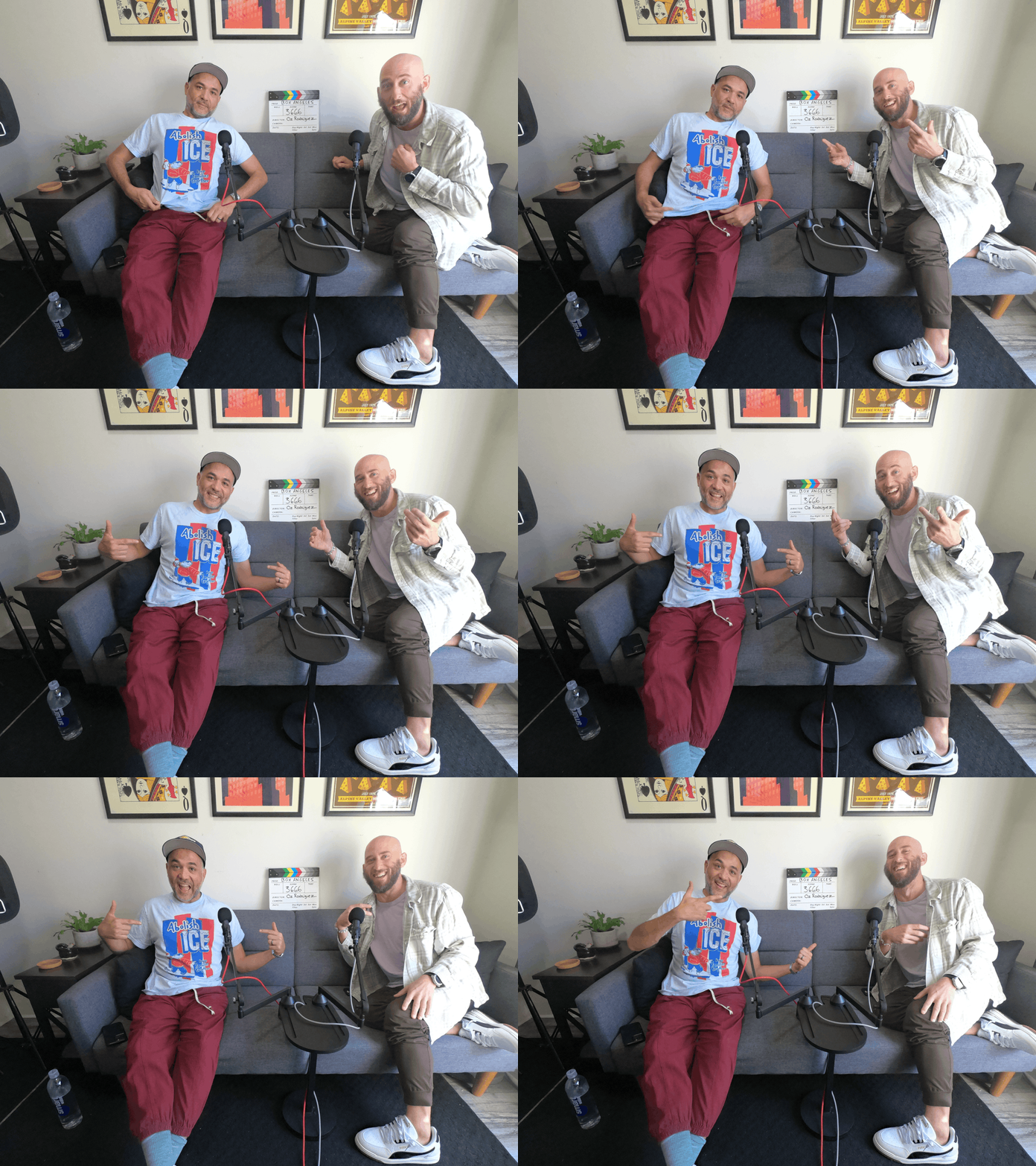
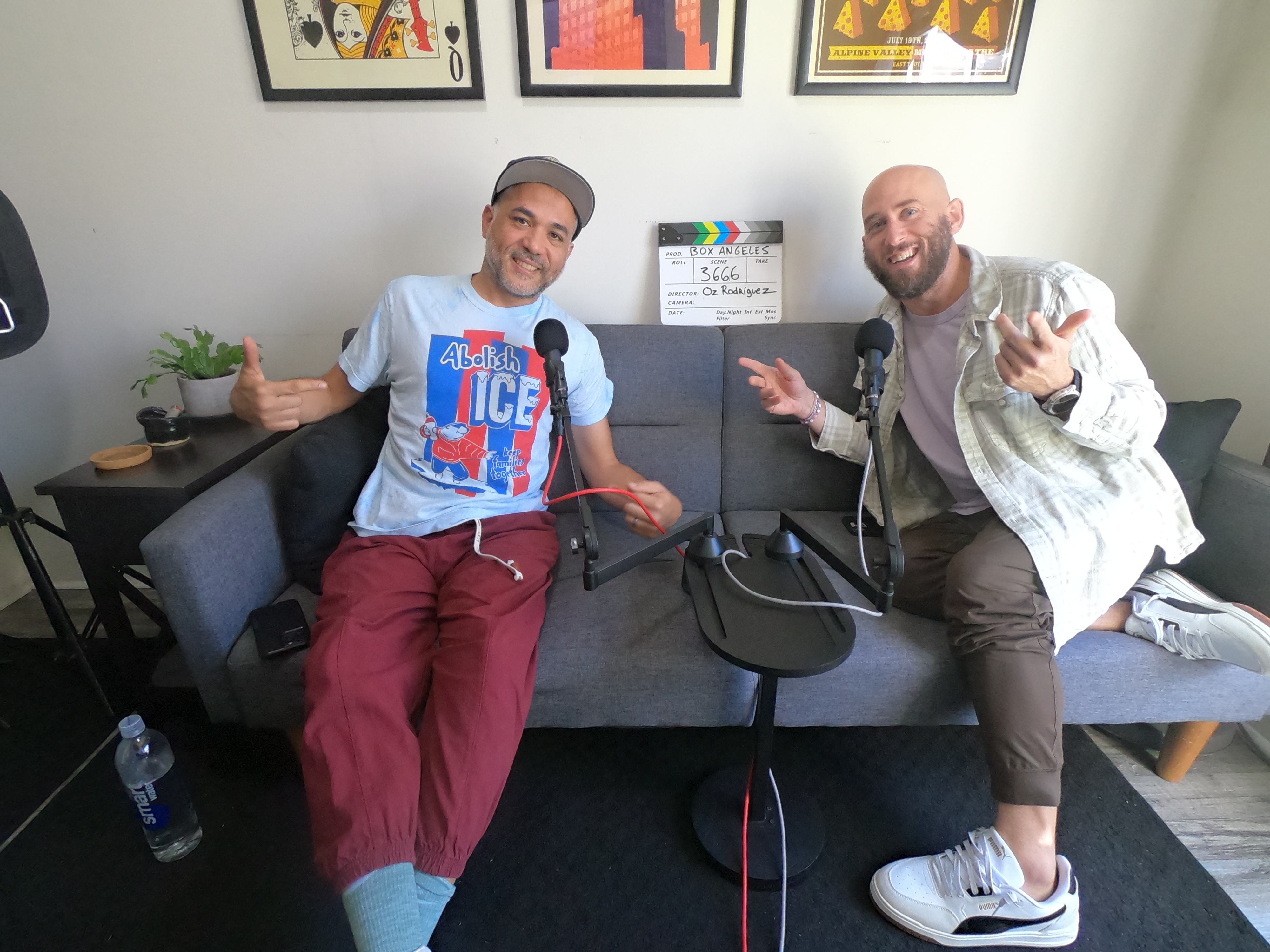
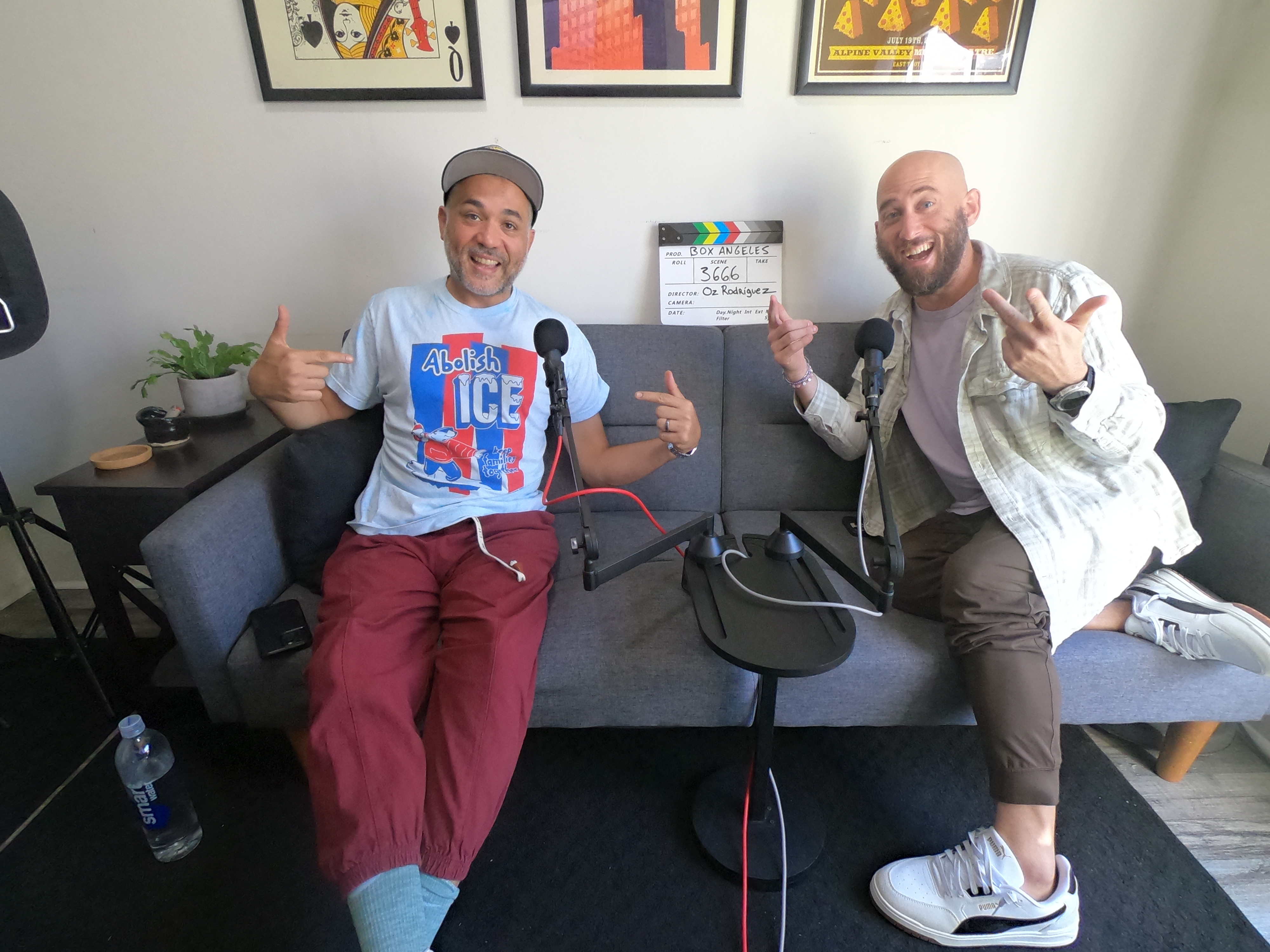
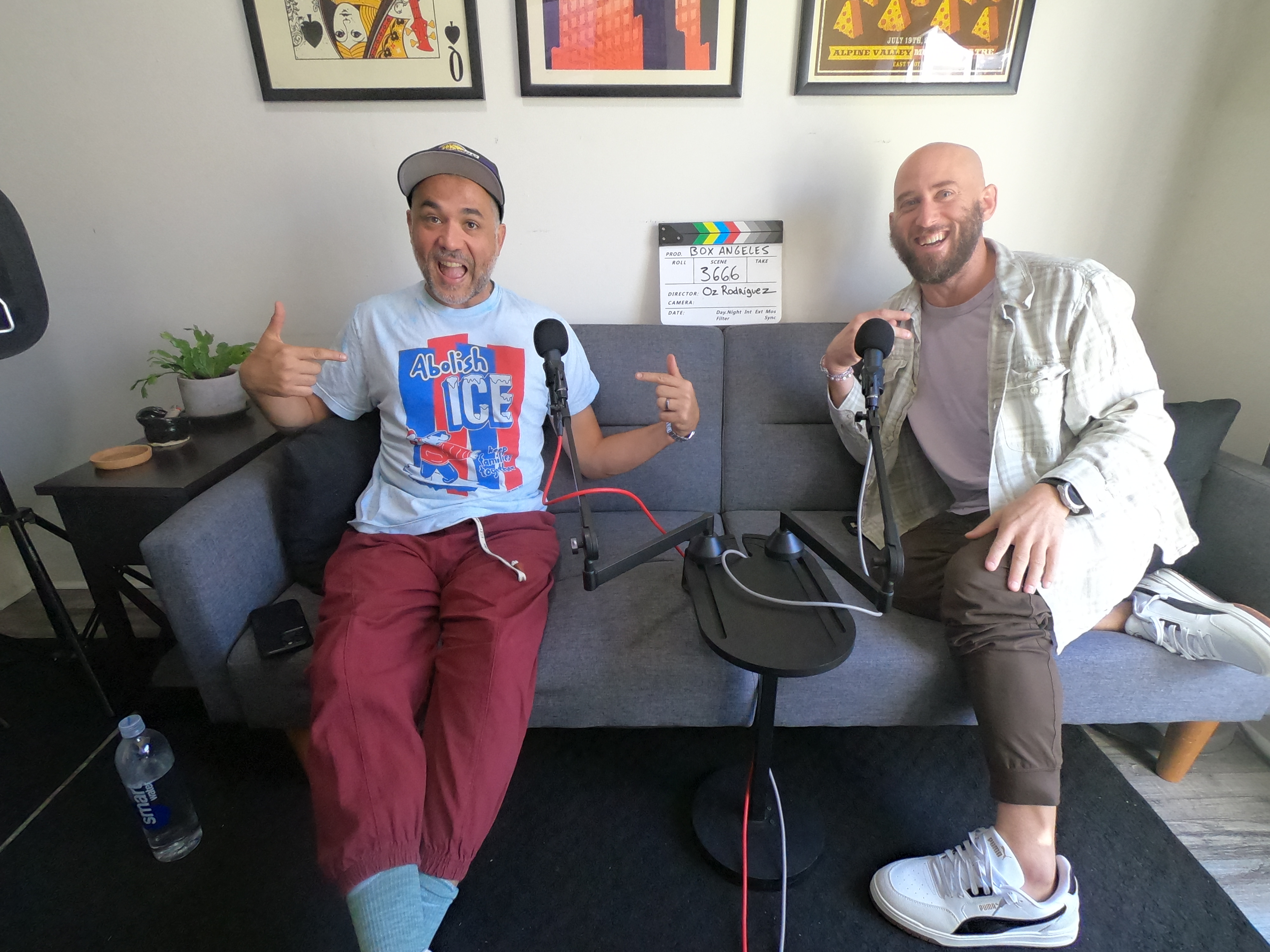
Director Oz Rodriguez (Rooster, The Four Seasons, Saturday Night Live) joins us on the Box Angeles podcast episode 366. Oz stops by the bungalow and discusses growing up in the Dominican Republic, how a DM to Adam McKay led to his big break at Funny or Die, directing comedy legends on Saturday Night Live, working with Steve Carell, why he prefers in-person auditions to self-tapes, what he looks for in actors, and more!
“I'm not judging the actor. I'm judging that take.”
— Oz Rodriguez
Beats
00:00 – Oz slates.
00:14 – Introduction.
01:41 – Being nervous in front of the camera.
02:42 – Directing Steve Carell in Rooster.
06:43 – Growing up in the Dominican Republic and breaking into Hollywood.
08:50 – How a DM to Adam McKay led to Funny or Die.
10:07 – Why editing makes you a better director.
14:48 – Behind the scenes of directing Saturday Night Live.
19:51 – Directing comedy legends and working with actors.
25:18 – Why in-person auditions beat self-tapes.
28:06 – Are actors doing too much for self-tapes?
39:17 – What makes directors want to work with an actor again?
45:19 – Creating a collaborative environment on set.
55:50 – Who took a chance on Oz.
More Oz
 – Check Oz’s IMDb.
 – Follow Oz on Instagram @oz_rodriguez.
 – Peep Oz’s website.
Transcript
OZ RODRIGUEZ (00:00)
Hi, I’m Oz Rodriguez. I’m a director, and I am here on Box Angeles.
MIKE ELDER (00:14)
Hello, welcome to the Box Angeles podcast. I’m your host, Mike Elder. It’s a pleasure having you here, and what an episode I’ve got for you today. My guest is director Oz Rodriguez. Oz has worked on some incredible shows like Rooster, Adults, The Four Seasons, Nobody Wants This, AP Bio, Detroiters, and of course Saturday Night Live, where he spent years directing some of the funniest people in comedy.
Show Full Transcript
And for a guy who spent as much time behind the camera, he was a little nervous about being in front of one, which I found incredibly satisfying as an actor. I gotta say, I love having directors on the podcast because I get to ask all these questions that actors want to ask and normally don’t get to on set, so this was a real pleasure. We talked about his start in comedy, how he ended up at SNL, what it’s like directing really funny people, and of course self-tapes. You know I can’t have a director sitting next to me in the bungalow and not talk about self-tapes, so I got you.
I also got into all my left-brain math guy questions about the business, things I probably spend way too much time worrying about, so those are in there as well. Oz was really great, really thoughtful, really open, and I think actors are gonna get a lot out of this one. Plus, it’s always nice to remember that directors, even they, get nervous when somebody points a camera at them.
Before we jump into this episode, though, a quick reminder that you can get hundreds of other episodes on the Box Angeles YouTube channel. Go to youtube.com/boxangeles. It generally helps. Click subscribe.
All right, without further ado, I give you Oz Rodriguez.
🎵 ROCKFORD (01:36) 🎵
You wanna talk to me? You wanna talk.
MIKE ELDER (01:41)
Yes, Oz, welcome.
OZ RODRIGUEZ (01:43)
We did it.
MIKE ELDER (01:44)
You did it.
OZ RODRIGUEZ (01:44)
You got a wonderful view out the window, which helped my anxiety. Again, I keep doing this. I don’t have to. Sorry.
MIKE ELDER (01:51)
Yeah, you said you were nervous. This is funny. You’re not often on this side of the camera?
OZ RODRIGUEZ (01:54)
I am never on this side of the camera, so yeah, not, not, not used to it. Don’t know what to do with my hands, and it’s gonna be great.
MIKE ELDER (02:03)
I can, I can read the nervousness, which is fun. I like making you guys sweat. Now I have all the power.
OZ RODRIGUEZ (02:08)
Yeah, yeah, I guess so. I guess so. Yeah, yeah..
MIKE ELDER (02:13)
This is my, this is my life. Auditions are like this every time. You go in there and you’re like, oh, what did I think? What’s going on?
OZ RODRIGUEZ (02:18)
I chose a different path, not a performer, where I could be behind the cameras. I forgot to shave this morning. That shows you everything. You know, I wasn’t ready for it.
MIKE ELDER (02:27)
No, I like, I like the salt and pepper. You got it.
OZ RODRIGUEZ (02:29)
Thank you.
MIKE ELDER (02:29)
Mine’s kind of out of control right now ’cause I got a callback tomorrow, and I’m like, I wanted to shave, but I got a callback, so it’s a good problem to have.
OZ RODRIGUEZ (02:35)
You gotta keep the, gotta keep the same look ’cause then they’ll be like, who’s this guy? It’s not the guy who did the thing before. How could it be?
MIKE ELDER (02:42)
Exactly. Well, I’m pumped to talk to you, Oz, because I was watching Rooster, and I thoroughly enjoyed it. And then I reached out to, like, every director that I could find that worked on that show, and you were one of them. And that was a great show, and I thought you guys did a really good job with it.
OZ RODRIGUEZ (02:54)
Thank you. Thank you.
MIKE ELDER (02:55)
All right.
OZ RODRIGUEZ (02:56)
Thank you. I was happy to, happy to have worked on it. I loved it. It was a great show, very funny, great people. And shot in Los Angeles, so.
MIKE ELDER (03:08)
Oh, you love that. Was it really?
OZ RODRIGUEZ (03:08)
I live in Los Angeles.
MIKE ELDER (03:10)
I thought it was shot in Northern California for some reason.
OZ RODRIGUEZ (03:12)
Well we shot so we shot in Warner Brothers. Studios are there, some of the exterior look, like houses and whatnot. And then the college itself is a mix of a little bit of USC, a little bit of Occidental, is that what it’s called?
MIKE ELDER (03:32)
Yeah, Oxy.
OZ RODRIGUEZ (03:33)
Yeah, yeah.
MIKE ELDER (03:33)
Where Barack star went.
OZ RODRIGUEZ (03:35)
Where who?
MIKE ELDER (03:35)
Barack Obama.
OZ RODRIGUEZ (03:36)
Oh.
MIKE ELDER (03:36)
Ever heard of him?
OZ RODRIGUEZ (03:37)
Oh, okay. Well, there you go. Barck Obama.
MIKE ELDER (03:39)
Didn’t he go to Occidental?
OZ RODRIGUEZ (03:40)
Barack Obama.
MIKE ELDER (03:40)
I’m not making that up.
OZ RODRIGUEZ (03:41)
And then Rooster. I don’t, I don’t know.
MIKE ELDER (03:42)
He went to Oxy.
OZ RODRIGUEZ (03:42)
He’s, he’s from Hawaii, and he ended up in Eagle Rock. That’s on you, man. You said that.
MIKE ELDER (03:46)
Yes, he did.
OZ RODRIGUEZ (03:47)
Not me.
MIKE ELDER (03:47)
I’m 99% sure.
OZ RODRIGUEZ (03:48)
If you say so. No signs or anything that said, no statues, but yeah, yeah. And then we went to Stockton, California, which is up north, which used to be the murder capo of the world. It is not anymore. Might be top five. So we went up there to do a week of exterior kind of locations.
MIKE ELDER (04:09)
Oh, that’s what I must have read.
OZ RODRIGUEZ (04:11)
Cause that has the trees feel East Coasty, and also it is the college, the university that Indiana Jones works at.
MIKE ELDER (04:22)
Oh, fun fact.
OZ RODRIGUEZ (04:23)
So that is where they shoot the exteriors for that too.
MIKE ELDER (04:25)
Were there statues of Indiana Jones there?
OZ RODRIGUEZ (04:27)
There were. No, there were not. There were not. No, there should be. There should be.
MIKE ELDER (04:31)
Wait, you said you loved that it shot in LA. Why do you say that? Because you live here?
OZ RODRIGUEZ (04:34)
Cause I live here.
MIKE ELDER (04:37)
Or because you want more production here or?
OZ RODRIGUEZ (04:38)
Both, but mainly me. I live five minutes away from Warner Brothers and in the other part too.
MIKE ELDER (04:42)
Got it. That makes sense.
OZ RODRIGUEZ (04:43)
Yes.
MIKE ELDER (04:43)
Well, it’s just funny ’cause, like, obviously we want production here, but to me, as I, I guess I’m a single guy who likes to travel, I think there’s something appealing about being asked to travel somewhere to shoot something.
Granted, I know that in the grand scheme of things, it’s not great, but from time to time, you just came back from New York, I think.
Like, is that enjoyable for you to go to New York and shoot something, or do you, is it at this point in your career you’re like, I wanna just stay home and sleep in my bed?
OZ RODRIGUEZ (05:07)
It is enjoyable. I do, yeah, I have a house here, I have a life here, I have a family here, so it’d be nice to be able to, you know.
MIKE ELDER (05:15)
Yeah.
OZ RODRIGUEZ (05:16)
Have a work-life balance that I could go home. And also yeah, yeah, I mean, it’s, it, it, it is nice, like, to travel and do the thing, but then there’s been years like last year, most of my jobs were outside of LA, except for Rooster. So you know, it could yes.
MIKE ELDER (05:39)
Yeah, that adds up.
OZ RODRIGUEZ (05:39)
It could be difficult.
MIKE ELDER (05:40)
Yeah.
OZ RODRIGUEZ (05:40)
It could be difficult. Very happy to be working, but it can be difficult for your personal life to not be at home ever.
My garden has suffered.
MIKE ELDER (05:50)
Oh, no. You’re a big gardener?
OZ RODRIGUEZ (05:51)
Well, I wouldn’t say big gardener, but a gardener.
MIKE ELDER (05:53)
What do you, what do you garden? I love plants. I always make, like, jalapeno peppers and stuff.
OZ RODRIGUEZ (05:58)
I, yeah, I’ve got some peppers. My tomatoes did okay with my ins and outs. I have some herbs. I have a peach tree, and then mostly a lot of Ls, you know, but those, those have survived.
MIKE ELDER (06:11)
Yeah.
OZ RODRIGUEZ (06:12)
I would say.
MIKE ELDER (06:12)
What got you into that? I find it to be so calming.
OZ RODRIGUEZ (06:15)
The actors strike.
MIKE ELDER (06:16)
Oh, funny.
OZ RODRIGUEZ (06:16)
It got me into that. Yes.
MIKE ELDER (06:18)
I find it to be so calming to do stuff like that with your hands where this stuff is, I do this stuff, this is my, like, my self-tape wall. This stuff is so ethereal and there’s nothing.
OZ RODRIGUEZ (06:27)
I notice your pothos.
MIKE ELDER (06:28)
There’s nothing in control, and then you can just get your hands in some dirt and, like, just relax and calm.
OZ RODRIGUEZ (06:34)
It’s good stuff.
MIKE ELDER (06:34)
And I, I find that to be very soothing.
OZ RODRIGUEZ (06:36)
It grounds you.
MIKE ELDER (06:37)
Yeah.
OZ RODRIGUEZ (06:37)
Right outside these shots, we got some good pothos, right?
MIKE ELDER (06:41)
Yeah.
OZ RODRIGUEZ (06:42)
Yeah, man, I’m proud of you. Oh, good stuff.
MIKE ELDER (06:43)
Thanks, dude. I don’t wanna get too much into your biography, but I do, I’m always fascinated, particularly with directors, how your path came to be. And to me, it seems like you ended up at, you went to film school and then ended up at Funny or Die, and that was kind of the way you got in, yeah?
OZ RODRIGUEZ (07:02)
Yeah. I mean.
MIKE ELDER (07:04)
Obviously, that’s.
OZ RODRIGUEZ (07:04)
How long is your podcast?
MIKE ELDER (07:06)
Right. I don’t.. Obviously, there’s a lot more, like, coming to this country and stuff.
OZ RODRIGUEZ (07:10)
Well, I was born in Cuba, Havana. One day.
MIKE ELDER (07:13)
Settle in kiddies.
OZ RODRIGUEZ (07:13)
And then no, I grew up in the Dominican Republic and you know, grew up watching movies, and my mom likes movies, and my mom opened the doors to movies that weren’t Indiana Jones type movies. Like, she was the first one to introduce me to, like, Hitchcock and stuff like that. One day she was like, “You’re watching too much crap. Watch some other movies.”
MIKE ELDER (07:36)
Oh, cool.
OZ RODRIGUEZ (07:37)
And so had this dream of going to film school or being in this business. So I went from the DR to LA to the LA Film School.
MIKE ELDER (07:47)
Oh, you went LA to New York back then to LA.
OZ RODRIGUEZ (07:49)
I know. Not a traditional Dominican path. We go to New York first.
MIKE ELDER (07:53)
I don’t know what that means, but okay.
OZ RODRIGUEZ (07:54)
Well, we’ll just tell you. We go to New York, where there are Dominicans.
MIKE ELDER (07:58)
In the heights, right?
OZ RODRIGUEZ (07:58)
To LA, where there are no Dominicans. And very far away and three time zones away. So I came here, went to film school and at film school, I met some friends, and I started directing with a friend of mine called Matt Valines. And with another friend called Dave Neer, we started making some sketches, and that led to us getting hired at this place called Super Deluxe, which was kind of concurrently with Funny or Die.
MIKE ELDER (08:25)
Yeah.
OZ RODRIGUEZ (08:25)
It maybe started a little bit earlier. But they were the first people that paid me to, or paid us to, to make a thing. And so I was technically getting paid to be a director, which was, like, the first time I, I couldn’t even wrap my head around it to be like, “We are paying the rent by making these dumb sketches.” it was early internet, so they weren’t monet- they didn’t know how to monetize anything.
MIKE ELDER (08:50)
Yeah.
OZ RODRIGUEZ (08:50)
So they ran out of money. We didn’t have a job. Ended up going back to film school, ended up being a teacher there.
And then I sent Adam McKay a DM through the Funny or Die website which I didn’t think he was ever gonna read. And then I didn’t even check it for two days, but I, in the email, sorry, in the message, I was like, “Hey, we’re, we’ve done this, and I don’t know.”
I don’t even remember what I said, but it was just like, “Hey, I don’t know. We’re here.” and he’s like, “These are great. Come for a general.”
So we went to Gary Sanchez for a general meeting, and from, and there we met the people at Funny or Die, people like Mike Farah, Owen Burke, and they gave us a thousand dollars or maybe 1,500 to make a sketch. We made it.
MIKE ELDER (09:37)
Wow.
OZ RODRIGUEZ (09:37)
It was called Dave and Jenny Get Laid. It was liked, they put it on the main website, on the front page. And then, like, a week later, we met with Harper Steele, and we were hired at Funny or Die.
MIKE ELDER (09:52)
That’s great.
OZ RODRIGUEZ (09:53)
Yeah. And well, I was there for three years, and then S- the major’s called two or three years. And then SNL, you know, offered a job, and that changed literally everything.
MIKE ELDER (10:07)
That’s awesome. Did you go to film school specifically thinking directing, or were you directing and writing, or did you know?
OZ RODRIGUEZ (10:15)
Directing.
MIKE ELDER (10:15)
You clearly it wasn’t acting. You seem averse to the acting side.
OZ RODRIGUEZ (10:18)
No, I don’t care for, I mean, I’m a clown, but I don’t care to act or, like, have to, you know, shave.
I went for directing, and I also had been before I went to film school, I started working at a commercial production company in the Dominican Republic, and that’s where I learned how to edit.
And so in this film school, you can take a major and a major and a minor, and I took directing and editing to this day.
I still love editing. I still edit. I.
MIKE ELDER (10:50)
Yeah.
OZ RODRIGUEZ (10:50)
I edited this or, well, I was one of the editors of this documentary we did about the music at SNL, so I, I, I still, still love it.
MIKE ELDER (10:59)
Yeah, editing has become something that everyone has to do at this point, and it’s.
OZ RODRIGUEZ (11:02)
Yeah.
MIKE ELDER (11:03)
I’ve learned a lot about it from all my self-tapes and all the podcasts, and it’s very valuable to.
OZ RODRIGUEZ (11:07)
It is. It is. I, I yeah, I hadn’t even thought about that. You’re right. Everybody has to edit their own show that they’re making constantly 24/7.
MIKE ELDER (11:16)
Yeah.
OZ RODRIGUEZ (11:16)
But I think it’s, it is very valuable for, I always, when, like, when I talk to young filmmakers, I always say, you know, don’t forget, pay attention to editing.
Editing is very important, and that’s where everything gets put together so you can learn. Like, I remember one of our first classes, this teacher, his name was Danny Brown.
He gave us the, the footage from some procedural, I forget, some law and order type of thing, and we, we could put the scene together, and everybody put the scene together differently. But as you’re like.
MIKE ELDER (11:49)
Oh, that’s cool to see.
OZ RODRIGUEZ (11:50)
But you’re also watching, like, how many takes of the wide they took, how many takes of the close-up they did.
MIKE ELDER (11:55)
That’s really cool actually.
OZ RODRIGUEZ (11:55)
How many or, or what takes they don’t use and what part of the thing you do wanna use. So it, it starts teaching you as a director, like, what’s important, what, and how to, like, keep editing in mind when you are on set.
And, like, know, like, well, I got this moment there. I know that that moment is good, and maybe we didn’t get those other moments, but I know that when I cut to you and you say that line, we got it.
MIKE ELDER (12:21)
Yeah.
OZ RODRIGUEZ (12:21)
So I, I do feel like it really helps. And I think it helped me to de- not it, it’s, when I first started directing, my biggest fear is sort of talking to actors ’cause I started working with my friends, and it, I didn’t really go to acting school, so I don’t, I felt like I didn’t have the tools to communicate.
But by watching the edit and watching the dailies, I could see, I could start at least seeing what the actor does take to take, where, like, I couldn’t really verbalize exactly what they were doing, but I’m like, “Oh, they changed this performance,” and I didn’t know if it was the actor or the director, but at least I could, like, see the work being done take by take.
MIKE ELDER (13:01)
Yeah.
OZ RODRIGUEZ (13:02)
And it’s, and it, it, I don’t know, it helped me appreciate what actors do more.
MIKE ELDER (13:06)
Yeah, for sure. That’s a really fun exercise to have everyone edit the same footage and see what comes out because then, God, there’s ways you wouldn’t even think of probably that.
OZ RODRIGUEZ (13:15)
Yeah.
MIKE ELDER (13:15)
Your peers do.
OZ RODRIGUEZ (13:16)
Yeah.
MIKE ELDER (13:16)
I, I was gonna ask this about SNL specifically, but now I’m curious about Funny or Die too. That was a job? They, they had you on.
OZ RODRIGUEZ (13:22)
Yes.
MIKE ELDER (13:23)
Salary.
OZ RODRIGUEZ (13:23)
Can you believe it?
MIKE ELDER (13:24)
It probably wasn’t very much, I assume, but it was enough to live?
OZ RODRIGUEZ (13:26)
It was enough to live. It was enough to live in my 20s. I.
MIKE ELDER (13:29)
That’s great.
OZ RODRIGUEZ (13:30)
It was great. Like, I, you know, sometimes we have friends I have drinks with some of those people that work there, and I, we can’t believe that was actually a job that we had where there were days I didn’t even do anything.
MIKE ELDER (13:42)
That’s what I was gonna ask. Was there’s, like, a quote or something, or did they bring it to you, or were you constantly pitching stuff, or?
OZ RODRIGUEZ (13:48)
I wouldn’t say constantly pitching. We had to pitch stuff, but, like, it wasn’t like, because it’s a website and it’s not like SNL where it’s like the show’s on Saturday, we all gotta do a 90-minute show, it wasn’t it wouldn’t have those deadlines.
MIKE ELDER (14:02)
Right.
OZ RODRIGUEZ (14:02)
It’s crazy. And.
MIKE ELDER (14:03)
So it was much more relaxed.
OZ RODRIGUEZ (14:04)
Yes. And I think there was a, there were a lot of writers there, and also people were coming in to bring stuff, and people were already, like, uploading stuff that was done, so it wasn’t like, “We need five videos this week,” you know? It’s like, “We need a video this week,” or.
MIKE ELDER (14:19)
Yeah.
OZ RODRIGUEZ (14:20)
Like, you’d plan for it, but it wasn’t, it was, like, minor leagues compared to SNL.
MIKE ELDER (14:24)
That’s awesome.
OZ RODRIGUEZ (14:25)
Yeah.
MIKE ELDER (14:25)
All from a DM you sent too. It’s so funny when we take chances on ourselves.
OZ RODRIGUEZ (14:30)
Yeah.
MIKE ELDER (14:30)
You never know what comes of it.
OZ RODRIGUEZ (14:32)
Yeah. And, you know, nine times out of ten, they might not respond to that DM, but if one person responds, it could be life-changing.
MIKE ELDER (14:39)
Yeah. And what’s the worst that happens is if they don’t respond. It’s not like you’re banished from Hollywood.
OZ RODRIGUEZ (14:43)
Nothing. You, you, you forget.
MIKE ELDER (14:45)
Yeah.
OZ RODRIGUEZ (14:45)
You move on to the next person.
MIKE ELDER (14:46)
They completely forget, for sure.
OZ RODRIGUEZ (14:48)
Yeah, yeah.
MIKE ELDER (14:48)
At SNL, I, so you, that also was, like, a full-time, like, you went in every day?
OZ RODRIGUEZ (14:53)
Yeah.
MIKE ELDER (14:53)
It wasn’t, like, a freelance directing gig? It was, they have, they had, like, a set number of segment producers? ‘Cause that was your title at SNL, right? Segment producer?
OZ RODRIGUEZ (15:02)
No, it was a director.
MIKE ELDER (15:03)
Oh, just director, straight up?
OZ RODRIGUEZ (15:04)
Yeah.
MIKE ELDER (15:04)
Okay. So they, they have a set number of directors on staff just as they would actors and writers?
OZ RODRIGUEZ (15:09)
Mm-hmm.
MIKE ELDER (15:09)
That’s awesome. How many is it? And, like, how much are you doing in a week?
OZ RODRIGUEZ (15:13)
Right now, it’s three. When we started, it was two. But there’s stuff to do. I mean, there’s promos, there’s and you’re kind of working from Wednesday to Saturday.
So Monday to Tuesday, you, Tuesday, if you’re a writer, you write, but if you’re not a writer, you don’t really do much. But Tuesday, you they shout promos, so that could be something you do on a Tuesday. You’re shooting some promo with whatever.
Monday, you Monday’s the first day. I’m sure you’ve seen the documentaries. That’s when the host comes in and everybody crams into Lorne’s office and blah, blah, blah, blah, everybody pitches.
I stopped going on Mondays ’cause I didn’t, no one missed me, and I was like, “I don’t have anything to do, so I’m just gonna not come. I’m, I’m gonna rest,” and it was fine. And but yeah, I had an office. I was there. I had 20, 21 weeks of guaranteed work, and it was great.
MIKE ELDER (16:14)
Oh, that’s awesome.
OZ RODRIGUEZ (16:15)
Yeah.
MIKE ELDER (16:15)
So how do you divvy up the work between the three directors, though? Do you guys just get in a rhythm where.
OZ RODRIGUEZ (16:20)
Well.
MIKE ELDER (16:21)
It’s work with a certain person or it’s a certain aspect of the show you guys own?
OZ RODRIGUEZ (16:25)
It, it comes up, it, so there’s a film unit. The film unit has been there from day one and it was literally, it’s called film unit ’cause they used to shoot on film and, like, the Albert Brooks and the parodies, all these things were shot on film. And then so the film unit for 30-something years was the unit that made the commercials or the anything that was they call it pre-tape.
MIKE ELDER (16:52)
Pre-tape, yeah.
OZ RODRIGUEZ (16:52)
Yeah, anything that’s pre-tape. And then when Digital Shorts dudes showed up, they created their own kind of unit. I’m sure you’ve heard the, the stories. They worked with the film unit, and it didn’t work out because they couldn’t get exactly what their vision, it, it was not a fit, and they needed to work on their own.
This is the when digital videos really blowing up and digital editing is a lot easier. So those guys did their thing. We all know what happened.
So when they left, there is now sort of videos are a lot more popular in SNL, so there’s demand for even more videos. So when I came in, I came in to sort of fill that spot. The LA Island had when they had left, they wanted more videos, but now it was open to any writer to write to that, any writer could occupy the Lonely Island spot.
So two directors the person from the film unit usually gets the bigger like, the bigger video of the week, like, the more expensive one.
MIKE ELDER (17:56)
Sure.
OZ RODRIGUEZ (17:57)
And they, they kind of have the more seasoned crew. So, like, if there’s, like, a big parody of whatever some crazy movie, they’re usually doing it.
And then and then it got to a point where then they added the Good Neighbor guys, and Dave McCarry came in, so he became the third director.
So Wednesday, when they do the table reads one of the producers, usually Eric Kenworth or Lorne, decides who will do which video. So you don’t really get to pick.
MIKE ELDER (18:25)
Got it.
OZ RODRIGUEZ (18:26)
Sometimes you can, like, “Hey, I’d love to do the thing.”
MIKE ELDER (18:28)
Speak, yeah.
OZ RODRIGUEZ (18:29)
But that’s happened to me where I, like, wanted to do a thing, but, like, when I was running the film unit, they were like, “No, you have to do the big video because of, you know, you got the big crew.” so I don’t know if I answered that question.
MIKE ELDER (18:43)
No, you did, for sure.
OZ RODRIGUEZ (18:44)
I’m rambling now.
MIKE ELDER (18:44)
You were there 10 years?
OZ RODRIGUEZ (18:46)
I was there officially seven years.
MIKE ELDER (18:48)
Seven.
OZ RODRIGUEZ (18:48)
But then I keep coming back for reasons. When they invite me. Like, I was there for the 50th. I was there for the Bad Bunny show. I’ve come for some shows when they need a director. So officially in-house, seven years.
MIKE ELDER (19:02)
Got it. Is that, like, a good tenure for, is that, like, a standard tenure for a director at SNL? I, I guess I don’t know. This is kind of new to me. I’ve never really even thought about this.
OZ RODRIGUEZ (19:12)
Yeah, me, yeah, I, me neither. They’ve asked me if this was a dream come true. I didn’t even know this was a job you could do. So depends. Some people have been there for decades.
MIKE ELDER (19:23)
Oh okay.
OZ RODRIGUEZ (19:23)
Some people have been there, but I think it’s usually around, I think my friend Paul Brigante, who did it right after me, was there for six years. So I think, I mean, it, it, like, I think it’s a great job.
It’s really fun. You kind of become addicted to it, and the stress and, like, when something hits, it’s, like, an amazing feeling.
And but I think if you wanna sort of challenge yourself and be able to do other things, you do have to at some point get out of there.
MIKE ELDER (19:51)
Yeah, for sure. When you’re directing those hilarious people, I’m thinking, like, I don’t know, Bobby Moynihan and, and such. When you direct those people, do you, do you let them just cook, or do you try to make them funnier, or do you, can you make them funnier as a director? How do you approach something like that where they’re just such in their wheelhouse and they just know what they’re bringing?
OZ RODRIGUEZ (20:15)
I think it’s a little bit of everything. Like, yes, you let some people cook.
I think sometimes you throw out ideas for, you know, example, with Bobby, he’s an amazing improviser, so Bobby will do an amazing take one, and then take two, you can just be like, “What if it’s this way?” And Bobby will be like, “Great, let’s go that way.”
And then you have all these amazing options in the, in the edit. So I’m not necessarily telling Bobby to say the line in a way that’ll make it funnier.
MIKE ELDER (20:45)
Sure.
OZ RODRIGUEZ (20:45)
But with Bobby, he’s such an amazing improviser where Bobby’s just trying to get all the, as much stuff as you can. And, and especially if he’s nailing it, part of it just becomes like, “Well, I’m just enjoying this.”
And then sometimes maybe there could be a thing of, like, maybe the joke is, will be funnier if it’s less, if it’s more understated or thrown this way, or, or maybe you gotta hit this word a little bit more because of X reasons will be sound funnier. So I think there’s adjustments that you can make too.
And I think sometimes if the joke isn’t landing, it could also be an adjustment in performance of, like, just regular kind of directing of, like, “I think you need a little more forward this,” or, “I think you wanna embarrass this person,” or whatever kind of direction you give someone. I think that could also make something funnier.
So I think it, it’s I think you kind of feel it in the room if it’s working or not. And I think you as far as, like, what the solution is, there’s different kind of approaches.
MIKE ELDER (21:50)
Yeah.
OZ RODRIGUEZ (21:50)
So I think it’s, it’s, you gotta kind of assess what’s happening and kind of think of, like, “Maybe let’s try it this way. Maybe I’ll try that.” so a long-winded way of saying, like, I think you can shape something to be funnier, but it’s sort of case by case.
MIKE ELDER (22:04)
Yeah, that makes sense.
OZ RODRIGUEZ (22:05)
And some people, you don’t, like, I just worked with Amy Sedaris. I was just, like, enjoying just, like. Just, yeah, just leaning back and just letting her cook. And my direction was actually now, like, actually go for it.
MIKE ELDER (22:21)
Yeah.
OZ RODRIGUEZ (22:21)
Whatever you wanna do. But.
MIKE ELDER (22:24)
Yeah, that makes total sense. I asked your peer a new this last week. Peer? Colleague?
OZ RODRIGUEZ (22:30)
Yeah. Enemy.
MIKE ELDER (22:30)
Co- co- DGA friend? Enemy?
OZ RODRIGUEZ (22:34)
Enemy.
MIKE ELDER (22:36)
And I feel like this is applicable here too. Do you treat somebody, like, when you’re on Rooster, like, Steve Carell, do you treat him differently than a co-star that’s bringing him the coffee? Do you have a different approach to people that are well-established versus, you know, the one-line co-star?
OZ RODRIGUEZ (22:54)
I mean, yes and no. I think that the one-line co-star is also the one-line co-star on a Steve Carell show, so that person could be nervous, could be you kind of wanna get a gauge of, like, how that person is, is feeling and working and doing the thing.
And I think that the answer is no, but, like, it’s, it depends on experience and it depends on many, many sort of other factors. But ultimately, the answer one would hope is no, and you just sort of treat everybody the same and obviously with respect and kindness.
So no, kind of. I don’t know. It’s, it’s also, like.
MIKE ELDER (23:40)
It’s such a democratic answer.
OZ RODRIGUEZ (23:41)
It’s also tough because Steve Carell is, like, incredible and, like, such a pleasant person and so good at his job. So it’s, it’s, it’s but I think that as a director, if we have one person that’s coming in from one with one line, I do wanna make that person feel like they are also part of the, the story that we’re telling and part of the scene and not feel left out and not feel like we’re only talking to Steve Carell here. He’s the one important person.
It’s like, no, you also need to nail your line, and we, I need to make, I need to do whatever we need to figure out so you feel good and you can do this line and do this performance. So so yeah, it’s, it’s, I guess every actor has their own language and their own way to work, and you gotta quickly figure that out.
So yeah, hashtag complicated. I’m not sure how to answer that. I think yes and no at the same time.
MIKE ELDER (24:37)
Yeah. It’s funny. They, they both have a pressure, right?.
OZ RODRIGUEZ (24:40)
Yeah.
MIKE ELDER (24:41)
Anu was talking about how, like, Steve Carell or Harrison Ford, when she worked on Shrinking , and it’s like, they are number one on the call sheet for a reason. They got a lot to think about, a lot to go on. But at the same time, it’s like this one-line co-star person, they have to book 26 of those in a year to get health insurance.
OZ RODRIGUEZ (24:54)
Right.
MIKE ELDER (24:55)
They don’t wanna fuck up this one because.
OZ RODRIGUEZ (24:56)
Yeah.
MIKE ELDER (24:57)
So there’s, it’s so funny, the different levels of pressure on different people.
OZ RODRIGUEZ (25:00)
Yeah, sometimes the number one is, is fun and involves you and sort of makes you feel as part of the group. And something number one is, like, comes in, does the thing, and then it’s like, “Bye, just call me.” Like, it’s not necessarily, like, it really involved with the other actors. So it’s, it, it is case by case.
MIKE ELDER (25:18)
Yeah. We talked about, I, I gotta talk about self-tapes ’cause, I mean, that’s such a hot issue for, for people. But I guess let’s just start there. Do, what are your thoughts on self-tapes? Do you love them? Do you hate them? Do you, are you, go ahead.
OZ RODRIGUEZ (25:35)
I do. I mean, it’s the norm right now. I think that.
It’s just better on, it’s better come, spoiler alert, better in the room. I think that in. When it comes to, like, a ton of stuff that you have to get through and you could just do it at 9:00 PM on a Monday, I think that aspect is great. Let me just open up this link and this collection of lines and da da da.
Can’t deny that there’s something to that instead of just, like, you need to put a whole day aside to, to read people. But I do feel like in the room, you get to really really figure out who this actor is ’cause, like, they could just do the thing, but especially in comedy, they’re rewriting so much, and then they rewrote the line, and this person just put all their work and energy to make it, to land it in that self-tape, and they landed that, that line, and it was perfect.
But then can they, like, be directed? Can they, like, you know, hang with someone that’s improvising all the time? And, like, it’s hard to, like, it’s hard to, to see. So I think it, it’s only good in the sort of the convenience of the work and the, it somewhat helps in, like again, if you’re in the middle of production and you gotta cast someone that has maybe two or three lines and you don’t have time to go to set, it is helpful there.
I think any, any big parts should be done sort of face to face, or you should, like, at some point meet with a person and not cast, like, the lead of your TV show or your movie just off a, a tape.
MIKE ELDER (27:24)
Do you push for that when you have, when that comes up for you?
OZ RODRIGUEZ (27:29)
It, it works sometimes, not always.
MIKE ELDER (27:32)
But you are pushing, you are pushing for it. You do say, “Hey, I’d like to cast this in person.”
OZ RODRIGUEZ (27:37)
If it’s possible, but, like there’s things of, like, “Well, we, our tax break is in this city, and we can’t fly a person this way,” or da da da..
MIKE ELDER (27:49)
That’s a great impression.
OZ RODRIGUEZ (27:51)
And so yeah, whenever you can, you go for it.
MIKE ELDER (27:54)
Yeah.
OZ RODRIGUEZ (27:54)
But I would say it’s it’s, it’s hard nowadays.
MIKE ELDER (27:58)
We were talking earlier about editing, and this is something do you direct many commercials?
OZ RODRIGUEZ (28:04)
Not many, but I do.
MIKE ELDER (28:06)
Okay. This is a thing more so in the commercial space, I feel like, lately, but there’s, there’s one casting director that wants you to embrace the environment and shoot the commercial per se.
OZ RODRIGUEZ (28:16)
Mm-hmm.
MIKE ELDER (28:17)
Like, really embrace, basically, they want you to make the commercial at your house. And it’s very controversial for a lot of reasons. But we were talking earlier about editing and, like, edit, knowing what the edit looks like.
OZ RODRIGUEZ (28:29)
So what does that mean? Do different shots of yourself?
MIKE ELDER (28:30)
It means if you’re, if you’re, if you’re driving a car, shoot in the car, or if you’re, you know, looking at yourself in a mirror, shoot yourself in a mirror.
OZ RODRIGUEZ (28:38)
But you have to get different shots or just?
MIKE ELDER (28:39)
Yeah, different shots. They, this casting director posted a video the other day that was like, “This woman nailed this audition, and the woman literally made a short film that was essentially the commercial.” And it was, like, three minutes of her in different rooms of her house in bed waking up and all this stuff.
And she was like, “This is perfect. I could see the commercial perfectly.” And other casting directors spoke up and said, “That’s a ridiculous standard,” which I tend to agree with, but.
OZ RODRIGUEZ (29:04)
I don’t know.
MIKE ELDER (29:04)
It seems like you agreed too.
OZ RODRIGUEZ (29:05)
Yeah, I don’t know what I would, I would, I would be like, “That’s a lot of work.”
MIKE ELDER (29:09)
Yeah.
OZ RODRIGUEZ (29:09)
And maybe you could be like, “Yeah, I guess I see it,” but also you could be like, “That’s a lot of work, and I’m just seeing the work and not your, the performance.” So I, I don’t know that it guarantees anything.
MIKE ELDER (29:19)
That’s true.
OZ RODRIGUEZ (29:20)
Yeah.
MIKE ELDER (29:20)
It definitely doesn’t guarantee anything. I think it just sets an unrealistic standard that we’re already having to do all of this.
OZ RODRIGUEZ (29:26)
I think it’s crazy.
MIKE ELDER (29:27)
Yeah, it’s crazy.
OZ RODRIGUEZ (29:27)
I mean, I think, like, being in the mirror helps. I think. Like, I think, or, like, having a scarf, whatever, like, some of that could help, but doing, like, a full edit session is insane. Sorry.
MIKE ELDER (29:38)
I agree. Sorry. I, I tend to agree, and I refuse to do it whenever I get auditions. You’re good. Auditions from this person. I just use my backdrop as I want to.
But what I was gonna ask you, though, is we were talking about editing earlier. Do you like seeing self-tapes that are edited kind of like how we would shoot? Does that help with you when you’re casting? Like obviously, you want specific turns and eye lines and stuff, but I mean, like, do you want movement towards camera? Does that help when you’re?
OZ RODRIGUEZ (30:07)
Yeah, I mean, movement, like, be alive and be a person, have physicality, but, like, I don’t need a dolly. You need to, like, hey, do a dolly when I move, like, it just, like, I mean, I think with self-tape, there’s also, like, a few, like, standards of, like, don’t be too far. I can’t see you. Don’t be too close. That’s too much. Or, like, you know, you gotta find the right shot.
MIKE ELDER (30:32)
Yeah.
OZ RODRIGUEZ (30:33)
And I think you wanna be somewhat physical, but, like, I don’t I don’t know. I don’t, like, do you it, it’s, you gotta get me here, you know? It’s, it’s, this is what’s gonna get the people that hire you. So it’s, all that fluff could help, but.
MIKE ELDER (30:55)
Yeah.
OZ RODRIGUEZ (30:55)
You might spend a lot, you might waste a lot of time too.
MIKE ELDER (30:58)
Oh, well, the, I’ll, I’ll just say this. I feel like we are wasting a lot of time ’cause we do all these self-tapes, and we’re like, “Is anyone watching this?” We just send it off. We’re like, “Goodbye, self-tape number 487.”
So I don’t know what the answer is, but yeah, it already feels like a waste of time. So I, what I guess I’m getting at is, like, is there a way outside of shooting the whole short film, is there a way to stand out in auditions, or is there something that you notice when actors do that really helps with auditions or, or specifically self-tapes?
Outside of, you know, good lighting, good audio, the basic stuff.. We’re trying to find the key, Oz.
OZ RODRIGUEZ (31:36)
I mean, good.
MIKE ELDER (31:36)
We want the secrets.
OZ RODRIGUEZ (31:38)
Good lighting, good audio helps, but it’s also not, I mean, you need to be there’s a baseline of good audio.
MIKE ELDER (31:44)
Yeah.
OZ RODRIGUEZ (31:45)
But also, like, if it’s, like, fully professional, doesn’t mean you’re getting the job either. I think it’s, I mean, it’s sort of the same thing that, like, I think it’s just finding a person that has an interesting point of view or an interesting way into the character.
I don’t really have anything new to add. I think you just know when you know.
I think I think that the, the tough thing about, I feel for actors because with self-tape, you’re just putting you’re putting forth an idea of what you or a take of what you think. And if I were to see in the room and I see you doing a voice, for example, I’d be like, “Can you not, can we not make it British or whatever?”
MIKE ELDER (32:26)
Yeah.
OZ RODRIGUEZ (32:26)
And then you might be able to have another chance at it. But if, like, you took a swing, you decided to be British, and I opened the video and I was like, “Oh, boy, I don’t know about this British stuff next.” And that sucks for.
MIKE ELDER (32:39)
Yeah.
OZ RODRIGUEZ (32:39)
The performer. If, and obviously, being British is a, is a crazy example, but just, like, let’s say you took a swing some way and you read the character in a way, and I don’t necessarily agree or, or I don’t see it that way, or I’m gonna tell the story this way.
It’s tough because you don’t, I’m not judging the actor. I’m judging that take. And, like, the actor could be amazing. It could give you a bunch of different colors.
So it’s, it’s, I feel for you guys, I got no solution.
MIKE ELDER (33:08)
I mean, yeah, that just stressed me out because I was like, “What they, they say make a strong choice,” and then that lends itself to just being vanilla and just being basic so that you don’t get dismissed right away. Oh, it’s tough.
OZ RODRIGUEZ (33:19)
No, you definitely need, yeah, but you definitely need to make a choice ’cause.
MIKE ELDER (33:22)
Are you watching, so you, you don’t watch, and this isn’t bad or good, I’m just curious. You don’t watch the whole audition of every tape you get?
OZ RODRIGUEZ (33:30)
Oh, no, you have to. I’m just saying that that sometimes you just get one, sometimes some actors give you two takes of, of one scene.
MIKE ELDER (33:41)
I got it.
OZ RODRIGUEZ (33:42)
And you get two different sort of flavors of direction or whatever.
But, like, if you just get one, the one scene and you did made one choice, and maybe that choice isn’t exactly what we’re looking for.
If you were in the room, I feel like in the room, you made a choice.
I feel like maybe there’d be some sort of recognition of you making the choice and be like, “I see something, but what if you. This way.”
MIKE ELDER (34:04)
Yeah.
OZ RODRIGUEZ (34:05)
Where, like, if I were to open up a clip and you make that choice and I don’t agree with it or I’m not, it’s not really speaking to me, I think it’s easier for me to go next than necessarily.
MIKE ELDER (34:16)
Yes.
OZ RODRIGUEZ (34:16)
Tell a casting director, “Can you ask this person to do it again?” and da da da da.
MIKE ELDER (34:21)
Right.
OZ RODRIGUEZ (34:21)
Which has happened, but I, I, I feel like it’s easier to move on to the next one when you’re getting clips.
MIKE ELDER (34:27)
How often, if at all, does it happen where they do do that do-do? That was so dumb. Why did I laugh?
OZ RODRIGUEZ (34:35)
You know, it’s the little things.
MIKE ELDER (34:36)
You’re used to working with Bobby Moynihan, and I’m laughing at saying do-do.
OZ RODRIGUEZ (34:40)
Do-do.
MIKE ELDER (34:40)
You know. We gotta get some joy in life somewhere.
OZ RODRIGUEZ (34:44)
You got it.
MIKE ELDER (34:45)
Somewhere. It’s election day.
OZ RODRIGUEZ (34:46)
It’s election day.
MIKE ELDER (34:46)
We’re recording this on election day.
OZ RODRIGUEZ (34:47)
Hopefully, things are brighter when you hear this. Hopefully, there’s power where you are.
MIKE ELDER (34:53)
Oh, God. Where was I going? What was I doing? I completely, oh, how often does the, the British accent surprise you and actually you like, “Oh, this actually,” not necessarily the British accent, but how often does somebody come in with something you weren’t expecting at all and you’re like, “Eh, ooh, this might, this might actually.”. Change my mind on this.
OZ RODRIGUEZ (35:11)
It definitely happens. I mean, I’m not, I can’t, like, give you a number right now, but let’s say one out of four times.
MIKE ELDER (35:19)
I need an exact percent.
OZ RODRIGUEZ (35:20)
One out of four times..
MIKE ELDER (35:22)
Well, that’s a lot.
OZ RODRIGUEZ (35:23)
I don’t know. It just, it, it does happen. I think sometimes the casting director, and especially if the casting director is, is great and someone you trust, they can even, like even even, like, show you, like, “No, no, no, this person’s got an interesting take,” not necessarily what you thought, but give, give them, give them a shot. Oops, sorry.
MIKE ELDER (35:45)
Yeah.
OZ RODRIGUEZ (35:45)
Sometimes casting directors have, have, like have helped me, like, get out of, like, what I thought was a character and sort of see someone else’s take and, and appreciate it, so.
MIKE ELDER (35:57)
How, okay, cool. How often do you go into a?
OZ RODRIGUEZ (36:00)
You like numbers. You like often. You like percentages. Oh, boy.
MIKE ELDER (36:05)
Oh, it’s funny. I studied engineering, so I am.
OZ RODRIGUEZ (36:06)
Okay.
MIKE ELDER (36:07)
And that is, and that’s the problem with me is I’m, like, trying to solve the self-tape algorithm when there’s not an answer.
OZ RODRIGUEZ (36:12)
Uh-huh.
MIKE ELDER (36:12)
It’s creative, and it’s always random, and I gotta get used to that. And I am used to that. I’ve been doing this for a long time, but I do, my brain still works in that way where I’m.
OZ RODRIGUEZ (36:20)
Uh-huh.
MIKE ELDER (36:20)
Like, I log every audition. I see how many casting directors bring me in and who doesn’t and all that, but.
OZ RODRIGUEZ (36:24)
Sure. Sure.
MIKE ELDER (36:25)
I think we just want some semblance of control is what I’m getting at.
OZ RODRIGUEZ (36:28)
Yeah, yeah, yeah.
MIKE ELDER (36:28)
But how often do you go into or how, I don’t even know how to rephrase it. How often do you go into something and have just have no idea what the character. Like, you’re like, “I don’t even know what this person is.” Just give me a, a potpourri of.
OZ RODRIGUEZ (36:44)
In an audition, you’re saying?
MIKE ELDER (36:46)
Yeah, like, for when you’re casting something, like.. I’m sure it happens with, like, smaller roles, obviously, but you’re like.
OZ RODRIGUEZ (36:52)
Yeah, it’s happening. It’s definitely happening.
MIKE ELDER (36:53)
I need a barista. I don’t know what kind of barista. Just give me a.
OZ RODRIGUEZ (36:56)
Yes. Sorry. You’re asking, has that happened or how many times?
MIKE ELDER (37:00)
I don’t need a specific number. I’m just curious.
OZ RODRIGUEZ (37:01)
It’s happened at the.
MIKE ELDER (37:02)
It comes across to me.
OZ RODRIGUEZ (37:03)
12% of the time of my life in casting. I would say at 12%. It has happened before. Yeah, and I think sometimes there are, like, I did the the pilot for Barbershop coming soon to.
MIKE ELDER (37:20)
Oh.
OZ RODRIGUEZ (37:20)
Amazon February 2027 Prime video. And there were definitely roles there that, like, on that, when we did casting, we, it was, it was nice to sort of be surprised and, like, see that we did a lot of in-person casting, and that was amazing.
MIKE ELDER (37:39)
Yeah.
OZ RODRIGUEZ (37:39)
And that was so cool to be like, “Oh, this person went that way, and that person went this way.” And I wasn’t necessarily, and that, like, it’s also informed people, me and the writers, when someone has a really strong take and then it’s like, “Oh, that’s amazing. Let’s lean that way, and let’s write more in that direction.”
MIKE ELDER (37:57)
Yeah.
OZ RODRIGUEZ (37:57)
Thing. And it it, it even happens you know, in Rooster, I saw this, Bill Lawrence and the writers did, like, some of the actors were already cast, but, like, they were, they were reacting to the performance on set and then wrote them even more into the series, like.
MIKE ELDER (38:20)
Oh, I love that.
OZ RODRIGUEZ (38:20)
Like, that happened with the Tommy character, that, that kid that, that Steve Carell kind of befriends. It’s, they were, they, it was really working those first weeks, so they wrote even more and more stuff to them.
So I think it does happen. I think it’s really exciting when, when when an actor shows you what, shows you what a character could be or shows you what else they could be. Like, it’s something on the page, and and when an actor just really blows it up, that’s really fun ’cause, like, like, on Barbershop, it’s an ensemble, so you have all these people.
And, like, sometimes the main character takes a lot of the attention and a lot of the notes and a lot of the sort of massaging, and then you have these other characters that, like, you know, you kind of have an idea of who they are, but when someone comes in and kind of shows you in person and shows you what direction they could go, it’s really, really exciting, so.
MIKE ELDER (39:15)
Yeah.
OZ RODRIGUEZ (39:16)
So yeah, it definitely has happened.
MIKE ELDER (39:17)
Well, in that vein, is there something that actors do that make you, makes you really wanna work with them again?
OZ RODRIGUEZ (39:23)
Yeah, be nice.
MIKE ELDER (39:26)
That’s it.
OZ RODRIGUEZ (39:27)
Be kind. I mean, that’s just, like, a base level. I think it’s
it’s I mean, it depends. Some actors are just like, you know, Bobby Moyniham, who we talked about, is a wonderful comedian, comedic actor, but also a great human being.
So that is a good example of someone who’s really talented, really funny, but also a great person. So I think I like people that are willing to sort of experiment and get in there and play and also say thank you and good night at the end of the day, I guess.
MIKE ELDER (40:05)
Yeah.
OZ RODRIGUEZ (40:05)
Life’s too short, so.
MIKE ELDER (40:07)
That actually seems very obvious, yeah. It’s, and it, but it’s true. It’s like, it’s, well, who do you wanna hang out with for 14-hour days or whatever?
OZ RODRIGUEZ (40:13)
Yeah, it’s, it’s very hard to do. So yeah, let’s just be nice, be kind, and have some fun.
MIKE ELDER (40:20)
When.
OZ RODRIGUEZ (40:20)
It really sounds ridiculous, but it’s very, it’s that easy.
MIKE ELDER (40:23)
Yeah. When you’re ca- when you’re casting your own thing, do you have a casting director you like, or how do you pick who’s gonna be your casting director?
OZ RODRIGUEZ (40:34)
Yes. I.
MIKE ELDER (40:39)
Cause us actors always just think about us, rightfully so. But you guys fight for work. Casting directors fight for work. I’m just curious if you audition casting directors or you have a few you like to go to, or.
OZ RODRIGUEZ (40:50)
I definitely have a, a, a couple. And I have worked with new people when they’re busy. Like, Henry [Russell Bergstein] and Allison [Estrin] did Vampires vs. the Bronx, and couldn’t work with him on some other projects, so the new sort of yeah, sorry.
I always go to them first. If it’s my own project, I, I w- we hire a casting director, but sometimes like, on Barbershop, I actually came second. I got hired as a director. We already had a an amazing casting director [Vickie Thomas].
MIKE ELDER (41:28)
Is there something that actors do, speaking of when I bring up numbers, that they’re worried about that you’re like, “What? You’re wasting your time worrying about that thing?”
OZ RODRIGUEZ (41:40)
On set or?
MIKE ELDER (41:41)
On set, in auditions, in life, when you meet them.
OZ RODRIGUEZ (41:44)
Yes.
MIKE ELDER (41:44)
Tell me. What is it?
OZ RODRIGUEZ (41:46)
Just, like, you’re worrying about this thing that’s not a, well, I mean, that’s where editing comes in. Like, it’s sometimes you’re worried about all this thing that is not gonna even make the picture. And I think sometimes I don’t know. I guess director is sometimes best friend, coach therapist. So I think that, like, it, it.
I guess, you know, actors are human too. They can even think like, “Man, was that any good? Yes, it was.” or like you’re stressing about a moment that is maybe not as big as you thought, or maybe you’re, you’re not thinking about this movie. I don’t know. I guess it depends. Maybe give me an example. I’ll give you a, a.
MIKE ELDER (42:35)
I just meant, like, do you, do you regularly see actors that are worried about something and you’re like, “This is, I don’t even care about this.” There, you know what I mean? Like, the color of their shirt or something. I don’t know. Like.
OZ RODRIGUEZ (42:49)
Yeah, I mean, I, I think.
MIKE ELDER (42:50)
They’re obsessing over the audio in the self-tape, even though you can hear, you know, I don’t know. I, I was just thinking in general, like, as I’m, you, I was annoying you with the question about numbers, and you’re like.
OZ RODRIGUEZ (43:00)
Yeah.
MIKE ELDER (43:00)
Numbers don’t matter. Just let’s work together. I didn’t know if there’s anything that, like, habitually actor pet peeves that you’re just like, “Why are they dealing with this?” It, it literally in the grand scheme of things doesn’t matter.
OZ RODRIGUEZ (43:11)
I don’t wanna say pet peeve, but I think it’s like knowing what the story is and how it’s gonna be put together and sort of being able to have a conversation as to, like, “Well, this thing you’re freaking out about is gonna be in the wide in the corner, and it’s gonna.”
MIKE ELDER (43:24)
Oh, sure.
OZ RODRIGUEZ (43:25)
It’s not a big deal. Or, “This thing you’re freaking out is something to freak about. Yes, we will be in a close-up, and this is the part where you tell them you are the father or whatever. So let’s talk it out and, and figure it out.”
And I think sometimes it is like, “Oh, my shoes aren’t even,” it’s like, “We don’t even see the shoes, dude. It’s fine.” so I think that yeah, I guess it’s, it’s always a conversation. It’s always figuring out what their point of view is.
And then I just have to always have the story in mind and talk to an actor and sort of talk about their concerns and get into it. And if it is a real concern, really get into it and try to figure it out. And if it’s something that is not that big a deal, find a way to talk about it where also they feel heard and it’s not like I’m just being like, “Now, you’re being silly, obviously.”
MIKE ELDER (44:16)
Yeah.
OZ RODRIGUEZ (44:16)
Treating people with respect and kindness, going back to that.
MIKE ELDER (44:19)
I like that you mentioned therapy because I’ve talked to a lot of casting directors on here where they’re like, “Casting is like therapy ’cause actors will come in and they’ll just trauma dump on you.” And I’ve never really thought of directors as that, but it’s true. You guys kind of have to do constant reassurance, probably to some people.
OZ RODRIGUEZ (44:33)
I think casting directors deal with that more because that feels more of a safe space. Because with directors, I think there’s also directors that like the idea of the job and the separation and the, and the director, you can’t . So I think there’s actors that don’t feel like they can go to the director and talk.
But I understand why casting directors, that it’s a space, a safe space for actors. Like, much like editors or the editing bay is a safe space for directors when you start editing, you’re like, “This fucking guy, this fucking day,” and and the editor’s like, “Oh, I didn’t even notice. It’s fine.”
But that’s where I do my, my trauma dump at the editing bay.
MIKE ELDER (45:18)
That’s really funny.
OZ RODRIGUEZ (45:19)
Yeah.
MIKE ELDER (45:19)
Do, do you have a way you try to set the tone on set, or do you approach set in a certain way when you’re, when you’re jumping on a TV show for the first time?
OZ RODRIGUEZ (45:31)
Yes.
MIKE ELDER (45:32)
And what is that?
OZ RODRIGUEZ (45:33)
Let me think about it.
MIKE ELDER (45:34)
Okay.
OZ RODRIGUEZ (45:34)
And I’ve, I don’t know if I’ve verbalized this.
MIKE ELDER (45:36)
Yeah.
OZ RODRIGUEZ (45:36)
I don’t know. Like, I have to, like, think about it, but I was told that I have a calm demeanor and I let people do their thing. Which is.
And then someone just said, “And you.”
MIKE ELDER (45:49)
Which is exactly what we want from a director. You guys just do your thing.
OZ RODRIGUEZ (45:52)
And they, and they also, someone said, “And you kind of just let it happen,” which I’m like.
MIKE ELDER (45:56)
Yeah, who said this?
OZ RODRIGUEZ (45:57)
An actor. I’m like.
MIKE ELDER (45:59)
It was Steve Carell.
OZ RODRIGUEZ (46:00)
I’m glad that you feel. I think I’m glad that you feel that way, but I think that for me, it’s, I have to take it as a positive ’cause it feels like they feel comfortable enough to do their best work.
MIKE ELDER (46:15)
Yeah.
OZ RODRIGUEZ (46:16)
And it’s, they feel like I’m just, like, doing this. Do it. But there’s a plan behind it, and then, like, you know, there’s meetings and there’s decisions, and I have come in with a plan, and I, I’m like, “I think this scene would be great if we shoot it here. We got this natural light, and then when we do this reverse, we’re gonna see this cool courtyard outside.”
Imagine it, guys. Oh, can you see it there? Anyway, it doesn’t matter.
MIKE ELDER (46:44)
No.
OZ RODRIGUEZ (46:48)
But yeah, I guess I, like I think that treating people with respect and kindness is just, like, letting people do their work. So you hired the production designer, you have all the conversations you have that you need to have. It’s like this is how I see the story, and then do the thing.
And I’m not trying to, like, be on top of them every minute of the day. Same with the DP, you have the conversations, like, “I want it to look this way,” and then you hope and assume that when you show up on set, it will be that way. I don’t need to micromanage this person.
And then I, I coming from SNL, I, when I walk on set, I feel like I’m running behind, and I, I, I wanna move fast and knowing what, knowing what we need to get, not just, like, moving fast just to move fast. But I do, I think because of my SNL training, I do hide that deep inside.
I’ve been told by people that I do not show when I am freaking out. So.
MIKE ELDER (47:48)
That’s good.
OZ RODRIGUEZ (47:49)
I try to internalize some of this, and I just try to create a situation where the actors feel safe and feel like they can do the thing, and also they can fail if they have to. We’ll get another take, and that’s fine.
So I think it’s just, I, I want to empower everyone around me to do their best work. And I especially want the actors to come in and feel like they can do it and feel heard and feel like I can, you know, like, we can exchange ideas.
And like many people have said, any good idea can come from anywhere. So I think you do wanna foster that kind of environment where someone can have an idea and be like, “Great, actually, that’s amazing. Let’s go this way.”.
MIKE ELDER (48:30)
Sure.
OZ RODRIGUEZ (48:31)
So I, I I don’t know. I, I I think it’s, it’s
I think the, there’s, there’s sort of an ego thing too of, like, I, I know what my job is, but I don’t wanna walk in there and feel like my job is more important than all these people that are there assembled.
I think I’m part of a team, and I have a, I have a job that’s different from the prop master, but I don’t need to make the prop master feel like that person is beneath me, if that makes sense.
MIKE ELDER (49:02)
Yeah. Kindness and joy and niceness.
OZ RODRIGUEZ (49:05)
Yeah, and I, I, I, I think.
MIKE ELDER (49:07)
That’s the theme of this podcast.
OZ RODRIGUEZ (49:08)
I think there’s, there is, there are directors that can abuse the power, and then.
MIKE ELDER (49:14)
But that’s the old guard, isn’t it? The vibe I get from people is that’s.
OZ RODRIGUEZ (49:17)
Yeah.
MIKE ELDER (49:18)
That’s the old way, and those guys are starting to get flushed out a little.
OZ RODRIGUEZ (49:21)
I think so. I think so.
MIKE ELDER (49:22)
Okay.
OZ RODRIGUEZ (49:23)
I think that’s, that’s going away.
MIKE ELDER (49:24)
With your internal freakouts, I wanna double-click on that. What triggers that? Is it, like, running behind? Is it people coming at you for random new things, or what, what triggles, triggers those?
OZ RODRIGUEZ (49:34)
Yeah, it’s usually the, the production the production dilemmas that every day is different. Every, every, every production is different. And I think I, what I try to do is not share that kind of stress with the actor of, like, “Fuck, the camera truck isn’t here or whatever. You can only shoot this camera with one camera.” Be like, “Great, awesome. Anyway.”
MIKE ELDER (50:01)
Yeah.
OZ RODRIGUEZ (50:01)
“Let’s do the scene.” And then if you’re like, “Well, how come there’s one camera?” It’s just, “It’s fine. It’s gonna be great. It’s gonna be great.” Action.
MIKE ELDER (50:09)
See, you are an actor.
OZ RODRIGUEZ (50:11)
Yes, I guess I am an actor. I just, it’s this thing that I’m afraid of.
MIKE ELDER (50:18)
Yeah.
OZ RODRIGUEZ (50:18)
Yeah.
MIKE ELDER (50:18)
That reminds me, I had Matt Shakman on many, many years ago.
OZ RODRIGUEZ (50:22)
Mm-hmm.
MIKE ELDER (50:22)
I don’t know if you know him.
OZ RODRIGUEZ (50:23)
Mm-hmm.
MIKE ELDER (50:23)
Back when he was mostly doing Always Sunny, but since he’s huge now, he got the Box Angeles bump, which I’m sure you’re gonna.
OZ RODRIGUEZ (50:29)
Yes, baby. Game of Thrones, best.
MIKE ELDER (50:32)
Succession, Fantastic Four.
OZ RODRIGUEZ (50:34)
Fantastic Four.
MIKE ELDER (50:34)
Yeah. He said at the time, which I thought was so fascinating, was he gets, he, he always gets to set first.
OZ RODRIGUEZ (50:41)
Yeah.
MIKE ELDER (50:41)
Because he wanted to make sure so many people come to him with those little problems, and he wanted to make sure he was there so that they didn’t pile up. When he got there, there was already a ton. He would, they would just come to him slowly and gradually.
OZ RODRIGUEZ (50:53)
Yeah.
MIKE ELDER (50:54)
And I thought that was so fucking fascinating.
OZ RODRIGUEZ (50:56)
I get there half an hour, at least half an hour earlier, not for that reason, but because I’m kind of alone, and I’m usually there with the art crew who’s usually like, “What are you fucking doing here? You’re not supposed to be here just yet. We’re still, like, painting.” but you’re able to see the set by yourself, and, like, as much as I plan to, like, shot list and this and that, sometimes the set isn’t ready until the day of.
They haven’t brought the couch until that morning. So, you know, I can think of all these shots, but I haven’t seen the couch until that day. So I do like to go in the morning, and sometimes I’ll change, change my whole shooting plan because, like, “Oh, this is what the set looks like,” or, “Oh, the light is coming from over here.”
But I think if you have done the work and, and, and dug into the script, I think it’s a little easier to make those, to make some of those adjustments on the day. So yeah, I like to go in just to see the set by myself before the whole army shows up.
MIKE ELDER (51:53)
You know what that reminds me of?
OZ RODRIGUEZ (51:55)
Mm-hmm.
MIKE ELDER (51:56)
It’s like when you go to the airport and you go and look at your gate and make sure your gate’s there.
OZ RODRIGUEZ (51:59)
Yes, it’s there.
MIKE ELDER (52:01)
And you go.
OZ RODRIGUEZ (52:01)
Yeah. I, I do the same thing. Oh, yep. Yep.
MIKE ELDER (52:03)
Yeah, everyone does that.
OZ RODRIGUEZ (52:04)
Okay. Yep.
MIKE ELDER (52:04)
That’s what you do on set.
OZ RODRIGUEZ (52:05)
I’ll be that gate.
MIKE ELDER (52:05)
That’s what you do on set. You’re like, “Okay, it’s there. It’s how I expected it. Okay, now I can.”
OZ RODRIGUEZ (52:10)
Well, but I also am like, “All right, so the gate’s there. I’m gonna sit over here, and I’m gonna go over there, and the camera’s gonna be here when they call my name, and then I’m gonna talk to that person, stand over here, look that way.” And, and then also, and also what I do is, like, I’ve also, like, sometimes you plan for a thing a month before, and then you’re finally that day, and then that day, the AD’s also like, “Oh, you also have to do this scene.”
And then you all of a sudden have six days, six pages to shoot. So you do have to adjust how you were gonna plan that, how you were gonna shoot that scene. ‘Cause before you had all day to shoot the scene, but now you have half a day, so you’re like, “Okay, I guess we gotta anyway, you gotta figure it out.”
MIKE ELDER (52:50)
Yeah.
OZ RODRIGUEZ (52:51)
Which I think is I, I yearn for the day I don’t have to do stuff like that. It seems to happen always.
MIKE ELDER (52:59)
For sure.
OZ RODRIGUEZ (52:59)
It’s part of filmmaking. It’s, it’s, it’s sometimes fun, so.
MIKE ELDER (53:03)
Well, we talked about you tr- you’re traveling a lot a little bit ago, and we mentioned gardening and stuff.
So I’d be curious, like, when you’re gone for most of the year, when you come home, what do you do outside of your family, obviously?
Well, you can answer that if you want, but, like, do you have things that you do to sort of just, like, get your brain out of entertainment mode, like gardening and things like that?
OZ RODRIGUEZ (53:22)
Yeah, gardening. Gardening, basketball is, I’m glad it’s back. It’s easy.
MIKE ELDER (53:32)
Are you in the comedy league that all these people are in?
OZ RODRIGUEZ (53:33)
No, no, I don’t play basketball. I don’t watch basketball.
MIKE ELDER (53:36)
Oh, watch it. Okay.
OZ RODRIGUEZ (53:37)
What?
MIKE ELDER (53:38)
There’s a comedy league that I gotta infiltrate somehow.
OZ RODRIGUEZ (53:40)
I’m trying not to hang out with comedians..
MIKE ELDER (53:43)
See, that’s a good point. Yeah, okay.
OZ RODRIGUEZ (53:45)
No, I think watching basketball is outside of, like, rooting for the Lakers and all that, is I don’t have to think about the shot or the thing.
MIKE ELDER (53:55)
Yeah.
OZ RODRIGUEZ (53:55)
Cause sometimes even, like, when you’re watching TV just to, like, decompress, I can’t sometimes stop myself from being like, “Ooh, that was a weird cut,” or, “Hmm, the camera,” or, you know.
Whereas, like, basketball, I’m not thinking of any of that. I’m just like, “Dunk it,” you know, “Shoot it,” and it’s easy. I do get to disconnect.
So so it’s either that, gardening, going for a walk with my dog, or drawing, or, like, I love watching movies, but sometimes it does feel like homework.
MIKE ELDER (54:25)
Yeah.
OZ RODRIGUEZ (54:26)
It’s, I, I, anything that doesn’t include shots and editing is what I’m into.
MIKE ELDER (54:33)
That’s fair. I love that.
OZ RODRIGUEZ (54:33)
To decompress.
MIKE ELDER (54:35)
Yeah, for me, I love, like, yoga because.
OZ RODRIGUEZ (54:37)
Right.
MIKE ELDER (54:37)
Then I somebody’s telling me exactly what to do, and I don’t have to.
OZ RODRIGUEZ (54:40)
Right.
MIKE ELDER (54:40)
All I gotta do is be mindful and present and.
OZ RODRIGUEZ (54:43)
Right.
MIKE ELDER (54:43)
Rather than, like, “What is the tone of the self tape? What do I gotta do here and there?”
OZ RODRIGUEZ (54:48)
Right, right, right, right.
MIKE ELDER (54:49)
There, I can just be like, “Okay, left leg, red.”
OZ RODRIGUEZ (54:52)
Right.
MIKE ELDER (54:53)
Right hand, yellow or whatever.
OZ RODRIGUEZ (54:54)
Yeah, yeah. I started, I started boxing recently.
MIKE ELDER (54:57)
Oh, hell yeah.
OZ RODRIGUEZ (54:57)
That was awesome, and that is also in, like, so out of my league and so, like, and true I’ve been, I’ve been making fun of you about your sort of left front brain approach of everything, but I, in boxing, I come at it with the left brain a little bit too.
MIKE ELDER (55:14)
You gotta.
OZ RODRIGUEZ (55:15)
And the guy’s like, “Stop. You’re thinking too much.” and he’s like, “It’s easy.”
MIKE ELDER (55:19)
Oh, really?
OZ RODRIGUEZ (55:20)
Cause, like, you do wanna be in the, you know, the, the whole thing is being in the flow.
MIKE ELDER (55:24)
Yeah.
OZ RODRIGUEZ (55:24)
But you do have to know where to put the thing and the thing and the thing.
MIKE ELDER (55:27)
Yeah.
OZ RODRIGUEZ (55:27)
But when you’re doing that, you get you’re all tight in the thing.
MIKE ELDER (55:30)
Oh, you get tight. Yeah.
OZ RODRIGUEZ (55:32)
And then he’s like, “I can see you fucking thinking, dude. You gotta, um.”
MIKE ELDER (55:36)
You gotta follow instincts.
OZ RODRIGUEZ (55:38)
Shout out to Ricky, my Puerto Rican king. He says, “Lose the whiteness.” Wait, I’m getting too stiff.
MIKE ELDER (55:44)
I was gonna joke, it’s not the, the comedy boxing league, is it?
OZ RODRIGUEZ (55:48)
No no.
MIKE ELDER (55:50)
All right, I got one more question. We’re almost to an hour, so we’ll wrap this up. I think it’s very important to send the elevator back down. So the last question is, like, who took a chance on you? Who gave you an opportunity that really allowed you to succeed?
OZ RODRIGUEZ (56:03)
Adam McKay, Harper Steele, Will Ferrell, Lorne Michaels, Erik Kenward. Then this guy in the Dominican Republic called Tabarre Blanchard.
MIKE ELDER (56:17)
I mean, that’s awesome. That’s awesome that you had so many to name. I mean, that’s great.
OZ RODRIGUEZ (56:21)
Mike Farah, Daniel Weidenfeld. Daniel Weidenfeld was at Super Deluxe. Now is the king of Fox Animation.
MIKE ELDER (56:31)
That’s great.
OZ RODRIGUEZ (56:33)
All those people changed my life. And Matt Villines and Dave Neer.
MIKE ELDER (56:38)
Beautiful.
OZ RODRIGUEZ (56:39)
Yeah.
MIKE ELDER (56:39)
Oz, this was wonderful.
OZ RODRIGUEZ (56:40)
Thank you. Thank you.
MIKE ELDER (56:41)
Thank you for doing it. Was it terrifying the whole time?. Did you lose some of that whiteness by the end?
OZ RODRIGUEZ (56:47)
It was fine. I mean, I’m just trying not to be boring and try to give you a good conversation, so I hope it was fine.
MIKE ELDER (56:52)
It was great.
OZ RODRIGUEZ (56:53)
You readers, let me know at Oz dot com.
MIKE ELDER (56:56)
Readers?
OZ RODRIGUEZ (56:56)
Readers, audience, listeners. Well, right. Don’t you, like. Transcript it, then read it? Isn’t that how a podcast works?
MIKE ELDER (57:04)
I do transcript it. How do you know that?
OZ RODRIGUEZ (57:06)
I feel like everybody transcripts a podcast and reads it.
MIKE ELDER (57:08)
Oh, I got it.
OZ RODRIGUEZ (57:09)
That’s how we all.
MIKE ELDER (57:10)
Oh, I got it.
OZ RODRIGUEZ (57:10)
That’s how we all consume our podcast, no?
MIKE ELDER (57:13)
Wink. No, I did. You know, it’s funny, though. I did start transcribing these recently.
OZ RODRIGUEZ (57:16)
Are you in the comedy podcast league?
MIKE ELDER (57:18)
Good callback. I did start transcribing these recently ’cause I was like, “Oh, that’s gonna help my Google search results by having all these transcribed in.” It’s actually.
OZ RODRIGUEZ (57:27)
Did it?
MIKE ELDER (57:27)
Yeah, a little bit.
OZ RODRIGUEZ (57:28)
Oh, okay. Well, good.
MIKE ELDER (57:29)
Top, top page of Google.
OZ RODRIGUEZ (57:31)
Why Box Angeles?
MIKE ELDER (57:32)
It’s such a bad name. My nickname in, in high school was Box, and I was like, “Let me put my name in the pod.” It’s dumb. It’s the most confusing thing. It’s the biggest mistake of my life. Oz, this was wonderful.
OZ RODRIGUEZ (57:42)
And I’m turning the podcast back on you. Are you just acting, or are you trying to tell your stories, directing, writing?
MIKE ELDER (57:49)
I made a short film last year I was really proud of. That was the first one I did. I quit my job. I worked a day job for 10 years, and I quit it, and I made that short film. That was the goal of my sabbatical, and I did it.
I mean, I do a lot of social media bits. I write. Yeah, I do a little of everything, but it’s kind of hard. I was talking to somebody on the podcast recently about this.
It’s kind of hard to pick multiple lanes, which I admire about you. We didn’t even talk about your books, but, like, it takes so much energy to be an actor. It’s like to do that equal amount of energy to direct or to write. It’s just like you can’t divide. I personally haven’t been able to find a way to divide all my energy.
OZ RODRIGUEZ (58:25)
Like you’re a storyteller. I don’t know why I have to look at the mic to say that, but you’re not an actor. You’re a storyteller. I mean, you are an actor, but you’re a storyteller, I guess, too, so.
MIKE ELDER (58:32)
That’s a good way to look at it.
OZ RODRIGUEZ (58:33)
Yeah.
MIKE ELDER (58:33)
Yeah, I do a lot, I do a lot of the other stuff too.
OZ RODRIGUEZ (58:35)
Yeah.
MIKE ELDER (58:36)
I was really proud of my short film. I thought it was great.
OZ RODRIGUEZ (58:38)
That’s awesome.
MIKE ELDER (58:38)
Yeah.
OZ RODRIGUEZ (58:39)
Well, I hope you get to do more stuff and.
MIKE ELDER (58:43)
Well, it starts with.
OZ RODRIGUEZ (58:44)
Trying to find a way to land the plane here. I don’t have a joke.
MIKE ELDER (58:48)
There you did.
OZ RODRIGUEZ (58:49)
Sorry.
MIKE ELDER (58:49)
I love that you just took this on, the director’s style.
OZ RODRIGUEZ (58:52)
But.
MIKE ELDER (58:52)
You don’t have to land the plane Oz.
OZ RODRIGUEZ (58:53)
I do wanna keep interviewing you. So you’ve been acting, self-tape, and directing. So you’re saying you feel like it’s too much work to do the thing, or you’re worried it’s too much work to do the next thing?
MIKE ELDER (59:05)
No, I’m saying there’s only so many hours in the day.
OZ RODRIGUEZ (59:07)
Yeah.
MIKE ELDER (59:08)
And when I have, you know, three or four auditions a week.
OZ RODRIGUEZ (59:11)
Yeah.
MIKE ELDER (59:11)
That takes priority.
OZ RODRIGUEZ (59:12)
Right.
MIKE ELDER (59:12)
And then you have to work to survive.
OZ RODRIGUEZ (59:14)
So how long are you working on, on audition? Like, let’s say you have an audition this week.
MIKE ELDER (59:18)
I have a.
OZ RODRIGUEZ (59:19)
Do you, do you?
MIKE ELDER (59:20)
It depends on what it is. If it’s a TV or movie, I give it a lot more time. If it’s commercials at this point, I, I breeze through it.
OZ RODRIGUEZ (59:26)
When you say give it a lot more time, how much time is it? Like, what, like.
MIKE ELDER (59:29)
Most of my auditions are, like, one or three lines. Like, they’re tiny, but that I will coach with somebody. Even if it’s one line, I’ll do a coaching session just because I fucking want it so bad.
OZ RODRIGUEZ (59:38)
Yeah, yeah, of course.
MIKE ELDER (59:39)
So that takes 30 minutes.
OZ RODRIGUEZ (59:40)
So that’s like a day or two of work, or?
MIKE ELDER (59:42)
No, it’s not that much work.
OZ RODRIGUEZ (59:44)
Okay.
MIKE ELDER (59:44)
Overall, an audition’s maybe four hours.
OZ RODRIGUEZ (59:46)
Okay. Okay.
MIKE ELDER (59:47)
But, like, commercial ones, I knock out in 30 minutes or an hour.
OZ RODRIGUEZ (59:50)
Got it, got it, got it, got it. But you do the four hours in includes talking to a coach, going over the lines.
MIKE ELDER (59:57)
Yes.
OZ RODRIGUEZ (59:57)
Talking about the approach, da-da-da-da.
MIKE ELDER (59:59)
Yeah.
OZ RODRIGUEZ (59:59)
And then putting yourself on tape as many times as you have to. And then you have to look at the tape and.
MIKE ELDER (1:00:05)
That’s the worst part.
OZ RODRIGUEZ (1:00:05)
Select the one.
MIKE ELDER (1:00:06)
That’s the literally worst part of self-tapes.
OZ RODRIGUEZ (1:00:07)
I can’t even, I can’t even imagine.
MIKE ELDER (1:00:08)
Yeah.
OZ RODRIGUEZ (1:00:08)
I wouldn’t do it just ’cause of that.
MIKE ELDER (1:00:10)
Yeah.
OZ RODRIGUEZ (1:00:10)
I would delete all of them.
MIKE ELDER (1:00:11)
Yeah.
OZ RODRIGUEZ (1:00:12)
So, yeah.
MIKE ELDER (1:00:13)
Plus editing this, this episode will take probably.
OZ RODRIGUEZ (1:00:16)
A lot of rambling. You gotta cut all that.
MIKE ELDER (1:00:18)
14 hours to edit.
OZ RODRIGUEZ (1:00:18)
Gotta call that casting director stuff. Yikes.
MIKE ELDER (1:00:22)
Oz, this was wonderful. We gotta wrap this up. Thank you so much for doing this.
OZ RODRIGUEZ (1:00:25)
We gotta wrap it up. Box Angeles baby.
MIKE ELDER (1:00:25)
Say your name into the thing to end it.
OZ RODRIGUEZ (1:00:26)
Say your name into the thing to end it. Oz Rodriguez, baby.
🎵 ROCKFORD (1:00:36) 🎵
MTV and the channel E!. A thing for a celebrity.