
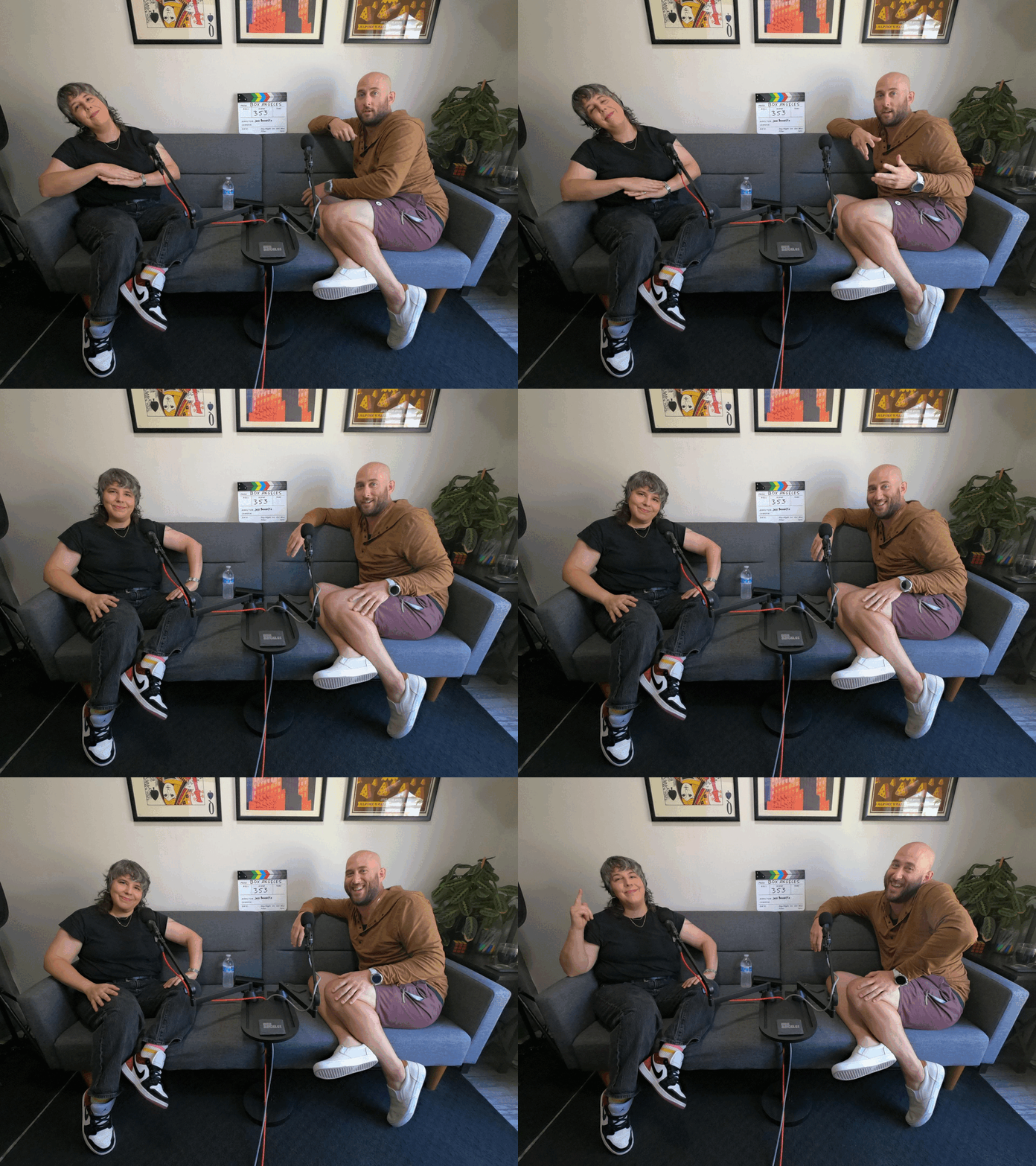
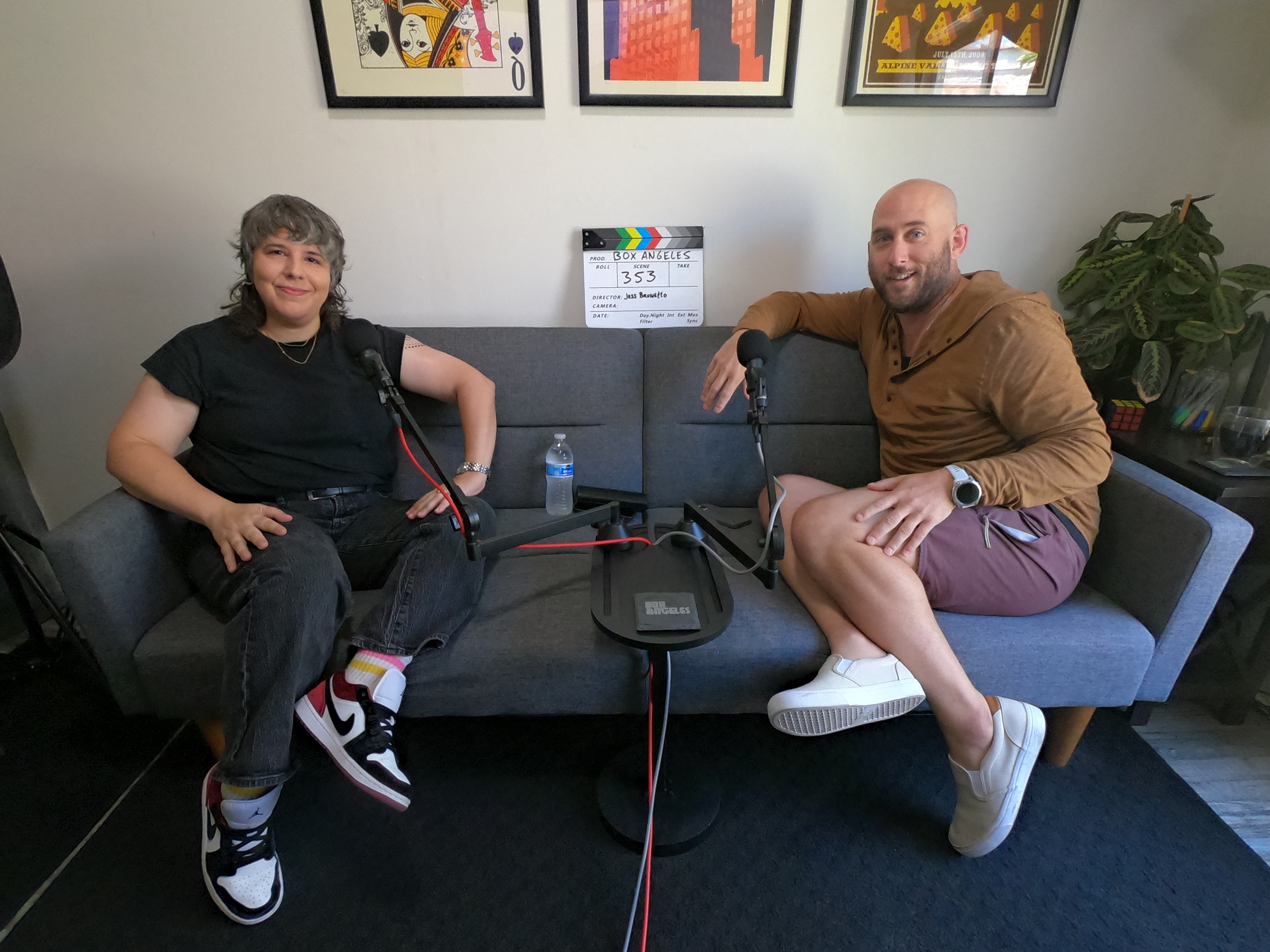
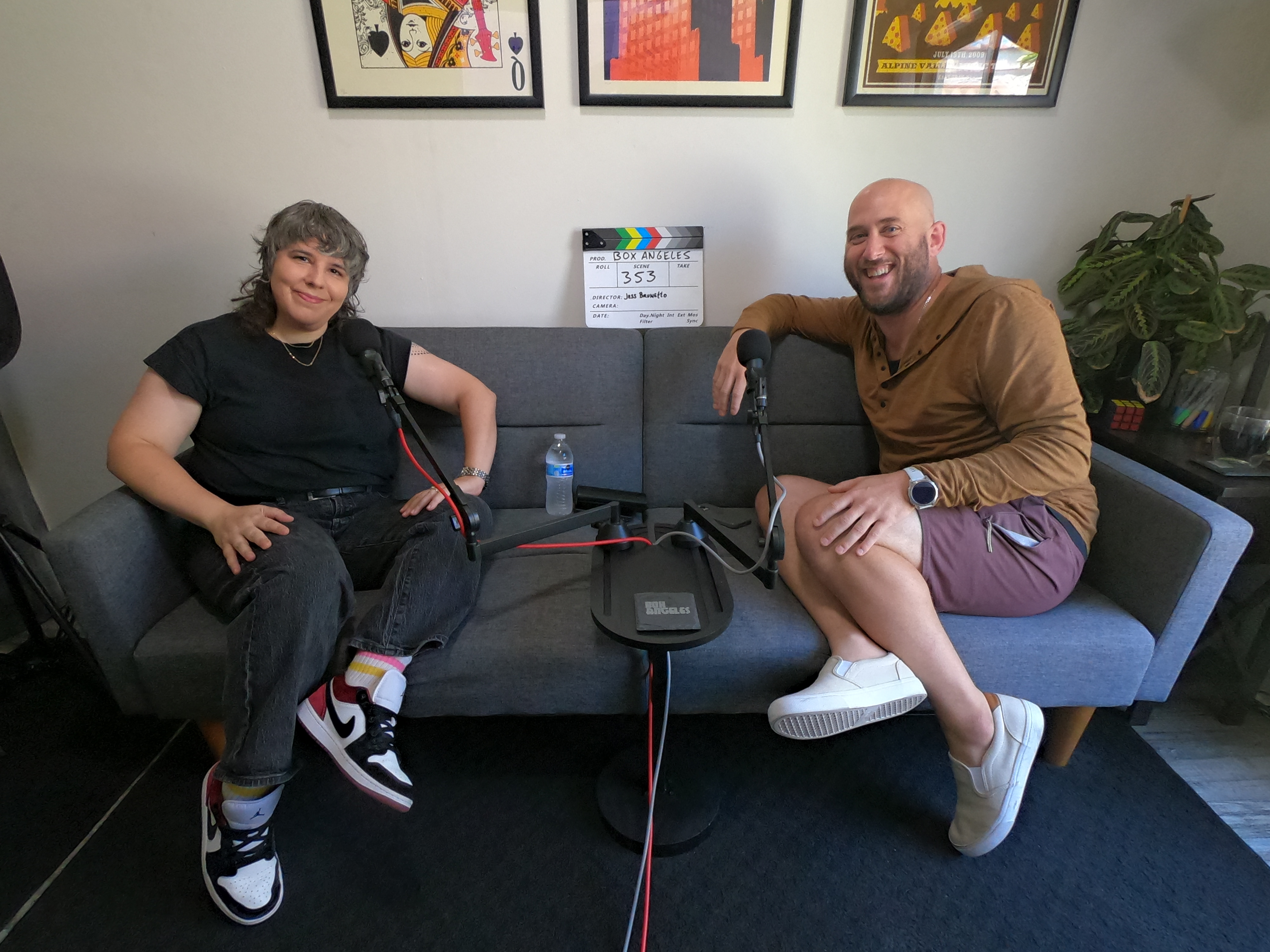
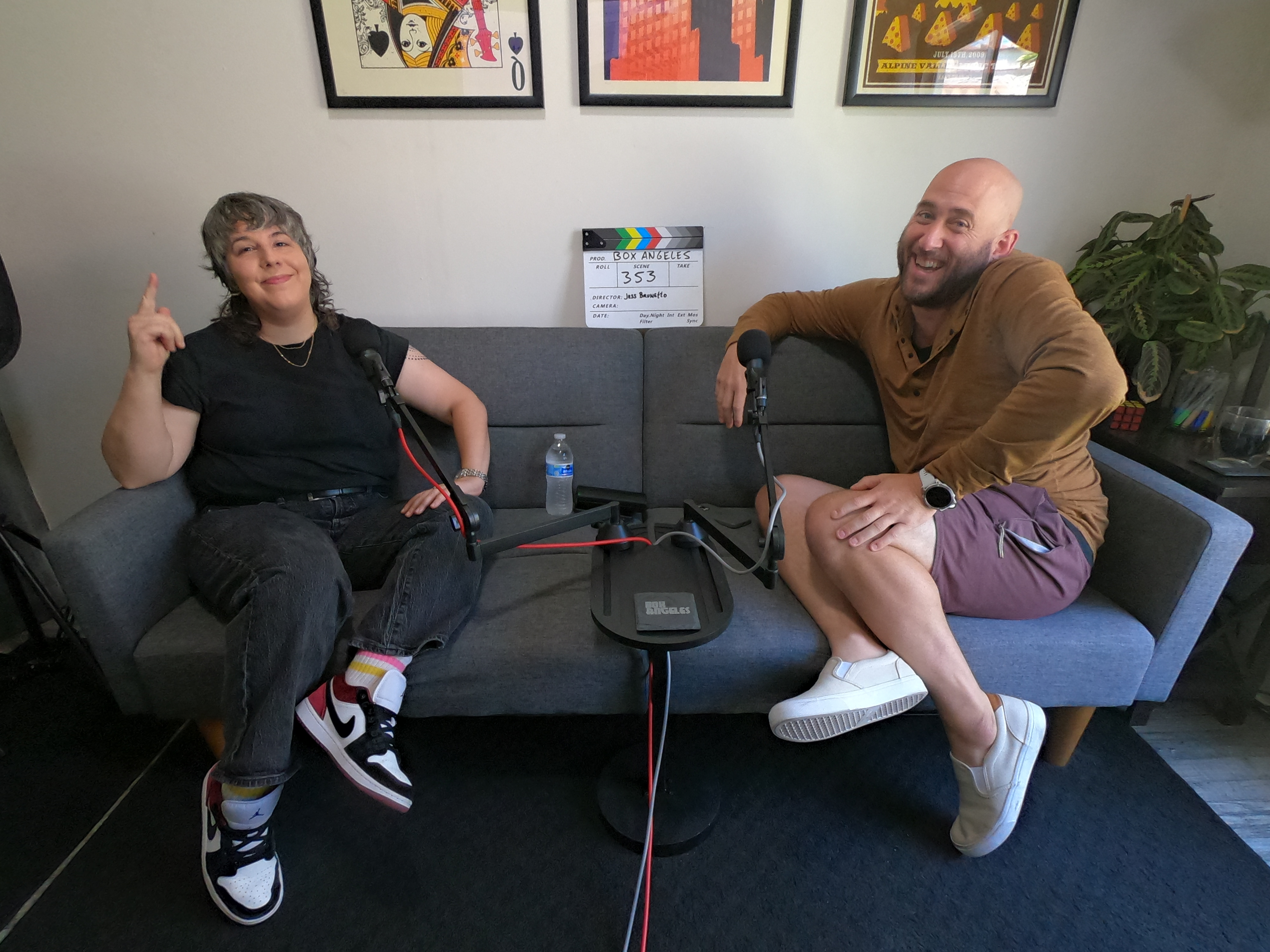
We’ve got another editing podcast today! Editor (and director) Jessica Brunetto (Hacks, Adults, Broad City) joins us on the Box Angeles podcast episode 353. Jessica stops by the bungalow and discusses the intricacies as well as the technical aspects of editing hit shows, her transition into directing, the importance for asking for stuff and making your intentions known, and more!
“The footage does weirdly tell you what it wants to be.”
— Jessica Brunetto
Beats
00:00 – Jessica slates her name.
00:10 – Introduction.
02:25 – Why Jess chose editing.
05:35 – Getting a BFA in directing from SUNY Purchase.
06:10 – Starting jobs and the editor career ladder.
10:12 – Coming into Broad City later and how many editors work a show.
12:11 – Are there editors’ rooms on shows.
13:21 – Editors chain of command and prepping before an episode.
15:38 – How long to cut an episode and schedules.
18:54 – Continuity vs good take vs clean audio.
21:01 – Editing montages.
24:40 – Approach to individual scenes.
25:51 – Jess taking her first improv class.
28:28 – How often is someone over an editor’s shoulder.
30:07 – Editing rituals.
34:13 – Economics of editing gigs.
35:30 – Technical questions; software, hardware.
38:23 – Views on current short form content.
42:31 – Pivoting to directing and asking for stuff.
47:45 – Shaking off first impressions.
48:47 – Coming on to direct Hacks in a later season and establishing a tone.
54:29 – Who took a chance on Jess.
More Jessica
 – Check Jessica’s IMDb.
 – Follow Jessica on Instagram @jessicabrunetto.
 – Check out Jessica’s website.
Transcript
JESS BRUNETTO (00:06)
Sure. I’m Jess Brunetto.
MIKE ELDER (00:10)
Hello and welcome to Box Angeles with me. I’m your host, Mike Elder. Thank you so much for listening to the show. It means a lot to me. Thank you, truly. I appreciate you and everybody that’s been coming up to me at auditions lately. By the way, I see you. I appreciate you. Thanks for saying hi.
And if you see me at an audition or a callback or in Los Feliz, come up and say hi. I really appreciate it. Okay, really quick housekeeping, Apple Podcasts. If you are listening in Apple Podcasts, please leave a rating and a review. That’s it.
I’m just gonna ask once. I’m gonna wait a second while you go in there and do that.
Great, thank you. I appreciate that. We’ve got a different episode today. We’ve had a lot of different episodes lately, things that are more niche in the industry. But I am fascinated by. This one was no different from the previous one we had with Jonathan Runyon, session director.
This is editor slash director Jess Brunetto. Jess is a fabulous editor on some of my favorite shows. As somebody who edits all these clips for YouTube and social media. And I’m working on my short film. This was a real treat for me because I really got into the minutiae of editing. But she’s worked on shows like Broad City, Man Seeking Woman, Hacks. She directed an episode of Hacks. She is such a treasure trove of information.
I love this conversation. We talked about what, what her rituals are around editing, how it’s like a hermit lifestyle, how it’s very ethereal, how her, what her process is when she edits an episode, what her like step by step processes. Does she try to get a rough cut? Does she go scene by scene? Really interesting stuff. We talked about her pivot to directing, what she’s trying to do more of. She’s trying to get out of the editing bay.
She, her goal was always to be a director. So we talked about how she’s made it a point to ask and put it out there that she wants to be a director. Really good conversation. Jess couldn’t have been sweeter. I had a great time with her. So I think you’re going to really dig this episode. So without further ado, ladies and gentlemen, I give you Jessica Brunetto.
🎵 ROCKFORD (02:10) 🎵
You wanna talk to me? You wanna talk.
MIKE ELDER (02:16)
Jess, thanks for coming down.
JESS BRUNETTO (02:18)
No problem. Thanks for having me.
MIKE ELDER (02:19)
Of course. I’m so excited to talk to you.
JESS BRUNETTO (02:22)
Same.
MIKE ELDER (02:22)
Do you want to know why?
JESS BRUNETTO (02:23)
Tell me, please.
MIKE ELDER (02:24)
I just shot my first short film.
JESS BRUNETTO (02:26)
Oh, awesome.
MIKE ELDER (02:27)
I’ve been editing it for like a week.
JESS BRUNETTO (02:29)
Okay.
MIKE ELDER (02:30)
And I have thoughts.
JESS BRUNETTO (02:32)
Okay, totally.
MIKE ELDER (02:33)
Editing is a monster.
JESS BRUNETTO (02:35)
It’s really hard.
MIKE ELDER (02:36)
And you are an editor by trade. You’ve edited a ton of amazing shows, Shows I love, Broad City, Man Seeking Woman, all this great stuff. Hacks. Why did you choose editing? In what world did you think, let me sit in the dark and cut this thing up and be so you just have to be so particular and it’s a little mind numbing and you’re all by yourself.
JESS BRUNETTO (02:58)
Yeah, that’s a good question. I definitely have, I shouldn’t say regret for my life choices, but I’ve definitely in recent years, especially with COVID have pivoted away from wanting to be in a dark room and, you know, really want to be more in the action on set with people every day feeling that kind of energy. But you know, honestly, it was just something I gravitated towards because, well, I went to a directing program at SUNY Purchase and I really liked writing, but I was just really good at editing. And I was really amazed by how you could change things and how much of your director brain you almost needed in the edit room and that I felt like I was learning so much more about like performances and storytelling and shot composition from the edit room versus, like being on set and being a PA and, you know, that sort of position. So for me, it was almost like reverse engineering my directing career and path.
MIKE ELDER (04:17)
I love that. And do you know. Do you know Ryan Case?
JESS BRUNETTO (04:20)
I do.
MIKE ELDER (04:21)
I had Ryan Case on years ago and she did the same thing. She was an editor and she was like, this is my way into directing. So I love, I was going to ask you about that. I love that you sort of thought through that and had the foresight to realize that.
JESS BRUNETTO (04:33)
Yeah, I mean, it was a little bit too just like circumstance, you know, I don’t know many people who can get out of film school and get directing work. So it was also like a way to like get in the door and like essentially see how the sausage is made. And see, you know, I’ve had the privilege of looking at like all these amazing directors dailies and you kind of know, you get a sense of what works and what doesn’t and you, you kind of have that inside knowledge that no one else really has.
MIKE ELDER (05:10)
Yeah.
JESS BRUNETTO (05:10)
So. So in a way it was kind of like, you know, another like almost like a master’s degree in filmmaking, but through experience.
MIKE ELDER (05:19)
Yeah. And now you can’t turn that off because right before this you were like, do we need to clap the clapper to make this auto line Up. And you’re, like, editing the podcast for me before we even started.
I loved it.
JESS BRUNETTO (05:29)
Hey, man, I just want to make it as easy as possible. No one needs to suffer.
MIKE ELDER (05:34)
I know. It can be so much work.
Wait, quickly, though. You got a BFA in directing?
JESS BRUNETTO (05:39)
Yeah.
MIKE ELDER (05:40)
I didn’t know you could get a bfa. I thought it was acting only. I’m an idiot.
Am I an idiot?
JESS BRUNETTO (05:45)
No.
MIKE ELDER (05:45)
Is that a common thing?
JESS BRUNETTO (05:48)
I don’t know. I’d have to check all the programs but mine. Ours was a BFA program, and it was a conservatory. It’s like a conservatory system, Right.
MIKE ELDER (05:56)
Even more, to me, that means acting.
JESS BRUNETTO (05:58)
Yeah. Well, we were in a conservatory that was, like, film and acting conservatory purchase. And they had music and visual arts and got it. Yeah. Dance.
MIKE ELDER (06:10)
That’s very cool. So I assume you moved to New York after that, and then just, like, you knew you were good at editing. How does one get editing job? Like, how do you. Do you start as, like, an assistant editor? I’m. I don’t know this career ladder at all.
JESS BRUNETTO (06:23)
No, it’s fine. Let’s see. I started well, it’s interesting. My first jobs were during film school. During the summers, I was working for the New York Film Academy.
MIKE ELDER (06:36)
Oh, cool.
JESS BRUNETTO (06:37)
And I was a teacher’s assistant in the Final Cut Pro editing room. So we were basically teacher’s assistant slash ras, because the kids were living on campus. We were at Princeton. So at night, we’d like, you know, make sure people weren’t drinking. And during the day, we would be in the edit rooms with kids, like, trying to teach them as fast as possible, like, how to be editing, how to be making their projects that they filmed that week and putting them together. It was. It was a lot to have, like, 20 some kids who never touched Final Cut Pro.
MIKE ELDER (07:19)
Yeah. There’s definitely a learning curve on all that stuff.
JESS BRUNETTO (07:22)
Yeah. I think it would be a little easier now because that was sort of at the tail end of, like, people not really having access to these things on a regular basis. Where now I think the concepts would be much easier to translate because everyone has a phone and they have, you know, they’re making videos at home.
MIKE ELDER (07:41)
Yeah.
JESS BRUNETTO (07:43)
So it was just like throwing yourself in the fire from there. Out of college, I started.
It’s called the Logger. That was for reality tv. And essentially I was just watching camera tapes and transcribing real time.
MIKE ELDER (08:01)
Okay.
JESS BRUNETTO (08:01)
So I spent a lot of time doing that. And that was so the story producers and the editors could, like, do paper edits.
MIKE ELDER (08:09)
Okay. And you weren’t Sorry, you weren’t logging shots. You weren’t like saying, this is shot as.
JESS BRUNETTO (08:14)
No, that’s more assistant editor work. This was like literally really gonna date myself here. Putting a VHS tape in a VCR, hitting play. And there was time code, but like you’re just essentially doing a quick transcription. Now, obviously we have AI, but that I think everything I’ve been able. Every position I’ve been able to get, I’ve always tried to ask for more or ask for opportunities. So I basically befriended the assistant editor and some weekends when they were working, they’re like, why don’t you come in, we’ll put you in front of an Avid and we’ll give you a couple things to do.
MIKE ELDER (09:02)
Yeah, that’s very cool.
JESS BRUNETTO (09:03)
And that’s. And I had taken an Avid course at SUNY Purchase, but, you know, again, it’s just like you really got to do it to. To learn it. And I don’t think that in college I was prepared for the, like, the naming systems you use in TV today, how you really organize a massive amount of footage versus just making like a 10 minute short.
MIKE ELDER (09:26)
Yeah, yeah. So. So you’re basically the ladder is logger, assistant editor, editor.
JESS BRUNETTO (09:33)
Yeah.
MIKE ELDER (09:33)
Or.
JESS BRUNETTO (09:33)
And post PA. I was a post PA after a logger, which just meant I. Then I started to help pick out music. It’s a little bit of like getting lunch orders for the editors. It was a lot of, again, dating myself here, picking up transfer tapes from Sony Digital and walking them back to the office. A lot of trips. A lot of manual labor.
Yeah, you know, doesn’t matter, the weather. Just dragging tapes from the west side to the east side and back, basically.
MIKE ELDER (10:12)
Okay, so let’s talk about like, you get Broad City. Did you do the entire run of Broad City or did you come in later?
JESS BRUNETTO (10:18)
I came in later on seasons four and five.
MIKE ELDER (10:20)
Okay, so you did seasons four and five. Are you the only editor on the show then? No. How many editors are on a show like that?
JESS BRUNETTO (10:28)
I want to say per season there might have been four and there’s 10 episodes. So they kind of just like divide them up according to what works with the shooting schedule and also like everyone’s personal schedule because some. Some people already have shows lined up. You know, some people don’t. So it’s really just, you know, the producers make it work kind of thing.
MIKE ELDER (10:52)
So it’s similar to directing. They bring in an almost a different editor every episode.
JESS BRUNETTO (10:57)
Yeah, Alma, you get a little more.
MIKE ELDER (10:59)
You rotate.
JESS BRUNETTO (11:00)
Yeah. And I think season one, there were only two editors Might have been that way season two as well. I’m not totally sure. But after a while I think people realize, like, oh, we can get more done if we have more people to bounce back and forth to.
MIKE ELDER (11:16)
Yeah, that’s really interesting. So then do you, when you come into something like that, do you just binge all of Broad City if you weren’t already and just get a sense of the show and how they already are editing it and cutting it and all that?
JESS BRUNETTO (11:32)
Yeah, I mean, my whole approach is I absorb the material if there’s material that exists. Sometimes it’s only scripts, but. Or just scripts and a pilot and I just try to come in and be like a chameleon and like blend in and, you know, offer my own take on things, but like playing within the same like rules and dynamic and field that everyone else is already existing in.
MIKE ELDER (12:04)
Yeah. So I’m gonna have a lot of just nuanced questions.
JESS BRUNETTO (12:08)
Yeah, no.
MIKE ELDER (12:10)
Are you guys, do you have a. Like there’s a writer’s room. Is there an editor’s room, theoretically? Or are you guys each editor at your own house, just cutting this on your own?
JESS BRUNETTO (12:18)
Well, now, after Covid or during COVID we’re all mainly at our own houses.
MIKE ELDER (12:25)
Okay.
JESS BRUNETTO (12:27)
We do try to have like zoom check in meetings. And we are all connected to the same hard drives. So in theory I could watch another editor’s episode or if someone is like, what do you think of this scene? But it’s a lot less communal. Like some. And you know, I don’t know, sometimes it’s like I. I do miss the days of like going in and sitting on someone else’s couch. Couch. And like just play them playing a scene for me.
Or vice versa. Or just like, honestly just like playing the funny things that happen before and after takes, like all the bloopers. You know, it’s certainly because I work in comedy, it’s a pretty light hearted environment and there’s a lot of bonding in those ways.
MIKE ELDER (13:21)
So who do you report to then? Is it the showrunner?
JESS BRUNETTO (13:24)
Theoretically, yeah. Yeah. Your main creative boss is the showrunner and the creators of the show.
MIKE ELDER (13:33)
Okay.
JESS BRUNETTO (13:35)
Sometimes if the showrunner is not the creator of the show, they’re not always in the edit room. It’s mainly the creators, but a lot of times the creators are the showrunners as well.
MIKE ELDER (13:48)
Yeah.
JESS BRUNETTO (13:49)
And we do have post producers who basically manage our department and set up like all the vendors to do visual effects and the sound mixing and color. And they help us, they make the schedules, they help us keep on Schedule that sort of thing.
MIKE ELDER (14:07)
So when you. So when they give you whatever. Season five, Episode two, they’re like, Jess, this is yours. Do you meet with the creator or the writer before you jump in, or do you just jump in and cut 22 and give it to them and take notes?
JESS BRUNETTO (14:20)
You just jump in.
MIKE ELDER (14:21)
Really?
JESS BRUNETTO (14:22)
Yeah.
MIKE ELDER (14:22)
Is that scary? Like, I feel a little bit. Yeah.
JESS BRUNETTO (14:26)
And the thing is, is, like, there are, you know, script supervisors on set, but, you know, no disrespect to script supervisors, but like, sometimes their notes are so helpful. Like, you’re like, oh my God, I know exactly what they want. And sometimes it’s full guesswork. And I. And I do trust my gut more than I trust notes that I’m giving given. Unless they’re specifically from the director or creators. Just because there are so many times where people are like, oh my God, this thing happened on set.
It was amazing. And then you’re like in the room being like, well, that’s not the best one.
MIKE ELDER (15:10)
Yeah. So that is interesting.
JESS BRUNETTO (15:13)
Yeah.
MIKE ELDER (15:13)
Because I’ve noticed that when I. When I. On my short film editing, it’s like, we all love this take. And then I watch it. It’s not that great.
JESS BRUNETTO (15:19)
Yeah. It’s something about getting caught up in the moment and the energy on set, which is lovely. But also it’s when you’re in the edit room, you’re like looking at the big picture more.
MIKE ELDER (15:34)
Yeah.
JESS BRUNETTO (15:35)
Than just tiny little takes.
MIKE ELDER (15:38)
So you cut a 22 minute thing. How. First off, how long does that take?
JESS BRUNETTO (15:44)
We usually get. So say it’s a five day shoot. We usually get seven days to put it together. So you get like two more days than what they have to.
MIKE ELDER (15:55)
Is it eight hour days or are we talking like 10 hour days? Are we talking like 12 hour days?
JESS BRUNETTO (15:59)
Depends on the show.
MIKE ELDER (16:00)
Okay.
JESS BRUNETTO (16:02)
Some are eight, some are 12.
MIKE ELDER (16:04)
Okay.
JESS BRUNETTO (16:04)
Okay.
MIKE ELDER (16:05)
Some are. So then you cut the 22. How many back and forths does it usually take? Do you ever nail it on the first one, I assume.
JESS BRUNETTO (16:12)
No.
MIKE ELDER (16:13)
Everyone wants to put their hand in the cookie jar, right?
JESS BRUNETTO (16:15)
Yeah, basically. But you’d be surprised. There’s a few scenes here and there that barely get touched.
But that’s not. I would say that’s never the goal for me because it’s just like the more time you spend and put into it, like you want it to get better.
MIKE ELDER (16:36)
Yeah.
JESS BRUNETTO (16:37)
Like, I mean, a writer shouldn’t shoot their first draft. Like, it’s kind of like that.
MIKE ELDER (16:42)
Yeah.
JESS BRUNETTO (16:42)
Concept.
MIKE ELDER (16:43)
Yeah. It’s collaborative.
JESS BRUNETTO (16:44)
Yeah.
MIKE ELDER (16:45)
Yeah. So in those seven days, do you have A first cut done by like day two and then. Or day four and then day five, six, seven is going back and forth, basically. Is it?
JESS BRUNETTO (16:55)
Well, they’re shooting five days. I still have to wait till the last day to get the last piece. Pieces.
MIKE ELDER (16:59)
Oh, so you’re editing it as you go. Oh, I didn’t even think about that.
JESS BRUNETTO (17:03)
Yeah, that’s most of the time. That’s how it’s structured.
MIKE ELDER (17:06)
Oh, I see. Okay.
JESS BRUNETTO (17:10)
So, yeah, I really just try to keep up with the dailies so I have enough time.
MIKE ELDER (17:16)
That’d be so much easier in retrospect.
JESS BRUNETTO (17:18)
Yeah. And sometimes it’s really hard, but I try to give myself as much time on the back end as possible. Because the other thing that’s happening is you need to be sound designing and putting in some music.
MIKE ELDER (17:34)
Yep.
JESS BRUNETTO (17:36)
And personally, I like to do more than one pass on my scenes because it’s just like.
MIKE ELDER (17:42)
I would hope so.
JESS BRUNETTO (17:42)
Yeah. Until you see that full episode, you’re just. You’re a little bit flying blind.
MIKE ELDER (17:48)
Yeah, I would think. Yeah. Especially for callbacks and things like that.
JESS BRUNETTO (17:51)
Yeah. And they shoot out of order or even improv that somehow gets like. Like it could be a thing where they do similar improv in a couple scenes or they do an improv line that like, later they put like. Like you said, a callback or something in a later scene they’re shooting. So that, to me, I think, is like another thing I need to be tweaking.
MIKE ELDER (18:17)
Yeah.
JESS BRUNETTO (18:19)
But I’m, you know, my editor’s cut is like, working towards the director’s vision more than the showrunner. And you just, like, hope and pray the director and the showrunner on the same page.
MIKE ELDER (18:33)
Yeah, yeah. But if they’re not. That’s not on you necessarily. It just stresses you out a little bit, probably.
JESS BRUNETTO (18:37)
And sometimes I have like, secret versions of scenes. Like, the director wanted to do this so bad that here’s that. But here’s a version that I think is more in line with what I know about your taste and what you like to do.
MIKE ELDER (18:54)
Yeah. Do you. Does. Does continuity issues? Are you like, hyper aware of those? Like, where do you fall on that? Like, would you rather have a good take over continuity or do you want continuity with a slightly less good take?
JESS BRUNETTO (19:10)
No, definitely. Good take really wins. And audio is more important than picture as well. Mind.
MIKE ELDER (19:20)
Okay.
JESS BRUNETTO (19:21)
Because I think that, like, the audience is more forgiving if, like, the picture is a little off, if the audio and the timing is singing, basically. So. And that’s something that’s also probably something from the Fact that I started in documentary and nonfiction, so. So a lot of times you were doing what they call like a radio edit to tell the story and then, like, doing the picture second.
MIKE ELDER (19:53)
Yeah.
JESS BRUNETTO (19:53)
And that could be. That could be with, like, verite production stuff, or that could be with archival. It could be with graphics. It could be with pictures, like, depending on what you’re making.
MIKE ELDER (20:03)
Right. Yeah. For our short film, it’s about me and my buddy Jason, and God love them, but Jason, they did something different with their hand in every fucking take. I swear to God, Jason. No. Have a perfect read, but your hand’s here and then it’s not here.
And I’m like, no.
JESS BRUNETTO (20:20)
Yeah. Oh, you know, I mean, we.
MIKE ELDER (20:24)
We’re a scrappy group. We obviously didn’t have, you know, a script supervisor or anything like that, but, yeah, watching that back, I’m like, no.
JESS BRUNETTO (20:31)
But, you know, that’s something of, like, more emerging actors aren’t as perfect their body movements. But a lot of times too, like, if I’m like, I love the audio of this take. Can I find picture that I could just. That matches better that I could just. That it still looks in sync.
MIKE ELDER (20:53)
Yeah.
JESS BRUNETTO (20:54)
So that’s a hot tip.
MIKE ELDER (20:56)
Yeah, for sure. Right? Yeah. I love hot tips, by the way.
If you think of any. Give me more. By the way, I watched your short film Sisters, which was delightful.
JESS BRUNETTO (21:04)
Thank you.
MIKE ELDER (21:05)
I love Mary. Mary’s a past guest of the podcast. You had such a fun montage in there.
Do you enjoy doing montages? Is that. To me, that’s just more work. You know, you’re putting, like, side cuts of different scenes and stuff. Is that something like you love doing? I. That montage just stuck out to me when they were dancing in the.
The dresses and stuff.
JESS BRUNETTO (21:26)
I mean, for me, it’s just, like, energy, like, of the characters and. And in terms of, like, doing sports, split screens, that. That was sort of pre planned, but once we got into post and I was like, oh, all these beats full screen are, like, making it too slow. Then we just tried to maximize what we shot with them by incorporating more split screens to get through all the beats faster and to keep the momentum going, you know, to me, it’s like we’re making entertainment. So even in, you know, a hard drama, like, I mean, my favorite montage, almost one of my favorite montages of all time is in Gone Girl when she, like, basically fakes her death and all the blood.
MIKE ELDER (22:24)
Yeah.
JESS BRUNETTO (22:26)
I mean, it’s amazing. It has, like, VO music and then like, the whole plot line of how she Plans her escape.
MIKE ELDER (22:33)
Sure.
JESS BRUNETTO (22:35)
So, you know, it’s just. It’s just fun.
MIKE ELDER (22:39)
Well, it’s interesting, definitely. Yeah. But it’s interesting to me because it’s like I wrestle in my head. And this dates back to even, like, I can specifically remember watching American Idol back in the late, late aughts, you know what I mean? When it was the huge show. And I would watch those early episodes where they’re going to the cities, right. And so it’s a lot of, like, crowd shots and quick cuts and stuff.
And I just couldn’t help but think about the editor that. Because, like, the editor is putting in so much work. And I say this with the most utmost respect, it’s like, so much work for something that is so ethereal and so quick and so, like, nobody’s gonna rewatch those early episodes of American Idol. People are gonna watch it once and be done. And it’s like they’re putting in so much work into this little fast cuts montage of Dallas. We’re in Dallas, Ryan Seacrest, Dallas.
And it’s like, bing, bong, bing bong. And I’m like, oh, you.
You’re doing so much for so. I mean, millions of people watch at the time, but they’re not rewatching it and enjoy, you know, and it’s just so passing and fleeting, and I just couldn’t help but empathize. I specifically remember that. And it’s like in those montages, you’re cut, cut, cut, cut, cut. You’re taking so much footage to make it so quick. I don’t know.
JESS BRUNETTO (23:48)
Yeah, but you know, again, too, like, another good analogy is like, it’s a roller coaster ride with where you’re building tension and release. So, like on a roller coaster, the slowest part is, like, going all the way up to the peak before it drops you down. So it’s like you have to just know in your gut, like, what you’re making, the tone of it and, like, where it feels like it’s dragging and where it works to not be cutting and where it works to be cutting.
MIKE ELDER (24:28)
Yeah. But I guess to me, it’s like the tediousness of it, like.
JESS BRUNETTO (24:31)
Oh, yeah.
MIKE ELDER (24:32)
It just feels like it’s so. It’s like, do I really need to do a couple extra cuts here? This is going to. It’s three seconds. Like.
JESS BRUNETTO (24:38)
Yeah.
MIKE ELDER (24:40)
Do you. To that point, like, do you start? Like, how do you approach a scene? Like, do you start? Because this is what I found I’m doing. And I’ve never really edited anything longer than a couple Minutes right until this point, I find I take a good, like one wide that I like, we take that good cut and then I go through that and start filling in the things I don’t dislike. Do you know what I mean? Like, I start with a two minute wide and then I start putting.
Is that a good strategy or is that a bad strategy? Do you start, do you go line by line?
JESS BRUNETTO (25:08)
I do go line by line.
MIKE ELDER (25:09)
Okay.
JESS BRUNETTO (25:10)
I don’t mean to hurt your feelings, but I usually ignore the wides.
MIKE ELDER (25:14)
Really?
JESS BRUNETTO (25:15)
Because I think for me things are more interesting when you maybe don’t start a scene on a wide or end a scene on a wide, but like you find a more interesting place in the middle to cut to it. And that’s usually a turning point in the scene. Yeah, and. But that’s just like my approach of like how to make it, how to make it work less on a technical level and more on like a performance, creative story level.
MIKE ELDER (25:51)
Well, did you study improv? I mean, that’s an improv thing. Start the scene in the middle. They always tell you that. Don’t start with hello, hello, how’s your day going? They say, well, why did you do that? You know what I mean?
Start in the middle of the scene.
JESS BRUNETTO (26:02)
I just took my first improv class.
MIKE ELDER (26:04)
Get out of town. Really?
JESS BRUNETTO (26:05)
Yeah.
MIKE ELDER (26:06)
You are around so many improvisers. I would have assumed you took at least one in New York.
JESS BRUNETTO (26:09)
Yeah, well, honestly, I tried to sign up so many times and I’m like, I’m working and I can’t. And then.
Or they fill up so quick. They were like, you know, I don’t know. It felt way more competitive in New York of how quickly they filled up. I could never make it work. But yeah, I’ve had this like, inner guilt.
Like I, I do. I work with so much improv.
MIKE ELDER (26:32)
What class did you take?
JESS BRUNETTO (26:34)
I just finished the improv 101 at UCB.
MIKE ELDER (26:37)
Great. What’d you think?
JESS BRUNETTO (26:38)
It was really fun. Honestly, like, I just, I’m starting to do more things where I put myself in the actor’s position. But it was just like fun to like run scenes whether I’m in them or not and just like see what works, see what doesn’t work, you know, kind of thing. Yeah, I’ve been doing some stunt classes.
MIKE ELDER (27:02)
Oh, very cool. After my short film, I was saying I want to take a lighting class.
Like, lighting is. I don’t know shit about fuck about lighting. And I would love to learn some stuff.
JESS BRUNETTO (27:12)
Yeah, totally. But a lot of it too is like, you know, it just depends what your approach is, because, like, a lighting class, you could find one that’s super technical, or you could find one that’s all about, like, painting the scene with light for the tone of what you’re making.
MIKE ELDER (27:30)
And that sounds like 201.
JESS BRUNETTO (27:32)
Yeah, but, like, that’s really what you want to find.
MIKE ELDER (27:37)
Yeah. Yeah.
JESS BRUNETTO (27:38)
Well, I mean, unless you want to be a gaffer.
MIKE ELDER (27:41)
No, I don’t want to be a gaffer, but I want. Yeah. Like, even this, I could light this better. I don’t know how. It’s a lot of work. You know what I mean?
JESS BRUNETTO (27:48)
Yeah.
MIKE ELDER (27:49)
Just. I think lighting is fascinating, but even improv.
Back to your improv. Like, I think improv would be amazing for an editor. Not only do I think it’s amazing for a human, I think it’s just good for all humans to take it. I think it improves your communication. But, like, for an editor like you, I think that would just be really enlightening to see.
JESS BRUNETTO (28:08)
Yeah. I mean, it’s not like I haven’t gone to improv shows in the past, but. Yeah, I’ve never really done it myself. You know, I’m trying to get out of the hermit lifestyle, like I said earlier.
MIKE ELDER (28:25)
I appreciate that. I like that. Speaking of the hermit lifestyle, how often does, like, when you make something, does somebody. Is it.
Do you have somebody over your shoulder? Do you ever have, like a. I guess.
Have you done many films? I feel like you haven’t done a lot of films. Would a director sit over your shoulder on a film?
JESS BRUNETTO (28:41)
Sure. You’re with them almost every day, except for when you’re putting the film together, which is usually during, while they’re shooting.
MIKE ELDER (28:48)
Oh, okay.
JESS BRUNETTO (28:49)
And then. But I really believe that, like, as much as I love working with someone and collaborating with some someone, some of my best work is when they leave me alone and when I get to try stuff that I know they wouldn’t let me try in. In person if they were there. I can play. And then they’ll come back and be like, literally say, I never would have let you do this, but it really works. And let’s keep it.
MIKE ELDER (29:21)
That’s cool.
JESS BRUNETTO (29:21)
Yeah. So those. Yeah, those are the rewarding moments. That is kind of, again, like going back to my documentary brain. Like, I don’t know, there’s no rules. Like, I’ll. I’ll take shots from before you said action.
You know, if it works and I need it.
MIKE ELDER (29:40)
Yeah. I found.
I did that in my short film, literally. That’s one of my biggest regrets, is we don’t have a lot of just sort of fluff, if you will. Like us walking around or us sitting around. And one scene we’re like, tired. And I literally took three different cuts where it says action in it. But it’s like, perfect of us looking tired like this. Yeah, but, yeah, to your point, like.
JESS BRUNETTO (30:01)
Yeah, the name of the game is make it work.
MIKE ELDER (30:04)
I love that. Back to your. Wait. I want to go back to your hermit lifestyle, though, for a second.
JESS BRUNETTO (30:08)
Sure.
MIKE ELDER (30:09)
Do you. What is, like, I always, like, romanticize writers. You know, like, they sit down with a scotch and a cigarette. Do you have any, like, rituals around your editing? Do you have to, like, do you have a proper desk? Do you have, like a space you gotta be in? Do you have lights you gotta have on?
Do you have music playing anything like that?
JESS BRUNETTO (30:25)
I’m usually a no music person, unless I’m just doing stuff. Say I have to do some temp graphics and I don’t need the audio. I do have a standing desk, which was acquired after years of backaches to improve my posture and live a better life.
MIKE ELDER (30:50)
Good for you.
JESS BRUNETTO (30:52)
I think walks are really important.
MIKE ELDER (30:54)
Oh, I love walks.
JESS BRUNETTO (30:56)
I try. I mean, our schedules are so tight, but I really try. Like, if it’s the end of the day and I know I’m just not being productive, I really try to stop working.
MIKE ELDER (31:10)
Yeah, you can’t fight it.
JESS BRUNETTO (31:11)
It just makes it worse. Yeah, I just. I just don’t feel like I’m making the right decisions and it’s just better for me to, like, start fresh in the morning. I’m very much like, get some great ideas in the shower kind of person. If I feel like if I’ve left the previous workday stuck, I don’t know, I’ll. It’ll be the morning, I’ll take a shower and I’ll be like, oh, my God, this is what I should do. So I.
I believe in that kind of thing of, like, turning it off, stepping away. I try to meditate, you know, try to just, like, take care of myself, exercise. I wasn’t always as good at all these things, but, you know, it comes with age and discipline.
MIKE ELDER (32:01)
Yeah, I like that. And it’s really true, though, like, when you’re not doing good work or you’re feeling. Not feeling it. Like I said, if you, like, are like, double down, it just makes it worse. It, like, exasperates it. You literally, same thing. Going to sleep, like the other day and I could not fall asleep.
I was like, no, I gotta fall asleep and it made it worse. And I was like, I just got to get up and read or do something else, because it’s not. It’s not happening for me.
JESS BRUNETTO (32:23)
Yeah. And, like, I don’t know. I just don’t like putting in a take to, like, finish the scene versus being like. No. I really want to find the best takes, and I really want to have the scene feel complete when I’m done with it.
MIKE ELDER (32:39)
I think I suck at editing. Literally, my goal this week was just to get a rough cut. I just wanted a start to finish so I could then smooth the edges. Because I was like, if I don’t have it done, it’s never gonna get done. So I was like, let me get a rough cut done. And I was so excited. I was.
I finished it on Tuesday, exported it. I’m like, all right, good. Now I can go in and smooth. But you’re saying you like to really smooth it in as you’re going a little both.
JESS BRUNETTO (33:03)
It has to be a little of both.
MIKE ELDER (33:05)
Okay.
JESS BRUNETTO (33:05)
But that’s. I mean, in a way, your approach also works because it’s like. You know, they call it the vomit pass.
MIKE ELDER (33:14)
Right. It’s a writing technique, for sure. Get it done and then come back. Yeah.
JESS BRUNETTO (33:17)
But I guess my advice to you is just being like, just check everything or just try it a new way for fun. Like, in this. In this scene, I started on the wide, and I’m living in the mediums. Like, what if I start on Closes? You know? Like, just play with it.
MIKE ELDER (33:37)
Okay. Yeah. I have a friend coming over tonight who’s going to. He’s definitely going to want to take a pass at it, so we’ll probably do that tonight. Yeah, that’s interesting.
JESS BRUNETTO (33:47)
Or also prioritize the most important scenes because that will give you so much more information of what the rest of the film should be.
MIKE ELDER (33:58)
Okay. Yeah.
JESS BRUNETTO (34:00)
The footage does weirdly tell you what it wants to be.
MIKE ELDER (34:04)
Yeah. I like that.
JESS BRUNETTO (34:06)
Once you see what’s working, then it kind of has a ripple effect.
MIKE ELDER (34:13)
Economically. Sorry. To hard pivot when you’re. How does it work?
Are you getting. Are you on a contract with Broad City, or are you getting paid per episode, I assume, or.
JESS BRUNETTO (34:22)
Well, I’m part of a union. The.
MIKE ELDER (34:24)
There is a.
JESS BRUNETTO (34:25)
That was my nice question. It’s an editor’s Union, the Local 700, and it’s BA. The contracts are based on, like, budget and then weekly rates.
MIKE ELDER (34:36)
Okay. So you get a weekly rate, essentially, for an episode. And there’s a minimum, obviously.
JESS BRUNETTO (34:42)
Yeah. There’s a minimum of what you should be making.
MIKE ELDER (34:44)
What is that minimum?
JESS BRUNETTO (34:46)
I don’t know.
MIKE ELDER (34:46)
Oh, you don’t know. Nice.
JESS BRUNETTO (34:48)
Because. Thank you.
MIKE ELDER (34:48)
Haven’t had the minimum in a while.
JESS BRUNETTO (34:50)
Yeah, exactly. That’s exactly why. I don’t know.
MIKE ELDER (34:53)
Nice. Okay, interesting. I didn’t know there was a guild. Do you guys, like, have meetups and stuff? Did you guys. Do you guys, like. How big is that guild?
How many members is that?
JESS BRUNETTO (35:04)
I could be wrong, but I swear I just saw, like, maybe close to 10,000.
MIKE ELDER (35:10)
That’s pretty good.
JESS BRUNETTO (35:11)
Yeah, yeah. There’s meetups. There’s a whole educational arm of it where you can take classes, they offer, you know, got a pension for myself and some health care. Try to use that.
MIKE ELDER (35:30)
Can. Can we talk about some technical stuff? Do. What software do you use? And is it same per show? Can you use whatever you want on every show?
JESS BRUNETTO (35:39)
It’s usually Avid.
MIKE ELDER (35:41)
Okay.
JESS BRUNETTO (35:41)
I’ve only worked on one show professionally in Premiere. I. But that’s just because it’s kind of the standard and it translates the easiest to color systems and to the.
The final mix. Like Pro Tools. Because I think Pro Tools and Avid are owned by the same company.
MIKE ELDER (36:03)
Okay.
JESS BRUNETTO (36:03)
So they talk to each other really well.
MIKE ELDER (36:05)
Yeah.
JESS BRUNETTO (36:07)
But, you know, there are some shows that do Premiere. So if I have to do Premiere, I can do it.
MIKE ELDER (36:13)
Do you. Do you. Can you use a trackpad or do you have to use a mouse?
JESS BRUNETTO (36:16)
I use a Wacom tablet with. So, like, a pen? Oh, yeah.
MIKE ELDER (36:23)
Okay, so you have a monitor and you use a tablet down here with a pen. Really?
JESS BRUNETTO (36:27)
Yeah.
MIKE ELDER (36:27)
And you, like, drag and pull with the pen?
JESS BRUNETTO (36:29)
Yeah, it’s like. It’s like a mouse, but, like, faster.
MIKE ELDER (36:31)
When did you start doing that? Is that like a. Is that like an expertise thing? Like, most people at your level do that, or is it perfect?
JESS BRUNETTO (36:39)
It’s like a personal preference. I started doing it when I worked on sicko in 2006, mostly because all the editors were using them.
What’s this cool thing? Slash. When you had to jump on their computer, that’s what was always hooked up. So it was kind of just like a convenience thing.
MIKE ELDER (36:59)
I think of that as more like an animator thing.
JESS BRUNETTO (37:01)
It is. They are more made for animators, but, like, they move around the screen so fast that I just got comfortable with it and, like, my wrist never hurts. And so.
MIKE ELDER (37:12)
So if you had to use a mouse, could you do it?
JESS BRUNETTO (37:14)
Yeah, I know how to use a mouse.
MIKE ELDER (37:15)
Well, I mean, it would throw you off. Like, I’m saying, I cannot not use a track.
If I use a trackpad. To do anything. Like, I’m a whiz in Excel and Google Sheets, but I cannot do it for shit with a trackpad.
JESS BRUNETTO (37:27)
Interesting.
MIKE ELDER (37:28)
Like I have to have a mouse wherever I’m at.
JESS BRUNETTO (37:30)
Oh, no, I like hate them.
MIKE ELDER (37:34)
Do you like trackpads?
JESS BRUNETTO (37:36)
I mean, on my laptop. That’s about it.
MIKE ELDER (37:38)
Can’t even do I need a touch screen on my laptop. I can’t trackpad for.
JESS BRUNETTO (37:41)
That’s so I’m just like.
MIKE ELDER (37:46)
Wow, that’s cool. How. What does that call? What is it called?
JESS BRUNETTO (37:49)
A Wacom tablet. They have different sizes.
MIKE ELDER (37:52)
What’s that run? What’s that run? A couple grand?
JESS BRUNETTO (37:55)
No, no, no, no. I usually use the medium sized one. I think they’re like $300 or something. They last a long time.
MIKE ELDER (38:04)
That’s very cool. I should look into that.
I’m just picturing. When you say that I literally pictured animators and like Steve Jobs, like doing a presentation or whatever. Oh yeah, that’s very cool.
JESS BRUNETTO (38:14)
I am doing a presentation always.
MIKE ELDER (38:17)
I love it. That’s very funny.
Do you speak. You mentioned very early on, like you come from. I forget how you phrased it.
So I apologize. But like old school or whatever. Do you have like a opinion about where we’re at now with content and like how it’s being. You know, we got, we had Vine, six seconds and we got TikTok and stuff. Do you, do you appreciate people that can edit that stuff? Do you begrudge it? Do you have an opinion about it?
JESS BRUNETTO (38:46)
I think, you know, I don’t begrudge it. I do. It would be really sad for me, in my opinion though, if the next generation just has like zero interest in long form. And right now long form could be a 22 minute show. But I, I’m such a lover of movies that like, I don’t mind things coexisting, but like, to get to totally erase this like, other beautiful art form and this complex level of storytelling would be just really sad for our culture, in my opinion.
MIKE ELDER (39:29)
Yeah. Do you have an appreciation for their ability to edit things that grab attention so quickly? Like, do you think your skill could translate to that?
JESS BRUNETTO (39:38)
I don’t know. If I see another person like snap at the camera, like put their hand in front of the camera and cut on that. It is.
MIKE ELDER (39:47)
That is kind of hack.
JESS BRUNETTO (39:48)
Irritating, like do something else. But of course, it’s like impressive how many eyeballs people are getting. As long as we don’t go full, like Idiocracy, I’m cool with it.
MIKE ELDER (40:07)
Yeah.
JESS BRUNETTO (40:07)
Because there is. Look, I also cut commercials and there’s something. Yeah. There’s something to be said for, like, telling. And a lot of the commercials I do are really just short comedy scenes. So there’s something to be said of, like, how much information and how much story can I pack in a 30 seconds?
I don’t know. It’s like a fun challenge.
MIKE ELDER (40:32)
That’s exactly it. Like, I cut so many of these. I’ll cut this interview up 20 times and put 30 second clips out there of you talking. And the goal is to get eyeballs for more than three seconds. You know, they stay on it. And that is such a tricky thing, I think, or a very hard thing to do.
JESS BRUNETTO (40:50)
And what have you learned? I’m reversing that interview.
MIKE ELDER (40:53)
Honestly, what it is, is it’s like a lot of movement. Right. So I used to just have the summary, like I’d say Jess talked about, you know, Premiere Pro or whatever. Now you zoom that in and then zoom, you know, zoom it out and then add in like an image.
JESS BRUNETTO (41:10)
Okay, so you have to zoom into my eyeball and zoom out.
MIKE ELDER (41:13)
Well, no, I’m just saying, like the text overlay. Zoom in or. Yeah, zoom in on that. That’s a. Definitely a one, though, actually. Like, even if it’s a slight zoom in.
JESS BRUNETTO (41:21)
Yeah.
MIKE ELDER (41:21)
Like to break that sort of focus. If it’s just you sitting here, it’s not gonna work.
JESS BRUNETTO (41:26)
Yeah.
MIKE ELDER (41:26)
You know what I mean?
JESS BRUNETTO (41:28)
Oh, man.
MIKE ELDER (41:30)
It’s tough. It’s a really interesting world out there as far as. And I try, and this is my approach to editing those. It’s like I just try to add something every video, try to make something a little better on each video. Because when I first started doing it, like, it would just be you sitting here, nothing else.
JESS BRUNETTO (41:48)
Sure.
MIKE ELDER (41:49)
And now I’m adding movement and all this stuff.
JESS BRUNETTO (41:51)
Well, the fact that you even do video is more than most podcasts. Right.
MIKE ELDER (41:57)
Maybe not anymore.
JESS BRUNETTO (41:58)
Maybe not anymore.
MIKE ELDER (41:59)
Yeah, well, but it’s. It’s all attention grabbing. Like, we’re all trying to grab that attention and see what we can do with it. And like, I don’t know, I find it a very interesting art form to. To try, like short form editing. It’s.
JESS BRUNETTO (42:13)
Yeah, no, there is something to it and I get why people are attracted to it. I just, you know, again, I don’t know, I love to like, curl up with a book, and that’s not something that you do for 10 seconds, for example.
MIKE ELDER (42:30)
That’s true. So as you pivot now to directing, which I think that’s your goal, as you alluded to when you do something like.
You edited all of. When did you join Hacks as an editor?
JESS BRUNETTO (42:42)
I joined in season one, and I did edit the pilot.
MIKE ELDER (42:45)
Oh, nice. Okay, so when you end up directing an episode of that, are you just constantly, like, putting that in Paul and Lucia, Lucia and Jen’s head, or are you, like, how does that work? How do you make them aware that you want to direct?
JESS BRUNETTO (43:07)
Lucia and I have been working together for a long time. I actually, before Broad City, there was a Comedy Central miniseries called Time Traveling Bong that Lucia Aniello, Paul W. Downs, and Ilana Glazer made together. And I had just moved to LA, so funny enough, it took moving to LA to work on Broad City.
MIKE ELDER (43:28)
Oh, what? That’s funny. I didn’t realize that.
JESS BRUNETTO (43:31)
So they were looking for another LA editor, and my name got dropped to them, and that was a really good experience. And, you know, Lucia was very generous about how she was able to step into directing, like, coming from improv and having someone like Amy Poehler vouch for her to direct the pilot of Broad City. And that really, you know, helped her turn a corner and give her a chance. And a lot of times, people just need a chance, and they can excel. She is definitely one of those people. It’s been really cool to see her career blossom, to see her and Paul get their own show with Jen Statsky.
And so it’s something, I don’t know. We’ve always just, like, talked about.
MIKE ELDER (44:30)
Right.
JESS BRUNETTO (44:32)
And that. So she’s known for a long time that my aspirations were to direct, and way back when I was applying to director fellowships, but it was before I had made a short film, and I had been asking for episodes of television again before I made a short film. So then I just decided, you know, a lot of these fellowships just give emerging directors shadowing opportunities.
So I’m just gonna start asking some people I know if I can shadow them on set. Yeah, so I was able to shadow some directors. Jorma Taccone on the Last OG, Nick Jasenovec on Arturo Castro’s Alternatino, and I shadowed Lucia on Awkwafina’s show Nora from Queens. So I think, too, once that happened, once I made my short, got into South by Southwest, I think she saw that. You know, it’s like, you got to do the work too. Like, you can’t just, like, sit around and, like, hope something will fall into your lap.
It’s just not like that anymore. It’s.
MIKE ELDER (45:47)
Was it at one point?
JESS BRUNETTO (45:49)
I think it was, like, 40 years ago. Like, if you were just at the right place in the right time. But now it’s like, you know, it’s like, just. You really have to fight for it, and you really have to advocate for yourself, and you have to back it up with actions.
MIKE ELDER (46:05)
Well, that’s it for sure. I learned early on in this podcast, like, you, it’s really hard to do, but you have to ask. People are not thinking about you. Jess is not on the forefront of Lucia’s mind at all times. Yeah, you have to ask, but it can be really hard. Did you struggle at all asking for stuff, or have you just always been a very forward. Yeah, it’s hard.
JESS BRUNETTO (46:23)
It’s really hard. It’s something I’m not. Like, it just doesn’t come naturally.
MIKE ELDER (46:29)
I know if it does come naturally to you, it’s probably not a good thing. Yeah, it’s like, the sociopaths know how to.
JESS BRUNETTO (46:34)
Or you’re, like, not ready at all.
MIKE ELDER (46:37)
The nice people are over here, like, hi, I don’t want to bother you.
JESS BRUNETTO (46:40)
Yeah. Yeah.
MIKE ELDER (46:42)
So it was a learning curve for you to ask. For. Sure.
JESS BRUNETTO (46:45)
Yeah. But, you know, I just. I think Ava DuVernay was the one who’s just out there saying, like, just ask. Yeah, just ask. And that really, like, resonated with me.
MIKE ELDER (46:58)
So was that Sisters, your short film? Was that the impetus of that was like, I need to put something out there that I personally directed. Was that the impetus from that, or did I infer.
JESS BRUNETTO (47:09)
I mean, let’s see. It was something I wanted to make as a feature, and I still do for a long time. And a director friend of mine one day just gave me a tough love conversation and was like, you know, don’t just sit around and wait for an episode, because even to direct, because even if you get it, people are still gonna look at you. Like an editor who got an episode, he’s like, you have to make a short. And he’s like, and I want you to send me the script in two weeks. Wow. That was the conversation.
MIKE ELDER (47:45)
That’s great. Well, I was gonna bring that up. It’s like, how do you. When people know you as something, first impressions are hard to shake. And if they know you’re an editor, how do you shake that? So that’s great advice by this guy.
JESS BRUNETTO (47:55)
Yeah, that’s John Lee, another director mentor of mine. Yeah, I call it the editor stink. How can I get this editor stink off me?
MIKE ELDER (48:07)
I hear you, but I don’t think that’s just a you thing, though, or an editor thing. Like, when I first moved here, I Wanted to be on set a lot. Why not? And to me, I was like, let me be a pa. But then I did a couple, and I was like, they’re just going to see me as a pa. They’re not going to see me as talent.
JESS BRUNETTO (48:21)
Yeah.
MIKE ELDER (48:22)
And I pulled away from it because of that. But, like, I think that, like, I imagine that happens with assistants out here. Assistants that just want to get experience, and then they’re always forever in their boss’s eye and assistant type of thing, so.
JESS BRUNETTO (48:35)
Yeah, but assistants have very interesting career path. Some of them are like, assistant to boss, and it’s like, how did you do that?
MIKE ELDER (48:45)
Well, that’s what I’m coming to learn is, like, everybody has an interesting path. Like, editor to director is fascinating to me. I mean, it all is very unique and different, and it just makes it really fun. When you’re directing hacks, though, like, they approach it where, like, every episode’s different. Right. It’s not. Or has Lucia directed a lot of them?
JESS BRUNETTO (49:07)
Lucia directs the majority, and Paul directs, like, is essentially the other main director.
MIKE ELDER (49:14)
Okay. So even more so, my question, like, how do you come in, then, and direct an episode of Hacks when it’s. I think you did season four, Right. So they already have season three. Three. They already have a rapport. They’re used to Lucia and Paul.
How do you, like, I guess, set the tone on that episode or, like, establish. You’re like, I’m here and I’m meeting. You know what I mean? How do you get.
JESS BRUNETTO (49:35)
Yeah, it’s hard to win a crew over, if you will. I was lucky in the sense that I had already had a previous relationship with the DP, Adam Bricker. He was really kind to me. He. He knew how much I. I just wanted the episode to be really good and to pull it off. So I think he had a lot of patience with me over asking him things, and I appreciate that.
The other person I really had in my corner was their first assistant director, Jeff Rosenberg. He also was directing his first episode that season. So although he wasn’t my first assistant on my episode, he kind of gave me the lay of the land in a really good way that I really appreciate. And, you know, I showed up when Lucia was shooting Block one and my episode was in Block two, just to kind of meet people, see how it’s made. Because with COVID I mean, I think had there not been Covid, I at least would have swung in, like, one day, one time to see how everything is, like, on the Hacks set, but because there were so many restrictions. I really couldn’t do it until I was about approaching my episode. So I don’t know, all I can say is, like, everyone was so kind to me and welcoming that I really loved.
My whole approach to editing and directing is just to make the experience fun. So I think I was able to do a little bit of that, even through some really long days. And the thing is, is, like, that’s a show where the whole crew loves the show.
MIKE ELDER (51:31)
Yeah.
JESS BRUNETTO (51:32)
They love being there. So it’s not. It’s really a blessing to be in that kind of environment, because if you’re on a show where the crew doesn’t really believe in the show, it’s just hard. It’s hard to get people on the same page, you know, it’s hard to make them want to make things as good as possible, possible. So, yeah, it was an amazing experience. They gave me a really big episode. I still can’t believe it, like, how big of an episode they gave me, how many locations we went to, all those sorts of things.
So it was like, the best experience ever. And I learned so much just from one episode.
MIKE ELDER (52:16)
Well, that’s why I was just gonna ask what. You can prep as much as you humanly possible. You’re still gonna learn something. Like, what stood out on that that you weren’t expecting, if anything.
JESS BRUNETTO (52:28)
You know, it’s funny. I think you always expect things to go wrong, but you don’t know.
MIKE ELDER (52:36)
Unless you’re a sociopath. Yeah.
JESS BRUNETTO (52:38)
You don’t really know how it’s gonna happen until it just happens. So. So I just try to take all the things that go wrong, like losing locations, as, like, opportunities to make it and find. To make it even better and find something even better. So even though things got really hard and stressful sometimes, like, they were just like. It’s just kind of the movie magic that happens. I know another thing. Like, I.
I went to bat to bring the pickleball game inside on my episode. They had already picked out an outside location. But I was really concerned with the fact that we were shooting in January. It was a night game. And I just also didn’t want people to get hurt. And when they’re cold, it’s like, you’re not. When they’re cold and freezing, like, you’re not going to get the best performances.
Their bodies aren’t going to be able to. To, like, maintain the physical activity for as long as we needed it to. And it was like a little bit of the story. Like, it was supposed to be, like, a luxury country club. So I didn’t want it just to be like kind of darkness with overhead lights.
MIKE ELDER (53:57)
Yeah.
JESS BRUNETTO (53:58)
So that was something. In the end, when we showed up to the indoor set, like Lucia, it was like, this looks really good.
And I was, you know. And so everything has to have, like, their blessing. It is their show. So I shared as much information as possible with them along the way. My shot lists, my approach to scenes, but they also, you know, they were there to have my back when I needed it. So.
MIKE ELDER (54:27)
That’s awesome.
JESS BRUNETTO (54:28)
Yeah.
MIKE ELDER (54:28)
Well, to your point about taking a chance, my last question I always ask on this is, who took a chance on you? And I think you kind of gave the answer. But go ahead, speak to me.
JESS BRUNETTO (54:38)
I mean, it’s gonna be the Hacks showrunners, Lucia Aniello, Paul W. Downs, Jennifer Statsky, like, gave me the biggest and best chance possible to really level up my career in a big way.
MIKE ELDER (54:52)
Yeah. That’s great. Wait, to that point, do editors have agents?
JESS BRUNETTO (54:57)
Some do.
MIKE ELDER (54:58)
Okay, do you have one?
JESS BRUNETTO (55:00)
I did for. For a while, but I decided not to have an agent a little after moving to LA 10 years ago. Cause I was getting all my own jobs and I decided I wanted to keep that 10% for me and my savings account.
MIKE ELDER (55:17)
Sure. But now as a director, are you.
JESS BRUNETTO (55:19)
Yeah, I have a manager at Artist First, and they’re really supportive of my TV directing, my film aspirations, my writing aspirations. Get some of my own projects off the ground someday.
MIKE ELDER (55:32)
Because direct, like editing, I imagine. Well, directing probably to a degree, too. It’s going to be a lot of your own procurement of work.
JESS BRUNETTO (55:41)
Yeah.
MIKE ELDER (55:43)
That’s interesting.
JESS BRUNETTO (55:44)
I will say, when I was editing indie films, the agents and managers just seem much more helpful to get scripts in front of me. Like, those are harder to just obtain by yourself. But once I decided, like, hey, I’m gonna stay in tv. Because I think staying in TV is gonna be the way I break into directing. It just seemed like I don’t fully need it. And I. And I did want to continue just relationships with the same people.
MIKE ELDER (56:16)
Yeah.
JESS BRUNETTO (56:16)
Which I’ve done, you know, a really good job at, honestly.
MIKE ELDER (56:19)
That’s awesome, Jess. This is wonderful.
JESS BRUNETTO (56:21)
Yeah, it’s been great.
MIKE ELDER (56:22)
Thank you for giving me all this advice. I have a lot to think about as you leave and I go back to the bay.
JESS BRUNETTO (56:29)
Yeah, the bay.
MIKE ELDER (56:29)
The bay right here. And I close the curtain and I go, yes, yes.
JESS BRUNETTO (56:33)
But you have a big window. Light is good. People try to convince us light is bad. As editors, it’s great. You need it. I promise.
MIKE ELDER (56:46)
That’s so funny. I literally, the other day, I was like, okay, I gotta do this. I gotta sit down. And I was. It’s like a darker scene. So I literally was like, all right, let’s go.
And I just shut it. And I.
JESS BRUNETTO (56:54)
No, just turn your monitor and your desk. Keep the light going.
MIKE ELDER (57:00)
All right, Jess, this was a pleasure. You got a tail slate at the end.
JESS BRUNETTO (57:02)
Thank you so much. All right, Jess Brunetto, Take a listen.
MIKE ELDER (57:06)
That’s great.
🎵 ROCKFORD (57:07) 🎵
MTV and the channel E!. A thing for a celebrity.