
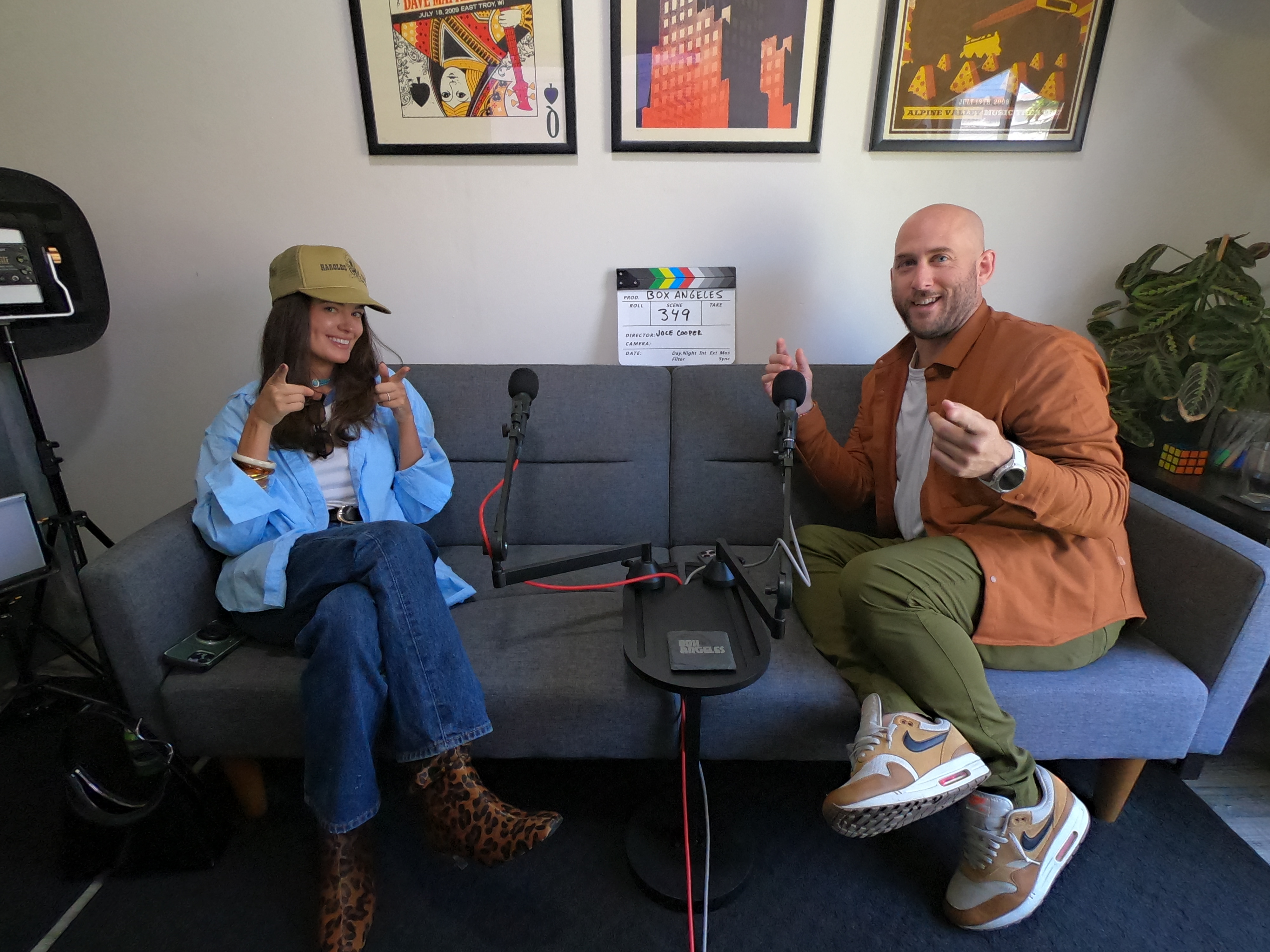
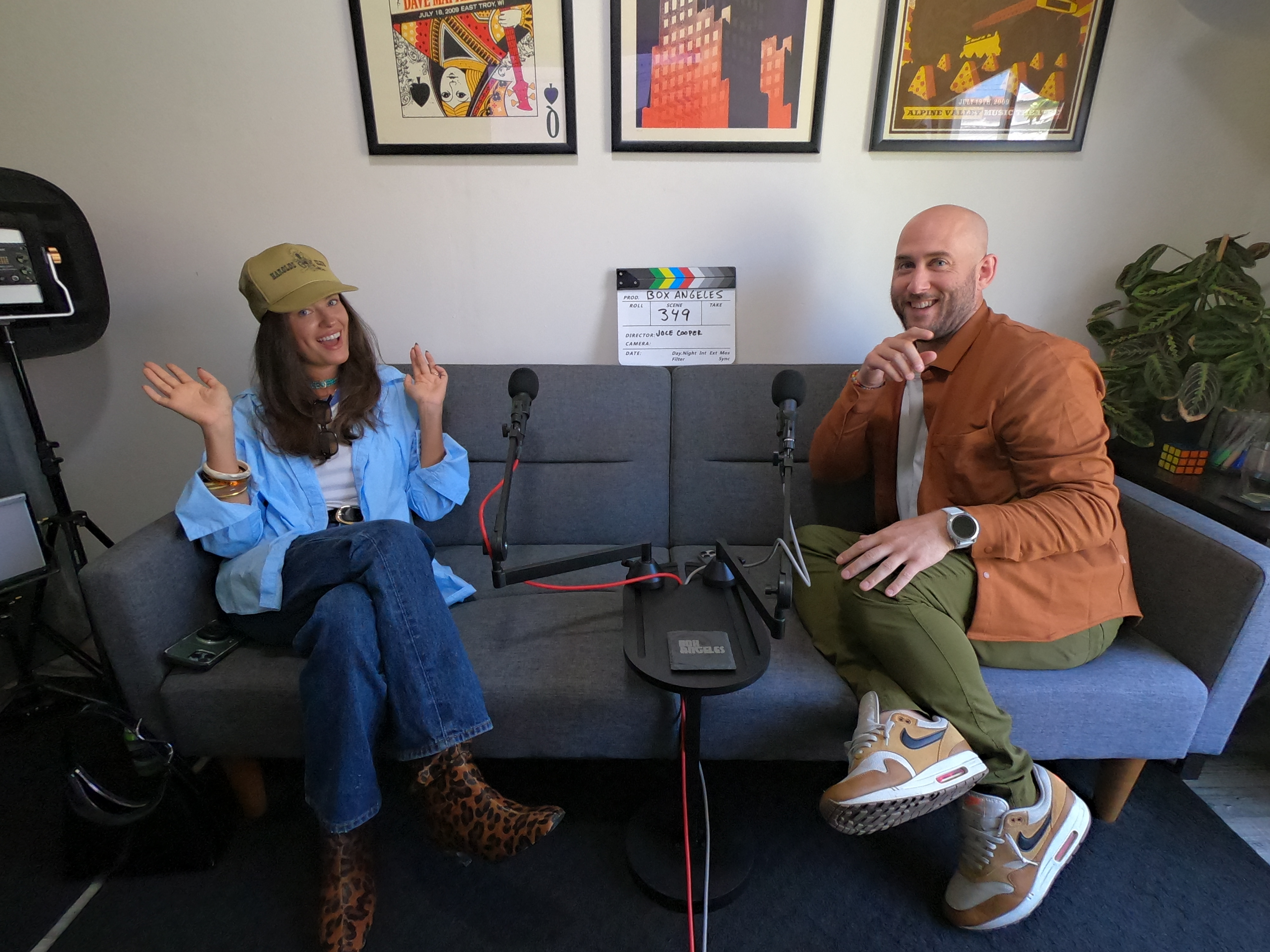
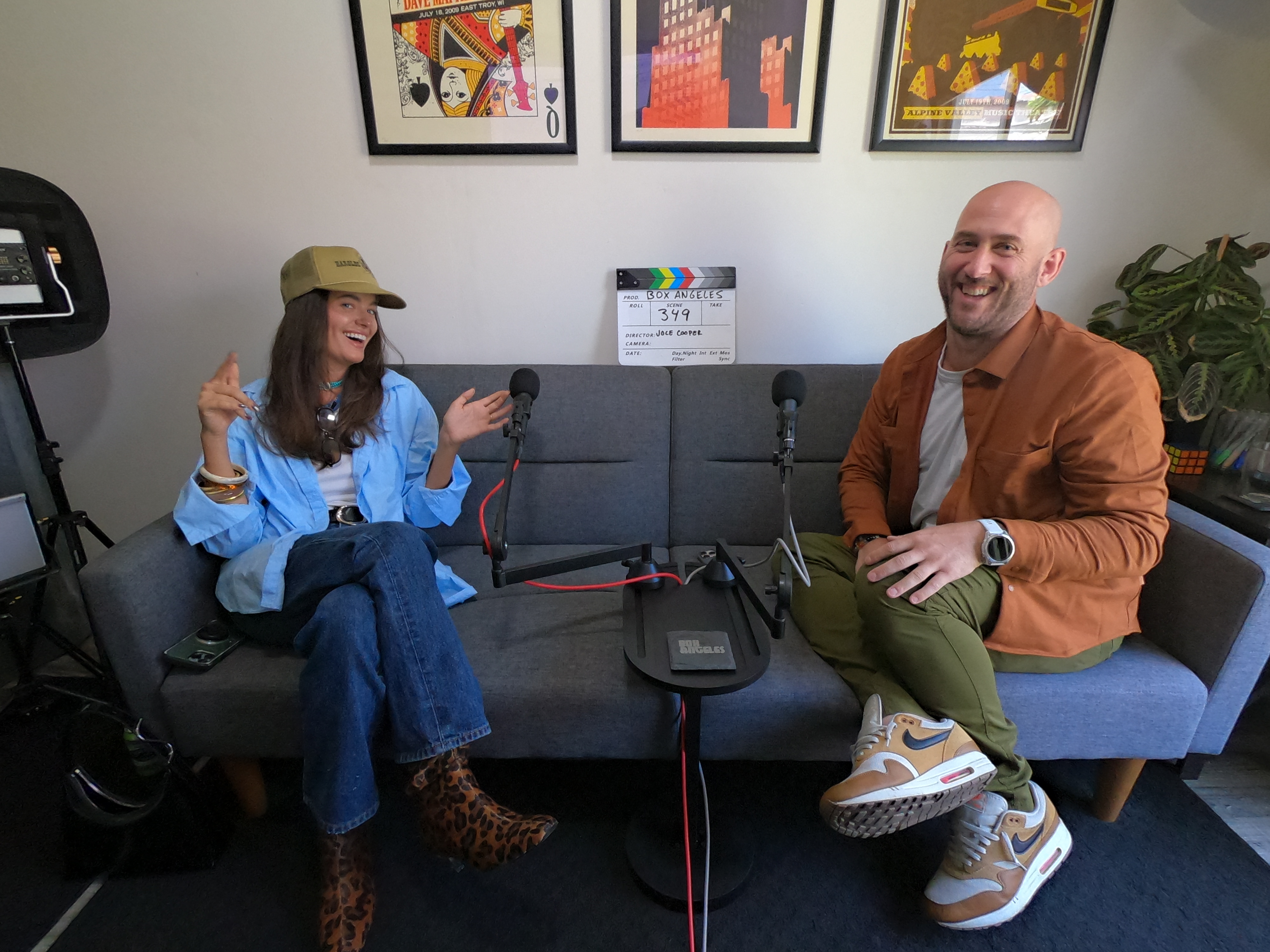
We’ve got another directing podcast today! Director Jocelyn Cooper joins us on the Box Angeles podcast episode 349. Jocelyn stops by the bungalow and discusses her unconventional path into the film industry, beginning with music video production, shares insights into directing, the importance of social media for creators, maintaining a positive, productive set environment, and more!
“You need to create the safest environment for [actors] to kill it,
in my opinion.”
— Jocelyn Cooper
Beats
00:00 – Jocelyn slates her name.
00:12 – Introduction.
02:00 – Sharing directing stories on TikTok.
05:06 – Surname Cooper meaning.
06:03 – Appendix removal.
07:25 – Studying film at Loyola Marymount.
09:52 – Working at a music video production company.
13:51 – Moving to the writing team.
19:32 – Having an analytical mind.
20:28 – Making a thesis film El Almuerzo.
25:15 – Moving from entry level and getting a chance to direct.
33:06 – Curating crews.
35:35 – Director’s as lighthouses.
37:03 – Setting the tone on set.
38:58 – Actor pet peeves.
43:25 – Social media.
44:59 – How involved in casting process.
51:19 – Average gigs in a year.
53:18 – Embracing AI.
58:23 – Who took a chance on Jocelyn.

More Jocelyn
 – Check Jocelyn’s IMDb.
 – Follow Jocelyn on Instagram @jocecooper.
 – Follow Jocelyn on TikTok @jocecooperrr.
 – Watch her thesis film “El Almuerzo” on her website.
Transcript
JOCELYN COOPER (00:06)
Hi, I’m Jocelyn or Joce Cooper.
MIKE ELDER (00:12)
Hello and welcome to the Box Angeles podcast with me. I’m your host, Mike Elder. Thank you so much for listening to the show. I really appreciate you, the listener. Let’s do some housekeeping really quick. I’m in the process of backing up the 300 plus audio archives on Apple Podcasts.
A lot of you listen on Apple Podcasts. Most of you do. They’re currently available on Patreon, but by the end of this week, they will be all available on Apple Podcasts. So you can become a subscriber there, support the show, get access to tons of really great episodes from back in the day.
Darcy C’Arden, Scott Aukerman, Lauren Lapkus. There’s a lot of good episodes back there that you can now listen to on Apple Podcasts, so please do that. Also, if you’re over there, please rate and review the show. I do not ask enough for ratings and reviews on Apple Podcasts, so this is me doing that. They help the show a lot and I should be better at asking for them, but I don’t like asking for stuff, so here I am asking. Anyways, I just had a really great conversation with director Jocelyn Cooper.
This episode is really fun. We talked about her start in music videos right out of college. She started working for a music video production house, which was really cool. That was her in. We talk about the importance of setting the tone as a director on set, how important that is, how much empathy she has for actors. Actors. This was a cool conversation.
I like talking to directors. I like hearing what they think and how they view us. Actors. I think you’re going to get a lot out of this episode just like I did. So, without further ado, ladies and gentlemen, I give you Jocelyn Cooper.
🎵 ROCKFORD (01:45) 🎵
You wanna talk to me? You wanna talk.
MIKE ELDER (01:52)
Hi, Joce.
JOCELYN COOPER (01:53)
Hi.
MIKE ELDER (01:53)
Thanks for coming down.
JOCELYN COOPER (01:54)
Thanks. Yeah, thanks for having me.
MIKE ELDER (01:56)
I’m really excited to talk to you.
JOCELYN COOPER (01:57)
Yeah.
MIKE ELDER (01:58)
I don’t know if I told you this in the email, but basically I’m trying to get more in the actor algorithm.
JOCELYN COOPER (02:04)
Okay.
MIKE ELDER (02:04)
And your fun TikTok videos showed up in my algorithm. And you are a director who is like talking about directing and how to get into it and stuff. And I feel like, keep me honest. I feel like a lot of directors don’t do that. I feel like there’s a lot of actors like me kind of showing their side of it. Definitely some writers too, recently, but not a lot of directors. Would you agree with that?
JOCELYN COOPER (02:24)
Yeah, I think there is some, like, gatekeeping a little bit in our industry. I don’t know if it’s because there’s. It’s been, like, a hard few years with the strikes, and it feels like there’s not a ton of work going around. So people. I don’t know, you know, so I don’t know if it’s. People just, like, are focused on just trying to get as much work as possible, and also if there’s, like, a competitiveness to it or they don’t have, like, time to.
To make TikToks or what. Yeah, I just wanted to. I just started, like, answering questions that I feel like, come up on when I take generals with people, or if I’m, like, meeting people and questions that I would have loved to have answered, like, when I was trying to figure out this nuanced industry, because it is. I feel like each pocket of the industry has its own rules, like, whether it’s music videos, commercials, films, television. And, like, me and my friends always get together and we’re like, okay, I think I figured out this. Like, I think I figured out that. So I just kind of, like, started making videos, explaining, and I’m.
I’m starting to do more, like, bringing people on set and kind of, like, want to, like, dive into the whole process a bit more. But. Yeah, yeah, I love that.
MIKE ELDER (03:42)
I. I do think, like, there’s many layers and gatekeepers, as you said, but, like, the more social media grows, the more we’re, like, not exposing it, but tearing those down. Like, I feel like casting was always kind of a sc. Everything to actors, and now that casting directors have their own podcast, and I think directors are sort of the next layer maybe for that.
JOCELYN COOPER (04:01)
Yeah, I mean, I would love that. I. Yeah, I’ve seen, like, some actors explain, you know, I have, like, this green screen set up, and I’m on these casting websites, and I’m doing this and I’m doing. I’m doing that. And so I think also, just, like, it’s such a necessary evil and not evil now. Like, I think everyone needs to be on social media. And I’ve been telling, like, my dp at the beginning of the year, I was like, you shoot the coolest things.
Like, this is so interesting. Like, you have to show the behind the scenes. And she’s, like, popping off.
And I’m like. I feel like it’s just such, like, a necessary part of.
Of where the world is going. And as a creator, like, you do have a brand, you know, like, people watch my work and they, like, try to piece together who I am and what I am and how I would be good for that role. And then, like, I feel like social media is, like, another way to kind of establish your brand and your style and your tone.
MIKE ELDER (05:01)
Yeah, style, for sure. You can curate it yourself. You can. Yeah, it’s absolutely true.
JOCELYN COOPER (05:06)
Yeah.
MIKE ELDER (05:06)
By the way, I was gonna say, before we get too far, this is really random, so I apologize in advance, but I was at trivia last night, okay. And I’m gonna put you on the spot here.
JOCELYN COOPER (05:15)
Oh, God.
MIKE ELDER (05:15)
The question was, what are these names and their profession? Do you. And Cooper was one of them.
Do you know what a. A Cooper does?
JOCELYN COOPER (05:24)
A barrel maker.
MIKE ELDER (05:25)
Wow. That’s incredible. I can’t believe you knew that.
JOCELYN COOPER (05:28)
Well it’s my name.
MIKE ELDER (05:30)
That’s phenomenal. I can’t believe you knew that.
JOCELYN COOPER (05:32)
Yeah, I know that. In, like, blacksmith, goldsmith, smiths. Did you get that right? In trivia.
MIKE ELDER (05:38)
I can’t believe you knew that. No, we got that wrong. We also got Wainwright wrong.
JOCELYN COOPER (05:42)
I don’t know what that is.
MIKE ELDER (05:42)
Wainwright is a wagon. Wagoner.
JOCELYN COOPER (05:45)
Okay.
MIKE ELDER (05:45)
I’m glad you knew that. That’s really cool. Now I should know what my last name is. I don’t know what an elder does.
JOCELYN COOPER (05:50)
It definitely does something like welder. Elder.
MIKE ELDER (05:54)
That’s funny. We’re just doing rhyming now.
JOCELYN COOPER (05:57)
Yeah.
MIKE ELDER (05:59)
Cooper is a Hooper.
JOCELYN COOPER (06:00)
Yeah, exactly. Exactly.
MIKE ELDER (06:01)
I knew that. That’s great. By the way, how’s your appendix?
You just said your appendix.
JOCELYN COOPER (06:05)
Oh, my gosh. It’s. I’m better. Yes. That was crazy. I had, like, stomach pain, and, like, I was like, oh, maybe I just, like, ate something funny and it wasn’t going away, and my husband was like, we have to go. Just see.
And then they were like, yeah, you have to get your appendix out right now.
MIKE ELDER (06:20)
That’s wild.
JOCELYN COOPER (06:20)
I know. It was crazy, but I’m fin. You know, I’m back. Back. Like, I never left.
MIKE ELDER (06:25)
It didn’t burst, did it?
JOCELYN COOPER (06:26)
No, it didn’t burst. It was just inflamed.
MIKE ELDER (06:28)
Yeah, I told you. I think I told you. My brother and mom had theirs out, so I feel like I’m next, probably.
JOCELYN COOPER (06:33)
Well, they don’t know what causes it.
MIKE ELDER (06:35)
I know. They don’t even know what that thing’s for.
JOCELYN COOPER (06:36)
I’m the only one in my family that’s had it removed.
MIKE ELDER (06:38)
So I have a theory that it’s some sort of, like, alien relic where the aliens are gonna come and if you still have your appendix, they know to attack your. Something like that.
Okay, well, you know what I mean. I have some weird, like, ancient aliens theory about it.
JOCELYN COOPER (06:53)
No, I have, like, none of my organs left because I’ve had my tonsils removed, my adenoids removed, my gallbladder removed, and now my appendix removed.
MIKE ELDER (07:01)
Geez.
JOCELYN COOPER (07:01)
I know. Like, what’s next?
MIKE ELDER (07:04)
You can get most of that.
JOCELYN COOPER (07:05)
I know. I have no organs. Like, it’s crazy.
MIKE ELDER (07:10)
Okay, that’s wild. I just pictured you in Mexico and.
JOCELYN COOPER (07:14)
Yeah. And they opened me up, and they’re like, she’s got nothing.
MIKE ELDER (07:17)
Sorry I went there. But I love that you. Yes. Handed me.
And they’re like, crap.
JOCELYN COOPER (07:21)
We grabbed the gravity. What the heck?
MIKE ELDER (07:24)
Okay, enough about the side stuff. Wait. You did a video recently that came up in my fyp, and it was about how you got started. And it’s kind of a unique way. Can you reiterate that to this audience?
JOCELYN COOPER (07:36)
So I’ll just. I’m from the Midwest. I’m from St. Louis, Missouri.
My dad’s a lawyer. My mom’s in the medical field. Like, create. I have creative grandparents. I do have creative grandparents, but it, like, skipped a generation.
And so I got in. I was.
Got a MacBook. I got an Apple Computer when I was in, like, eighth grade and loved editing and making videos. So I was like, oh, maybe I’ll be a journalist or, like, work in editing for journalism. Because film is just not what comes to mind when you’re in the Midwest. Like, it’s not. Yeah. I just feel like.
I know I never really had been to California. Like, maybe I went when I was, like, in seventh grade. Like, it just wasn’t on my mind. And then I was touring University of Texas journalism program, and they have an amazing film school, and their tour happened to be with the film school program. And I was like, oh, my gosh. Like, I want to do that. Like, I want it.
I get these. Like, telling a journalism story just wasn’t interesting to me. I didn’t. I wasn’t passionate about doing that. I, you know, got overwhelmed with, like, the scandal or politics, and I didn’t want to tell, like, the sappy stories. Like, it just wasn’t.
Wasn’t for me. And so I was like, okay, I’m going to apply to film school. And I did my research and applied to Loyola Marymount University and got in, and they had an amazing film program. And that’s where I’ve met all the people, like, I’m still working with. I think they have, like, 100 kids per class, and you have classes on their sound stages. You pick up a camera your freshman year. You know, you’re constantly on set making things.
And so my junior year, you could Kind of do, like, a class credit for if you got an internship. And so I applied to various companies and got hired at a music video production company. I was like, I’ll just do anything in the industry. That’s kind of what they advise. They were like, just get into the industry. Just get in somewhere.
MIKE ELDER (09:34)
Yeah. Wait, sorry. So your degree was in film?
JOCELYN COOPER (09:36)
My degree is in film, so my degree is in film and television production.
MIKE ELDER (09:39)
Got it.
JOCELYN COOPER (09:40)
And I was still figuring out if I wanted to edit, if I wanted to produce, and I just knew I loved telling stories, I knew I loved writing. I was still trying to figure it all out. And then I got an internship at a music video production company, and they did, like, the first job I PA’d on as an intern was Kendrick Lamar’s Alright, which was nominated for a Grammy. It was huge, huge project. And then I was on an Ariana Grande Focus on Me. And from, like, her. I forget the album, but from, like, her big, big album that had, you know, all the.
All the hits, and it was really awesome to see. And I kind of fell in love with music videos. I was like, these are. This is a really fun way to tell a story. And there’s no rules. Like, you can. In a music video.
There’s no, like, continuity. Like, you can just have fun. Like, someone could be flying one second and in a business meeting the next.
And, like, doing. It’s like, such a creative medium. And so. So I was an intern there, and then they had an office manager position open, and I applied and got the position right out of school. And so I was, you know, getting coffees, taking lunch orders, you know, doing, like, answering, like, info emails, you know, just like a glorified assistant. And then also, like, making sure we had enough pens and papers and the printer worked and stuff like that.
MIKE ELDER (11:13)
That’s how long ago this was.
JOCELYN COOPER (11:15)
Yeah, it was kind of like. Yeah, looking back, like, it’s almost like 10 years now.
MIKE ELDER (11:20)
So the internship was unpaid.
JOCELYN COOPER (11:22)
Unpaid for school, and then they brought.
MIKE ELDER (11:24)
You in right after you graduated?
JOCELYN COOPER (11:25)
Yes, yes. And that was a really great opportunity.
MIKE ELDER (11:30)
Part of my naivety. You said it’s a music video production house. I didn’t know that was a thing.
JOCELYN COOPER (11:35)
Yeah.
MIKE ELDER (11:36)
So they only did music videos.
JOCELYN COOPER (11:38)
Yeah, and some commercials.
MIKE ELDER (11:39)
Okay.
JOCELYN COOPER (11:39)
Yeah. But, like, they’re. So production companies are structured with, like, a roster of directors, and so their roster of directors specializes in music videos.
MIKE ELDER (11:52)
Okay.
JOCELYN COOPER (11:53)
So there’s like, Hannah Lux Davis, Tim Mattia. Hannah does all the Ariana Grande, like, Halsey, like, Big Pops Up. They had Benny Boom who did big rap videos. They had Colin Tilly who was doing other big rap videos. So, yeah, if you are a music video director, like, directors can’t just make productions on their own. They need a producer, they need coordinators, they need all the things. So they pair up with production companies who are their, like, support staff, basically.
And you get, like, rostered at a production company is what it’s called.
MIKE ELDER (12:33)
How does an artist pick a director?
JOCELYN COOPER (12:35)
So how it works is artists label decide that they want to make a music video and they, their team reaches out to these production companies. So they’re like, oh, like Pretty Bird did these past music videos, they have these directors on the roster. We’ll send them the song, send them like a brief and a budget, and then they’ll gather pitches from directors at all these different production companies. And so it’ll be. It’s literally just a document with words and images describing the plot, the vibe, the edit, the casting that you pitch everything out. It’s called a treatment. And you. Yeah. Then they review the treatment.
Sometimes there’s a call, sometimes there’s not. And then they pick the idea that they want the best.
MIKE ELDER (13:23)
Are the artists actually doing that, though, or is it their team?
JOCELYN COOPER (13:25)
It depends on how big they are. So. And like, what? So independent artists are definitely for sure. Yeah. And if they’re really big, I think they definitely are too. But if their A and R team at the label is, like, curating them, then they’ll have a commissioner.
That is a commissioner works at the label and is in charge of these videos. And they are in between the production company director and the artist. So how I got into directing was at that company that I was office managing at. They realized I could write because I had to, like, write something. And they were like, oh. They moved me to the writing team for writing these pitches and treatments.
MIKE ELDER (14:02)
Wait, just because you wrote something?
JOCELYN COOPER (14:04)
So you wrote, like an email? So, like, some scripts came by my desk because they, some of the directors wanted to get into features and television.
And so I started providing coverage. And I think my coverage writing was like, really fluffy and like, that’s awesome. I remember, though, the day they were like, you’re going to write your first treatment, and I was, like, shitting myself. I was so nervous. It was for a Rihanna DJ Khaled song and I was losing it. And I remember my co workers were like, I don’t know, just do it. Like they said, for you to do it, you just have to do.
I was like, so scared and nervous.
MIKE ELDER (14:44)
Why do you think you were Nervous. I mean, you were around it for so long, you felt confident.
JOCELYN COOPER (14:48)
I just had never. Well, yeah, I had never done it before and I, I, yeah, I read a bunch of other of pitch documents of their treatments. I read a bunch of the treatments and tried to just like emulate them and take the ideas that. Cause I talked with the directors and we would come up with the ideas together. And now I don’t think that job exists anymore. Like, I’m sure ChatGPT is helping directors that can’t really write. Like, some of these directors just weren’t writer directors.
So then they would have someone like me write it with them, or like we would talk about the idea and then I would write it. Luckily, I’m a writer director, so I write all my own pitches. But I think ChatGPT is helping these directors now.
Anyways, I was just really nervous. Cause I didn’t, I didn’t know. But they got the job and that was like, whew, okay. Like, I can do this one for one. Yeah.
MIKE ELDER (15:36)
Was that a big raise to go to the writing department? Like, I don’t even know what we’re even talking about. You don’t have to tell me, but.
JOCELYN COOPER (15:41)
Like, no, it was not. Because I don’t think production, I mean, it’s a saturated industry, so I don’t really know how these like, production companies, like, survive, to be honest.
MIKE ELDER (15:54)
Yeah.
JOCELYN COOPER (15:55)
And yeah, I. Music videos budgets don’t align with commercial budgets, you know.
MIKE ELDER (16:04)
I think you mean they’re significantly smaller.
JOCELYN COOPER (16:07)
Yes. Yeah. And I think any director producer will.
Will tell you that. I think if you’re working for, you know, someone, the big artist that can afford it and they want a big concept, then that’s great. But how many music videos is a top? Is an Ariana Grande, Taylor Swift, you know, making a year? Maybe like one or two. So then you have to fill your time in with these, like a lot smaller budget videos, you know.
MIKE ELDER (16:33)
Do you remember Making The Video? Yeah, on MTV and Jay Z, like one of them, he’s like, we’re gonna spend a million dollars. We’re working our way up to a million dollars. And that was like a big deal to spend a million dollars. And that seems like nothing now.
JOCELYN COOPER (16:46)
Music videos are not a million dollars really ever. Taylor Swift, probably. Yes, but that’s like, no, it’s for. I think they’re three minutes, four minutes. So it’s a lot smaller. The technology is a lot better. Like, you can do so much in post.
Like it’s not needed.
MIKE ELDER (17:07)
Yeah. It’s also very simple. Like, the best videos are very simple.
JOCELYN COOPER (17:10)
Yeah. It’s just not. I don’t know why. I’m not, like, I’m not a producer, so I don’t, like. I don’t know why, but they’re not a million dollars.
MIKE ELDER (17:18)
That’s funny. I made a short film recently. Finally, I shot my short film. I’m really. I’m chomping at the bit to edit it, but I just shot it a few weekends ago. And everyone’s like, you spend like five, ten grand. I’m like, I don’t think I’m gonna bootstrap this.
And I spent like a grand. And most that was for food for my friends that were helping me out.
JOCELYN COOPER (17:32)
Yeah, exactly.
MIKE ELDER (17:32)
You don’t have to spend that much money to make this stuff.
JOCELYN COOPER (17:35)
Totally. And, you know, obviously you don’t want to, like, not pay your crews and not people pay people livable wages if you’re gonna be doing this frequently. But even with paying people livable wages, like, you can, like, shoot a house for like $1,000 or, like, whatever. You don’t need to be on a soundstage. You don’t need to be. There’s, like, ways to, like, keep it small. And I think that labels have picked up on that.
And it’s also different. Like, if you’re shooting a commercial, the world needs to be extremely controlled. There’s so much legal involved in that of, like, when you’re advertising something that’s going to be broadcasted to the world. So you really like that. I think the budgets, like, make more sense, like, why commercials have higher budgets. Because there’s just, like, so many implications where these music videos are getting thrown up on YouTube for the most part. And it can, like, be whatever.
MIKE ELDER (18:27)
So I will say this, though. I have a rom com night. Or I used to have it more regularly, but once a month we usually do a rom com night. And one of my favorite things, even not on the rom com nights, but it happens on rom com night. Every watch a rom com, we’ll just sit on my couch and watch music videos for two hours.
JOCELYN COOPER (18:42)
Yeah. Because they’re so fun.
I love doing it too. I fell in love with it. I liked watching TRL as, like, a young kid. And then I definitely, like, search music videos. But working at that company, I was so exposed to all these amazing music videos and art pieces that it really opened my eyes. And I was like, wow, this is such a great way to tell stories, to have fun as a creator and, like, get good at filmmaking. You know, it’s a really I always tell people like, it was a great.
It’s a great way to start. You know, if you have a friend that’s a musician, like grab your phone, like edit in whatever, you know, just make something and practice and get better at it. And I think it’s like such a great way to explore storytelling.
MIKE ELDER (19:33)
When you left film school, was directing what you were thinking or was it.
JOCELYN COOPER (19:37)
Yeah, so I thought I wanted to produce. Like, I do have like an analytical, you know, like organized mind in that way.
MIKE ELDER (19:47)
So great for creativity. I’m the same and I feel like.
JOCELYN COOPER (19:50)
Yeah. But it also can be like a strong suit because I feel like you can make something smart decisions, creatively.
MIKE ELDER (19:58)
Yeah, I just want to like, I. That’s my self table and I’m like, okay, there’s got to be a formula to book this thing. And that’s how my brain works. But it’s not.
JOCELYN COOPER (20:07)
No, no, you have to just like. Yeah, you have to go with the flow.
MIKE ELDER (20:12)
And that’s not analytical at all.
JOCELYN COOPER (20:13)
Totally. There’s. I have like the two parts of me, like the like. And I realized that the like creative director, like being a leader of the creative space on a project is like where I wanted to land. And so I made a thesis film my senior year. It was like a 12 minute short and I realized I really wanted to direct. I don’t remember what, but I know there LMU had.
Has a speaker series and I know Jake Gyllenhaal came and talked about his relationship with Ang Lee and I was like, yeah, I’m gonna direct and I’m gonna make a thesis.
MIKE ELDER (20:51)
Very cool.
JOCELYN COOPER (20:51)
Can’t tell you what I was said and why, but I just know that was like a shifting moment and yeah. Then loved making my thesis.
MIKE ELDER (21:00)
Did your thesis go anywhere? Did you do anything with it?
JOCELYN COOPER (21:02)
Yeah, played at Austin Film Festival and some other film festivals. And I used it as a proof of concept for a series that I pitched to do, you know, remember the Spirit Awards and Independent. So there was.
MIKE ELDER (21:20)
They don’t exist anymore.
JOCELYN COOPER (21:21)
No, I don’t. Or maybe they do. But it was run by Film Independent and Film Independent had a director’s like program. I forget what it’s called, but I applied to that and was like fleshing out a script with them, a series with them and a pilot script with them back in like 2017 or 2018.
MIKE ELDER (21:44)
As a result of your thesis. Oh, very cool.
JOCELYN COOPER (21:46)
Yeah, yeah. And so it definitely. And it’s. I still share it with managers and people and it’s. It was beautifully shot, you know, I would do a lot of things differently now, but I’m so proud of it. And it’s, it’s based on my mom, you know, and so it’s personal and. Yeah, that’s awesome.
MIKE ELDER (22:07)
Is it online?
JOCELYN COOPER (22:08)
Yeah, it’s on my website.
MIKE ELDER (22:10)
Okay, I’ll watch it after this. I did it. I didn’t know.
JOCELYN COOPER (22:12)
Don’t judge me.
MIKE ELDER (22:13)
Why would I judge you?
JOCELYN COOPER (22:15)
It’s just, it’s to. I mean it’s totally like a 20 sec, 22 year old.
Like a 21 year old. You know what I mean? It’s just very like there’s like amateur things. Like there’s this really long shot that goes in and out of focus on accident. Like that was a choice. It was not a freaking choice.
The AC screwed me.
MIKE ELDER (22:35)
Well, I was going to ask about like did you want to direct? Because like you went the music video production house obviously, but like your peers at lmu, what, what did they end up doing that were trying to direct? And, and I’m just curious because it feels like an unconventional path. But every path out here is unconventional.
JOCELYN COOPER (22:52)
Every path is unconventional.
MIKE ELDER (22:53)
It worked out better going that route or no.
JOCELYN COOPER (22:57)
I think so. To be honest, from my graduating class, I think there’s like two or three of us that are working directors.
MIKE ELDER (23:05)
Oh, wow. So I mean that’s pretty good for you said it was like 100 people, right?
JOCELYN COOPER (23:09)
Yeah, that’s not bad. Yeah. And so I, A lot of my. I have a lot of friends that are writers though that and are successful.
I just don’t. I’m not saying that being a director is harder, just maybe I just don’t know as many from my graduating class, but I do have a lot of director friends now. But I think I was, I had to just make the jump.
To be honest. I was making music videos on the weekends when I had a full time job and that was super helpful. But my connections with my classmates and then the people I met at the production company and then making the jump of quitting and just going for it was kind of, I think that was the recipe to success. You know, I think like you have to. If you are coming from middle of America or wherever you are and you don’t know anybody and you want to be a director, you got to go to school or get a job or do something to just meet people that know how to operate a camera, that know how to operate a boom pole, that know how to operate like you have to meet people. It’s not a one person job. And so for me that was Film school and this entry level job and then you have to make stuff.
And so when I had a full time job at the production company, it came to a point where I wasn’t able to make stuff because I was busy. So I finally just had to like go for it and try to fly.
MIKE ELDER (24:35)
Yeah.
JOCELYN COOPER (24:36)
And so, yeah, it’s a tricky dance, right?
MIKE ELDER (24:38)
Like, I just quit a day job I had for 10 years because I was burnt out. But also like, I was like, I got some creative things. I want the short film. Namely, I was like, I want to take a little sabbatical, a creative sabbatical and just focus all my attention to it and see what I can do. When you’re not supplementing your day job and you’re like already burnt out and then you have to go create stuff, it’s like very tricky.
JOCELYN COOPER (25:00)
You work and then you go home and you want to scroll. Like the last thing you want do is sit down and write. And so. Yeah, or like network or whatever. And so I learned invaluable things, having an entry level. And then it, it went from entry level to not. I was writing and then I started a development department for them.
I had like a slate of six scripts and it. I learned a lot about, you know, pitching and development and how to we, you know, we had pitches with like YouTube, Red and @ the time, I think Tubi. And then there was that weird thing that started and ended really fast.
MIKE ELDER (25:37)
Yeah, the short video.
JOCELYN COOPER (25:38)
Yes. What was that called?
MIKE ELDER (25:40)
I don’t remember.
JOCELYN COOPER (25:41)
We were pitching to them all the time and so I learned a lot. And then I was directing on the weekends for my friends that had bands.
MIKE ELDER (25:49)
That’s awesome.
JOCELYN COOPER (25:49)
And then I met a director at the A roster. Director who I was writing with a lot. And he’s a writer and so he didn’t really need me. But it would be times when he was like on set, too busy, got a someone, you know, Green Day was like, we want to make a music video. And he’s like, cooper, I’m on set.
This is my idea. Like, write this out, flesh this out. Then he would fix it and then we would go back and forth anyways, we developed a really amazing relationship. And when I quit my job or left my job, he sent me projects that he wasn’t available for, who was like, hey, like, they want me to pitch on this.
I’m already on this. Like, why don’t you pitch on it? And so that really opened up doors for me.
MIKE ELDER (26:36)
Amazing.
JOCELYN COOPER (26:36)
Yeah. He was like really, really supportive of my career and that I’M so, so thankful to him.
MIKE ELDER (26:45)
And how do you then, though, branch out into commercials? So I get the music video. You’re around that.
That all makes sense.
JOCELYN COOPER (26:50)
Yeah.
MIKE ELDER (26:51)
Then how do you start? So I guess in general, how do you procure work?
JOCELYN COOPER (26:58)
Yeah, you gotta say every job. No, I paid for my first music video.
MIKE ELDER (27:03)
Oh, Really?
JOCELYN COOPER (27:03)
I invested $2,000. I asked my friend who was in a band. I was like, can I use your song and make a music video? They were like, sure. So I paid for my first music video.
And that was. And then. So I had that in my senior thesis. And then the band liked the music video. I did so much, they gave me 500. $500 to make another one, which is.
MIKE ELDER (27:22)
Damn, girl, give me some money.
JOCELYN COOPER (27:23)
No money, though. No, that’s no money. That’s crazy.
MIKE ELDER (27:28)
Talking to an actor.
JOCELYN COOPER (27:29)
No. Okay, I had five. No, I didn’t get to keep the $500. I had to spend the $500.
It was a $500 budget I made. I probably put money into it, you know.
MIKE ELDER (27:40)
Got it.
JOCELYN COOPER (27:40)
That’s funny. So like, I. Which. It’s called Mental Karate by Thumpasaurus. It has like a ton of views.
BuzzFeed picked it up. It was like, I spent the money on getting karate outfits for the guys. I think we rented a camera from a friend. It was just like a. I think it was just a dslr. And then we asked a guy to come, like, bounce, like light on the, you know, in the day.
That was it. I edited it with the musician and then we paid a graphics guy. So whatever. Everything I’ve done and how I’ve gotten into music videos and commercials, I paid for my first job. So I paid for a spec commercial. And then I also edited music videos that had. That had product placement into commercials.
So I did a Zach Brown band music video that Benjamin Moore Paints had product placement in. And so I took all that footage and edited it into a spec commercial.
MIKE ELDER (28:37)
Smart.
JOCELYN COOPER (28:38)
Yeah. And like there.
There’s other music videos that I had that had like, you know, a Nikki Lane music video. I had had some Slow and Low, which is a whiskey stuff.
And we just. You get so much content, you know, you shoot for 12 hours for a three minute thing. Like, there’s so much content. You can put a 15 second spot together, record yourself doing a voiceover, you know, show some like, beautiful images, be like, with Slow and Low, you know, the life’s always moving.
Whatever, you know. There you go.
A 15 second spec.
MIKE ELDER (29:11)
Okay, but then what do you do with that? Do you approach Slow and Low. Or do you take it to like producer or production companies?
JOCELYN COOPER (29:18)
Production companies that are getting bids from brands and agencies and they need to put up directors. So they’re like, oh, this alcohol company, this tequila company. Let’s send the Slow and Low thing. Like, oh, let’s send like, oh, sweet dad and daughter painting together. There’s a family commercial. Let’s send that, you know, and they sent my other stuff. So they have to send work to these brands to prove what you can do.
So yeah, so you make specs. Then you reach out to production companies, commercial production companies.
MIKE ELDER (29:56)
So that’s on you though. You’re like doing that all by yourself. You’re just constantly reaching out to production companies. Basically, yeah.
JOCELYN COOPER (30:02)
But they also reach out to you once they see you and see your work on social media. So I have, have, honestly I haven’t reached out to a ton of commercial production companies. A lot of them have reached out to me. But I have like, I saw a, I followed a producer on Instagram. She posted on her story like, do I know any female directors? And I was like, yes, you do. Hi. I mean we don’t know each other but we can, right?
You know, or like I, it’s crazy. But like I. Another producer guy posted, he was like, hey, like, I need someone that’s worked with kids that is bilingual. I’m not bilingual, but I’m Mexican. Like, what is it? Let’s figure it out. And like we didn’t work out but we got to know each other and he has my reel and he has my work.
And so yeah, I mean, but also they see you and then they’ll reach out to you because they, if Microsoft or whoever is like, hey, I need a commercial and they don’t have any director to throw at them, they look stupid. So they also need directors and work to send them because they can’t send work unless they know directors and have work to send.
MIKE ELDER (31:08)
So at what stage then do you become, I don’t know the term, quote unquote rostered on a production company? Because a lot of production companies I see like when I have a callback, I look them up and stuff and I’m like, oh, they have seven directors listed on their website.
JOCELYN COOPER (31:21)
Yeah.
MIKE ELDER (31:21)
At what point do you do that? Is that like a contract?
JOCELYN COOPER (31:24)
Then you would do some, some make you sign like, not like contracts, but also you can be non exclusive with production companies but on their website so that they can advertise you. So I’ve had that situation at places. I’ve had exclusive relationships with production companies. And then where I’m at right now is I have great relationships with a lot of production companies. And they ask me, hey, this came across my desk.
Can I send this for you? Is anyone else sending this for you? And I’ll say yes or no. And I will say yes. But I haven’t had the point where. I haven’t had the point where two companies have come with the same job. Because sometimes an agency is going to company A and company B.
And if I know company A and B, if they both can’t put me up. So I would have to pick. Like, that’s never happened. But they always say, like, please let me know if someone else is putting you up. It’s up to you. And there. The times I have been rostered and on people websites have been when I really needed work and when I’ve been earlier in my career.
I think at this point, I. I’ve learned that if you’re going to be rostered, you should have a really good relationship with these people and you should only want to work with them, basically because. And make sure and know that they are putting you up for all the jobs that come your way.
MIKE ELDER (32:46)
Yeah.
JOCELYN COOPER (32:47)
You know, it’s because if they. They get this, they get one commercial and they have 10 directors. Like, how are they. If they know you’re the right fit, but like, Billy more Are they gonna send Billy, you know, like, you need to have a good relationship with them and that they know your voice and they know if you’re right for this project.
MIKE ELDER (33:06)
So, okay, I should know this stuff, and I think I do, but I’m just gonna go for it anyway. So if a production company puts you up for a Bud Light job and they select you, do you bring your own DP and all that stuff, or is it the production company’s DP and stuff?
JOCELYN COOPER (33:24)
You work with the production company, they will. The director is the creative leader. So they will let you bring your people that you want to work with. But if you don’t have someone, they’ll say, like, if it’s a. Like, I’ve shot in markets I’ve never worked in.
So, like, I just shot in Kansas City. Yeah, I’ve never worked there before, so.
MIKE ELDER (33:43)
Why would you have.
JOCELYN COOPER (33:44)
Yeah, the production company, I was. They brought their people and I was like, yeah, you know, sometimes they let me fly out someone if the job needs it. But, like, you know, I shot a New Kids on the Block commercial in Miami and I got to bring my dp. Cause it was a big job. It was a very Specific tone. I made my case for why I needed her. We’re best friends.
The day’s gonna go. It was a hard day. Like, the day’s gonna go better if we have a vibe, but. And then she worked with Miami crew.
MIKE ELDER (34:17)
Got it. So. But to me, that’s weird, like, to go to KC just you. Because, like, there’s all. There’s already weird power dynamics with the director.
You know, There is. It’s. It is. But, like, was that weird for you to, like, meet all these people at the shoot?
JOCELYN COOPER (34:32)
Almost, yeah. But that’s kind of part of your job is to get to know them and they, like. And to, like, let them do their thing, but then also, like, communicate with them your vision, you know? It’s hard. I definitely like working with my crew if I can, but that’s just, like, kind of a part of a. Part of it is that, like, they just don’t have the budget to, like, bring all their people. And, like, I was on calls before, you know, I met the production designer on calls before, you know, we.
I met the DP on so many calls. Like, we get to know each other. We go. We get dinner the night before the shoot. Like, I didn’t know the hair and makeup people before I got there because there wasn’t a need for a call because it was really straightforward. But, you know, there’s three hours of setting up.
You get to know each other. You talk about everything.
Like, this is the look. And they’re like, okay, yeah. Like, you, like, you’re the creative leader on set, and they ultimately listen to your guidance. But you also, like, know to give their. In creative positions, too, so give them their freedom to do their thing and really shine. Like, you’re just there to be like a lighthouse, basically, and speak on that. Yeah.
MIKE ELDER (35:45)
What do you mean by lighthouse?
JOCELYN COOPER (35:46)
Okay, so I like this metaphor.
MIKE ELDER (35:48)
Could be very good.
JOCELYN COOPER (35:51)
I say it a lot. As the director, you are the most informed on the story and creative vision. So you are there to guide all of these departments home, basically. So you are there. There’s wardrobe, there’s production design, there’s lighting, there’s camera. There’s all these departments that need to work together to make your vision happen. And you have to be this guiding force of, let’s work together, let’s make it all.
Let’s make it all happen. And because a lot of these crew members, they’re coming from a shoot yesterday onto this one. They haven’t had the time. They haven’t been a part of the writing process. They don’t know what I just said. A Lego shoot. They don’t know what Lego’s trying to accomplish.
They don’t know what the target audience is. They don’t know that this is supposed to be bright and airy and fun and encouraging. You know, they don’t have. Because they were just shooting freaking Netflix the day before.
So, you know, like, they. They don’t have the time. So you have to be there guiding them and explaining that and just like making sure everyone is aligned.
MIKE ELDER (37:03)
Yeah, I like that. That’s good.
JOCELYN COOPER (37:05)
Yeah.
MIKE ELDER (37:05)
How important is like, to that degree? Like, how important is like, tone on the set and do you go out of your way or what do you do to make sure that, like, I’m just talking about, like the, you know, cross functional tone of the set isn’t like, like a regimented.
JOCELYN COOPER (37:20)
Oh, it’s so important in my opinion. You know, I’ve shadowed or co directed or been on sets where there’s just a totally different vibe and tone. And it’s not how I think creativity thrives and productivity thrives. You know, sets is 12 hours and if you. Or 10 hours and if you are late or if you are over that is costing so much money, you start going into time and a half. So you need to be productive. You need to be creative.
And for me, that is having like a very calm, direct, like, positive demeanor with everybody and making sure everyone kind of like stays in that. I don’t like yelling on sets. Also, the minute someone yells around an actor, you’ve lost them, in my opinion. Like, they are doing something that’s so vulnerable, that is. Has so much pressure on them. They are putting. They are like burying their souls.
Even if it’s comedy, even if it’s something silly, it is so hard to do. And you need to create like, the safest environment for them to kill it, in my opinion. And so I like to just have like a really calm. I don’t like yellers. I don’t like, if we’re running late, we need to rush. Rush quietly. But I mean, there could be like music playing and what.
And like, we can be focused and we can be like, okay, we need to move to the next one and like, we gotta get this done. Like that is fine, you know, But I. The booming voices, the yelling at your dp, like, oh, you mess that. Like that is crazy to me and I will never be down for that.
MIKE ELDER (38:56)
Yeah, that’s not good. Wait, do you. Speaking of actors, like, do you have any pet peeves around what they do on set? Or anything that does frustrate you as. Even though they are in a very vulnerable situation.
JOCELYN COOPER (39:12)
Not being focused, like, joking around with, hey, what’s wrong with joking around? I mean, I love fun, but, like, if we’re like, you’re on your mark. We’re, like, about to get into something, and I’m trying to speak, and you’re like. And I’m, like, trying to talk to you, or like, someone’s trying to mic you up and you’re, like, dropping a bit. Like, I love comedians. I’ve worked with a lot of comedians. Like, I do a lot of comedy.
But, like, now, you know, like, that that’s the only thing that is a pet peeve, is just, like, being too much of a ham. Like, you’re the center of attention.
Don’t worry, right? We’re all watching you. You got this job. Like, you don’t. You know what I mean? I’m kind of like, it does.
It comes from a place of insecurity. I’m. Is what I’ve learned. And so I try to just, like, make them feel safe. But, yeah, that’s. That’s a. Just adding more chaos when there doesn’t need to be chaos because sets, there’s so many moving pieces.
There’s lights moving, there’s a boom. There’s. You know what I mean?
Just be chill.
MIKE ELDER (40:13)
Yeah, this is me on my high horse, probably. But something that really bugs me is, like, being on a set and seeing actors just staring at their phones, trying to.
When can I leave? When can I? I’m like, you are an actor.
This is what you want to do. Why are you in such a hurry to leave and also not be present in this moment? I book maybe two or three things a year. I’m going to savior, savor every moment of it because it’s so fun and it’s what I want to do. Why would I just be staring? It just drives me bonkers when there’s actors that are just, like, so uninterested. I’m like, what?
JOCELYN COOPER (40:50)
What do you.
MIKE ELDER (40:51)
Why?
JOCELYN COOPER (40:51)
Yeah, that’s definitely sad. I haven’t dealt with that too much. I mean, I know what you’re talking about, and I always wonder it also, I’m always like, are we not paying them enough? Are we. Are they not, like, excited about this? Like, how can I. If I see that, I try to, like, draw them in more, you know, and bring them in more to the process of, like, how can we get you to engage more and realize the importance of this project?
MIKE ELDER (41:16)
I think a lot of Actors sadly like to point at the thing they did rather than do the thing. They don’t like the process. They like the reward.
JOCELYN COOPER (41:25)
Yeah, that’s hard.
MIKE ELDER (41:26)
Look, I did this rather than enjoying the fact.
JOCELYN COOPER (41:29)
Yeah. I mean, actors are, like, very nuanced, you know, like, if you want to be like the. I just can never do it. Cause, oh, my gosh, I’ve just been on so many commercials where a client’s in my ear, like, they need to be bigger. And so I’m like, okay, let’s do it again, but bigger. And then they’re like, bigger. And I’m like, okay, bigger.
And they’re like, you know, And I feel so bad for these people. And I’m trying to be like, you’re doing amazing. You really are doing amazing. And so I just feel so bad for actors. I feel like you feel kind of like a pony sometimes.
Just, like, dance. Yeah, yeah. And, like, it’s like. It’s hard.
MIKE ELDER (42:07)
It’s funny, though. So a lot of us actors like being the pony, so who cares?
JOCELYN COOPER (42:11)
Yeah, don’t worry about it. So true. So true. Yeah. But I do. I do have a lot of. A lot of empathy, I think.
I did theater and I acted as a kid, so I remember that. Those feelings. And I think as a director, I try to. I really want to take an acting class just to, like, remind myself what it feels like and what is good direction and what. What I need in scenes where I feel lost, just. Cause I think that’s so important. I mean, there’s a lot of, like, bad directors out there.
I’m not gonna lie. And, like, I don’t want to be one. I don’t want to make it harder on people.
MIKE ELDER (42:46)
You should take an acting class.
JOCELYN COOPER (42:47)
That’s really interesting. I want to. I really want to. I just need to, like, find the right one. Or maybe you have a wreck for me.
MIKE ELDER (42:53)
I just took. I was taking Robert d’. Avanzo. I stepped out because I’m traveling a bit, but Robert d’ Avanzo is a very sweet guy, and he does an on camera class that.
JOCELYN COOPER (43:03)
Oh, cool.
MIKE ELDER (43:04)
Pretty good. Because you. You do it and then you watch it and you see what the camera sees.
JOCELYN COOPER (43:08)
Oh, my God. I don’t want to die. I don’t want to watch myself.
MIKE ELDER (43:11)
You do it on TikTok every day.
JOCELYN COOPER (43:13)
Yeah, that’s true.
MIKE ELDER (43:14)
It’s the same thing.
JOCELYN COOPER (43:15)
But I can, like, control and edit out anything.
MIKE ELDER (43:20)
Oh, my God.
JOCELYN COOPER (43:21)
I’m behind the camera.
MIKE ELDER (43:25)
Speaking of, why do you only. I’ve noticed this lately, and I don’t know if it’s just me, but why do you not put your, like, question and answers on Instagram? Why do you only do it on Tick Tock?
JOCELYN COOPER (43:34)
I think Tick Tock’s, like, a safer space.
MIKE ELDER (43:36)
Oh.
JOCELYN COOPER (43:37)
Like, I don’t. Yeah, I’m still figuring out Tick Tock. I think, too. Like, I. Yeah, I’m just playing around with different things and, like, everyone’s moms follows me and I don’t know. On Instagram and, like, family members and, like, judgy wedgies from high school.
MIKE ELDER (43:56)
Judgy wedgies, the word. That’s funny.
JOCELYN COOPER (44:00)
Yeah. I mean, maybe I’ll put it on Instagram.
MIKE ELDER (44:03)
I always get annoyed because so many of my friends are not on TikTok and I want to share a video I see on TikTok. So I go to Instagram and people don’t put it on Instagram. Like, that annoys me. I put everything on TikTok, Instagram, and YouTube.
JOCELYN COOPER (44:13)
Okay.
MIKE ELDER (44:13)
Exact same video.
JOCELYN COOPER (44:14)
Maybe I should. I also, I use Instagram more. I mean, I did just post my wedding, but I don’t post a lot of, like, personal stuff on the grid. I usually just post my work on the grid. And so if you, like, go through my Instagram, it’s like this commercial, this music video, this commercial, this, and you can kind of see it all. And so I think I get like. I’ve always been like, people send people’s, oops, I hit the mic.
People send people’s Instagrams when they’re like, hey, do you have a good dp? Someone will send me their Instagram.
MIKE ELDER (44:44)
Sure. But you can hide reels. You can post reels and hide them from your grid.
JOCELYN COOPER (44:49)
You think I should do that? Well, I don’t know.
MIKE ELDER (44:51)
You’re doing fine. You don’t need me.
But I’m just saying. Okay, I have a thousand reels. They’re not all on my grid.
JOCELYN COOPER (44:56)
Okay, that’s a good idea. Maybe.
MIKE ELDER (44:59)
Speaking of actors, how involved are you in the casting process when you’re shooting a commercial or even a music video? I guess maybe you need some people.
JOCELYN COOPER (45:07)
Yeah, very involved. I. If we’re working with a casting director, I will, like, sift through everything, make selects, send the client or musician selects, and I’ll usually will point out a favorite, and then they’ll either go with that or go with, like, a backup select. So. Yeah.
MIKE ELDER (45:25)
Are you watching all the tapes?
JOCELYN COOPER (45:26)
I do, because I feel bad. I know a lot of people don’t.
MIKE ELDER (45:29)
You have so much empathy for us. I appreciate it.
JOCELYN COOPER (45:32)
Well, because, like, I spent so much time putting together a pitch. And if I knew someone wasn’t reading my pitch, I’d be. I mean, I know that happens and it makes me mad.
MIKE ELDER (45:42)
Yeah.
JOCELYN COOPER (45:42)
And so I know you, like, took time out of your day and, like. Yeah, I just feel bad.
MIKE ELDER (45:49)
Yeah.
JOCELYN COOPER (45:49)
But there’s times where I’m set like, a thousand, and I’m like, okay, oh.
MIKE ELDER (45:53)
Who sent you a thousand? Aren’t they supposed to filter it down?
JOCELYN COOPER (45:56)
Bad agent, bad casting agent.
MIKE ELDER (45:58)
Do you select your own casting director? Do you have a casting director you go to?
JOCELYN COOPER (46:02)
No. The producers usually have their relationships. That is something I would like to do, though, is build a relationship with the casting director. Because that. It’s so, to me, what it feels like. And I could be totally wrong, and if there’s a casting director listening to this and wants to correct me, but it feels like we tell them what we’re looking for and they put out a big call and then just send us everything. Sometimes it’s more filtered and I appreciate that, but I don’t.
Like, I would think they would need to have a call with me to understand how to narrow it down. Yeah. And I’ve never had a call with a casting director.
MIKE ELDER (46:45)
I know I got some recommended.
JOCELYN COOPER (46:47)
Usually the producers have the call with them and, like, relay my thoughts, I think. Yeah, I know.
MIKE ELDER (46:54)
Well, I appreciate you watching the full tapes because lately that’s come up a lot with my interviews with actors. Like, we don’t even know if anyone’s watching it. We film it here, we edit it there, we send it off. We’re like, what are we even doing here?
JOCELYN COOPER (47:05)
Yeah, I mean, I definitely first impression is the headshot is like.
MIKE ELDER (47:10)
Oh, you even look at headshots?
JOCELYN COOPER (47:11)
Well, usually that’s the first thing you see on these platforms.
MIKE ELDER (47:14)
You, like, you don’t see a screen grab of the table.
JOCELYN COOPER (47:17)
You, like, see the headshot and then the screen grab, if you, like, dive in or sometimes. Yeah, it’s usually headshot, then screen grab.
MIKE ELDER (47:24)
Is it LA casting or.
JOCELYN COOPER (47:28)
Yeah, casting networks. Casting networks, yeah. I think I could be wrong, but actors access, if, like, someone doesn’t have a real headshot, then I’m like, have. I might not watch it. Oh, okay.
MIKE ELDER (47:43)
What’s a real headshot?
JOCELYN COOPER (47:44)
Like, if someone’s taking a selfie.
MIKE ELDER (47:45)
Oh, no.
JOCELYN COOPER (47:46)
Yeah, that’s what I mean. Like a. Like a real head. Just, like, any photo that’s not a selfie or a mirror pic. Yeah, you’ll be surprised sometimes. Like, I’ve also posted on, like, backstage casting before and gotten, like, crazy things.
MIKE ELDER (48:00)
So there’s a lot of weirdos out there.
JOCELYN COOPER (48:02)
Yeah, totally.
MIKE ELDER (48:04)
Which sucks because then there’s so much chafe for you to get through to find the good ones. But you mentioned like you find your favorite and I know this is a very difficult and not fair question, but like what makes some somebody your favorite when you’re casting them? Is it what you saw in your mind and they are that or what. What stand. How does it, how do, how do I stand out? If you’re watching my tape, I. I.
JOCELYN COOPER (48:29)
Think well, for commercials, professional headshot commercials, there’s a look people are usually going for, but sometimes it’s open, you know, and so it’s not always the look that people are going for because sometimes it is like you’re like, let’s see who does the best performance. A lot of the times it’s their though video.
What am I? The audition. Yeah, the self tape that they’re, that they’re submitting and how they understand the assignment and at. At hand that. I’m sorry if that’s not a good answer, but that, that is kind of the. Yeah. And like just maybe how much.
If also if they give a couple different reads, if it’s like a quick 15 second thing, that’s nice, like variation for commercials, they want a bunch of different reads on set. Like the agency will be like, let’s make it sad just for fun, you know, or they’ll be like, let’s make it happen. So seeing range for commercials is, is really helpful. Yeah, I would think.
MIKE ELDER (49:38)
Yeah. But we, we see, this is where I struggle with an analytical mind. It’s like, I would do that, but I get a list of directions. So I don’t want to vary from the directions. So if it doesn’t say give four takes, I’m not gonna give four takes, you know?
JOCELYN COOPER (49:51)
Yeah, Maybe give two.
MIKE ELDER (49:53)
Yeah, I always try to give two.
JOCELYN COOPER (49:54)
Yeah. Yeah.
MIKE ELDER (49:58)
Because if I don’t follow the instructions, the casting’s gonna be pissed off.
JOCELYN COOPER (50:01)
No, you need to follow the instructions. So that’s like number one is like what I of what is kind of what I said is just like how if you follow directions and like completed the task at hand and you were able to do that and deliver a good performance doing that. And then if you want to provide like a second option, that would be nice.
MIKE ELDER (50:23)
You mentioned, you mentioned you don’t talk to casting though. But to me that’s interesting because like yesterday I got a very specific one for an NFL commercial and it was like, do this, do this, do this. This is the scene. This is the scene.
There’s blah, blah, blah. And to me I’m like the director’s relaying that to the casting director.
But maybe they’re.
JOCELYN COOPER (50:38)
Yeah, we’re like writing it out though, usually.
MIKE ELDER (50:41)
Right. It’s like a PDF or whatever. But I assumed it was you guys.
JOCELYN COOPER (50:46)
So we will. I.
MIKE ELDER (50:47)
To some degree.
JOCELYN COOPER (50:48)
Yes. So my producers will be like, what do you want to relay to the casting director? And then I’ll write it out and tell them and they’ll. So I don’t have a phone call with the casting director.
It’s kind of what I’m. What I would like in the future is to like, like, so they can actually weed out and like know and understand what I’m looking for. Cuz it’s usually just that same document that you’re seeing probably put into there with their letterhead on it.
MIKE ELDER (51:12)
Okay.
JOCELYN COOPER (51:13)
Is what it feels like in this new age, but I don’t know.
MIKE ELDER (51:17)
What is this new age?
JOCELYN COOPER (51:18)
Yeah.
MIKE ELDER (51:18)
How many, how many gigs do you work? Like a year? What’s like a normal year for you?
JOCELYN COOPER (51:22)
You work three or four? No, like 10 to 12. Oh yeah. That’s a good year for sure. Yeah, it seems great.
I like to. I want to be on set at least once a month. Yeah.
MIKE ELDER (51:32)
Damn.
JOCELYN COOPER (51:33)
Yeah. Especially if it’s music videos and commercials. I’m transitioning into like the feature world. So I’m hoping to get a feature off by the end of the year. You know, I think when that becomes the case, it’ll be like three times on set. You know, if I’m in a future that’s taking up a month of my life or more. Yeah. Each job, a commercial is about like a month of prep and then a few days of shooting or a day of shooting.
And a music video is like two weeks of prep.
MIKE ELDER (52:06)
Yeah.
JOCELYN COOPER (52:07)
And a day of shooting.
MIKE ELDER (52:08)
So is that a, like. That’s just your general rule of thumb, basically?
JOCELYN COOPER (52:12)
It’s just how it happens. Yeah. I mean, the more time, the better for prep.
MIKE ELDER (52:17)
Like isn’t there a moment of like over doing it? Could you over prep for something like that?
JOCELYN COOPER (52:24)
No.
MIKE ELDER (52:24)
Really?
JOCELYN COOPER (52:25)
I mean, you can’t book people that far out. You know, usually it’s hard to book people like six months out or something like that. You can put them on like a soft hold or like a. Ask them to keep those dates. Like crew members I’m talking about. But no, the more, the more time you have like scouting locations and vetting talent and like the more time, the better. You know, I, I have some Jobs that by the time it gets to me, you know, we have like two months and that’s really nice.
But I mean, that’s not to say that the agencies aren’t working on it more than like a month or two out. Like, they are working on it for a long time, you know, concepting and all that stuff.
MIKE ELDER (53:17)
Yeah. You mentioned ChatGPT earlier. Are you. Where are you at with AI? Are you afraid it’s going to ruin our business or help our business or. What’s your thought? Do you have a thought?
JOCELYN COOPER (53:27)
I think we have to, like, embrace it, to be honest. As, like, sad as that is, I do think they.
MIKE ELDER (53:33)
Why is it so necessarily sad?
JOCELYN COOPER (53:35)
Well, I think there’s parts of it that are, you know, the fact that I used to write treatments for directors all the time and don’t and just like, haven’t. It’s a little sad, you know, that’s like taking work from people. I am curious about it for. For, like, filling stands and arenas and like, using people. Using AI instead of people is. I’m curious about. I’m also, I don’t know a ton about how you use it.
Your likeness, you know, and. How do you mean?
Like, for that? Yeah. And how to get paid for your likeness being created as. And who owns that? The studio or the project? And then do they create it? You know, there’s a lot to figure out, but I.
I use it in terms of, like, I like script titles. I will, like, put in my log line and be like, come up with like 40 script titles for me. And then I will, like, read a bunch of them, ponder and like, make a combo sometimes of that or, like. And a lot of my writer friends do that. It’s. I use it for research, you know, like, tell I was doing a Lego piece that had some IP associated with it with like, a TV show that I had never seen. And so I’m like, summarize these characters for me.
Summarize this for me. Like, help me, like, get to know instead of having to sit and watch that whole TV show, which I didn’t have time for. So in that way, I would say, like, embrace it. Like, don’t be a total boomer. Not use it.
MIKE ELDER (55:20)
Yeah, I’m doing that too. It scares the shit out of me to a degree, but I’m doing that too. Like, I’ll use it for Captions on my TikTok video and draw the little graphics on there and stuff.
JOCELYN COOPER (55:30)
Oh, that’s amazing. ChatGPT.
MIKE ELDER (55:33)
Yeah, like, I’ll have a draw. You just like, Reacting to whatever you just said, basically.
JOCELYN COOPER (55:38)
Oh, cool.
MIKE ELDER (55:39)
I don’t know what we just talked about, like, you setting the tone on set, being very quiet. I’ll just say draw this person as a director on set.
JOCELYN COOPER (55:46)
Oh, yeah. That’s awesome. Well, I don’t know.
And I use. I use the imaging pitches because.
MIKE ELDER (55:54)
Oh, yeah, yeah.
JOCELYN COOPER (55:54)
When you’re putting together a commercial pitch, it can be really hard because you can’t find the exact situation you’re writing. And so, yeah, I used it for a commercial I just did when I was storyboarding and also just putting together images to tell the story that I was pitching to them.
And it was awesome. Like, being able to write out camera coming through the door. We have soft light from this window. Like, all that, like, explaining everything to a T and then getting that image was great because before I would just peruse Pinterest and shot deck and various different, like, try to get thumbnails from movies and screen grabs and stuff. And like, you couldn’t get the exact thing you were trying to tell. So that. That’s awesome.
MIKE ELDER (56:46)
Yeah. Yeah. I think embrace it is Right. Because it’s not gonna go away. And if you fight it, you’re just gonna.
Gonna be behind.
JOCELYN COOPER (56:51)
Totally. And that’s just the reality of it all. I think it’s like the same thing with, like, directors not being on TikTok, you know, like, I’m like, every.
MIKE ELDER (57:04)
Speaking of, we need some gaffers on TikTok.
JOCELYN COOPER (57:07)
Yeah.
MIKE ELDER (57:07)
I want to take the same way you want to take an acting class. I want to take a lighting class. I wish I knew better. Better lighting.
JOCELYN COOPER (57:14)
My gaffer’s on TikTok.
MIKE ELDER (57:16)
What?
JOCELYN COOPER (57:16)
Yeah, I’ll send you. I don’t know.
I’ll tell him. He only does, like, my minute in a day for the most part. But I should tell him he should, like, talk about what’s a my minute in a day. My day in one minute. Oh, sorry. That’s, like, so dyslexic.
MIKE ELDER (57:30)
One minute in a day is pretty funny, though.
JOCELYN COOPER (57:31)
Yeah. No, I. Yes. Have dyslexia. So.
MIKE ELDER (57:35)
No, but like, I was like, LACC is right over here. They gotta have a lighting class. I wonder how much I could pay.
JOCELYN COOPER (57:41)
Totally. I had my friend. I have some friends that just took a class at. Maybe it was AFI or it was.
MIKE ELDER (57:52)
That’s over here too.
JOCELYN COOPER (57:53)
Yeah. In Hollywood is AFI okay.
MIKE ELDER (57:55)
It was Don Franklin.
JOCELYN COOPER (57:56)
Yeah. They took like a week long intensive lighting intensive and learned a lot.
MIKE ELDER (58:01)
All right, I’m gonna look that up.
JOCELYN COOPER (58:02)
Yes. But I should tell my DP and my gaffer that they should post about lighting.
I know lighting’s crazy. I don’t. I just let them do their thing.
MIKE ELDER (58:15)
It’s a nightmare.
JOCELYN COOPER (58:16)
I’m like, make it moodier. And they’re like.
MIKE ELDER (58:20)
That’S a great note.
JOCELYN COOPER (58:21)
Moodier, moodier.
MIKE ELDER (58:23)
The last question I ask is, who took a chance on you?
JOCELYN COOPER (58:27)
Brandon Dermer, that director that I met at my first job, who I quit and was like, hey, I can’t direct this music video. I’m busy. Do you want to pitch on it? And I was like, yes. And that changed my career. And he did it a few times after that.
MIKE ELDER (58:44)
That’s awesome.
JOCELYN COOPER (58:45)
He’s really awesome. Brandon Dermer. He directed the feature film I’m Totally Fine. Feature film is called I’m Totally Fine with Natalie Morales and Gillian Bell. It’s on Hulu. It’s really great. He’s an amazing writer director.
He took a chance on me, and he’s an awesome mentor.
MIKE ELDER (59:04)
That’s awesome. You still hanging out?
JOCELYN COOPER (59:06)
Yeah, we’re neighbors. We’re friends.
MIKE ELDER (59:07)
Oh, funny.
JOCELYN COOPER (59:08)
Yeah, we’ve, like, it started back in 2017 or 2019, whatever. And, yeah, we’re friends now. And he. He’s really. And I. I want to do that to people too, you know, like, that’s how anyone’s gonna. Someone has to take a chance on you.
MIKE ELDER (59:23)
Absolutely.
JOCELYN COOPER (59:24)
Yeah.
MIKE ELDER (59:24)
It’s, like, very important that somebody sends the elevator down.
JOCELYN COOPER (59:28)
Totally.
MIKE ELDER (59:29)
And hopefully somebody did for them. And hopefully people keep doing it, because I think that’s. Especially now.
Everything’s such a crapshoot.
JOCELYN COOPER (59:35)
I know. Well, thanks for having me.
MIKE ELDER (59:37)
This was lovely, Jocelyn. Thank you. I can’t wait for your TikTok to explode now after this.
JOCELYN COOPER (59:43)
Oh, I hope so.
MIKE ELDER (59:43)
You’re gonna get the Box Angeles bump.
JOCELYN COOPER (59:45)
Heck, yeah.
MIKE ELDER (59:46)
I just made that up. You got a tail slate here at the end.
JOCELYN COOPER (59:49)
Okay. Hey, I’m Joce Cooper. Thanks.
MIKE ELDER (59:53)
Lovely.
🎵 ROCKFORD (59:55) 🎵
MTV and the channel E!. A thing for a celebrity.