
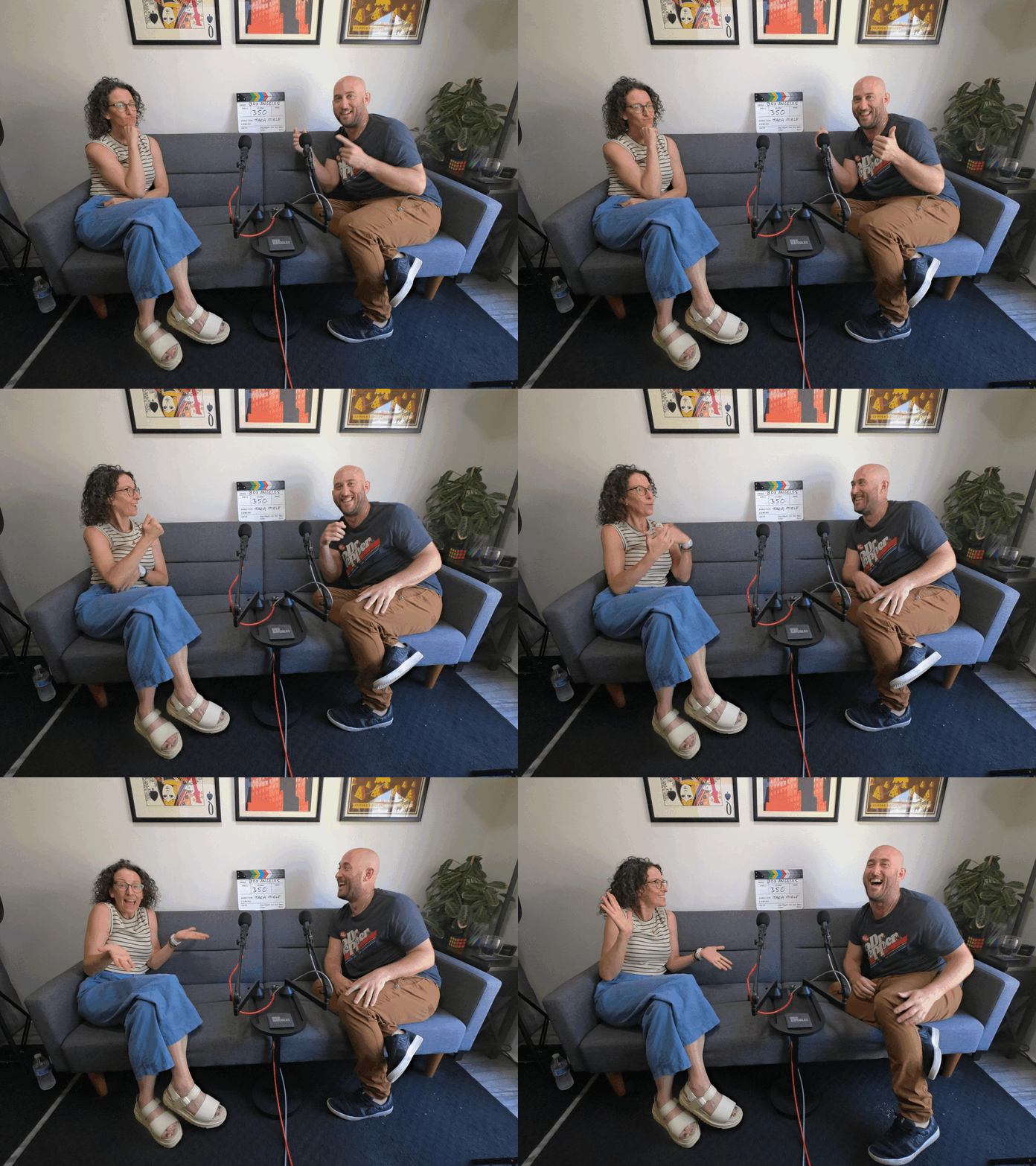
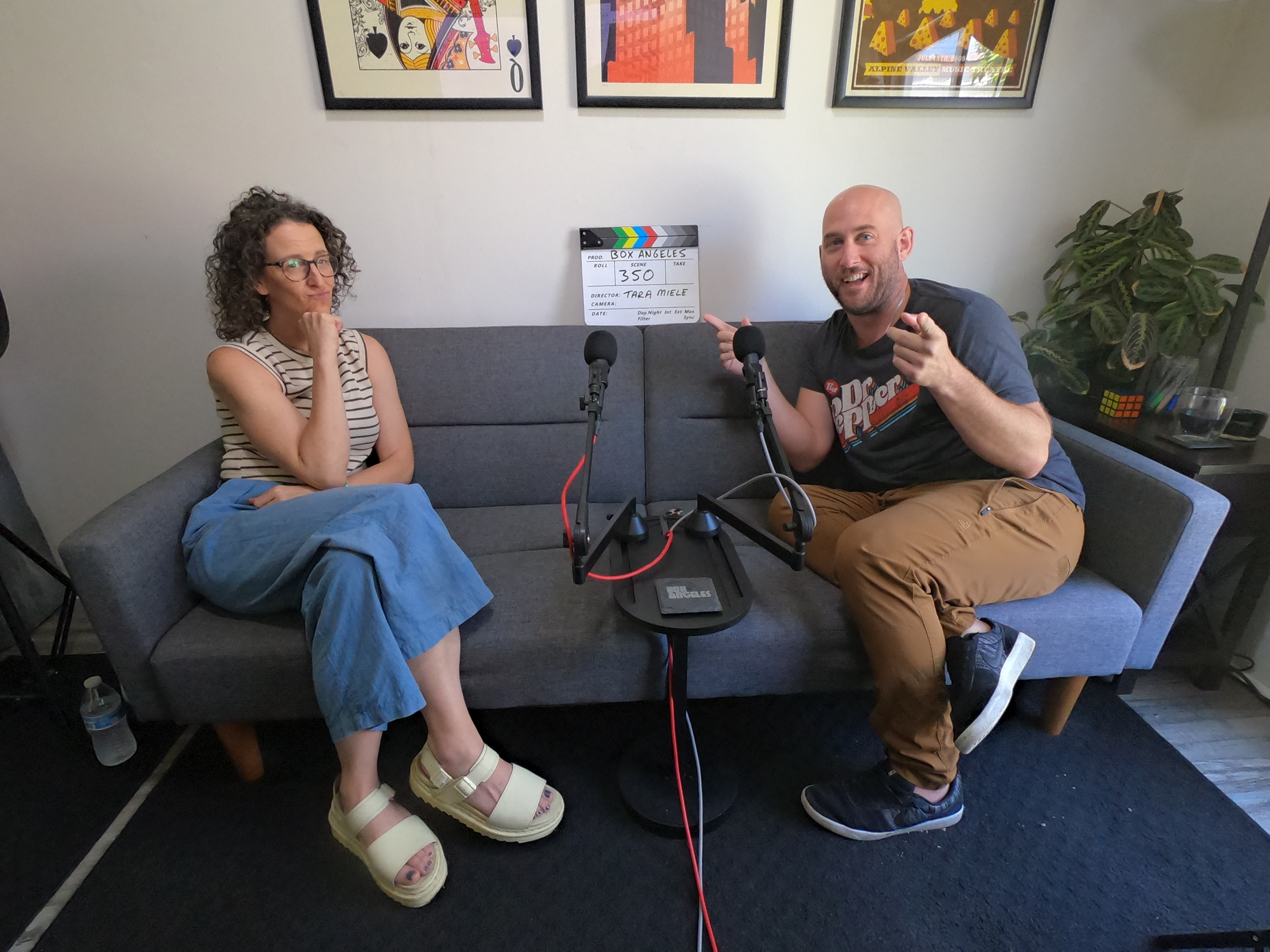
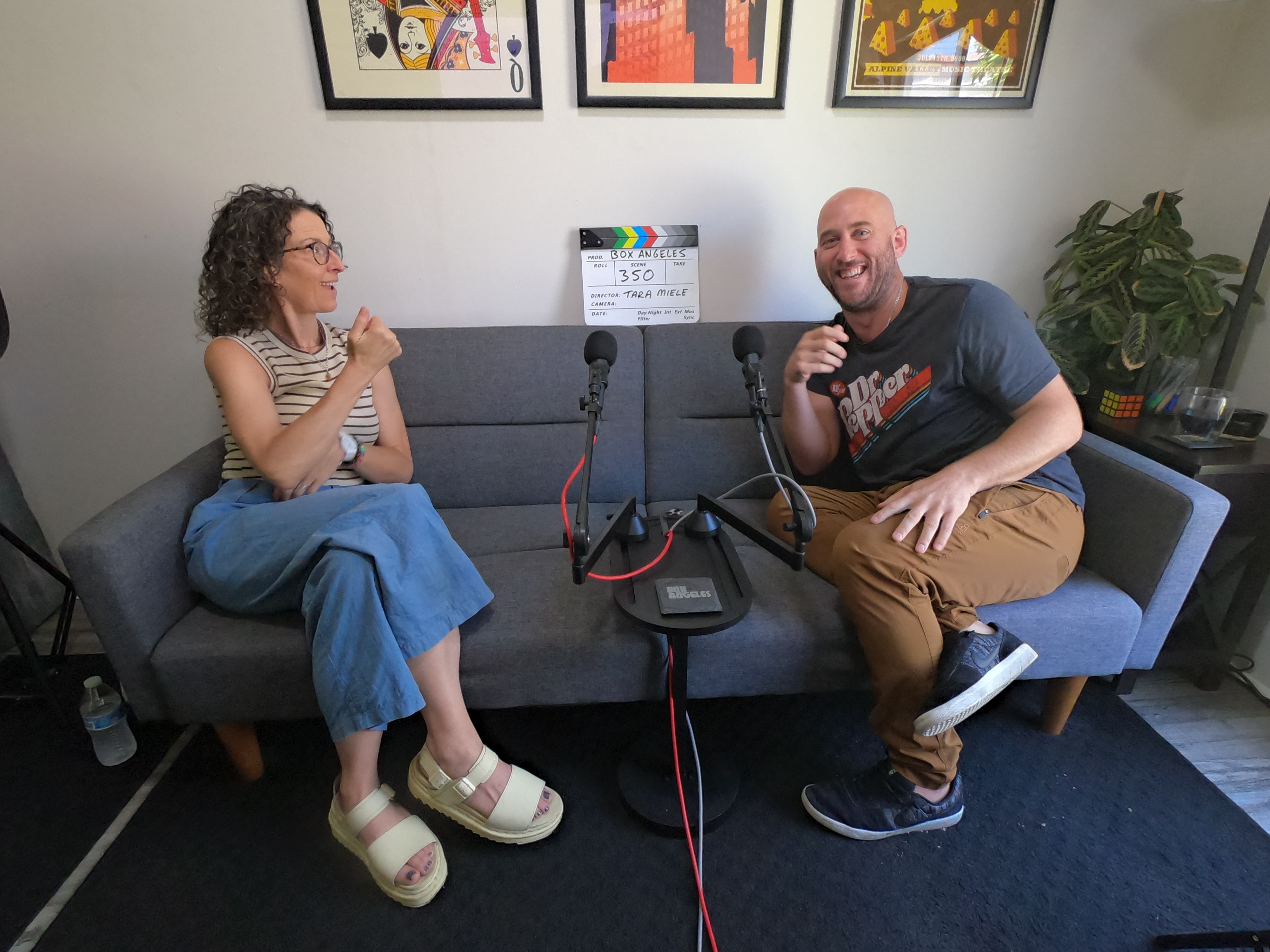
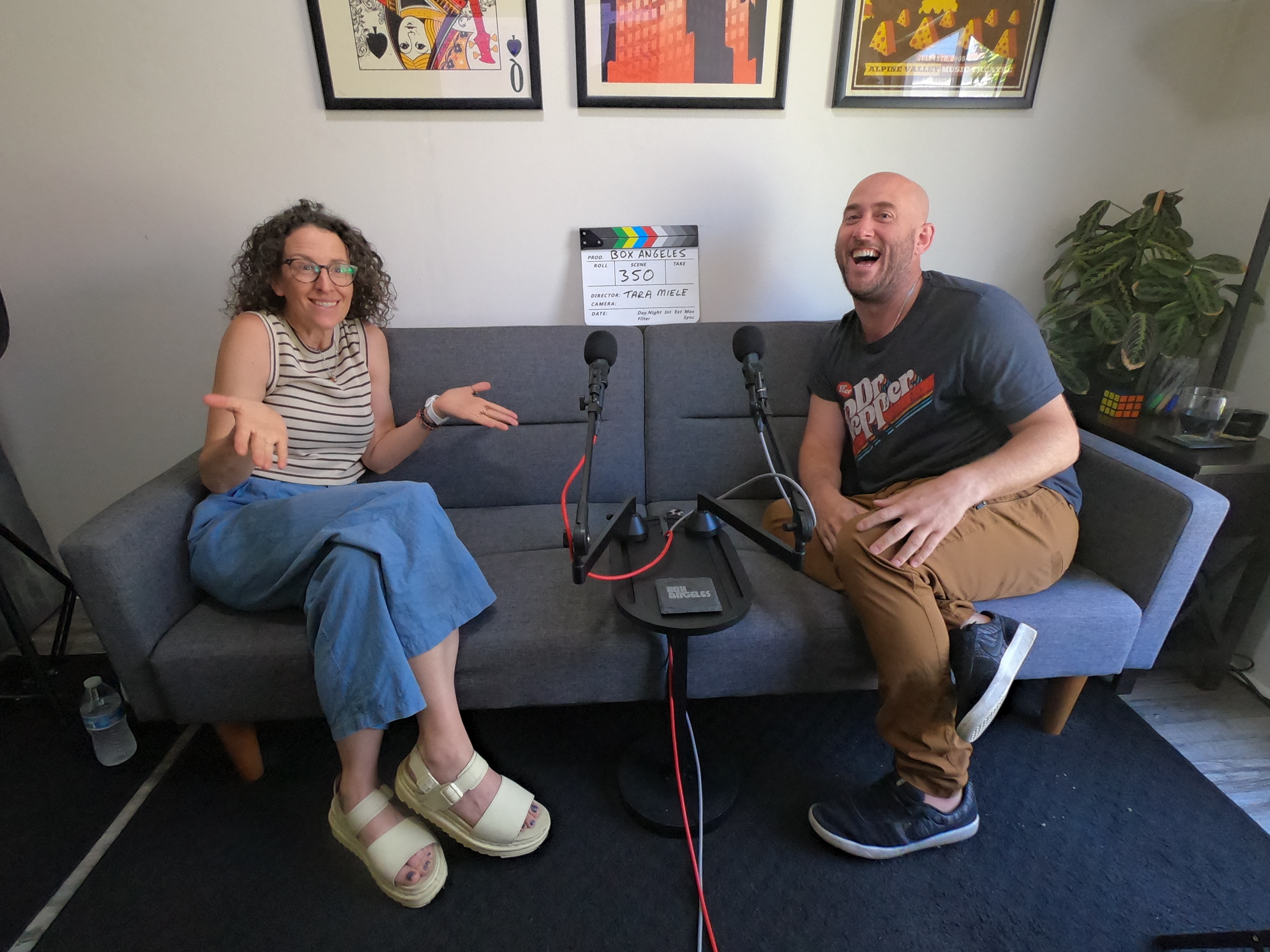
We’ve got another directing podcast today! Director Tara Miele joins us on the Box Angeles podcast episode 350. Tara stops by the bungalow and discusses her peers historically keeping to themselves, what she loves about filmmaking, her need to be the Tigger on set, how she approaches various levels of actors differently, and more!
“That’s what I love about filmmaking
is you just get to dive into so many different worlds. And I’m
constantly learning.”
— Tara Miele
Beats
00:00 – Tara slates her name.
00:11 – Introduction.
02:12 – Tara loves podcasts.
04:50 – Directors historically being lone wolfs.
06:47 – Up and coming director groups.
08:25 – Young directors replacing old.
12:35 – The recent strikes, DGA versus others like the WGA.
19:07 – Double majoring in theatre and film at UC Santa Barbara.
21:54 – Getting an internship at Jodie Foster’s production company.
26:09 – Work procurement and relationship with agents.
33:47 – Interview / pitch prep.
38:43 – Directors staying curious during filmmaking.
41:27 – Casting and audition tapes.
48:03 – Tone on set.
51:18 – Directing last two episodes of Lessons in Chemistry and staying true to source material / earlier episodes.
54:30 – Approach to various levels of actors.
59:03 – Firing actors.
1:01:15 – Who took a chance on Tara.
More Tara
 – Check Tara’s IMDb.
 – Follow Tara on Instagram @tara_miele.
 – Check out Tara’s website.
Transcript
TARA MIELE (00:06)
Hi, I’m Tara Miele.
MIKE ELDER (00:10)
Hello and welcome to Box Angeles podcast with me. I am your host, Mike Elder.
Thank you for being here. Thank you for listening. Thank you for your support. You’ve picked a great episode to listen to, but let’s do some housekeeping really quick. I got a shout out. Griffin Taylor, for being a Patreon subscriber. Thank you, Griffin.
Really appreciate your support of the show. If you want a shout out, go to my Patreon patreon.com/boxangeles and you can also become a subscriber. Support me and get a shout out in one of these intros. That’d be cool. Also, Apple Podcasts, I now have all the full episodes of the archives. 300 plus episodes on Apple Podcasts. If you listen to Apple Podcasts, you can now be a subscriber there and get all the archives.
So that’s great. While you’re there, please leave a rating and review. I am now asking for more Apple Podcasts reviews. It would mean a lot to me if you could do that. That’s a good way to support the show. Even if you don’t become a subscriber, support me in little free ways like that. Okay, We’ve got a really great episode today.
I spoke to director Tara Miele. Tara is a fantastic director you’d recognize from shows like Arrow, Batwoman, Lessons in Chemistry, The Rookie, her movie Wander Darkly. She has done so much stuff. We had a really nice conversation. We talked about the DGA, the WGA, the deals they had, sort of if they can work together, if they can’t, the importance of tone on set, how she handles different actors, different level of actors. Like Brie Larson is very different than a co-star. We talked about all sorts of really good stuff, director groups that she is a part of, her coming up in the business.
It was a really good conversation. She, she’s done a lot of podcasts and she knows what she’s talking about and she likes talking about this sort of stuff and being candid. And she was. And she didn’t disappoint. So I don’t want to waste any more time. Without further ado, ladies and gentlemen, I give you Tara Miele.
🎵 ROCKFORD (02:03) 🎵
You wanna talk to me? You wanna talk.
MIKE ELDER (02:08)
Hi, Tara.
TARA MIELE (02:09)
Hi, Mike.
MIKE ELDER (02:10)
Thanks for coming down.
TARA MIELE (02:11)
Absolutely. Happy to be here.
MIKE ELDER (02:12)
You know what’s funny is this is how big this world is. I literally was like, I wonder if Tara’s done a podcast and then I search your name in Apple Podcasts right before you get here. You’ve done a lot of podcasts.
TARA MIELE (02:26)
I feel like I’ve done a lot of podcasts. And, like, you reached out a while ago, and I, like, didn’t see it or something, and then I was like, oh, I feel bad. Like, you know, I think when I was coming up as a filmmaker, we didn’t have this. And so I love the idea of, like, giving that back and being like, here’s the real, real. I didn’t have family in the business. I didn’t have friends in the business. I was like, you know, so I like that idea of, like, here’s the real deal.
Like, I like to be really honest about it, which is maybe to my detriment.
MIKE ELDER (02:55)
I can’t wait.
TARA MIELE (02:56)
Yeah. But no, I mean, I did.
I just did. Yeah. I don’t know. I’ve done a couple.
MIKE ELDER (03:02)
Yeah. More than a couple.
TARA MIELE (03:04)
You make me seem like I will show up at any podcast.
MIKE ELDER (03:07)
Well, you might. Who knows?
TARA MIELE (03:08)
I don’t think that’s true.
MIKE ELDER (03:09)
Or you’ve turned some down. Who have we turned down?
TARA MIELE (03:12)
Well, that’s not, you know.
MIKE ELDER (03:13)
Well, just give me, like, the general. Was it like a.
TARA MIELE (03:15)
Like, I see who’s been on the podcast.
MIKE ELDER (03:17)
Oh, you do.
TARA MIELE (03:18)
Okay. I just, like, want to make sure.
MIKE ELDER (03:19)
That it’s like, yeah, you do your vetting process.
TARA MIELE (03:21)
Yeah. Cause it’s time. You know, it takes time to do this stuff.
MIKE ELDER (03:23)
Yeah. It’s also one of those things where it’s like, so many podcasts start, and if it’s a very early one, you probably don’t want to because they might quit next week, and your episode might not even get put out there. It’s something like, I don’t know the number of podcasts on Apple podcasts. I want to say it’s like 20,000, but, like, there’s only a small fraction that are actively doing most of them. Do it for, like, a little run and then quit.
TARA MIELE (03:43)
I also, by the way, like, kind of dream secretly of having a podcast, and I’m. Don’t do it. Like, I haven’t done it, but if I wasn’t a filmmaker, I just would want to be, like, interviewing people all the time. Like, I would be Oprah. Like, I just fucking love.
MIKE ELDER (03:58)
Set the bar low.
TARA MIELE (03:59)
I know. Set the bar low.
You know, no. No worries, Tara. Totally go be Oprah.
But I just. I really, really love, like, talking to people and getting their stories and, like, here, like, I just think it’s so. Everybody has such wild stories that you could never imagine. Like. Yeah.
MIKE ELDER (04:15)
So it’s also, to your point about filmmaking, though, it is kind of. Now with. I cut these up, I slice and Dice. Nobody listens to the audio of the podcast, truthfully. But I slice these up into, you know, the bite sized TikToks and Instagrams, and I get thousands and thousands of views on all those and it’s become every video I do, I try to do something a little better because it’s such a different game, but it’s like you got to hook them in the first second.
TARA MIELE (04:38)
Yeah.
MIKE ELDER (04:38)
How can you tease them? And it’s kind of like a fun little challenge. Filmmaking, storytelling. Storytelling aspect to it that isn’t historically been there until the last couple years. Yeah.
TARA MIELE (04:49)
That’s cool.
MIKE ELDER (04:50)
I like the idea though. You said giving back and that’s why I’ve been interviewing a lot of directors lately. I feel like I don’t feel like directors and keep me honest, maybe I’m wrong. I don’t feel like directors like revealing their hand as much.
TARA MIELE (05:03)
I. Yeah, I think maybe you’re right. Like, directors are sort of like lone wolves. You know, they go off on their own. They don’t have like a tribe all the time. I do think that’s changing. I think at least the generation of filmmakers I know, we have lots of groups.
We like to chat, we like to share. We’re all very helpful with each other, which I think is great. It doesn’t feel as competitive as it may be.
It used to. It definitely feels like more communal, but. Yeah, I don’t know, I mean, is it like giving away the secret sauce or something? It’s like, you know, it’s a little bit of that magic. Maybe you don’t want to reveal, but. Yeah, I love talking shop.
MIKE ELDER (05:42)
Well, you clearly do it. I would argue though, like, there’s no reason not to share your secret sauce because then you’ll influence people and you’ll learn something from sharing that. And people can talk, work together. Like, it’s such a collaborative medium in general.
TARA MIELE (05:54)
It’s like, I think that it’s hard, you know, like in some ways, like, writers are allowed to be all like, you know, vulnerable and nebbishy and be like, oh, I’m so tortured and blah, blah, blah. And like directors are supposed to have their shit together. And I think that like a lot more directors than we think are having anxiety, have ocd, you know, have panic nightmares the day before they get to set. You know, like, I love Spielberg said at one point, every day, day one, he gets to set and sees all this stuff and goes, oh, God, today’s the day they figure out I’m a fraud.
MIKE ELDER (06:24)
Sure.
TARA MIELE (06:24)
And I’m like, I love that. Like, that’s. People need to hear when they’re starting out. Like, that first day you show up on set and there’s like, many trucks and many people, and you’re like, oh, shit. They’re all going to be like, what are we doing? You know, like, you have that moment. And so, yeah, I think we got to share that. It’s like.
It’s a pretty daunting job. It’s the best job. Well, you mentioned job.
MIKE ELDER (06:48)
Definitely daunting. You mentioned groups. You have groups. Where are these groups meeting up? And how do I.
TARA MIELE (06:53)
How do you find them?
MIKE ELDER (06:53)
How do I just walk by?
TARA MIELE (06:55)
They’re very secret.
MIKE ELDER (06:56)
Are you talking, like, Facebook groups or whatever?
TARA MIELE (06:59)
There’s a. There’s like, a little WhatsApp group that is, like a little secret society.
And I have a few of those. You know, like, there’s something. The dga. When I first started out, I was in a group called Film Fatales that really gave me a sense of, like, how it could work. I remember I said to a friend of mine, you know, I really want to create, like, a group of women filmmakers and just, like, get together, like, once a month and talk. And she goes, oh, that exists. Like, Leah Meyerhoff has made it in New York and we’re bringing it to la.
And I was like, oh, my God, get me in, please. Can I get in? And then, you know, two years later, there was 30 women sitting in my living room in West Adams, and we were all working, some as writers, but nobody was really getting paid to direct. This was like, what year? 2012 or something like that? No, 2015. And seeing all those women who I knew were talented, who I knew were awesome, and who weren’t getting paid to direct, I was like, oh, it’s not just me.
And so that was so powerful. And then now I look back at, like, a photo of that night, and it’s like Lulu Wang and Sian Heder and Ry Russo-Young and Bert and Bertie and, like, these incredible filmmaker Hanelle Culpepper. I’m like, and now we’re all working, so it’s like. It’s pretty. You know, it’s like you start with the people who are around you in your peer group, and then you all rise together.
MIKE ELDER (08:18)
Yeah, but that’s so cool.
TARA MIELE (08:20)
Yeah.
MIKE ELDER (08:20)
And you also help people out. And you.
TARA MIELE (08:22)
I try to mentor a lot.
MIKE ELDER (08:23)
Yeah, that’s really.
TARA MIELE (08:24)
Mentor a lot.
MIKE ELDER (08:24)
That’s really cool. Keep me honest here. I do feel like. And I don’t remember if somebody told me this on a podcast or I Saw an interview or something. But it does seem like there’s sort of a changing of the guard with directors right now in the sense that. And I could be way wrong, but it seems like there was the same 15 or 20 that were directing the sitcoms, and they’re all white men, and they’re at this point getting really old. And from my understanding, maybe I’m completely misremembering this, right?
A lot of them are kind of dicks on set and just rude. And it seems like they are starting to get flushed out because time and all that, and now it’s a lot younger collaborative directors coming in.
TARA MIELE (09:01)
It feels like, yeah, it might be. I mean, I definitely think, like, with MeToo and Time’s up, things, you know, opened. Like, it was like we were all standing outside the playing field, smashing our heads against the gate. And then all of a sudden, the gate opened, and so we were able to compete at least on the field. Like, before that. I mean, I literally was, like, begging to direct an episode of Kirby Buckets. And, like, couldn’t get enough.
I mean, begging, begging.
MIKE ELDER (09:25)
You probably don’t want to do that. I mean. Well, no, I mean, like, something about a sexy indifference. I don’t need Kirby Buckets
TARA MIELE (09:28)
Honestly. I’m never slumming it. I gotta be honest. Like, whatever I’m doing, I’m doing with my full heart. And, like, there’s room for everything and no shade for any. Anybody who is supporting their family, doing creative work in any way. But it’s just.
Just to say that I could not get hired. Like, literally could not get hired. And I forget what we were talking about.
MIKE ELDER (09:54)
We were talking about getting rid of the old guy.
TARA MIELE (09:56)
Getting rid of the old guy. So. So what I would say is, like, you know, one of my first jobs that I got was because an old dude had been accused of sexual misconduct. And I showed up on this set, and he was one of their beloved older directors. And I was like, it was my second, third episode of television ever. And everybody was like, like, okay, here comes the female diversity hire, because they want to make it look good, and she doesn’t know what she’s doing. And. And they didn’t believe he’d done anything wrong.
And so I sort of had to, like, you know, three days in, I’m like, I don’t know anything about anything. I’m just here.
I’m just gonna do my job. And then little by little, it was like, you know, all the office assistants are like, yeah, by the way, that guy used to corner me in the kitchen, and da, da, da, da, da. And I’m like, oh. And then at some point, I said to one of the higher, you know, guys on the. On the staff, you know, they haven’t told you because they don’t think you’ll believe them. And he was like, no, no, it’s just, like, not true. And I’m like, right.
But, like, they all told me because they thought I’d believe them. And he was like, you know, so it was, like, sort of, like, edging my way into that difficult conversation that, like, this is all real and it does happen, and. And even if this guy’s a good Catholic and a family man, he can also be a perv and make people feel uncomfortable at work or be inappropriate. So, anyway, but then the ad I remember said to me on that show, yeah, so you’re like, the diversity hire. And I was like, yeah. And he goes, so, you know, don’t fuck up. I was like, yeah, no, I won’t.
And he was like. Cause, you know, it was like the idea that if I fuck up, I fuck up for everybody. And I said, but don’t. Haven’t you had, like, bad white dudes come in? And he was like, oh, yeah, tons. And I was like, right, but they don’t represent every white dude. And he was like, yeah, right.
So you can’t fuck up, you know.
MIKE ELDER (11:41)
So you work with that guy often know?
TARA MIELE (11:43)
No, I mean, I love that guy. Actually. It was, like, a really honest conversation, you know, Like, I’m, like, not afraid of, like, having those kind of, like. Because I’m not always. Right. Like, there’s always a different perspective on stuff. But what I would say is.
Yeah, so, like, there was a time where, for sure, there was this wave of all the DEI stuff, right? And now I’m not so sure that that is still mattering in the conversations. Like, there’s been a great compression in the industry, and I. You know, my fear is that it’s like the tides have turned back the other way. Maybe it went too far. You know, like, maybe, like, the way that we were having identity politics all went a little bit too far.
MIKE ELDER (12:23)
Yeah.
TARA MIELE (12:24)
And, you know, I was, you know. Yeah, that’s all I’ll say about that. So. So. Jury’s out. Jury’s out.
MIKE ELDER (12:32)
Well, you. You said you started with this saying. You’re. I think you said something like you’re an open book on these podcasts or whatever. So let me ask you something about the DGA.
TARA MIELE (12:39)
Oh, no, I’ve, like, set myself up. You’re like, let’s get into the hardship.
MIKE ELDER (12:42)
Say whatever you want. No, I. And I don’t know enough about this to really even grill you if I wanted to. Not that I would ever grill somebody. I’m a sweet little boy. So when all the strikes were happening, the DGA sort of just was like, we’re good, and didn’t help. Is my.
And took their deal and ran off. Did you. What was your sense on that? And were you okay with that? Were you fine? What was the hap.
TARA MIELE (13:06)
Look, I have. I think I have a different perspective on that for sure. But what I can say is the Writers Guild and the Directors Guild have different needs, different negotiation strategies, and cannot really see eye to eye. And I truly don’t think that either side is innocent or. Yeah. Like, without some responsibility in that dynamic, what’s hard as a director? Most of the time I’m working for a writer, so there’s this feeling from the writer sometimes.
Oh, the directors. This, this, this. And I’m like, but you guys are my boss. Like, what are you talking about? You know, and then I think on the writer side, there is like a history of, you know, when directors ran features, they were like, yeah, fuck the writer.
Get out of here. And so, you know, I think there’s a lot of old bad blood. And I’m in both guilds. I think it’s unfortunate there’s. That there’s that much bad blood because I know a lot of writer directors who really wish that our unions could work together. And, Yeah, I don’t know that it’s ever gonna happen. That’s the truth.
Like, the directors did what the directors needed to do for them.
MIKE ELDER (14:21)
Okay, so you were good with the deal you guys got. You didn’t think. You guys. The thing that rolled over is how I felt like the trades were writing it or something.
TARA MIELE (14:28)
Might be. No, I don’t. I mean, look, the DGA will say, we got a historic deal. We got the best deal we ever dealed, blah, blah, blah. And the trade. Or the Writers Guild will say they sold out. And I think it’s all spin.
The thing that I wish the Directors Guild had gotten is international scope, which is if you have an American project shooting overseas, you have to have an American director. And right now, that’s not always happening. So there’s plenty of, like, Apple ABC Family shows or whatever, Ted Lasso that shoot overseas that are paying non union directors, non union rates and not playing healthcare. And these are massive companies. They, like, have the money. So. So that’s the thing that I Find, like, that’s the thing I wish we had gotten, and I hope we get it next time.
I mean, it’s, like, coming up already. It’s like a year out.
MIKE ELDER (15:14)
Oh, wild.
TARA MIELE (15:15)
It’s sickening. God, not again.
MIKE ELDER (15:19)
That’s funny. Why do you think the DGA and WGA essentially can’t get along? You kind of led that with, like, they’re just never gonna work.
TARA MIELE (15:29)
So the DGA.
MIKE ELDER (15:29)
Is it a toxic?
TARA MIELE (15:31)
No, it’s like. It’s like their negotiation strategies are different. Right. The DG doesn’t go in saying, you know, we’re going to strike if you don’t give us what we want. Like, they go in, in good faith and say, okay, let’s see what we can work out. And the Writers Guild says, first thing out, you don’t give us what we want, we’re going on strike.
And, like, that’s. That’s. That’s just in terms of literally, like, their negotiation strategy is just night and day, and. And it’s like a little bit of, like, if you can’t play the way we want to play, we’re not playing with you.
MIKE ELDER (15:57)
Yeah, so.
TARA MIELE (15:58)
So. So that’s a little bit of what it is. We always thought, like, couldn’t we do something where the DGA says we agree never to shoot an AI script if you guys agree never to do an international production without DGA directors? And everyone’s like, no. It’s like, okay, you know, on both sides.
MIKE ELDER (16:15)
Right. And also, don’t give awards to all those shows that do skirt the union lines.
TARA MIELE (16:20)
I know.
MIKE ELDER (16:21)
Like, I had Matt Jones on recently, and he was like, I can’t believe that SAG. The biggest shows or movies for the SAG Awards all had international things that were ducking the union.
TARA MIELE (16:32)
The best stuff is being made overseas, I think. Right? Yeah, they’re all. Because, whatever. I mean, you know, it’s like, are we already in the algorithm so deep that we’re all trying, like, that Hollywood is trying to make stuff that’s just, like, the four quadrants and fitting that, you know, is it just content and overseas it’s different. Somebody’s telling me, like, when they develop in England, you know, they’ve got, like, four projects on their slate that they’re developing, and they intend to make them all.
And it feels like sometimes in America, like, in Hollywood, our plan is, okay, we’ve got 40 things on the slate. Let’s see which one sticks. And then everybody’s exhausted. Everybody has a slate of things that are never gonna go. Everybody’s stretched too thin, writers included. You know, and then you’ve got, like, 36 things that don’t end up going that you’ve wasted all that time on, so. Yeah.
MIKE ELDER (17:19)
But that’s always how it’s been, though, right? To a degree. Because they always make hundreds of pilots and then only select a couple of them, right?
TARA MIELE (17:26)
Yeah.
MIKE ELDER (17:26)
But then you have networks like HBO and FX that are much more Selective.
TARA MIELE (17:31)
Selective, yeah.
MIKE ELDER (17:32)
And then they let those things breathe rather than just.
TARA MIELE (17:37)
Yes. Yes.
MIKE ELDER (17:40)
So it’s safe to say you’re not worried about where we’re at at all?
TARA MIELE (17:43)
Not at all. It’s fine. It’s all fine.
MIKE ELDER (17:46)
Were you good with the WGA deal at the time? As. Since you are also in the WGA.
TARA MIELE (17:51)
Oh, man. Let me, like, remember, how did I feel about the WGA deal at the time? It’s like the same thing, you know? Like, I kind of feel like what’s told to you and what the real real is is never exact. You know.
MIKE ELDER (18:03)
Yeah, it’s all politics.
TARA MIELE (18:04)
And I wasn’t involved. I wasn’t as involved at the WGA. So, like, do I believe they did the best they could do? Yes. Do I believe that the DGA did the best they could do? Yes. Do I know that it was worth it for us to go on strike?
I don’t know.
MIKE ELDER (18:17)
Oh, interesting.
TARA MIELE (18:18)
I don’t know. I just. Look, I was around during the first strike in 2007. I sold my first script, got into the WGA, and they were like, don’t buy a house. Don’t have a kid.
Don’t buy a car. And I was like, wait, what? And then I didn’t work for five years. You know, like, I didn’t work for five years. It took me five years. And so when the WGA was talking about going on strike, I went to one of our little meetings, and I was like, you know, this is gonna, like, destroy people’s careers. Like, people will not survive.
And, you know, they were like, yeah, it’s war that happens. That’s gonna happen. I was like, damn, you guys are hardcore. You know? Like, that’s so horrible, you know, but. So. I don’t know.
I mean, yes, the. The industry will squish every little thing out of you. It’s so unfortunate, right?
MIKE ELDER (18:59)
Yes.
TARA MIELE (18:59)
And. And somebody has to fight. The unions have to fight, you know, so. And it’s like, maybe it’s above my pay grade.
Like, I don’t know answers. I don’t know.
MIKE ELDER (19:08)
Do you. Wait. Did you always want to direct? Did you always aspire to be a director?
TARA MIELE (19:12)
When I was Little. I wanted to either be an actor or the president, and then did a lot of theater. Yeah, totally both. Achievable.
MIKE ELDER (19:20)
Acting might be harder, Honestly, at this point.
TARA MIELE (19:23)
Thank God I’m not the president. I mean, better me than some people, but not, you know. No. So I did a lot of theater, and everybody was trying to push me to write. Like, every time I had a teacher, journalist, my mom was sort of a writer and stuff, I was like, you’re such a good writer.
You’re such a good writer. I was like, I’m not a writer. And. And acted. Acted. Went to college for acting, then started directing in theater and hated that because I’m too OCD and couldn’t control the, you know, every little nuance of the connection on stage. And then one night I went to Santa Barbara and I was in Isla Vista, and I was probably stoned, and a friend of mine was like, I was really depressed because I did not know what I was doing with my life.
And they were like, come with me to the student film screening. And I don’t know if you’ve ever been to Ivy Theater, but it’s like just pot smoke, just, like, fluming up. And there’s like, you know, And I was watching these little student films. They were shot on, like, 8 millimeter, and they were splice tape on them, and you could see where the cuts had been made. And there’s, like, a live guitarist. And I was like, oh, fuck, I could make this.
MIKE ELDER (20:22)
Yeah.
TARA MIELE (20:23)
Like, I could do this. And my family is very obsessed with films. Growing up, like, we did a lot of quoting Beetlejuice and, you know, Dirty Rotten Scoundrels. And, like, that was just, like, how we communicated was movie quotes mostly. And it just was like, oh, this is what? This is, like, the space, you know, like, this is my. Just, like, that was it.
It was a full lock in. I was like, this is what I’m meant to do. So, like, march down to the film office on Monday morning. I was like, I’m gonna make a movie. And they were like, well, you should maybe be like a film major first. And I was like, yeah, okay, let’s do that, you know.
MIKE ELDER (20:50)
Oh, so you were still in school at the time?
TARA MIELE (20:51)
Yeah, I was in theater. Okay, Okay, I was in theater. So. So then I double majored and I made a senior thesis film that went to slam dance in 2000. And I was like, set my sights on Sundance. It took me 20 years to get down the hill. I did that with Wander Darkly in 2020.
And, yeah, but it was, you know, it was just like. It’s nice to know what you love. It’s nice to know what you love to do. It’s hard to see it. You know, it’s funny because I’m writing this film right now that’s set on a ranch in Texas. And it’s like you can’t make a living as a rancher anymore, right? And I’m like, oh, maybe that’s filmmaking now.
I’m like so identifying with like the kind of evolution and change of this business and this industry. And it’s like I’m like an old cowboy just like holding on, you know, like I have 300 acres and 100 cattle just holding on. So, yeah.
MIKE ELDER (21:42)
Wait, what school did you go to? Were you out here at. Oh, okay, got it. And so you, you had that moment where you’re like, oh, I should direct.
TARA MIELE (21:50)
Yeah.
MIKE ELDER (21:51)
So then quickly, now I’m a film.
TARA MIELE (21:53)
Director, that’s who I am.
MIKE ELDER (21:54)
Right. So how, how did you like. To me, it’s just like ostensibly obvious how actors get work, right? They get an agent, an agent submits them to all the breakdowns. But directing, you obviously have to procure work. You have to like find an in. And.
TARA MIELE (22:06)
Yeah.
MIKE ELDER (22:07)
So was it for you making content, was your in? Or did you work at a production house or something?
TARA MIELE (22:12)
This was in like 1998, you know, pre the word content. I. So what did I do? I was in school, I made my short film and my senior year I befriended my production teacher and he was like, you know, I was looking for an internship in LA and like, I didn’t know anybody. And he said, oh, you should meet with this old student of mine, she works at Jodie Foster’s company, Egg Pictures at Paramount Studios. And I was like, oh my God, yes please. And so I went, I interviewed there and I got this internship.
So for like the second half of my senior year, I would go to class on Monday, drive to Thousand Oaks, sleep at my parents house, drive to Paramount Tuesday morning, do my shift, like my day shift. And then I had asked them, do you guys mind if I leave at 5 so I can make my 7pm screenings on Tuesdays and Thursday nights. So drive back to Santa Barbara, do my screenings, which was like for a class or whatever, Wednesday, Thursday. And I mean I was like falling asleep on the freeway. It was not recommended, it was too much. But that was how I kind of got my foot in the door. And then they helped me get my first job, which was after graduation.
And I remember it’s really interesting I remember Nicole hall, center, needed an intern and she didn’t have money to pay an assistant. She needed an intern. And I couldn’t take the job because I could not live at my parents house. It was like, you know, like they were like, get out. And I needed a job job. So I always think about, like, what would have happened if I’d had some sort of financial support to be able to go do that route. But instead I got a job at the Kushner-Locke Company and three days into my job, I found out they were making softcore porn. And that was my job for like eight months I worked at this company that made like B movies and softcore porn.
And it was a fabulous experience, a learning experience. And that’s.
MIKE ELDER (23:57)
Yeah, probably learned a lot about lighting. I feel like.
TARA MIELE (23:59)
Oh my God. It was something.
MIKE ELDER (24:00)
And closeups.
TARA MIELE (24:01)
It was something. And then. Yeah.
MIKE ELDER (24:02)
I love that the name was like a law firm though. Kushner and Locke or whatever.
TARA MIELE (24:07)
Oh my God, those guys, they were getting sued all the time. I don’t know. But you know, it was definitely like very different. Was they go from Egg Pictures, which was like the soft nest with Diet Coke. And we’d all walk around barefoot on the Paramount lot. A little bungalow. And then I was like in some bank building and you know, Brentwood with like people who all hated each other and were like being awful and whatever.
MIKE ELDER (24:28)
That’s so cool that you gotta go on the Paramount lot though. Like, I still love going on.
TARA MIELE (24:32)
I know I just shot the rookie there in the fall and we were riding our bikes around scouting like some. We needed like a college campus locations for scouting. And my AD, who I love, put on, you know, the Cindy Lauper song from Goonies. And we’re all just like riding bikes around the lot. And I was like, this is like the best moment of my whole life. Like, you know, like I’m literally like sunshine riding a bike around the lot like in Pee Wee Herman. And like, this is it.
Like, this is it, you guys. This is a full circle moment.
MIKE ELDER (25:02)
You know, I love that even if it is empty. My buddy works for. He does Warner Brothers tours and they do a 5k every year. And he signed us up this year because suddenly he got into. He wants to run the marathon. But it was so fun to run the lot just on a Saturday morning with a bunch of friends and families of co workers. And I was like, why have you.
He’s worked there forever. I’m like, why have you not done this every year? He’s like, I don’t know. I didn’t like, running. I’m like, yeah, but you give an opportunity for your friends to get on the lot, and it’s so magical and fun to run through a lot and do a 5k.
TARA MIELE (25:31)
Yeah. And I actually got to shoot at Warner Brothers for Little America. We shot, like, Brooklyn, you know? Like, we did, like, Hasidic Brooklyn on the back lot, and it was like, this is where they shot Easy street in Annie. I was like, this is like, this is a moment.
MIKE ELDER (25:44)
Yeah.
TARA MIELE (25:44)
And it was actually funny. We show up, and I’m like, oh, my God, we’ll put the crane and we’ll do this whole thing. And then I was like, wait, no, stop, stop, stop. Just because you’re, like, on the lot, you’re all excited. That is not the show. The show is, like, handheld and on the ground and, like, real. That’s like a documentary.
I was like, okay, okay, okay. So it was really cool.
MIKE ELDER (26:00)
That’s how inspiring they are, though.
TARA MIELE (26:02)
It was so cool.
MIKE ELDER (26:03)
You just get that in your.
TARA MIELE (26:04)
Yeah, yeah. That history, you know, that’s great.
MIKE ELDER (26:09)
Back to procurement. How at this moment in your life, how much you’re with WME, one of the big agencies. How do you. What. How much work are you finding yourself? How much are from relationships? How much is WME getting you?
TARA MIELE (26:20)
That’s a good question. I feel like the last several jobs I’ve gotten are from me and my connections. But what can be helpful with the agents? They’re all great, by the way. And I love my managers and my reps. You know, they work hard. I mean, I actually like them.
MIKE ELDER (26:39)
Contract that she has to sign up.
TARA MIELE (26:40)
Yeah, no, I actually like them, but sometimes I’ll say, like, hey, can we circle the wagons on this? Like, I heard that. This job.
MIKE ELDER (26:48)
Back to your rodeo connection.
TARA MIELE (26:50)
Yeah, right. Born to rodeo, you know, so, like, not who I am. I’m just in that world.
MIKE ELDER (26:57)
Sure, sure.
TARA MIELE (26:58)
Like a long island.
MIKE ELDER (26:59)
Don’t fight who you are.
TARA MIELE (26:59)
Don’t fight it. Don’t fight it. Annie Oakley.
MIKE ELDER (27:03)
Circle the wagon on a project.
TARA MIELE (27:05)
So circle the wagons. I’m like, who knows who? And it’s like, you’d be surprised if, like, you’re like, oh, I’m actually best friends with the producer on that show. Oh, I actually know the agent who reps the actor. Oh, I actually know this person. And so, like, when you come in, it’s sort of like they’re like, oh, everybody’s aware of you, as opposed to just being like, hey, me, me, me. And you have to inform everybody, and then they have to win everybody. It’s like, Sometimes I find that can be really helpful to use the agents that way.
And then they do, like, you know, like, somebody just, you know, one of the agents at WME just sent me something, and they were like, hey, they’re, you know, wondering if you’d be interested in an episode. And. And I’m like, definitely interested in episode. Like, I’ll go watch this season, and then I’ll have the interview. And, like, so that is happening where, like, things are coming in or they’re putting me out for things. Right. Like, you have a lot of reps, man.
I’ve got, like, agents and managers and the lawyer, and it’s a lot of people.
MIKE ELDER (27:55)
How. How long did it take you before you could do that circle of wagon with them? Like, do you feel like this is something I think actors wrestle with? And I imagine directors and writers do too, but, like. Like, there’s. There’s a fine line of, like, annoying them.
TARA MIELE (28:09)
Yeah.
MIKE ELDER (28:09)
So getting what you need out of them.
TARA MIELE (28:11)
Yeah, for sure.
MIKE ELDER (28:12)
When did you get comfortable enough to be like, yo, what’s happening here? Let’s powwow?
TARA MIELE (28:17)
Probably not that long ago, if I’m gonna be perfectly honest. Like, I’ve hopped agencies a bit, like, early in my career, and I’ve left agents and managers, and it’s always kind of ugly. And you take that risk of, like, going on somewhere else.
And, you know, I’ve. I’ve said to agents, hey, I feel like if I wasn’t your client, I would have more meetings right now. Or, like, you know, like, I would have had, you know, like. Yeah, so I’ve had those tough moments. And then also try to be really appreciative and say, like. Like, anytime something happens that they’re doing, I’m like, oh, my God. Go, go, go.
I love you. Thank you. Like, I really try to do that. I don’t know. You always feel like you’re bugging, you.
MIKE ELDER (28:56)
Know, Like, I know it’s tough.
TARA MIELE (28:58)
Like, I’ll send an email and say a couple quick things, you know, like, have we heard back on this? Have we heard back on this? Or, like, also, I’m meeting with this person. Does anybody, you know. You know, is there anything specific about that? It’s like, a part. You know, it’s just like, a team effort at this point.
I kind of feel like.
MIKE ELDER (29:15)
But did something spark, like, your confidence? You said it was recently. Did you shoot something, or did you have, like, a moment where you’re like.
TARA MIELE (29:21)
Like, did I stop giving fucks?
MIKE ELDER (29:24)
I don’t know. Because it is hard I don’t know.
TARA MIELE (29:27)
You know, it’s like, last year I got nominated for a DGA award, and that was nice. And I’m like, kind of have to remind myself, like. Like, no, my career is a good career. It’s money making for people. Like, I have value as a artist. Like, I think sometimes I feel like I have to remind them of that too. I don’t know, man, what a hard.
It is really hard. Like, but that’s the truth. Like, see this again. I’m like, I should be really honest. It’s. I do think that relationship is. Is interesting because in some ways they work for you, but in some ways they’re like a gatekeeper.
And when you’re first starting out, I remember I had, like, project ideas that they were like, well, that won’t sell. And you’re like, why do you get to decide? Like, theoretically, you work for me, but they have to be excited about what you’re doing too, you know, so you have to be with the right person, I guess, as part of that equation.
MIKE ELDER (30:17)
Ain’t that the truth? Yeah. Yeah, it’s interesting. I just recently broke up with a manager, and it didn’t go great.
TARA MIELE (30:23)
It’s hard. Yeah, it’s really hard.
MIKE ELDER (30:25)
But I find betting on yourself, like, when you leap, you fly, and I’ve learned that in the last, like, year, I feel like, really a lot more than normal, but, like, taking a chance.
TARA MIELE (30:36)
Maybe it’s because of COVID and the strikes and the, like, you know, look, like, I premiere. I finally get to Sundance in 2020, and then Covid hit, and then it was like, I finally, like, was about to, like, you know, going out for pilots, and then the strike hit, and, like, this has been like, I don’t know.
MIKE ELDER (30:51)
Yeah, it’s resiliency, right?
TARA MIELE (30:52)
There’s some level of, like, yeah, like, I’m still here, and if you’re still at here, like, yeah, pay attention to me. Yeah, I guess so. I guess so.
MIKE ELDER (31:00)
It’s interesting that you. You specifically said, like, we ask who knows who. And that’s so funny to me because, like, on our end, we have the breakdowns where agents scour and I had access to those 10 years ago. I think most of the resources have dried up for actors. We’re not supposed to have them, which is such bullshit, I think. But I get it to a degree, because it was a little weird, right.
TARA MIELE (31:20)
To be, like, inundated.
MIKE ELDER (31:22)
But I used to, when I had access to it, that’s literally what I would do. I would scan for anybody I knew Writers, directors, or anyone I knew on the shows. And I literally would just email them and say, I saw this. I would like to audition for. Not asking. Anything that takes.
TARA MIELE (31:34)
That’s right.
MIKE ELDER (31:35)
Makes them uncomfortable. It’s as simple as that. And, like, I cannot get my reps, it seems like, too. Because they don’t know everybody I know, obviously, but, like, it’s one of those things where that’s cool that you can.
TARA MIELE (31:47)
Well, I mean, like, it’s funny because recently they sent. I was like, can you guys just tell me what you’re putting me up for? And so, like, they sent me a list of, you know, the feature projects or whatever that were ODAs, open directing assignments. And I was like, oh, I do know this person, but I’m not right for that. Oh, that does sound interesting. But that’s gonna go to a bigger drive, you know? Like, I was like, okay, it’s hard, you know?
Or sometimes I’ll be like, hey, can we not do this strategy? And they’re like, well, here’s why we can’t. I’m like, that’s smart. Okay, thank you. Like, and that’s it. You know? Like, so trying to also honor what their opinion is about it or what they know about it.
But I do kind of hate, like, I wouldn’t say my reps do this all the time or much at all, but that feeling of, like, it’s really hard. Like, that vibe I hate. I’m like, yeah, movies are hard. I know. I’ve heard. Like. I know it’s hard to be a TV director.
Like, a tv. Right. Yeah, I get it. Like, it’s all hard, you know, so that I’m not so keen on with previous agents or previous reps. Where do ODAs open directing assignments?
MIKE ELDER (32:46)
Yeah, but where do they end up?
TARA MIELE (32:47)
What do you mean? Like, like, they’ll meet.
MIKE ELDER (32:49)
Does the network just, like, send those out to agencies? So say, this is things we need.
TARA MIELE (32:55)
Yeah, they’re looking for a pilot director for something or a feature director for something.
MIKE ELDER (32:59)
Sorry, I understand what they are, but I’m like, for us, it’s like actors access or whatever. Do you have. Is there a website that you guys can access it? Or they literally just go to big agencies and say, we need.
TARA MIELE (33:10)
Yeah, I think it’s all in conversation with the agencies of, like, what the studios are doing, what the networks are doing, what different pods are working on. Yeah, I think. I don’t know who knows this magic secret y stuff that they do. You should bring an agent on here and ask all the questions.
MIKE ELDER (33:26)
I’ve reached out to a few. They won’t come on none of them yet really. They’re busy. I’ve had some commercials.
TARA MIELE (33:31)
They’re busy making actual money. While we are an executive. Who else makes money?
MIKE ELDER (33:35)
I ain’t making money, though. It’s so hard for artists to make money. I find it fascinating economics that there are this many agents in this town.
TARA MIELE (33:43)
Yeah. I mean, I think it’s like getting harder for everybody to make money. Right. Because like. Anyway. Yeah, I think it’s getting harder.
MIKE ELDER (33:49)
You mentioned interview. Like doing an interview for a TV show.
TARA MIELE (33:53)
Yeah.
MIKE ELDER (33:53)
Gig. When you go into those, that’s ostensibly your audition.
How much prep do you like? What do you bring to something like that? That one you just mentioned, like, did you watch the show? Did you?
TARA MIELE (34:03)
Yeah.
MIKE ELDER (34:04)
So do you bring in a headshot and a resume?
TARA MIELE (34:06)
Print resume. So for this one they sent me, they were like, oh, we’re sending you season one, but you should at least watch these episodes. Like, like five episodes. And then I was like, well, just watch it. Like, I’ll just watch the whole thing.
MIKE ELDER (34:23)
Yeah.
TARA MIELE (34:23)
And then I’ll like make notes of specifically what was like, created in the pilot. Things I liked, things that, like questions I have for them. And like, for this one, it’s a, you know, it’s network episodic. So it’s not so much like, Tara, what would you do? What would be your dream version of. I think it’s a little bit more about like appreciating what they’re doing, that I understand what they’re doing and why and how it works and when it worked best and what I liked the best. Luckily, I think on this one I’m meeting with the producing director who is also came from cinematography.
And his episodes I thought were the most cinematic and interesting looking. And so that’s an. That’s my. That’s my in to that is.
MIKE ELDER (35:09)
Yeah, flattery.
TARA MIELE (35:11)
Yeah. Like, but it’s not. It’s not disingenuous either. Right. It’s like, it’s like always trying to find what’s good about something and what’s working about something and then asking them if there’s things now in season two that they’d like to do differently or like what didn’t work for you guys or what concerns you about having a new director come in.
Like, sometimes the questions I’m asking are as revealing as what I could be saying about myself. Like, I don’t spend a lot of time and maybe I should do this more. I don’t know what other directors do. Like telling like, hero stories about the one time that I got the thing done, you know, or whatever. Like, I hate that. Like, I. I feel like I used to have interviews with producers that’d be like.
And then this one time, I saved the day, and I would. I’m always like, I don’t love that. Like, take none of the credit and all the blame. Like, my vibe, you know?
MIKE ELDER (36:02)
Like, I hate to minimize this, but it literally sounds like a job interview.
TARA MIELE (36:06)
It’s a job.
MIKE ELDER (36:07)
I was picturing you, like, going in with, like, a storyboard, maybe, like, a light storyboard.
TARA MIELE (36:12)
And, like, I do that only if I’m pitching on a feature.
MIKE ELDER (36:15)
Okay.
TARA MIELE (36:16)
Or, like, if I was pitching on a pilot. The other day, I was pitching to write and direct something that I think is gonna be a graphic novel first for a company. And that was really fun and new. And I took a hint from another from one of my friends in the Secret Society, who’s way more established than me and can probably get away with this more than I can. But instead, instead of doing a whole lookbook, which I often do, I just had, like, a bunch of images in a folder, and I casually was like, oh, you know, I pulled together these images, like, pull them up and, like, just talk through them. And I remember at one point, like, I didn’t have a whole presentation, but I go, and here’s, you know, Cillian Murphy in a beanie, because that’s important. And then I kept going.
It was like. I mean, it makes sense in the course of the story, but it was, like, real basic. And, you know, I try to be as authentic as possible, as keyed in as possible, as present as possible.
MIKE ELDER (37:06)
I think it’s very astute about the question thing because I just quit my day job. I worked at a tech startup for, like, 10 years at a what? A tech startup. And I did, like, so many interviews because I was there so long, and by the end, honestly, I would ask two or three questions, and then I’d say, what questions do you have for me? And their questions, to me were much more interesting. If they had no questions, that’s a red flag. They’re not interested.
They’re not excited. They’re just going through the motions. But if they had thoughtful questions, I think that goes a really long way. So that’s very astute of you, I think, to pick up on that.
TARA MIELE (37:36)
Yeah, it’s really funny. I got a job that way. Once I had been asked by alliance of Women Directors to interview Sian Heder, who I’ve mentioned twice now on this podcast. Who doesn’t love Sian Heder?
So she made Coda, right? And I’ve known her for years, but I interviewed her for Coda and, you know, asked questions that I thought were interesting, that I wanted to know answers I needed to know. And then she texted me, like, a few months later and was like, hey, do you think you could. Would you be interested in doing an episode of Little America? And I was like, oh, my God, yeah. Like, absolutely, yes. And she said that she had asked me not because she’d seen my work, but because she thought I was so smart when I did that podcast with her. That’s cool.
And then she had to go watch my work and was like, oh, thank God she’s good. And I was like, that is so funny.
Like, what a funny. You know, the things that you don’t expect.
MIKE ELDER (38:27)
Well, if there was ever a push for you to actually do your podcast, I mean, right. Example, you did a podcast and it got you work.
TARA MIELE (38:34)
I love the chats. I mean, I could turn this on you real quick. I could be like, okay, so tech startup, and what were they doing? And how did you find you’re into it? And as an actor, how are you transitioning out? I have lots of questions.
MIKE ELDER (38:44)
Well, that’s interesting, because it’s like, I feel like directing. Is that right? You have to know all the answers. So you have to ask these questions of all the people that you don’t. I don’t know what you know about production design or gaffing. You have to ask them to get what you need. So it actually, they probably go really hand in hand.
TARA MIELE (38:59)
Yeah. I think staying curious is, like, the key to it. Right. Like, and that’s what I love about filmmaking is you just get to dive into so many different worlds. And I’m constantly learning, and I’m working with artists who are really good is so fun. Like, I love working with a production designer who surprises me. Or DP.
I mean, all of it. All of the actors. When. When. When you’re surprised by something that comes, like, that’s the. That’s the best thing. You plan everything, and then you’re like, oh, my God, I could never have done that, because I’m not the production designer, I’m not the actor, I’m not the DP.
Like, you brought something to it that makes it so much better.
MIKE ELDER (39:38)
Yeah.
TARA MIELE (39:38)
Yeah.
MIKE ELDER (39:39)
That trust is, like, fun, too. Like, to let yourself. Because you mentioned you had OCD earlier, and I kind of do to. To a degree. And I just shot a short film that I Had wanted to shoot for a long time. It’s part of the reason I quit my job. I was like, I gotta do the short film.
TARA MIELE (39:53)
Yeah, I did that several times.
MIKE ELDER (39:55)
There you go.
TARA MIELE (39:55)
I gotta do the short. I gotta quit. Sorry. Bye.
MIKE ELDER (39:57)
Yeah, exactly. And I was. Yeah, I trusted my. I was a very small group of people, and my buddy did the dping, and I. He made it look absolutely incredible, and I just trusted him. It was a leap of faith and he didn’t disappoint. I was surprised and I was very happy.
So it’s very cool.
TARA MIELE (40:14)
Yeah. I think my favorite sort of collaboration. And, like, I’ve done this with stunts. I’ve done this with, like, all sorts of things. Like, you have this conversation about, like, what is it about? What are we getting at? Like, what are we.
Like, what are we doing? What does it mean? Why? Why are we doing it? And then all those artists get to go away and then come back and present you with something and you’re like, ah, that’s great also. And. Or if you know.
And then you’re, like, tweaking and like, I think, like, that’s what makes film so cool. Right? Is like that, like, freedom?
Like, I don’t. I think there are. There is the idea of the auteur, as if it’s, like, born out of some, like, you know, direct pipeway from the brain. Yeah, that’s like. I mean, I think I thought I was that at some point, and then now I’m like, I really love the play. I love that, you know, constant evolution and, like, letting it grow up. And maybe that’s part of being a mom, too, is like watching, like, you know, I brought these kids into the world and then they’re, like, becoming these other beings.
I’m like, damn, that’s a wild thing you’re becoming. Who knew? Great.
MIKE ELDER (41:23)
It’s all from their dad.
TARA MIELE (41:24)
It’s all from their dad. I blame their father.
Oh, my God. It’s real.
MIKE ELDER (41:29)
I have to ask about casting, like, as an actor, selfishly.
TARA MIELE (41:33)
Yeah. Yeah, for sure.
MIKE ELDER (41:34)
How involved are you in the process? What do you like to see when you’re casting? Like, what’s your relationship with, like, casting directors? That was like, seven questions in one.
TARA MIELE (41:42)
No, it’s all good. Let’s talk about casting. So it’s always different, depending on, like, what the project is. Whether I come in as an episodic director and there is, like, a brand new series regular being cast, or if I am doing a feature and I’m casting the whole shebang in the very Beginning when you’re doing attachments, there is no auditioning process, obviously. Like, you’re trying to go out to, you know, name talent that will finance your thing or whatever. But. So, like, let’s move past that.
MIKE ELDER (42:07)
Yes, please.
TARA MIELE (42:08)
To working with a casting director. I. I think it is really important that it’s. Again, it’s like working with a key where you’re explaining, like, what ilk of person are you looking for? Like, what? Because I think, you know, maybe there’s this feeling of, like, well, any actor could play anything, you know, like, whatever. But the truth is, if you’re looking for Irish Italian family in New York, it is different than, like, a family in Texas, you know, like, whatever.
So I think having a casting director that is committed to understanding that and can communicate that with you is so important. And also, they know the town so much better than you do. They just know these, like, secret actors who are out there who they’ve seen 15 times and haven’t booked, but they love them and they, like, they all know that. So, like, they have a whole little magic field of amazing talent that they’re gonna hopefully pull for you. And what do I like to see from an actor? I think, surprisingly, not surprisingly, but, like, I have seen a lot of, like, perfect performances. Like, yep, that was exactly as it felt like it would be and should be.
And, like, he had nailed it. And I wish there was more. Like, I wish there was something unexpected. I wish there was something I hadn’t thought of. I wish that it, you know, had veered, like, a little to the left or a little, you know, like, I wish there’d been one moment that I went, oh, you know, like an actor will laugh in the middle of a crying scene. And I’m like, oh, that’s it.
There it is. You know, so that’s what I’m looking for.
I’m looking to be. To be connected, to be affected, to be surprised. You know, I find the audition process to be awful. Like, I just think it’s awful. Awful for actors. It’s. I just don’t.
The process of it, I just think is, like, how could you possibly work like this?
MIKE ELDER (44:07)
Especially now with self tapes? Because it seems like all of us are like, is anybody watching this? Do you watch tapes when you. When you’re.
Or do you wait?
TARA MIELE (44:15)
Absolutely.
MIKE ELDER (44:16)
You do? Yeah. Okay.
TARA MIELE (44:17)
But they filter for me, right? I can’t.
I don’t have time. Like, especially on an episode, like, if we’re casting a guest star, they’re filtering for me.
MIKE ELDER (44:24)
Right, Right. Do you Have a number you like to see.
TARA MIELE (44:30)
I will say, I have said lately, please send me fewer, because I will watch all of it. I really am very attentive and I watch it all and I, like, really invest. And I also. I feel like I’m the kind of director that, like, maybe for so many years, like, I didn’t have the opportunity to work with, like, you know, huge experienced, amazing talent who could do 10 notes and, like, juggle and whatever, which I have gotten to work with now, which is great.
MIKE ELDER (44:52)
Yeah.
TARA MIELE (44:53)
But back in the day, I was like, oh, I can help anyone get there. And so, like, I’ll be looking at a person and, like, wanting to. To say, like, okay, I. I see what they’re doing. I see how I could get them there. Like, I think there’s value in every performance in a way. So I have had to say, send me fewer.
MIKE ELDER (45:09)
That’s fair.
TARA MIELE (45:10)
And then if I don’t respond to any, I go, send me more. So, like, it’s not like I’m like, oh, I only have these. And there have been many times especially, you know, you’re casting kids, you’re casting someone older, you’re casting in Vancouver. You can’t, you know, like, there’s times where you’re like, really? Like, can we not dig deeper? Can we.
Can we go further?
MIKE ELDER (45:28)
Do you have a casting director you use or do you just go with wherever the studio tells you?
TARA MIELE (45:35)
Yeah, no, I mean, like, I, you know, I worked with an incredible team on Wanderdarkly, but I haven’t made a feature since then. So, like. Yeah, lately it’s been popping around quite a bit.
MIKE ELDER (45:45)
Yeah.
TARA MIELE (45:45)
But I think there’s a lot of great, talented people that I’d be very happy to work with.
MIKE ELDER (45:48)
Coming up. Yeah, I like that idea of, like, you mentioned, like, laugh when they’re supposed to be crying. It’s so interesting because, like, we. We want to do it perfect, but honestly, life is imperfect. I’ve been taking it on camera.
TARA MIELE (46:02)
It depends on who your director is. Some directors wanted that, like, perfect thing. Like, it’s like, you know, I’m always like. Like the house and E.T. it’s gotta be messy, you know? Like, I’m like, make it messier, please. Please make it.
MIKE ELDER (46:13)
Well, life’s messy, right? So I agree. It’s. It’s just so.
To your point about auditioning sex? It’s just so, so weird. Like, I’m. I’m. I come from, like, an analytical world where I did. I studied math and science. Like, I have an engineering degree, and it’s like I.
TARA MIELE (46:27)
And then you switch to acting.
MIKE ELDER (46:28)
I know it’s annoying.
TARA MIELE (46:29)
That’s so wild.
MIKE ELDER (46:31)
But to me it’s like A plus B equals C. And so like, I want to formula for auditions, but like, that’s absolutely not how you can approach those. Because that is just gonna put you in a box when you need that laugh when you’re supposed to cry or whatever.
TARA MIELE (46:46)
Yeah, yeah, yeah. Where you’re playing against the moment. Yeah, yeah.
MIKE ELDER (46:49)
It’s really interesting. And with self tapes, it’s just become this thing where it’s like, how can I stand out on this gray backdrop?
What can I do? And it’s just.
TARA MIELE (46:56)
It’s funny. I remember casting. Now I’m going to forget who I’m talking about.
Oh, never mind. Let’s skip it.
MIKE ELDER (47:05)
No, we don’t need the name. We’ll put it in post.
TARA MIELE (47:08)
You know, casting an actress for something. And she did this thing in the audition where she like put her hair up or something. And it was like kind of like supposed to be a flirty moment, but she did it so casually. And I was like, that’s cute.
MIKE ELDER (47:19)
Yeah.
TARA MIELE (47:20)
Like, that’s the moment. Like, wasn’t scripted. Wasn’t, you know, And I was like, oh, that’s the moment.
MIKE ELDER (47:25)
That’s so funny. My acting teacher Robert Devon’s had a girl do that in a class recently.
TARA MIELE (47:29)
Oh, really?
MIKE ELDER (47:30)
Yeah.
TARA MIELE (47:30)
Just put your hair up.
MIKE ELDER (47:31)
Just put your hair up at the start of it.
TARA MIELE (47:32)
Giving yourself some business, doing whatever. Yeah. I think there’s also, like, I heard somebody talking about this. There’s like a tendency for this generation to want to like, mumble, you know, if like, they don’t buy a line, if they don’t, you know, like, they kind of mumble through things. And I think if you can manage to not be afraid of a line and actually say it and have it feel authentic, like that’s a pretty good trick.
MIKE ELDER (47:53)
Yeah. You know, Are we back to mumblecore now?
TARA MIELE (47:56)
Maybe, maybe. No shade on mumblecore. Those guys are geniuses.
MIKE ELDER (48:05)
You mentioned earlier, like, you went to a set, you were new to the set, you replaced somebody that was there.
TARA MIELE (48:10)
Oh, yeah.
MIKE ELDER (48:11)
How do you have a way that you approach, like, the tone of a set? Like, do you have a tone on set you like to think you bring?
TARA MIELE (48:19)
I like to be the tigger in a room of eeyores and piglets. That’s my camp counselor energy. Full on camp counselor energy. And like, I think that, you know, it only works if you have a pretty dry ad who will not shame you. For it and who understands their role in the dynamic. Like, their role is the rule maker and the time, you know, like, their role is the marching on. And you get to be like, you know, like, playful and giddy and coming in and, like, you know, creating and having fun.
That’s my favorite way to run set. Not every actor enjoys that. Some actors need to be that. And so then you have to take that step back and be like that for your cast, you know, the rest of your crew, and let them have it’s, you know, that be in that spotlight, you know, like, and have that centrality to it to a set. And then sometimes you’re shooting a really hardcore scene and I’m like, making sure that there’s no phones on glowing while an actor’s doing some horribly devastating, difficult performance. But, yeah, it’s always different, right? Like, every day is different.
Just like every scene is different and commands and requires different things. But, yeah, mostly I like to have, like, a really good time on set. Keep it focused, keep it, like fun and play. Yeah, yeah. That’s like. I love being on set.
MIKE ELDER (49:59)
So do I. I love it. Yeah, I just.
TARA MIELE (50:02)
The circus coming into town and you, like, put up all the tents and you, like, put on the show. It’s just like. It’s like the best thing in the world.
MIKE ELDER (50:08)
I agree. I was just listening to a Martin Short interview and he said we have the best time on Murders in the Building because historically he’s like, I don’t know if something’s going to take off or work or last, so you might as well have fun in making it.
TARA MIELE (50:22)
Yeah, that’s.
MIKE ELDER (50:23)
Otherwise, what’s the point?
TARA MIELE (50:25)
Yeah.
MIKE ELDER (50:25)
And that’s kind of what that reminds me of.
TARA MIELE (50:26)
Yeah, that’s exactly right. And like, it’s funny because, you know, especially being an episodic director, I hop from just such different worlds. Different worlds. Like, last year I went. This year I went from We Were Liars to the Rookie. And it was like, could not have been more different, you know, and both fun and both adventures in different ways. And, you know, like, it’s.
Yeah, it’s like to try to find your speed within that family takes a second. Right. And you have to be respectful when you’re coming into somebody else’s.
MIKE ELDER (50:57)
Yeah. You’re like the substitute teacher and you need to gain respect, but also, like.
TARA MIELE (51:01)
Yeah. And also keep everybody thinking, man, she should be our teacher all the time. I’m, like, a little bit competitive. Like, I. I just want to make the best episode of the season. You guys like that’s all. I just want to make the best one.
Like, that’s true. I do. I want to make, like. I want it to be the best I can do. That’s the truth.
MIKE ELDER (51:20)
Speaking of, I reach out to you because of Lessons in Chemistry, which you did the last two episodes, which were phenomenal.
TARA MIELE (51:25)
Thank you.
MIKE ELDER (51:25)
I want to quickly ask you. I fucking loved the book. The book was incredible. I loved the show.
They were different, in my opinion. Definitely. Which isn’t a bad thing. I don’t. I think it would be impossible to make any adaption exactly the same, and it wouldn’t behoove anybody. But when you do something like that and you are not doing all eight, you’re doing two, how do you pay homage? Homage.
TARA MIELE (51:50)
Yeah. Either way, I think it works. Yeah.
MIKE ELDER (51:53)
To the material without, you know, did that make sense?
TARA MIELE (51:57)
Yeah, it totally makes sense. You know, it’s interesting because really, that job fell onto the shoulders of Lee Eisenberg, who was the showrunner, because I came in, like, at the end, right. And so I will say, you know, they were still reimagining and still reworking and, like, still, you know, deeply in it in my first weeks of prep. So I felt very lucky to be able to, like, slip into that, like, creative process with them. And I have long relationship with Lee, and so we have that. You know, we did a little America together. And so there was sort of like an easy trust already established, which was wonderful.
But I definitely, for myself, read the book, put the book down, and then started reading all eight scripts and watching Sarah Adina Smith’s version, which I know you interviewed Sarah, watching her footage, because I felt like whatever Sarah was establishing, I had to answer. So the pilot was like a call. And she had inherited a Elizabeth Zott that was different than my Elizabeth Zott. My Elizabeth had gone on a whole journey, and so I wanted my style to be an evolution of where she began. And so, like, that, for me, was more of the concern than the book, actually. It was like, what are we doing now? And what is it now?
And what is it now? And what is it now? So, yeah, so once I read the book once, then I was into the series, and I was like, I had to put that down. And then, you know, like, really just invest in. In what the series was.
Was trying to be.
MIKE ELDER (53:40)
I love that how much. I mean, you’re coming in while they’re making it. So of the pilot, how much was. Oh, I guess was a shot earlier than the rest of it. Like, how many. How many episodes could you see That I saw.
TARA MIELE (53:51)
I don’t even know that I saw Cut.
MIKE ELDER (53:52)
Oh, wow.
TARA MIELE (53:52)
Like, I can’t remember if I even saw a cut of the pilot where I was shooting. It is really hard. But there was a lot of conversations again, like, you know, directors helping directors. I had a long talk with Sarah, a long talk with Bert and Bertie, a long talk with Millicent Shelton, all about what had worked and what had not worked and where they were and what they were doing. So I think that sort of, like, camaraderie was key to me succeeding. Like, like learning about the, you know, the actors quirks and what had worked or what had been difficult or what the production challenges were. That is, like, just so helpful coming onto a show.
MIKE ELDER (54:30)
Yeah. You just mentioned actor quirks. Do you approach somebody like Brie Larson, an Academy Award winner.
TARA MIELE (54:38)
Yeah.
MIKE ELDER (54:38)
Versus, like, a co star on the Rookie. Do you approach them differently?
TARA MIELE (54:42)
Hell, yeah.
MIKE ELDER (54:43)
How can you. Can you talk about. Oh, I don’t know. I mean, it seems obvious, but I guess I don’t know.
TARA MIELE (54:49)
Yes, for sure. And, like, I actually wish I could get better at approaching Brie Larson more like I would approach a co star. Oh, tell me. Like, I’m so casual, you know? Like, I’m so, like, much more like, you know, it’s really funny. I was just remembering there were two actors on a set that they were dating and their characters were not supposed to be dating. And I, like, yelled across the set at them, like, don’t touch.
You know, just like, I. I can keep it light like that.
MIKE ELDER (55:15)
I see.
TARA MIELE (55:15)
But it’s not as easy to do that with someone like Brie.
MIKE ELDER (55:17)
I see.
TARA MIELE (55:18)
Who. It’s her show. It’s her set.
I’m coming in. I want to impress her, you know, So I tend to be, like, a little bit more like. And maybe this is to my detriment, actually like, a little bit more reserved or something in those situations, which maybe it isn’t good. I don’t know.
MIKE ELDER (55:34)
Well, it worked. He got nominated for DGA. But it is interesting.
TARA MIELE (55:37)
Like, she’s really good. I mean, like. And I asked a lot of weird. I ask a lot of weird things of actors, you know, Like, I did this movie with Sienna Miller and Diego Luna, and I was constantly like, okay. But there’s this transition. So, like, I know you’re in it. Just stay right there.
The camera’s gonna swoop all the way around your head. Seeing it be like, okay, like, trying to stay in this moment, you know? So I ask a lot of actors, like, I have some precise, you know things in mind. But certainly I think I’ve learned to ask an actor how they like to work. And that’s something you don’t do with a guest star.
MIKE ELDER (56:08)
Right. Definitely.
TARA MIELE (56:10)
To try to shoot number one first to. If you are making them go again, it better be for a good reason, you know, especially after, like, three takes or something.
MIKE ELDER (56:20)
Yeah.
TARA MIELE (56:21)
You know, and. And to trust that they know it. Like, you know, Bri shows up, and she knows her shit.
She’s very good. She’s very, like, prepared. She’s thought it out. She is. She’s really smart. So, you know, you just have to be, like, a little bit more on your game, like, maybe with a guest star who’s like, whatever you want. Although somebody told me recently, like, actors in Britain will be like, how can I help?
And you’re like. Like, that’s not always what you get, you know, like, from, like, a number one on a. On a call sheet. But no, Brie, she’s like a ninja. You know, she, like, shows up and does the thing. So it is less work in a way. Then sometimes a guest star comes in and, like, it’s a really tough position to be in.
MIKE ELDER (57:01)
That’s what I was just gonna say.
TARA MIELE (57:02)
In the show, we had an actor that came in, and he had, like, maybe four or five lines. He just couldn’t get them, and it was so hard for everybody. And I remember just being like, all right, I’m just gonna have. We’re gonna do your single. I’m gonna read the line, and then you’ll say the line. I’m gonna read the line, and then you’ll say the line. I’m gonna read the line.
It was really, really, really hard, but, like, you don’t have to do that with Brie Larson, you know? So, like, I’m not a different deference. It’s a different, you know, different level of deference.
MIKE ELDER (57:32)
For sure.
TARA MIELE (57:32)
Yeah.
MIKE ELDER (57:33)
I’m not saying this is necessarily Brie, but, like, I wonder how many of those stars are. Are surrounded by people that constantly are saying yes and, you know, and I wonder what a director that pushes back a little bit, how. How receptive some of those people would be to them.
TARA MIELE (57:49)
You know, I will say, like, not talking specifically about that, I do push back. I just did a panel actually, like, at the DGA two nights ago or something about.
MIKE ELDER (57:59)
You all over.
TARA MIELE (58:00)
I mean, like, I’m not filming right now, so let’s. Let’s talk about it. I’m avoiding my writing. No, that’s not true. I’m on a Deadline. I’m going right back to the script right after this. I’m turning it in by the end of the day.
No, I just. I do think that, like, your job isn’t always to make an actor comfortable. Even though, like, you know, people say, oh, you can do your best work when you’re comfortable. Like, sometimes the job is to make them uncomfortable or to disagree or to, like, push them past what they want to do. And I’m not saying anything that’s like, intimacy coordinator what they want to do. I just mean to. Sometimes getting into real, truly vulnerable spaces isn’t fun and isn’t comfortable.
And so that’s okay, you know, So I. I certainly am not one to, like, agree. If I don’t actually agree, like, I might say, I will do it however you want me to do it. Or if that’s what you want to do, we can do that. I really feel strongly that this is a better scene or this is a better choice here or, like, you know. So, yeah, I think it’s important to be able to talk those things out.
MIKE ELDER (59:03)
Yeah, for sure.
TARA MIELE (59:04)
Yeah.
MIKE ELDER (59:04)
I think you have to do that back to this guest star. So at what point do you cut your losses? Do you ever fire an actor? Have you ever fired an actor? Because I find it.
TARA MIELE (59:14)
Think about this.
MIKE ELDER (59:15)
Who was I talking to? Was it George Basil? I think it was George Basil. And it might have been Barbie. Maybe not. George did something where, like, he was flubbing his line and he was like, they’re not gonna fire you once you’re there.
Like, they, they.
TARA MIELE (59:29)
I don’t think I’ve ever fired. Right.
MIKE ELDER (59:31)
Once you book it.
TARA MIELE (59:33)
Once you book it. Oh. But they have, like, replaced number ones, like in series and stuff before and gone back and reshot around them. And like, I mean, I guess that happens.
MIKE ELDER (59:42)
Yeah.
TARA MIELE (59:42)
Or you shoot the pilot and then you don’t get the series. They, like, recast you.
MIKE ELDER (59:45)
Yeah.
TARA MIELE (59:46)
Who?
MIKE ELDER (59:47)
It is wild to me, though, that, like. Because now with self tapes, it’s like, I. I can’t speak for this person. I don’t mean to, Like, I get the pressure, but, like, I wonder how many takes they had on their self tape.
TARA MIELE (59:57)
Yeah, that’s right.
MIKE ELDER (59:58)
And if they were literally reading it over the teleprompting it, you know, it’s really interesting.
TARA MIELE (1:00:03)
Yeah, no, I’ve never ever fired an actor.
MIKE ELDER (1:00:05)
This is why I hate self tapes, by the way.
TARA MIELE (1:00:07)
And I have had actors where I’m like, over that person. I’m like, you’re so lucky you’re here. You’re over the whole thing. You’re young, you know, like, we’re all standing out here, it’s three in the morning and like you’re like wobbling in from your trailer. And I’m like. You’re like, I’m so tired. I’m like, we’re all drenched, like, drenched in zero degree Canadian weather.
You know, like, do your fisty fights. Come on, let’s go.
MIKE ELDER (1:00:35)
Yeah, actors are very.
TARA MIELE (1:00:37)
No, I think a lot. Yeah, a lot of them are abused. I think a lot of. A lot of actors are. Feel like meat puppets. Have you ever heard that term?
MIKE ELDER (1:00:46)
Sure.
TARA MIELE (1:00:47)
Camera operators love to call them, get the meat puppets. I’m like, Jesus Christ. I love actors. I do. I love that. You know, it’s such a. It’s the thing that we’re doing, like, that’s the thing we’re all here for, is to see what happens in that moment.
So I think the most frustrating thing maybe is as an episodic director, is that you don’t even get to talk to them sometimes before, like, you have to make that effort to say, can I please go meet them? Can I go find them in the trailer? Can I find them on set? It’s like the one department that you don’t prep with.
MIKE ELDER (1:01:15)
That’s wild.
TARA MIELE (1:01:16)
It’s crazy.
MIKE ELDER (1:01:16)
It’s wild.
TARA MIELE (1:01:17)
It’s crazy.
MIKE ELDER (1:01:18)
We’re at an hour. The last question I like to ask is, who took a chance on you?
TARA MIELE (1:01:21)
Oh, so many people have taken a chance on me.
MIKE ELDER (1:01:26)
Name all of them, I guess.
TARA MIELE (1:01:27)
Okay, wait. So my first episode. Okay, wait. So my first feature that I ever got made was this woman, Jennifer Westin, who we made a little micro budget feature together. And now she is at Artist’s Equity at Ben Affleck and Matt Damon’s company. And she’s doing great and she’s still a fine friend. And I was eight months pregnant and she let me go shoot a movie with her in Michigan.
MIKE ELDER (1:01:49)
Amazing.
TARA MIELE (1:01:50)
That was amazing. And then my second one is this woman, Sharon Bordas, who was working at Mar Vista at the time. And they were not hiring women at the time. And I had a bunch of development stuff happening, and I’d made this movie, the Lake Effect, and she was like, I’m gonna hire you. And she gave me three Lifetime movies back to back over three years. The next person is Lynette Howell, who is a longtime friend and a huge producer and a very talented filmmaker. And she took a chance with me with wanderdarkly.
And when I couldn’t, somebody that had promised it wasn’t gonna make it. And she said, just go write it. I’ll help you get it made. Bruce Paltrow also did that for me.
Brian Spicer at Hawaii Five-0. He was the producing director, and I shadowed him. Glenn Geller at CBS got me that shadow, and I was like, they’re never gonna hire me. And then they did hire me, and Brian was like, stay close.
Ask a lot of questions. And then he gave me my first episode ever. I mean, it’s like, so many people.
MIKE ELDER (1:02:46)
What I love about this is not only are you so lucky to have so many people take a chance on you, but you remember every single one very specifically and very quickly.
TARA MIELE (1:02:53)
And Wendy Mericle got me my first Arrow, which was like, you know, you have to get that episode after. And, yeah, I mean, it’s like that.
MIKE ELDER (1:03:00)
You know, everybody.
TARA MIELE (1:03:01)
Lee Eisenberg and Sian Heder. Again, dude, I’m gonna have to call her after this. But, yeah, like, all these people, so many people have. Have taken a chance on me. And I would say, even right now, like, I’m working with someone who, just because the project’s not official, I don’t want to say it, but, like, you know, they’re taking a chance to be doing something bigger and something different, you know? Or, like, you know, Tina Fey and Carol Burnett took a chance on me with that project that I did for them. And, I mean, so many people. Josh McLaughlin.
I mean, I mean, the list. Every time somebody hires me, I’m like, you’re taking a chance. High risk. High risk.
MIKE ELDER (1:03:34)
I took a chance on you by interviewing you. You were a wild card. Everyone told me about you.
TARA MIELE (1:03:37)
It’s like, crazy.
MIKE ELDER (1:03:38)
Tara, this was a delight. Thank you so much for doing it. This is so good.
TARA MIELE (1:03:43)
Mike, this is great.
MIKE ELDER (1:03:44)
People are gonna love this.
TARA MIELE (1:03:45)
You’re lovely.
MIKE ELDER (1:03:46)
Okay, well, you are, too.
TARA MIELE (1:03:47)
So envious of your podcast.
MIKE ELDER (1:03:49)
You can make one podcast and look at this. This is all just janky put together. Nobody even listens. Okay, tail slate.
TARA MIELE (1:03:57)
Bye, everybody. Tara me out. Peace.
MIKE ELDER (1:03:59)
Great.
🎵 ROCKFORD (1:04:01) 🎵
MTV and the channel E!. A thing for a celebrity.